

Catalyst-state-aware AI agents for trajectory design in reconstructing 2D electrocatalysts
 0
0 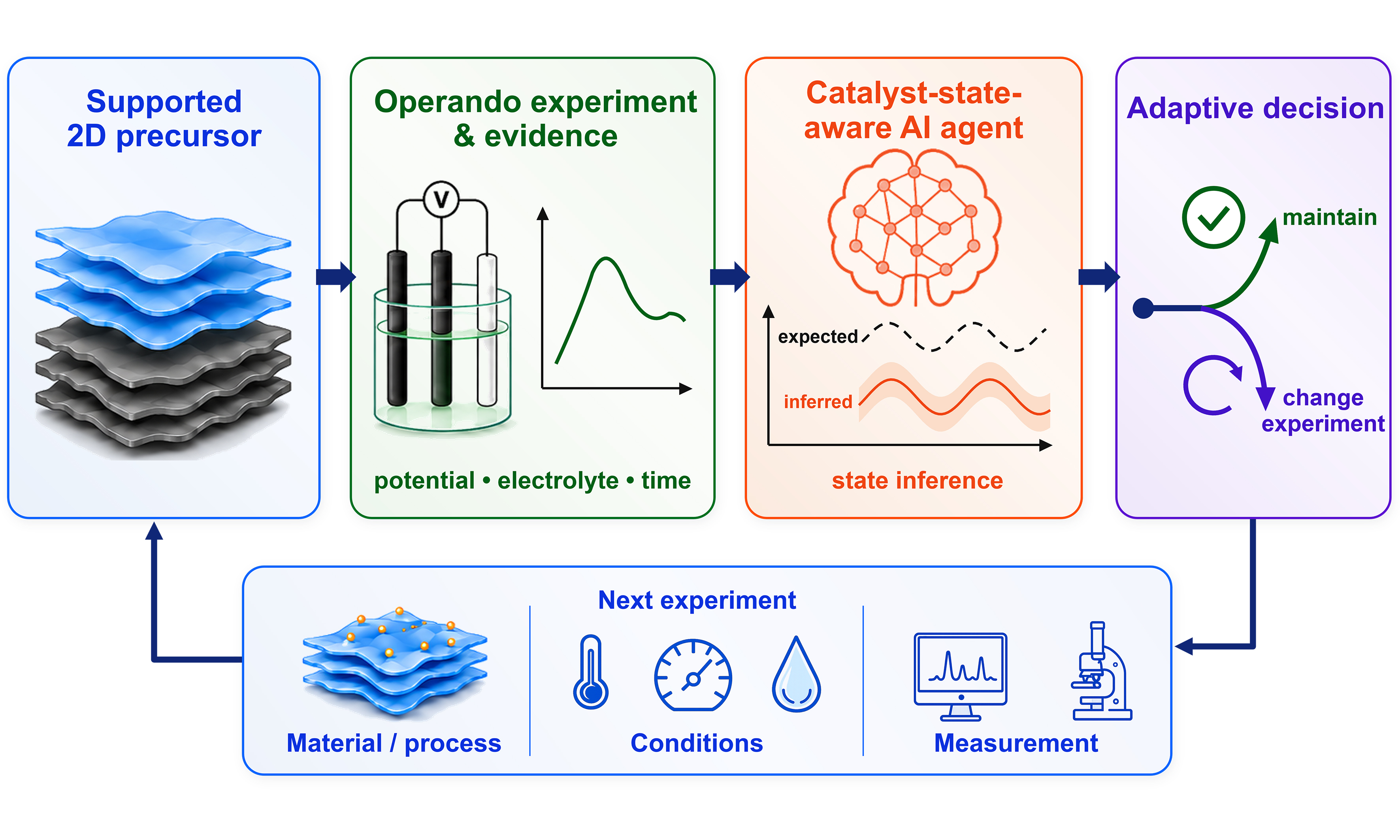


 Download PDF
FROM STATIC CANDIDATES TO CATALYTIC TRAJECTORIES
Artificial intelligence (AI) now helps electrocatalysis researchers rank candidates, generate structures, and decide what to test. In 2D systems, adsorption sites, strain, support configurations, and selected synthesis variables can often be encoded as explicit search variables for AI-guided design[1-3]. High-throughput density functional theory (DFT) and machine learning, for example, screened a defined library of hydrogen-adsorption sites before an Au-MoSe2 candidate was synthesized and tested[1]. Generative active learning and property-guided search have likewise proposed electrocatalyst candidates for subsequent evaluation[4,5]. These studies demonstrate the tractability of candidate-level design, but candidate selection remains distinct from controlling the catalyst states populated during operation.
This design tractability does not mean that the working catalyst remains structurally static. A recent Viewpoint reviewed machine-learning studies of surface reconstruction, defect evolution, and heterogeneous active-site ensembles[6], while a Perspective on hydrogen evolution reaction (HER) reconstruction connected precatalyst structure, electrolyte, and potential to the phases formed during operation[7]. Substrate interactions can alter precursor phase stability in supported 2D materials[2]. Under reaction conditions, local coordination and heterointerface reconstruction can further depend on electrolyte, potential, and scaffold effects[8,9]. Reconstructing 2D electrocatalysts therefore provides a focused testbed for extending inverse design from static candidate structures to experimentally accessible catalytic trajectories.
For these systems, the relevant design object is not a static composition but a trajectory linking a supported precursor, an executable preparation route, and an uncertainty-aware operando-state population under specified conditions and over time. For the purposes of this Commentary, a catalyst state is a distinguishable configuration populated during operation, characterized by attributes such as oxidation state, local coordination environment, reconstructed surface or interface phase, or adsorbate-associated configuration. A state population denotes the relative distribution of such coexisting states for a specified precursor and preparation history under a given electrolyte, applied potential, and operating time; where exact fractions are not identifiable, the distribution may instead be reported as constrained relative abundances or ranges. We use catalytic trajectory to describe this evolution. Reconstructing 2D electrocatalysts provides a particularly useful testbed because their precursor and preparation variables can often be parameterized explicitly, while substrate and interface effects, electrolyte, applied potential, and operating time can substantially redirect working-state evolution. This combination makes the gap between a nominal candidate and its condition-dependent working states especially consequential for design. The underlying logic is not restricted to 2D materials: it is most applicable to catalyst systems in which the working catalyst differs substantially from its prepared precursor, multiple states coexist or interconvert in a history- and condition-dependent manner, and their evolution can be observed or inferred well enough to inform the next experimental decision. We define a catalyst-state-aware AI agent (hereafter, state-aware agent) as one in which an uncertainty-aware estimate of the catalyst-state population changes the next synthesis, operating, or measurement decision. Figure 1 contrasts this state-aware trajectory loop with performance-centered candidate selection by highlighting the feedback used to guide the next decision.
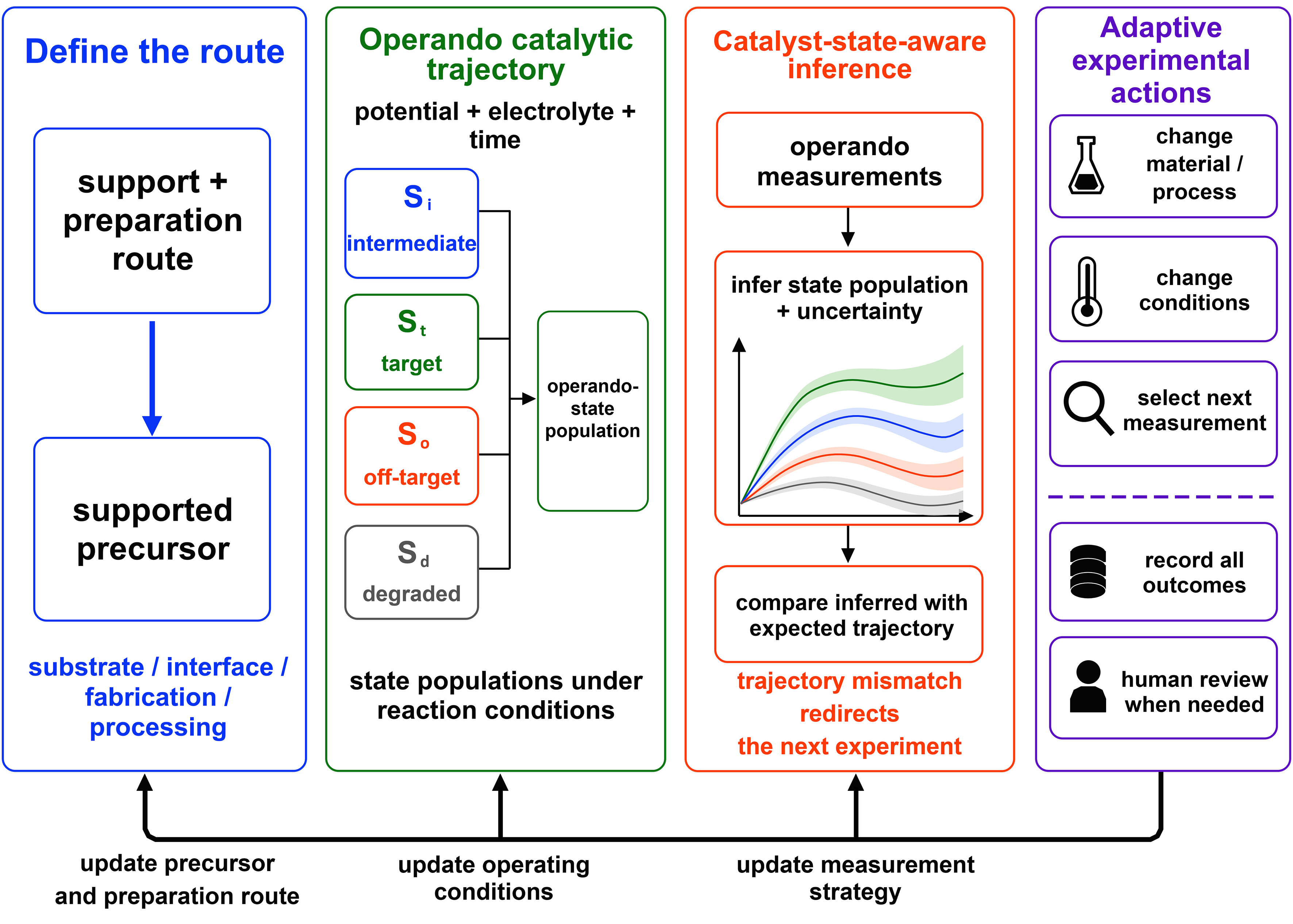
Figure 1. Performance-centered candidate selection and catalyst-state-aware trajectory control use different decision feedback. In a conventional performance-driven loop, catalytic performance is the primary feedback used to select the next candidate. In the proposed state-aware loop, the inferred catalyst-state population and its uncertainty are compared with the expected trajectory to redirect subsequent decisions on precursor selection, preparation, operating conditions, or measurement.
The coupling appears first during precursor definition. For Mo-S layers on sapphire, computation predicted that substrate interactions would alter relative phase stabilities and stabilize a P4mm Mo4S phase[2]. Ab initio thermodynamics then mapped chemical-vapor-deposition-relevant temperature and precursor chemical-potential ranges. The reported work therefore provided thermodynamic guidance rather than a validated preparation route. The operating environment can then alter the local catalyst state, as illustrated by Ni@1T-MoS2. In situ X-ray absorption spectroscopy (XAS) found little change in local Ni coordination during acidic HER. In alkaline electrolyte, Ni adopted an oxygen-containing coordination environment, and a metallic Ni species appeared reversibly under applied potential[8]. These examples show why a nominal 2D composition is incompletely specified without its support, preparation history, electrolyte, and potential.
Time further complicates the link between a precursor and its working state. A 2D/2D FeNiCo-MOF/1T-rich MoS2 precatalyst formed a metastable, partially reconstructed metal oxyhydroxide (MOOH)/MoS2 interface, while the MoS2 scaffold suppressed rapid and complete conversion to conventional MOOH[9]. As methodological comparators beyond strictly 2D systems, one study showed that different perovskite precursors reconstructed at different rates toward a common CoFe-layered-double-hydroxide active phase[10], whereas Martini et al. used operando XAS with principal component analysis and constrained spectral decomposition to identify three spectroscopically distinct Ni components and reconstruct their relative concentration profiles, followed by machine-learning-assisted X-ray absorption near-edge structure (XANES) fitting and extended X-ray absorption fine structure (EXAFS) validation of their structural assignments[11]. This example shows that a working-state population is inferred through model-based interpretation rather than read directly from a spectrum. For state-aware decision-making, such inference should be constrained by physically plausible or reference-informed models and validated, where applicable, through cross-validated model behavior or consistency with independent observables. Uncertainty arising from measurement noise, non-unique spectral decomposition, and model choice should be propagated to the inferred state population and quantified, for example, as intervals or ranges across physically admissible fits. If competing state assignments remain unresolved within those uncertainties, the next decision should prioritize a more discriminating measurement rather than act on a single nominal structure.
Taken together, these examples show that a single, time-independent structure is an incomplete design target. Reconstruction-centered HER work has already shifted attention from the as-prepared precursor to the active phase formed during operation[7]. A catalyst-state-aware description must explicitly represent state coexistence. It should define which states matter, the population range sought for each one, and the potential and electrolyte under which those ranges are expected. The inferred population should carry its uncertainty, and the desired population should be required to persist for a specified period.
Thermodynamic calculations can narrow the candidate synthesis window, but they do not by themselves establish an experimentally validated preparation route. Trajectory feasibility therefore requires two conditions: the supported precursor must be reachable through a defined preparation route, and it must evolve into the intended working-state population under the chosen operating conditions. Constrained Bayesian optimization of MoS2 chemical vapor deposition (CVD) illustrates the first test[3]. A classifier learned feasible and failed regions in a five-variable process space, while a Gaussian-process model linked feasible conditions to the measured A-exciton linewidth, used as a proxy for optical quality. Successful, low-quality, and failed experiments informed subsequent selections in different ways. The reported experiments were confined to MoS2 in one CVD configuration; the workflow therefore learned a preparation window rather than an operando catalyst trajectory.
FROM PERFORMANCE FEEDBACK TO CATALYST-STATE FEEDBACK
As a methodological comparator beyond 2D systems, a robotic multi-objective optimization study of chlorine evolution selected candidates using performance-related objectives, while Raman spectroscopy, differential electrochemical mass spectrometry, and long-duration testing were applied to selected catalysts for mechanistic and durability analysis[12]. A catalyst-state-aware loop would additionally use the inferred catalyst evolution to update the next precursor, preparation process, operating condition, or measurement.
Adjacent agentic frameworks help locate this proposal. StableOx-Cat demonstrates condition-aware screening by combining natural-language orchestration with bulk thermodynamic and aqueous-stability tools, while noting that bulk stability does not necessarily represent an evolving catalyst surface[13]. Within this broader context, our domain-specific contribution is to define the catalytic trajectory as the reasoning object for reconstructing electrocatalysis: a supported precursor and preparation route linked to an evolving, uncertainty-aware catalyst-state population under specified operating conditions over time. More broadly, autonomous catalysis frameworks already combine automated experimentation with AI-guided decision-making to adapt catalyst and reaction-condition choices[14]. The distinction here is therefore not closed-loop adaptation itself, but the explicit use of an evolving catalyst-state trajectory as a decision-relevant representation. In this formulation, operando measurements provide observations, the inferred state population is the state-aware agent’s working belief about the catalyst, and synthesis, operating, and measurement choices define its action space.
After each operando measurement, the state-aware agent would update its estimate of the state population and its uncertainty, then compare the inferred trajectory with that expected for the current precursor-support system. A mismatch should change the next decision. Pattengale et al., for example, showed experimentally that Ni in Ni@1T-MoS2 forms an oxygen-containing NiSxOy environment in alkaline electrolyte and develops a reversible metallic Ni contribution under catalytic potential[8]. In a hypothetical state-aware loop, if the trajectory model prescribed an expected range of NiSxOy-like and metallic Ni contributions under the chosen conditions, an inferred metallic Ni contribution outside that range, beyond the associated uncertainty, would signal a trajectory mismatch and prompt adjustment of the applied potential. A subsequent in situ XAS measurement would then determine whether the inferred state population moved closer to the target trajectory while retaining the required HER performance. A synthesis failure narrows the preparation space; off-target reconstruction rules out a proposed route under the tested conditions; rapid degradation shows that the target population cannot be retained. These negative results should remain in the dataset. The agent may revise the material or its preparation, change the potential or electrolyte, or collect a measurement that better distinguishes competing state assignments. Autonomous execution should remain within validated protocols, with ambiguous interpretations and safety-critical changes returned to human review[14].
WHAT WOULD COUNT AS SUCCESS?
A high final activity is not sufficient evidence that a catalytic trajectory has been designed successfully. The intended precursor must first be obtained under the specified preparation conditions. Trajectory success should then be evaluated using measurable criteria. State matching can be reported as the agreement between the inferred state population, together with its uncertainty, and a prespecified target population range. Persistence can be reported as the time, or fraction of the specified operating period, for which the inferred population remains within that range. State control must also retain the required catalytic function, assessed through activity, selectivity, and performance retention under the specified operating conditions, consistent with calls to assess reconstructed catalysts under steady operation[7]. Experimental efficiency should additionally account for the resources required to reach and verify the target trajectory, such as the number of experiments, operando measurement time and instrument usage, and material consumption. Acceptance thresholds for these metrics should be prespecified according to the catalyst system, reaction objective, and experimental constraints rather than treated as universal. A single structural label is not an adequate substitute for this information. When an unexpected state appears, either the trajectory model or the next experiment should change in a traceable way. Experimental confirmation becomes experimental learning only when the observed outcome changes what the system does next. These trajectory-specific criteria complement the broader Transparent Reporting for Agentic Catalysis Enabled by Artificial Intelligence (TRACE-AI) requirements for provenance, model documentation, workflow integration, human intervention, and traceability[15]. A key technical challenge is to learn precursor-to-state relationships that remain useful for decision-making despite sparse and noisy operando data and changes in potential, electrolyte, support, and operating time. Until then, autonomous optimization may identify high-performing candidates without gaining reliable control over the states that produce that performance. For reconstructing 2D electrocatalysts, the next advance in agentic design will depend not only on choosing better candidates, but on learning how to create, observe, and redirect catalytic trajectories.
DECLARATIONS
Authors’ contributions
Manuscript writing and preparation: He, J.; Wang, J.; Zhang, C.; Su, Y.
Availability of data and materials
Not applicable.
AI and AI-assisted tools statement
During the preparation of this manuscript, the AI tool OpenAI ChatGPT (version GPT-5.6 Sol, released 2026-07-09) was used to polish the language and generate selected graphical elements in the Graphical Abstract and Figure 1. In the Graphical Abstract, AI was used to generate the layered 2D precursor, electrochemical cell, AI agent, thermometer, gauge, water droplet, computer, and microscope icons. In Figure 1, AI was used to generate the conical flask, thermometer, magnifying glass, and human-shaped icons. The tool did not influence the study design, data collection, analysis, interpretation, or the scientific content of the work. All authors take full responsibility for the accuracy, integrity, and final content of the manuscript.
Financial support and sponsorship
This work was supported by the National Natural Science Foundation of China (22672164), National Key R&D Program of China (2023YFB4203900), Carbon Neutrality Research Institute Fund (CNIF20240111), the Distinguished Young Scholars in Shaanxi Province (No. 2026JC-JCQN-020), Key Research and Development Program of Shaanxi Province (2025SF-YBXM-526), Shaanxi Sanqin Scholars Fund Project (2024STZZK07), Xiaomi Young Talents Program, the International Science & Technology Cooperation Program of Hainan Province (GHYF2026004), and the Major Science and Technology Projects of Yunnan Province (202302AB080019-4). Su, Y. acknowledges the “Young Talent Support Plan” of Xi’an Jiaotong University and the Fundamental Research Funds for the Central Universities (xtr072024025, xzy012024049 and xtr072024032).
Conflicts of interest
Su, Y. is an Editorial Board Member of the journal AI Agent. Su, Y. was not involved in any steps of editorial processing, including reviewer selection, manuscript handling, and decision-making, and the other authors have declared no conflicts of interest.
Ethical approval and consent to participate
Not applicable.
Consent for publication
Not applicable.
Copyright
© The Author(s) 2026.
REFERENCES
1. Zhang, T.; Ye, Q.; Liu, Y.; et al. Data-driven discovery of biaxially strained single atoms array for hydrogen production. Nat. Commun. 2025, 16, 3644.
2. Mazitov, A.; Kruglov, I.; Yanilkin, A. V.; et al. Substrate-aware computational design of two-dimensional materials. npj. Comput. Mater. 2025, 11, 270.
3. Wang, Y.; Li, G.; Natarajan, A. H.; Mukerjee, S.; Jin, X.; Kar, S. Accelerating optimal synthesis of atomically thin MoS2: a constrained bayesian optimization guided brachistochrone approach. Adv. Mater. Technol. 2025, 10, 2401465.
4. Mok, D. H.; Yan, Y.; Yu, G.; Li, Y.; Jiang, K.; Back, S. Generative active learning discovers high-performance O2 reduction catalysts for H2O2 production. ACS. Catal. 2026, 16, 7979-90.
5. Song, Z.; Fan, L.; Lu, S.; Ling, C.; Zhou, Q.; Wang, J. Inverse design of promising electrocatalysts for CO2 reduction via generative models and bird swarm algorithm. Nat. Commun. 2025, 16, 1053.
6. Tao, W.; Chun, H.; Han, B. Decoding structural complexity with machine learning to empower physical AI driven electrocatalyst design. Appl. Surf. Sci. Adv. 2026, 34, 100984.
7. Ding, X.; Fu, X. Dynamic reconstruction defines true active states in the hydrogen evolution reaction. Energy. Environ. Sci. 2026, 19, 1497-507.
8. Pattengale, B.; Huang, Y.; Yan, X.; et al. Dynamic evolution and reversibility of single-atom Ni(II) active site in 1T-MoS2 electrocatalysts for hydrogen evolution. Nat. Commun. 2020, 11, 4114.
9. Qi, L.; Xu, Z.; Chen, J. L.; et al. Engineering 1 T-rich MoS2-tuned FeNiCo-based metal-organic framework heterostructure for enhanced oxygen evolution reaction activity. J. Colloid. Interface. Sci. 2026, 715, 140286.
10. Zhang, W.; Feng, Q.; Zhang, X.; et al. In situ reconstruction of perovskite oxides during electroreduction of nitrate to ammonia. Chem. Eng. J. 2026, 529, 173076.
11. Martini, A.; Hursán, D.; Timoshenko, J.; et al. Tracking the Evolution of single-atom catalysts for the CO2 electrocatalytic reduction using operando X-ray absorption spectroscopy and machine learning. J. Am. Chem. Soc. 2023, 145, 17351-66.
12. Yang, R.; Zhou, D.; Jia, Z.; et al. Toward practical design of high-entropy catalysts for chlorine evolution reaction via pareto-guided multi-objective bayesian optimization enabled by a robotic AI-chemist. Angew. Chem. Int. Ed. Engl. 2026, 65, e8794274.
13. Jia, X.; Zhang, D.; Lu, Y.; Wang, Q.; Li, H. StableOx-Cat agent: an AI agent for exploring stable metal oxide electrocatalysts. AI. Agent. 2026, 2, 1.
14. Orouji, N.; Bennett, J. A.; Canty, R. B.; et al. Autonomous catalysis research with human-AI-robot collaboration. Nat. Catal. 2025, 8, 1135-45.
Cite This Article
 Open Access
How to Cite
He, J.; Wang, J.; Zhang, C.; Su, Y. Catalyst-state-aware AI agents for trajectory design in reconstructing 2D electrocatalysts. AI Agent 2026, 2, 24. https://dx.doi.org/10.20517/aiagent.2026.47
Download Citation
If you have the appropriate software installed, you can download article citation data to the citation manager of your choice. Simply select your manager software from the list below and click on download.
Export Citation File
Type of Import
Tips on Downloading Citation
Citation Manager File Format
Type of Import
Direct Import: When the Direct Import option is selected (the default state), a dialogue box will give you the option to Save or Open the downloaded citation data. Choosing Open will either launch your citation manager or give you a choice of applications with which to use the metadata. The Save option saves the file locally for later use.
Indirect Import: When the Indirect Import option is selected, the metadata is displayed and may be copied and pasted as needed.
About This Article
Copyright

Data & Comments
Data
0









Comments
Comments must be written in English. Spam, offensive content, impersonation, and private information will not be permitted. If any comment is reported and identified as inappropriate content by OAE staff, the comment will be removed without notice. If you have any queries or need any help, please contact us at [email protected].