

Beyond the Haber-Bosch process: graphdiyne as an active platform for sustainable ammonia synthesis
 0
0 
Graphical Abstract
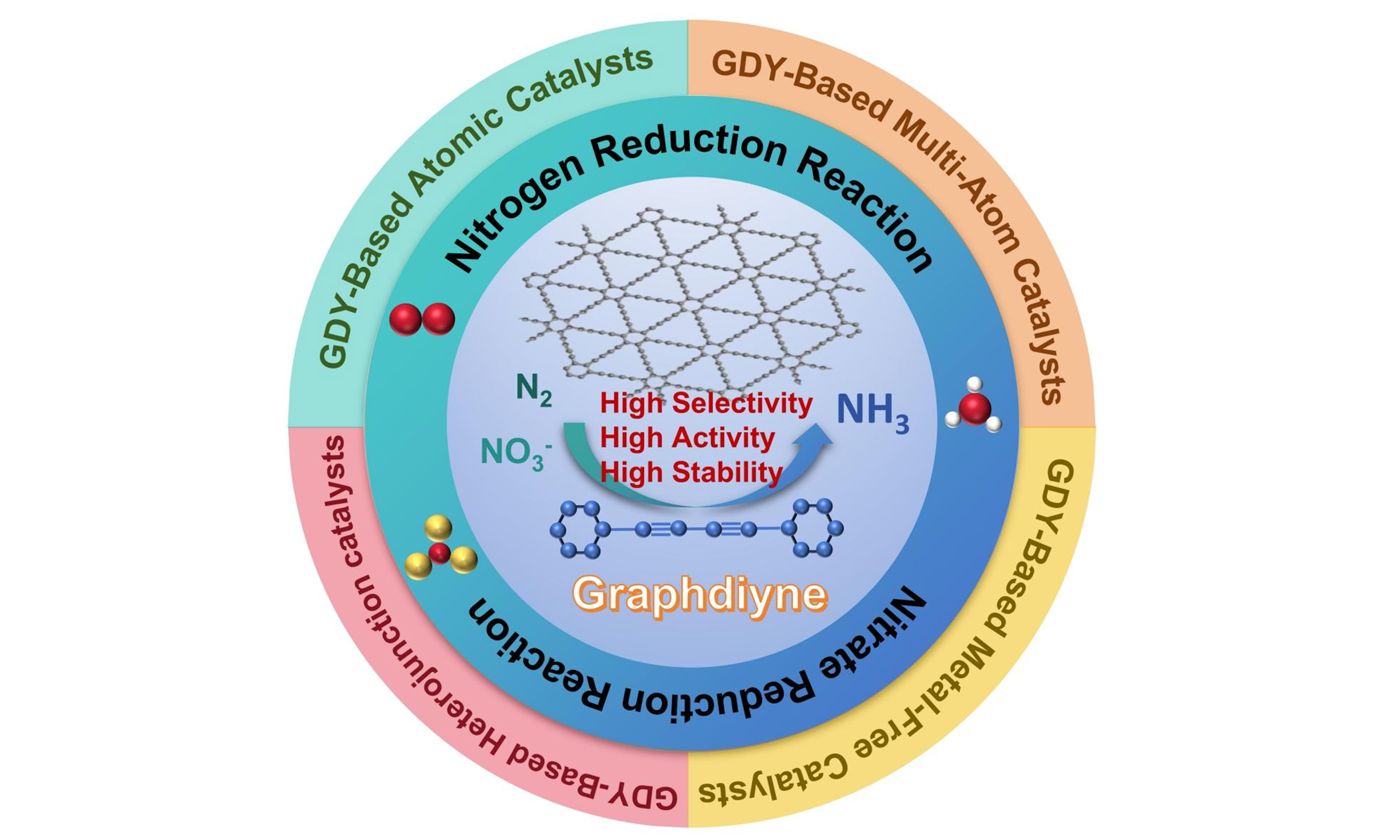
Abstract
Sustainable ammonia production under ambient conditions is a potential alternative to the fossil-fuel-dependent and CO2-intensive Haber-Bosch route. However, the practical realization of such routes is impeded by the scarcity of catalysts capable of delivering high activity, selectivity, and durability simultaneously. Graphdiyne (GDY), a two-dimensional carbon allotrope with an intrinsically heterogeneous sp/sp2-hybridized framework, has emerged as a transformative active platform to address this challenge. GDY offers unique advantages that are particularly beneficial for nitrogen fixation; for example, the noninteger charge transfer between GDY and metal atoms can stabilize unconventional zero-valent metal atoms and modulate their d-band centers for optimal N2/NOx activation. The natural alkyne-rich pore structure facilitates the assembly of active species from single atoms to clusters, maximizing site utilization and preventing aggregation. This review provides a focused and systematic analysis of GDY-based catalysts for ammonia synthesis. The design principles, including electronic modulation, spatial confinement, and interfacial synergy, that govern the construction of high-performance GDY catalysts are introduced. The applications of the catalysts in both the nitrogen reduction reaction (NRR) and nitrate reduction reaction (NtRR) are then critically discussed, with particular emphasis on the mechanistic origins of enhanced activity and suppressed competing reactions. Finally, the key challenges that remain in this field are identified, and future research directions are proposed to guide the development of GDY-based catalysts toward practical and sustainable ammonia production.
Keywords


 Download PDF
INTRODUCTION
Ammonia (NH3) stands as a cornerstone of modern industry and agriculture. As the primary feedstock for nitrogen-based fertilizers, it supports the food supply for roughly half of the world’s population, while its high hydrogen content has positioned it as a leading candidate for a carbon-free energy vector[1-8]. Despite its significance, the conventional industrial NH3 production process is extremely energy-intensive, operating under harsh conditions[9], which has intensified the search for more sustainable routes for NH3 synthesis under milder conditions[10-16]. Electrocatalytic nitrogen reduction reaction (NRR) and nitrate reduction reaction (NtRR) using renewable electricity and water as the hydrogen source have emerged as compelling electrochemical alternatives[17-22]. However, the practical realization of these electrochemical approaches still faces many obstacles. Both processes are complex, involving multielectron, multiproton transfer processes (six electrons for the NRR to NH3 and eight for the NtRR) and proceeding through complex intermediates (e.g., NxHy for the NRR; NO2-, NO, and N2O for the NtRR)[23-32]. Another significant challenge is the competitive hydrogen evolution reaction (HER), which consumes electrons, thereby lowering Faradaic efficiency (FE) and decreasing overall ammonia yield[33-38]. Catalysts must be designed with atomic-level precision to activate inert nitrogenous species, stabilize key reaction intermediates, and inhibit proton reduction to boost both activity and selectivity toward NH3.
Carbon-based materials have attracted considerable interest for nitrogen fixation, owing to their abundance, low cost, and tunable surface properties[39-42]. Nevertheless, conventional sp2-hybridized carbon materials (such as graphene[43], carbon nanotubes[44], graphite[45]) possess electronically homogeneous surfaces[46-49]. Graphdiyne (GDY), a 2D carbon allotrope with a periodic sp-/sp2-cohybridized network[50-53], has distinguished itself from other carbon allotropes through its intrinsic electronic heterogeneity arising from the periodic dispersion of electron-rich alkyne linkages (–C≡C–C≡C–) and electron-deficient aromatic rings[54-59]. This endows GDY with noninteger charge transfer. This, in turn, can stabilize unconventional zero-valent metal atoms and modulate their d-band centers, enabling precise optimization of the adsorption energy for nitrogenous intermediates[60-63]. Furthermore, sp-hybridized carbon atoms facilitate covalent functionalization, heteroatom doping, and organometallic coordination, providing a versatile platform to tailor the electronic structure of GDY for optimized nitrogen-fixation activity[64-67]. This integrated functionality positions GDY as a transformative catalytic platform[68].
Recent years have witnessed remarkable advancements in GDY-based catalysts for nitrogen fixation[69,70]. Various configurations, including zero-valent atom catalysts, multi-atom catalysts, quantum dots (QDs), and heterostructures, have all shown exceptional catalytic activity and selectivity for NH3 production [Tables 1 and 2][71-100]. These findings demonstrate the crucial role of GDY in enhancing catalytic performance. Theoretical calculations and experimental characterization show that GDY plays a critical role in facilitating reactant activation, stabilizing reaction intermediates, and promoting selective protonation pathways[101,102]. Despite this rapid progress, a systematic and critical review that combines the design principles, catalytic mechanisms, and performance benchmarks of GDY-based catalysts for nitrogen fixation is lacking.
Comparison of the NRR performance of GDY-based catalysts
| Catalysts | Electrolyte/Conditions | Potential (V) | FE (%) | YNH3 | Ref. |
| Mo0/GDY | 0.1 M Na2SO4 | -1.20 V vs. SCE | 21 | 145.4 µg·h-1·mgcat.-1 | [71] |
| Mo0/GDY | 0.1 M HCl | -0.1 V vs. SCE | 15.6 | 2 µg·h-1·mgcat.-1 | [71] |
| Pd-GDY | 0.1 M Na2SO4 | -0.16 V vs. RHE | 31.62 ± 1.06 | 4.45 ± 0.30 mg·h-1·mgPd-1 | [72] |
| Pd-GDY | 0.1 M HCl | -0.26 V vs. RHE | 4.32 | 1,580 µg·h-1·mgcat.-1 | [72] |
| Rh SA/GDY | K2SO4 + H2SO4 (N2, 55 atm, 25 ℃) | -0.20 V vs. RHE | 20.36 | 74.15 µg·h-1·cm-2 | [73] |
| Rh SA/GDY | K2SO4 + H2SO4 (Ambient) | -0.25 V vs. RHE | 3.97 | 10.10 µg·h-1·cm-2 | [73] |
| Ru SAs/GDY/G | 0.5 M Na2SO4 | -0.10 V vs. RHE | 37.6 | 56.8 µg·h-1·mgcat.-1 | [74] |
| Ru/GDY-bAz | 0.1 M K2SO4 | -0.2 V vs. RHE | 33.5 ± 0.5 | 150.2 ± 1.3 μg·h-1·mgcat.-1 | [75] |
| Ru/GDY-bNap | 0.1 M K2SO4 | -0.3 V vs. RHE | 21.9 ± 0.5 | 58.3 ± 1.1 μg·h-1·mgcat.-1 | [75] |
| Re SA/GDY | 0.1 M K2SO4 + 0.005 M H2SO4 | -0.35 V vs. RHE | 8.07 | 15.3 µg·h-1·cm-2 | [76] |
| Mn SA/GDY | 0.1 M Na2SO4 | -0.045 V vs. RHE | 39.83 | 46.78 µg·h-1·mgcat.-1 | [77] |
| Pd/HsGDY | 0.05 M H2SO4 | -0.25 V vs. RHE | 44.45 | 115.93 mg·g-1·h-1 | [78] |
| cFGDY | 0.1 M Na2SO4 | -1.20 V vs. SCE | 25.95 ± 2.60 | 44.14 ± 4.54 µg·h-1·mgcat.-1 | [79] |
| HsGDY | 0.05 M H2SO4 | -0.20 V vs. RHE | 5.13 | 103 µg·h-1·mgcat.-1 | [80] |
| Cl-GDY | 0.1 M HCl | -0.40 V vs. RHE | 8.7 | 10.7 µg·h-1·cm-2 | [81] |
| IVR-FO/GDY | 0.1 M Na2SO4 | +0.255 V vs. RHE | 59.48 ± 2.57 | 127.9 ± 9.11 µg·h-1·mgcat.-1 | [82] |
| GDY/Co2N | 0.1 M Na2SO4 | +0.055 V vs. RHE | 35.84 | 123.66 µg·h-1·mgcat.-1 | [83] |
| GDY/Co2N | 0.1 M HCl | +0.101 V vs. RHE | 58.60 | 219.72 µg·h-1·mgcat.-1 | [83] |
| Mo1/HsGDY@Cu2O | 0.01 M PBS (AM 1.5 G, 100 mW·cm-2) | 0 V vs. RHE | 42.8 | 15.8 µg·h-1·cm-2 | [84] |
Comparison of the NtRR performance of GDY-based catalysts
| Catalysts | Electrolyte | Potential (V) | FE (%) | YNH3 | Ref. |
| Cu/CuxO/GDY | 1.0 M KOH + 0.1 M KNO3 | -0.80 V vs. RHE | 99.8 | 25.4 mg·h-1·mgcat.-1 | [85] |
| PtCux/GDY | 1.0 M KOH + 0.1 M KNO3 | -0.50 V vs. RHE | 96.5 ± 5.1 | 345.3 ± 38.9 µmol·h-1·cm-2 | [86] |
| Pd/GDY-F | 0.1 M KOH + 0.1 M NO3- | -0.7 V vs. RHE | 74.9 ± 1.8 | 2,812.8 ± 40.8 µg·h-1·mgcat.-1 | [87] |
| Cu0/GDYNA | 0.1 M NO3- + 0.5 M SO42- | -2.0 V vs. SCE | 81.25 | 15.45 mmol·h-1·cm-2 | [88] |
| Cu3N/GDY | 1.0 M KOH + 0.1 M KNO3 | -0.90 V vs. RHE | 98.1 | 35,280 µg·h-1·mgcat.-1 | [89] |
| Cu2O/GDY | 1.0 M KOH + 0.1 M KNO3 | -1.70 V vs. Hg/HgO | 94 | 26,997 µg·h-1·mgcat.-1 | [90] |
| CuxO/N-GDY | 1.0 M KOH + 0.1 M KNO3 | -0.50 V vs. RHE | 89 | 340 µmol·h-1·mgcat.-1 | [91] |
| CuCo2Ox/GDY | 1.0 M KOH + 0.1 M NO3- | -0.132 V vs. RHE | ≈100 | 3332 µmol·h-1·cm-2 | [92] |
| Co3O4/GDY | 0.5 M K2SO4 + 0.1 M KNO3 | -1.05 V vs. RHE | 92.45 | 0.78 mmol·h-1·cm-2 | [93] |
| Fe3C@GDY | 0.1 M K2SO4 + 0.01 M NO3- | -0.6 V vs. RHE | 96.8 | 205.57 µmol·h-1·cm-2 | [94] |
| GDY-MnOx | 0.1 M KOH + 0.1 M NO3- | -0.891 V vs. RHE | 95.4 | 463.4 µmol·h-1·cm-2 | [95] |
| ZIFNC@GDY | 0.1 M NO3- + 0.5 M SO42- | -0.745 V vs. RHE | 98.51 ± 0.75 | 0.40 ± 0.02 mmol·h-1·cm-2 | [96] |
| NiBDC@HsGDY@Cu | 1.0 M KOH + 0.1 M KNO3 | -0.11 V vs. RHE | 95.5 | 0.321 mmol·h-1·cm-2 | [97] |
| NiCoBDC@HsGDY | 1.0 M KOH + 0.1 M NO3- | -0.34 V vs. RHE | 99.1 | 0.56 mmol·h-1·cm-2 | [98] |
| h-FeCoNiPBA@GDY | 0.5 M KNO3 + 1.0 M KOH | -0.432 V vs. RHE | 95.10 | 1,015.5 µmol·h-1·cm-2 | [99] |
| Cu3(BTC)2@HsGDY | 200 ppm NO3- + 0.5 M SO42- | -0.7 V vs. RHE | 95.10 | 1.016 mmol·h-1·cm-2 | [100] |
This review provides a focused and systematic analysis of GDY as an active carbon platform for selective and efficient nitrogen fixation, beginning by establishing the fundamental design principles, electronic modulation, and interfacial synergy that govern the construction of high-performance GDY-based catalysts and then critically evaluating the application of these catalysts in both the NRR and the NtRR, elucidating the mechanistic origins of enhanced activity and selectivity. This review further discusses the integration of GDY-based catalysts into practical electrochemical systems and emerging directions such as photocatalytic nitrogen fixation. Finally, the remaining challenges in scalable synthesis, operational stability under industrially relevant conditions, and the need for advanced operando characterization are discussed, and roadmaps are proposed to guide the transition of GDY-based nitrogen-fixation catalysts from fundamental breakthroughs to practical, sustainable ammonia production.
DESIGN PRINCIPLES OF GDY-BASED CATALYSTS FOR NITROGEN FIXATION
Electronic modulation, spatial confinement, and interfacial synergy are not independent but synergistically integrated within the unique sp/sp2-cohybridized structure of GDY to efficiently catalyze ammonia production. This integrated functionality positions GDY as an ideal platform that actively participates in catalytic turnover through multiple, interconnected mechanisms rather than passively supporting active species, and provides a systematic framework for rational catalyst design[54,103-107]. This section elaborates on each principle, establishing the mechanistic foundation for the catalytic applications discussed in subsequent sections.
Electronic modulation via noninteger charge transfer
The fundamental and distinguishing feature of GDY as a catalytic platform is its ability to engage in noninteger charge transfer with anchored metal atoms[108]. This capability arises directly from GDY’s intrinsic electronic heterogeneity of the periodic alternation of electron-rich alkyne linkages (–C≡C-C≡C–) and electron-deficient aromatic rings, which creates a spatially varying electrostatic potential that facilitates bidirectional electron exchange with anchored atoms. The alkyne domains of GDY actively participate in electronic communication with metal species[106,109-111]. The electron-rich sp-hybridized carbon atoms donate electron density to incoming metal atoms while accepting back-donation from the metal’s d-orbitals. This synergistic charge transfer stabilizes metal atoms in unconventional zero-valent states, a configuration that maximizes d-electron availability for catalytic turnover while preventing aggregation into larger clusters or nanoparticles[112-114].
Through efficient charge transfer, the d-band center of anchored metal atoms can be precisely modulated to achieve optimal binding strength for nitrogenous intermediates, thereby facilitating N2/NO3- activation and the release of NH3. Such electronic tunability is unattainable on electronically homogeneous sp2-carbon surfaces.
This electronic modulation principle has been demonstrated across a wide range of metal species. Theoretical screening has identified numerous transition metal atom catalysts (TM@GDY) with tailored d-band centers for nitrogen reduction. Experimentally, zero-valent metal atoms of Pd[72], Pt[115], Ru[74], Rh[73], Os[116], Mo[71], Fe[117], Co[118], and Ni[117] have all been successfully stabilized on GDY through noninteger charge transfer. The extent of charge transfer can be further tuned by varying the metal identity, GDY thickness, or the introduction of substituent groups, providing a versatile platform for optimizing catalytic activity and selectivity across different nitrogen-fixation reactions. Beyond single atoms, unique noninteger charge transfer also extends to dual-atom catalysts (DACs), QD catalysts, and heterostructured catalysts. These reported catalysts all exhibit enhanced catalytic performance through cooperative electron transfer.
Spatial confinement effect of natural pores
GDY possesses natural triangular pores with a radius of approximately 0.45 nm[101,119,120]. These nanopores can also serve as geometrically matched cages that impose spatial confinement on deposited metal species and simultaneously modulate their local electronic environment. For example, triangular pores are ideally sized to accommodate isolated metal atoms, preventing their migration and coalescence even under harsh electrochemical conditions[121-123]. This restricts the free movement and volume change of the anchored species, ensuring high active-site stability and maximizing the atom-utilization efficiency, which are the critical requirements for efficient catalysis[101]. Owing to these advantages, the extended 2D surface of GDY can direct the growth of QDs, clusters, and heterostructures with controlled size, crystallinity, and dispersion.
Importantly, the spatial confinement effect is not merely passive but also synergistically coupled with electronic modulation. Density functional theory (DFT) calculations show that transition metal atoms and clusters anchored within the triangular pores of GDY exhibit high adsorption energies, indicating the stability of these catalytic systems[124]. Experimentally, researchers have achieved controlled growth of active sites on GDY by exploiting the confinement effect. Such spatial and electronic dual confinement of GDY creates a unique catalytic microenvironment that cannot be replicated on open surfaces or in larger pores[55,103]. For nitrogen fixation applications, this capability enables rational catalyst design with precisely defined active-site architectures, from isolated single atoms to closely spaced dual atoms and clusters, for selective N2 or NO3- activation and NH3 formation.
Interfacial synergy in heterostructures
Another important design principle extends beyond the GDY itself to the interfaces formed between the GDY and metal nanostructures. The chemical addressability of GDY, enabled by its sp-hybridized carbon atoms, allows for seamless integration with a diverse range of materials, from transition metal dichalcogenides (TMDs) to metal oxides, nitrides, and metal-organic frameworks (MOFs)[97,125]. The resulting heterointerfaces exhibit synergistic effects that are unavailable in single-component systems, including heterointerface charge redistribution that drives electron transfer across the interface, creating an internal electric field that facilitates charge separation and enhances catalytic kinetics[68]. For nitrogen fixation, interfacial charge transfer can optimize the adsorption energetics of nitrogenous intermediates on the active sites. For example, the GDY/Co2N[83] interface has been shown to facilitate preferential N2 adsorption at coordinatively unsaturated Co sites, whereas alkyne C-sites redistribute H-species to suppress the competing HER. In addition, the lattice strain effect at GDY heterointerfaces can continuously tune the electronic structure of the active sites, shifting d-band centers and modifying adsorption energetics. The magnitude of strain can be systematically controlled by varying the GDY layer thickness or the heterostructure partner, providing a tunable parameter for optimizing catalytic performance. Strain engineering offers an additional lever for fine-tuning the binding strength of N2, NO3-, and reaction intermediates to achieve the optimal balance between activation and product release during the nitrogen fixation process.
GDY-BASED CATALYSTS FOR NRRs
Atom catalysts on GDY
Atomic catalysts (ACs) represent a new frontier in catalysis and are defined as catalysts consisting of zero-valent metal atoms that are atomically dispersed and anchored on supporting materials[126-128]. This architectural paradigm maximizes metal atom utilization efficiency, approaching the theoretical limit of 100%, while offering unique electronic and geometric properties that are unattainable with conventional nanoparticles or clusters[129-131]. However, traditional single-atom catalysts face persistent challenges in terms of the migration and aggregation of metal atoms, and conventional synthesis methods lack precision in controlling the chemical structure and charge distribution of individual metal atoms. These limitations seriously impede the understanding of structure-activity relationships and catalytic mechanisms at the atomic level[35,132-134]. The unique sp/sp2-carbon framework and the confinement effects resulting from the uniform acetylenic cavities and strong noninteger charge transfer between metal atoms and GDY enable effective and precise single-metal-atom stabilization[135-137]. Unlike N-doped carbon substrates, the neutral C≡C bonds in GDY tend to stabilize zero-valent or low-valence transition metals[138]. This electronic regulation simultaneously activates the N≡N triple bond via M-to-N2 π-backdonation and optimizes p-d orbital coupling while restraining competitive HER, thus increasing both selectivity and catalytic activity in electrochemical NRR.
In 2019, Hui et al. reported the first zero-valent molybdenum-atom catalyst (Mo0/GDY) with a high metal loading of 7.5 wt% for ammonia synthesis from the reduction of nitrogen[71]. The structural configurations of Mo0/GDY at different reaction stages are shown in Figure 1A. High-angle annular dark field imaging in the aberration-corrected scanning transmission electron microscope (HAADF-STEM) and X-ray absorption near edge strucure (XANES) confirm the anchoring of individual Mo0 atoms at the alkyne ring corners of GDY [Figure 1B and C]. For example, Mo0/GDY achieved a maximum FE exceeding 21% and an ammonia yield rate (YNH3) of
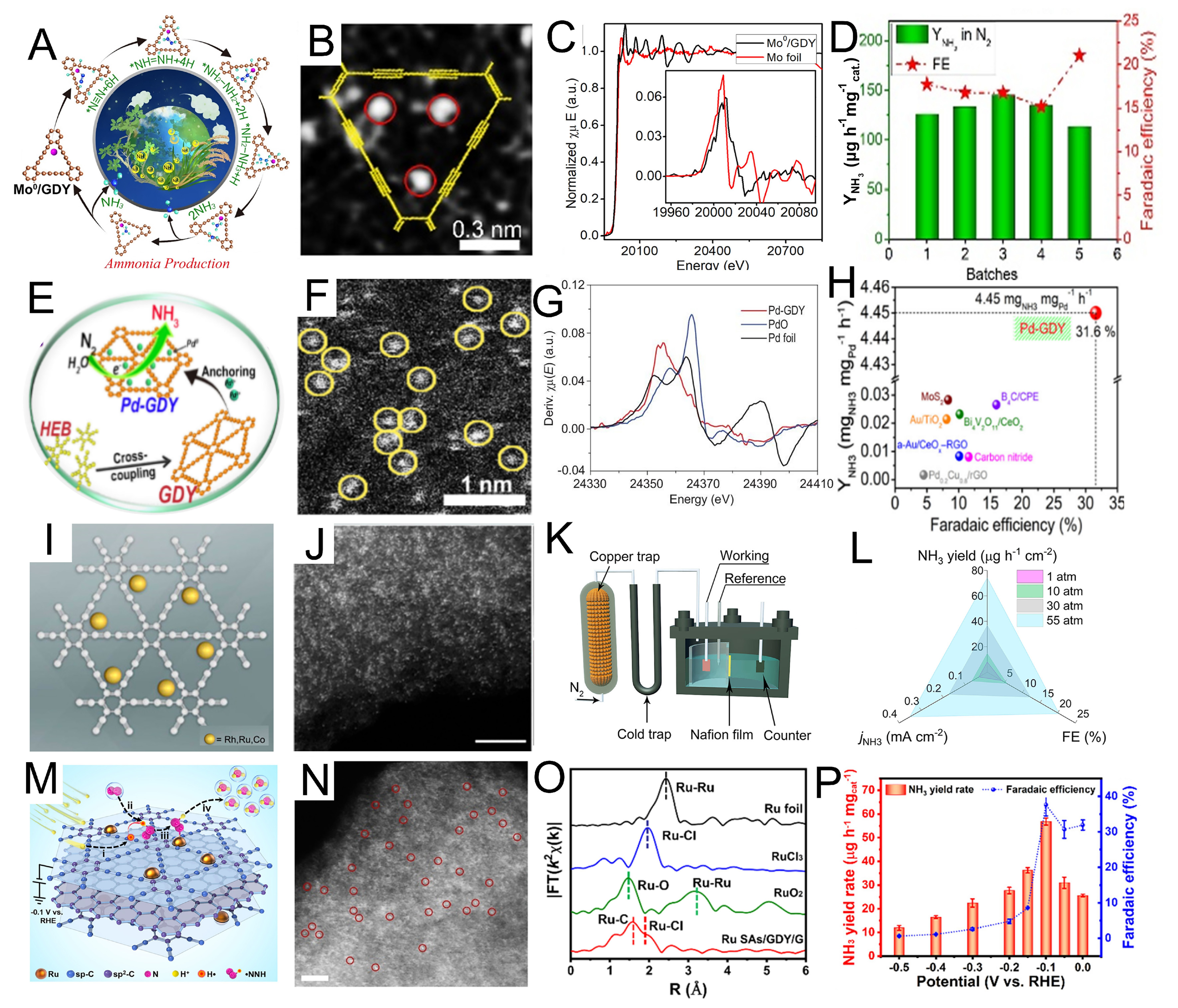
Figure 1. (A) Mo0/GDY structural evolution during catalysis; (B) HAADF-STEM image of Mo0/GDY samples; (C) Mo K-edge XANES profiles of Mo0/GDY and Mo foil (inset: derived first derivative curves); (D) NH3 production performance for different batches of Mo0/GDY[71]; (A-D) are reprinted with permission from reference[71]. Copyright 2019 American Chemical Society; (E) Pd-GDY catalyst synthesis schematic; (F) HAADF-STEM results of Pd-GDY; (G) First derivative curves of Pd K-edge XANES spectra for Pd-GDY, PdO, and Pd foil; (H) Comparison of the catalytic performance of Pd-GDY with reported catalysts[72]; (E-H) are reprinted with permission from reference[72]. Reproduced under the CC BY license; (I) Schematic illustration of M SA/GDY (M = Rh, Ru, and Co); (J) HAADF-STEM image of Rh SA/GDY; (K) Schematic of the homemade pressurized NRR setup; (L) Performance comparison of Rh SA/GDY at different applied N2 pressures[73]; (I-L) are reprinted with permission from reference[73]. Reproduced under the CC BY license; (M) NRR process on Ru SAs/GDY/G; (N) Imaging of Ru SAs/GDY/G by HAADF-STEM. Some Ru single atoms are highlighted with red rings; (O) FT k2-weighted χ(k) function of the EXAFS spectra at the Ru K-edge of Ru SAs/GDY/G, Ru foil, RuCl3, and RuO2; (P) Catalytic performance of Ru SAs/GDY/G at different potentials[74]; (M-P) are reprinted with permission from reference[74]. Copyright 2023 American Chemical Society. GDY: Graphdiyne; HEB: hexaethynylbenzene; RHE: reversible hydrogen electrode; HAADF-STEM: high-angle annular dark field imaging in the aberration-corrected scanning transmission electron microscope; XANES: X-ray absorption near edge strucure; SA: single atom; NRR: nitrogen reduction reaction; FT: Fourier transform.
Recently, researchers have investigated the durability and distinctive characteristics of zero-valent single-atom catalysts. Feng et al. designed a Ru single-atom catalyst supported on a graphdiyne/graphene sandwich architecture (Ru SAs/GDY/G)[74]. At a low potential of -0.1 V vs. RHE, the catalyst delivered a remarkable NH3 yield rate of 56.8 μg·h-1·mgcat.-1 (4.7 mg·h-1·mgRu-1), with a FE of 37.6%. GDY not only suppresses hydrogen coverage at Ru single-atom sites, thereby minimizing the competitive HER, but also generates hydrogen radicals (H·), accelerating the hydrogenation kinetics of the NRR. Notably, this hydrogen radical transfer (H·-transfer) pathway represents a novel mechanistic discovery in the electrocatalytic NRR [Figure 1M-P]. In addition, Mn SA/GDY exhibits efficient NH3 synthesis under ambient conditions, delivering a production rate of
Collectively, these studies reveal that GDY, with a unique sp/sp2-hybridized framework and intrinsic noninteger charge-transfer capability, serves as an exceptional platform for stabilizing zero-valent single atoms across a broad range of transition metals and even actinides. Precise control over metal coordination environments, combined with the electronic modulation enabled by GDY’s alkyne-rich cavities, not only optimizes reactant activation and hydrogenation kinetics but also effectively suppresses the competing HER. This atomic-level catalyst design paradigm offers a versatile, robust strategy for high catalytic performance, paving the way for the rational development of next-generation single-atom catalysts for sustainable ammonia synthesis.
GDY-based multi-atom catalysts for NRR
While single-atom catalysts offer maximized atom utilization and well-defined active sites, they are inherently limited by the linear scaling relations (LSRs) that govern the adsorption energies of reaction intermediates on single metal centers[140,141]. In the context of the NRR, this limitation manifests as competition between N2 activation/hydrogenation and NH3 desorption, which demand opposite binding strengths, thereby imposing a thermodynamic ceiling on the achievable activity and selectivity. Multi-atom catalysts provide a compelling strategy to overcome this limitation by introducing proximal metal centers that can cooperatively bind and transform nitrogenous species, effectively decoupling the scaling constraints inherent to single-site catalysis[142].
A representative demonstration of this cooperative effect comes from Guo et al., who synthesized subnanometer Pd clusters supported on hydrogen-substituted GDY (Pd/HsGDY)[78] [Figure 2A-E]. Their results showed that the electron-withdrawing diacetylene units in HsGDY shift the d-band center of Pd clusters downward, preventing overbinding of nitrogen reaction intermediates and accelerating N-hydrogenation kinetics, leading to high FE (44.45%) and an NH3 yield rate (115.93 mgcat-1·h-1).
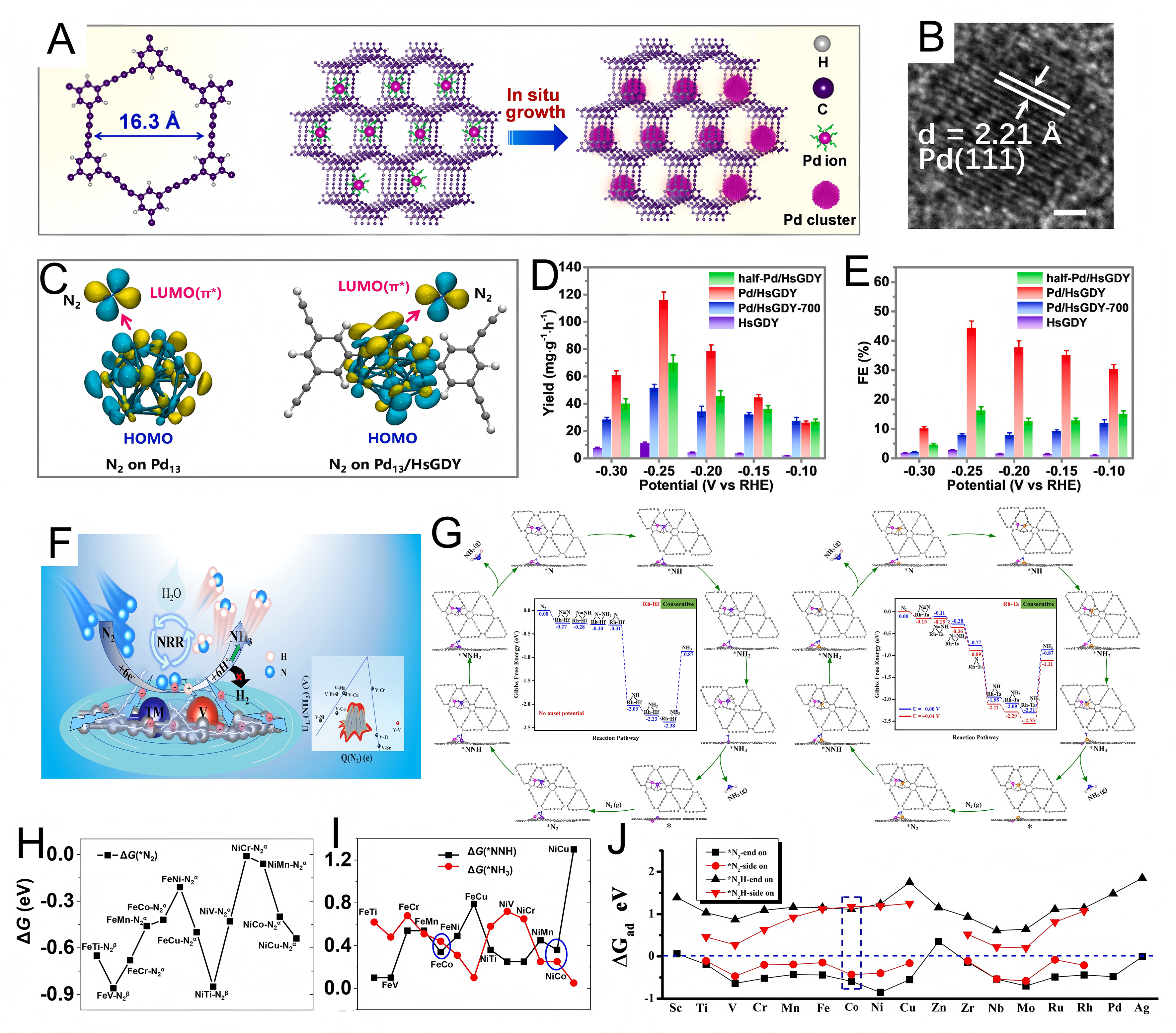
Figure 2. (A) The structural feature of HsGDY, along with a schematic depiction of the preparation route for Pd/HsGDY; (B) HRTEM of Pd/HsGDY; (C) N2 adsorption on Pd13 and Pd13/HsGDY; pink arrows denote electron-transfer direction; (D and E) NH3 yields and FEs for the catalysts[78]; (A-E) are reprinted with permission from reference[78]. Copyright 2021 Elsevier; (F) Dual-atom catalysts composed of V and 3d TMs have enhanced NRR activity because they modulate charge transfer[143]. Reprinted with permission from reference[143]. Copyright 2025 The Royal Society of Chemistry; (G) Gibbs free-energy profiles and intermediate geometries along optimal routes on Rh-Hf@GDY and Rh-Ta@GDY at zero (blue) and onset (red) potentials, respectively[144]. Reprinted with permission from reference[144]. Reproduced under the CC BY license; (H) Free-energy changes for the best N2 adsorption on tested catalysts (ΔG(N2)), with N2α and N2β representing end-on and side-on adsorption; (I) ΔG(NNH) and ΔG(*NH3) correspond to the first and last proton-electron pair transfers to N2 (forming NNH) and NH2 (forming NH3), respectively[145]; (H and I) are reprinted with permission from reference[145]. Copyright 2020 Science Press and Dalian Institute of Chemical Physics, Chinese Academy of Sciences. Published by Elsevier B.V. and Science Press; (J) Adsorption energies of N2 and N2H in the end-on and side-on patterns on TM-Co3@GDY[146]. Reprinted with permission from reference[146]. Copyright 2021 American Chemical Society. LUMO: Lowest unoccupied molecular orbital; HOMO: highest occupied molecular orbital; HsGDY: hydrogen-substituted graphdiyne; RHE: reversible hydrogen electrode; FEs: Faraday efficiencies; TMs: Sc, Ti, V, Cr, Mn, Fe, Co, Ni, Cu, Zn, Zr, Nb, Mo, Ru, Rh, Pd, and Ag, toxic/radioactive elements were excluded in this study; NRR: nitrogen reduction reaction; NNH: *NNH free radical; HRTEM: high-resolution transmission electron microscopy.
Extending this concept to heteronuclear dual-atom systems, theoretical studies have demonstrated that GDY can function as a dynamic electron reservoir, shuttling charge through metal bridges to adsorbed NxHy intermediates and thereby breaking conventional scaling restrictions between *N2H and *NH2 species [Figure 2F]. Systematic DFT screening of vanadium-paired transition metals of the 3d series on GDY (V-TM@GDY) revealed a volcano-type correlation between N2 charge transfer (Q(N2)) and the limiting potential. V-Cr@GDY and V-Fe@GDY achieve exceptionally low limiting potentials (-0.36 and -0.42 V) alongside a theoretical FE of nearly 100% for NH3[143]. Free-energy profile evaluations for Co-Ni@GDY (distal mechanism, UL = -0.52 V) and Mo2@GDY (consecutive mechanism, UL = -0.61 V) further confirm that dual-atom bridging sites provide the coordination flexibility to optimize intermediate binding and lower reaction barriers[147]. Another pivotal insight emerges from comparative studies on homonuclear (Co2@GDY[148], Fe2@GDY[145], and Mo2@GDY[145]) and heteronuclear (FeCo@GDY and NiCo@GDY[145], and Rh-Hf@GDY and Rh-Ta@GDY[144]) dimers [Figure 2G-I], which highlight the decisive role of the metal interatomic distance (~2.4-2.6 Å) in determining the N2 adsorption geometry. Optimal interatomic spacing promotes side-on N2 chemisorption, enabling simultaneous two-center electron donation/backdonation to elongate the N≡N bond and lower the initial hydrogenation barrier (ΔG*N2→*NNH).
Pushing the boundary toward higher nuclearity, investigations into Mo3@GDY[149], Fe3-GDY[150] and Ti-Co3@GDY[146] catalysts reveal that triatomic hollow sites achieve ultrahigh mass loading while expertly balancing reactant activation and product release, with limiting potentials between -0.26 and -0.32 V [Figure 2J]. Notably, this multinuclear synergy is not confined to metallic systems. In the nonmetallic domain, double boron-doped GDY (GDY-2B[151]) exemplifies a dual-Lewis-acid “pull-pull” mechanism that traps N2 lone pairs, achieving an overpotential as low as 0.12 V. Theoretical simulations confirm the stable incorporation of S and N atoms into the GDY monolayer (GDY@SN), yielding structurally robust doped frameworks with tunable electronic properties for NRR[152]. This multinuclear strategy defines a robust framework for the design of efficient electrocatalytic nitrogen conversion systems.
These studies demonstrate that GDY-based multi-atom catalysts effectively circumvent the intrinsic scaling limitations of single-site catalysis through the synergistic interaction of adjacent metal sites. Continued exploration of GDY-supported multi-atom architectures, through integrated computational screening and precision synthesis, holds great promise for unlocking next-generation catalysts toward sustainable and scalable ammonia production.
Metal-free GDY and heteroatom-doped GDY
In addition to serving as a support for metal-based catalysts, GDY and its derivatives can also be used as metal-free catalysts with high intrinsic activity for NRR. This is particularly attractive from the perspectives of cost, sustainability, and scalability. This section summarizes the strategies for realizing and enhancing metal-free NRRs on GDY-based platforms, including H[80], N[153,154], O[155], B[156], F[79], or Cl-doped graphdiyne[81].
HsGDY features a fully conjugated sp/sp2 carbon network[157]. The localized electron polarization on its inner alkynyl carbon chain lowers the activation barrier for key hydrogenation steps, particularly the NH2NH2 formation, while inherently suppressing the competing HER. Xing et al. successfully synthesized crystalline fluorinated GDY (cFGDY) with a 9-fold stacking mode, as confirmed by high resolution transmission electron microscopy (HRTEM) analyses [Figure 3A and B]. The high-quality and unique characteristics of cFGDY enable it to act as an efficient metal-free NRR electrocatalyst [Figure 3C], with 100% selectivity toward NH3 production under room-temperature conditions. The electron-withdrawing fluorine atoms create electron-deficient carbon sites that facilitate N2 adsorption while suppressing HER[79]. Yang et al. presented a scalable protocol in which Zn (instead of traditional Cu) was used as the support for growing planar crystalline HsGDY [Figure 3D and E]. At -0.2 V, the synthesized HsGDY shows outstanding NRR catalytic performance, with an NH3 yield rate of
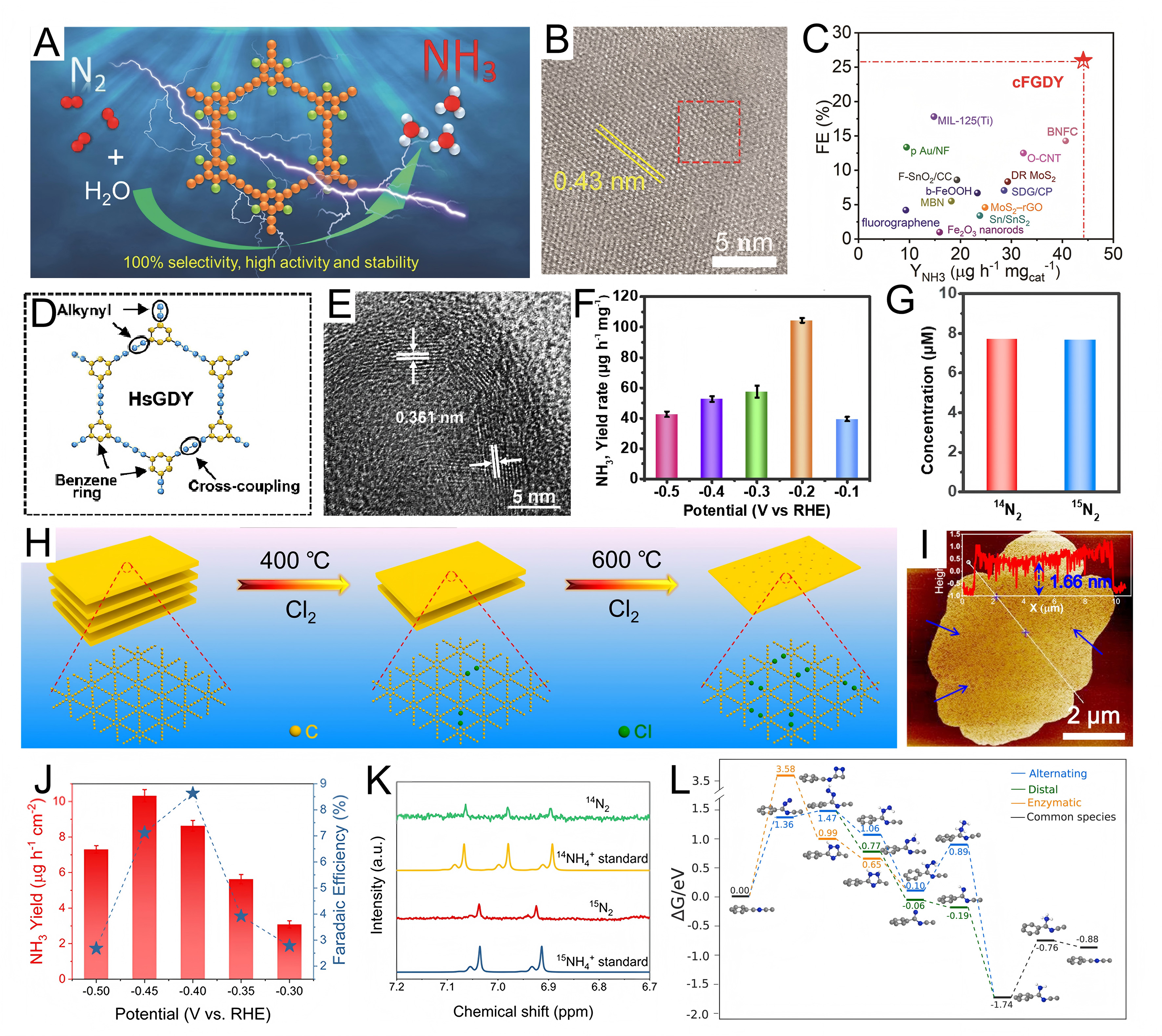
Figure 3. (A) Crystalline cFGDY was prepared for NH3 synthesis from N2 and H2O at ambient conditions, showing 100% selectivity and excellent activity; (B) HRTEM image of cFGDY nanosheets; (C) YNH3 and FEs of cFGDY versus reported metal-free and metal-based catalysts[79]; (A-C) are reprinted with permission from reference[79]. Copyright 2020 The Royal Society of Chemistry; (D) Corresponding schematic illustration of HsGDY; (E) HRTEM image of HsGDY grown on Zn substrate; (F) Calculated NH3 production rates at different potentials; (G) Concentrations of (NH4)2SO4 in the electrolytes when 14N2 and 15N2 were used as the feed gases[80]; (D-G) are reprinted with permission from reference[80]. Copyright 2020 Elsevier; (H) Illustration of the Cl2 etching process of GDY; (I) AFM image of Cl-GDY; (J) NH3 production rates and FE of Cl-GDY; (K) 1H NMR spectra of 15N2- and 14N2-fed electrolytes after electrolysis and of commercial 14NH4Cl and 15NH4Cl[81]; (H-K) are reprinted with permission from reference[81]. Copyright 2019 American Chemical Society; (L) Free-energy map of NRR over sp-N-2 GDY[153]. Reprinted with permission from reference[153]. Copyright 2021 Elsevier B.V. cFGDY: Crystalline fluorinated graphdiyne; HsGDY: hydrogen-substituted graphdiyne; RHE: reversible hydrogen electrode; HRTEM: high resolution transmission electron microscopy.
Zou et al. introduced a corrosion engineering approach using Cl2 gas to simultaneously etch and dope bulk GDY [Figure 3H and I][81]. The electronegative Cl atoms form electron-deficient carbon sites that enhance N2 chemisorption. In performance testing [Figure 3J], Cl-GDY achieves an NH3 yield rate of 10.7 μg·h-1·cm-2 and a peak FE of 8.7%. Isotopic labeling with 15N2 and 14N2 gas feeds [Figure 3K] confirms that the detected ammonia originates directly from dissolved N2 gas. Supporting these experimental observations, DFT studies have mapped the free energy landscape for NRR on various heteroatom-doped GDY systems. Wang et al. investigated four different N-doped GDY models and found that sp-N-2-substituted GDY exhibits the highest activity, with nitrogen doping at sp-hybridized acetylenic sites reducing the energy barrier for the potential-limiting step (N2(g)→HN-N) to -0.99 V through a hybrid pathway [Figure 3L][153]. Computational investigations further validate the efficacy of heteroatom doping in metal-free graphdiyne, as evidenced by DFT calculations on oxygen-doped GDY (O-doped GDY)[156], single-boron-substituted GDY at acetylenic sites (B(S3)@GDY), and dual-boron-doped GDY frameworks (GDY-2B(S2 S2’))[157], which collectively demonstrate enhanced N2 activation and reduced reaction barriers.
The above results are summarized in Figure 3. The conjugated backbone of GDY, upon heteroatom doping or polarization modulation, forms electrondeficient carbon active centers, which strengthen dinitrogen activation and suppress side reactions while eliminating metal dependence, thereby achieving highly selective and efficient nitrogen-to-ammonia conversion.
Heterostructured GDY catalysts for the NRR
The abundant sp/sp2-hybridized carbon, delocalized π-electrons, and regular acetylenic pores of GDY render it an ideal substrate for constructing heterostructured electrocatalysts. When combined with transition metal nitrides, oxides, borides, or QDs, GDY modulates interfacial charge redistribution and tunes the electronic states of the active sites. This optimizes light absorption and electrical conductivity while simultaneously restraining the competing HER and facilitating N≡N bond cleavage for the NRR[158,159].
Defect and interface engineering of GDY-based heterostructured electrocatalysts has shown great potential for enhancing ambient nitrogen reduction. Fang et al. designed an Fe-vacancy-rich Fe3O4/graphdiyne heterostructure (IVR-FO/GDY) through coprecipitation and a cross-coupling sequence [Figure 4A and B]. Owing to the synergistic interaction between GDY and Fe3O4, many Fe vacancies were introduced in IVR-FO/GDY, and the valence state of Fe was precisely regulated, thus improving the catalytic performance[82]. In neutral 0.1 M Na2SO4, IVR-FO/GDY achieves a peak NH3 yield (YNH3) of 127.92 ± 9.11 μg·h-1·mgcat.-1 and a FE of 59.48% ± 2.57% at 0.255 V vs. RHE [Figure 4C], vastly outperforming pristine Fe3O4 and bare GDY. Interfacial regulation can also effectively mitigate competitive HER. Fang et al. constructed a self-standing 3D GDY/Co2N composite by nitriding cobalt layered double hydroxide (CoLDH) nanowires, followed by in situ growth of GDY films [Figure 4D]. Transmission electron microscope (TEM) imaging [Figure 4E] illustrates the core-shell nanowire morphology when an ultrathin GDY coats the Co2N core. The rich acetylenic bonds in GDY draw electrons from Co2N, creating electron-deficient Co sites that favor N2 adsorption while increasing the kinetic barrier for H chemisorption. In neutral media, GDY/Co2N maintains stable performance across multiple cycles, delivering a high NH3 yield rate and FE [Figure 4F][83].
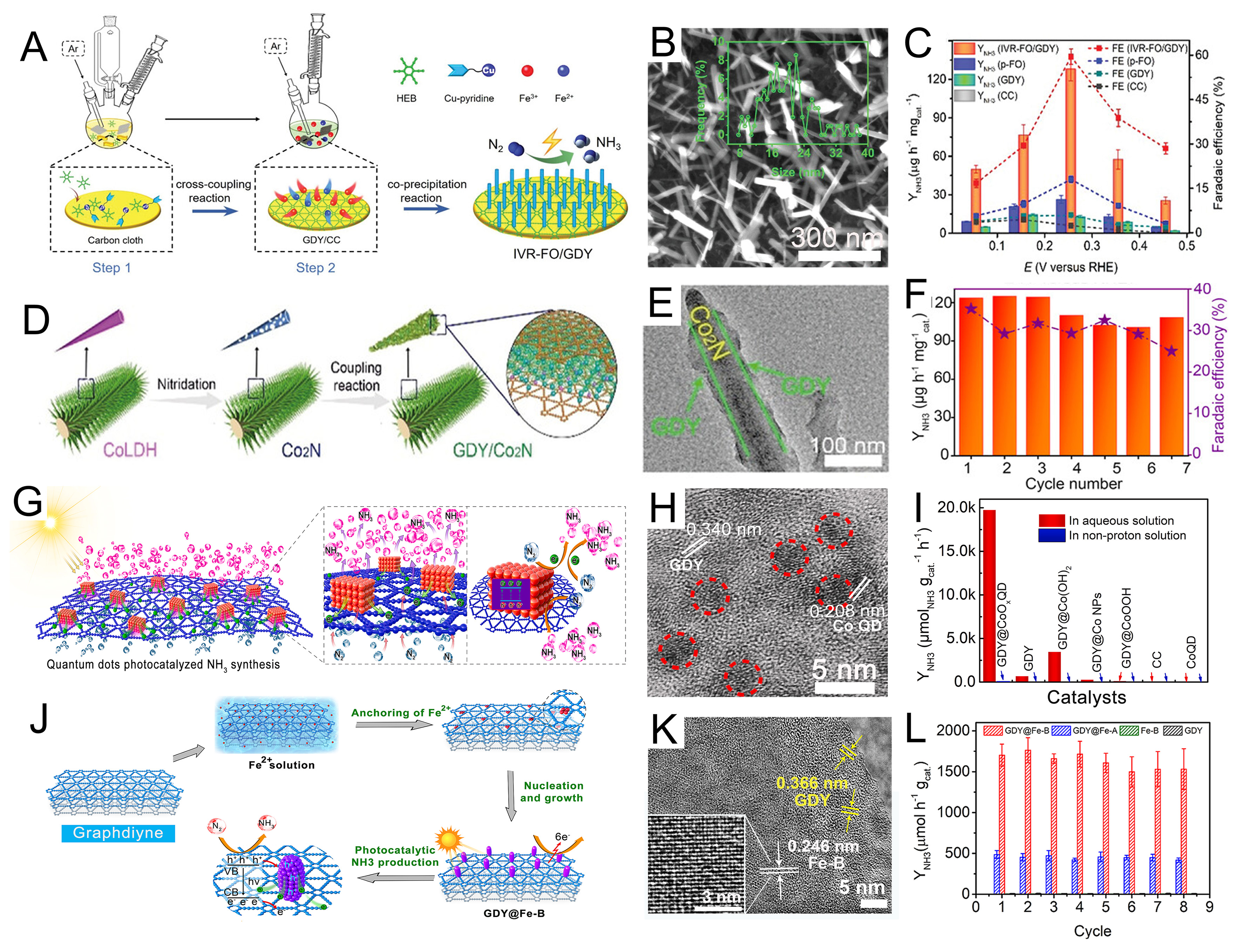
Figure 4. (A) Schematic illustration of IVR-FO/GDY preparation; (B) SEM of IVR-FO/GDY; (C) YNH3 and FEs of the samples at different potentials in N2-saturated 0.1 M Na2SO4 (error bars represent the standard deviation)[82]; (A-C) are reprinted with permission from reference[82]. Reproduced under the CC BY 4.0 license; (D) Synthesis of self-supported GDY/Co2N; (E) TEM image of GDY/Co2N. NRR performance of GDY/Co2N in (F) neutral media[83]; (D-F) are reprinted with permission from reference[83]. Copyright 2020 Wiley-VCH Verlag GmbH & Co. KGaA, Weinheim; (G) Schematic diagram of the ammonia production process on porous GDY@CoOxQD; (H) HRTEM images of porous GDY@CoOxQD nanosheets; (I) YNH3 of the samples in different electrolytes[160]; (G-I) are reprinted with permission from reference[160]. Copyright 2021 Elsevier; (J) Preparation and reaction route for GDY@Fe-B; (K) HRTEM images of GDY@Fe-B; (L) YNH3 obtained after the stability test[161]; (J-L) are reprinted with permission from reference[161]. Copyright 2020 Wiley-VCH GmbH. IVR-FO/GDY: Iron vacancy (VFe)-rich ferroferric oxide on GDY; HEB: hexaethynylbenzene; CC: carbon cloth; FE: Faradaic efficiency; RHE: reversible hydrogen electrode; SEM: scanning electron microscope; NRR: nitrogen reduction reaction; TEM: transmission electron microscope; HRTEM: high resolution transmission electron microscopy.
Photocatalytic nitrogen fixation represents another promising direction for GDY heterostructures, wherein GDY acts as an electron acceptor to accelerate photogenerated carrier separation and lower activation barriers[162,163]. Liu et al. reported porous GDY loaded with cobalt oxide quantum dots (GDY@CoOxQD) [Figure 4G][160]. HRTEM [Figure 4H] shows ultrasmall CoOxQDs (~3.75 nm) uniformly anchored across the porous GDY nanosheets. Under light irradiation in water, the mixed Co2+/Co3+ valence states and surface plasmon resonance (SPR)-like behavior drive directional electron flow to GDY. In aqueous testing [Figure 4I], GDY@CoOxQD yields an extraordinary average NH3 formation rate of 19,583 μmolNH3·gcat-1·h-1, whereas nonprotonic solvents or control catalysts yield negligible amounts of ammonia, confirming that water is the proton donor[160]. Fang et al. developed a Janus magnetite/GDY nanorod heterostructure (GDY@Fe-B). Rod-shaped GDY@Fe3O4 (GDY@Fe-B) was controllably synthesized [Figure 4J]. HRTEM [Figure 4K] displays distinct lattice fringes of GDY (0.365 nm) and Fe-B (0.246 nm), with nanorod lengths distributed approximately 15-25 nm (inset). Under light and magnetic field assistance, the Janus interface exhibits enhanced charge separation. Consequently, compared with the GDY, Fe-B, and non-Janus GDY@Fe-A controls, GDY@Fe-B maintains superior photocatalytic stability over 8 cycles [Figure 4L], achieving markedly higher NH3 yields. This study fully exploits the structural and intrinsic properties of GDY and pioneers a new avenue for photocatalysis[161]. In a single-molybdenum-atom-decorated hydrogen-substituted graphdiyne photocathode system (Mo1/HsGDY@Cu2O)[84], Cu2O generates photogenerated electrons, while the alkynyl-rich network of HsGDY serves not only as a charge transport channel but also efficiently dissociates water to supply active H·. Concurrently, the adjacent Mo1 single-atom sites function as robust centers for N2 adsorption and activation, markedly lowering the hydrogenation activation barrier. Under standard simulated sunlight irradiation [Air mass (AM) 1.5G, 100 mW·cm-2, 0 V vs. RHE], this system delivers an NH3 yield rate of 15.8 μg·h-1·cm-2 with an FE of 42.8%. Remarkably, under 10-sun concentrated solar illumination, the NH3 yield rate surges to a record 78.9 μg·h-1·cm-2 alongside a FE of 38.9%, retaining 86% of its initial catalytic activity after continuous operation for 240 h. This breakthrough further substantiates the universal utility of GDY-based materials in stabilizing single-atom sites, mediating in situ active hydrogen supply, and modulating interfacial charge dynamics.
GDY-based catalysts exhibit exceptional catalytic activity in photocatalytic nitrogen fixation, primarily due to GDY’s unique framework structure and strong electronic coupling with active centers[164,165]. First, the intrinsic uniform microporous structure and the enyne-rich backbone (sp/sp2-hybridized carbon) endow GDY with a highly heterogeneous surface charge distribution and strong reducibility, providing ideal anchoring sites for active metal species and effectively preventing their aggregation and deactivation during the reaction. Second, pronounced interfacial charge transfer and orbital hybridization occur between GDY and the supported metals, which, under light irradiation, accelerate the dynamic valence-state transitions of the metals and facilitate efficient electron transfer to the π* antibonding orbitals of adsorbed N2, thereby substantially reducing the N≡N bond strength and decreasing the protonation energy barrier. Moreover, GDY not only significantly enhances the localized SPR effect but also serves as a fast electron-transport channel, effectively suppressing photogenerated charge-carrier recombination and improving the apparent quantum efficiency.
GDY-BASED CATALYSTS FOR NtRR
Electrochemical NtRR is thermodynamically more favorable than NRR, as the nitrogen-oxygen bond energy (204 kJ·mol-1) is substantially lower than that of the nitrogen-nitrogen triple bond
GDY-based metal atom catalysts for NtRR
Integrating low-dimensional metals, from QDs[171] and subnanometer clusters[172] to single-atom sites[173], onto GDY offers an effective platform for the electrochemical reduction of nitrogenous species. Catalytic design and interface engineering play a central role in driving nitrate electroreduction[167]. A prime example is the Cu/CuxO/GDY catalyst engineered by Feng et al. [Figure 5A][85]. The proposed reaction scheme exploits spatial catalytic coupling, in which the Cu/CuxO interface promotes the initial conversion of NO3- to NO2-, after which the surrounding GDY matrix captures the released NO2- to drive subsequent hydrogenation to NH3. HRTEM [Figure 5B] reveals intimate phase boundaries between the CuxO(110) (0.286 nm) and Cu(111) (0.209 nm) domains on GDY. This cooperative pathway yields an NH3 production rate (YNH3) exceeding 34,000 μg·h-1·mgcat-1 and a FE close to 100% at -0.9 V vs. RHE [Figure 5C]. Extending this concept to bimetallic QDs, Wu et al. synthesized amorphous/crystalline PtCux QDs on GDY (PtCux/GDY) via microwave-assisted anchoring and thermal annealing [Figure 5D]. Characterization revealed “incomplete charge transfer” across the QD-GDY heterojunction interface [Figure 5E], where localized electronic redistribution stabilized mixed valence states (Pt0/Pt2+ and Cu0/Cu2+) to prevent intermediate overbinding. Consequently, PtCux/GDY achieves a YNH3 of 345.3 ± 38.9 μmol·h-1·cm-2 and an FE of 96.5 ± 5.1% at -0.5 V vs. RHE [Figure 5F][86]. Ligand-mediated electronic tuning allows precise control over the local coordination sphere. Wang et al. introduced fluorine modifications to single Pd atoms on GDY (Pd/GDY-F). The chemical structure [Figure 5G] shows how electron-withdrawing F atoms on the aromatic ring alter the conjugated backbone, increasing the oxidation state of the central Pd site. Aberration-corrected HAADF-STEM [Figure 5H] verifies the atomic dispersion of Pd. For NtRR, Pd/GDY-F delivers an NH3 yield exceeding 5,000 μg·h-1·mgPd-1 at -1.1 V vs. RHE [Figure 5I], significantly outperforming the other catalysts [Figure 5J]. This is because F-induced electron withdrawal increases the activation barrier for H* formation, mitigating the competitive HER[87].
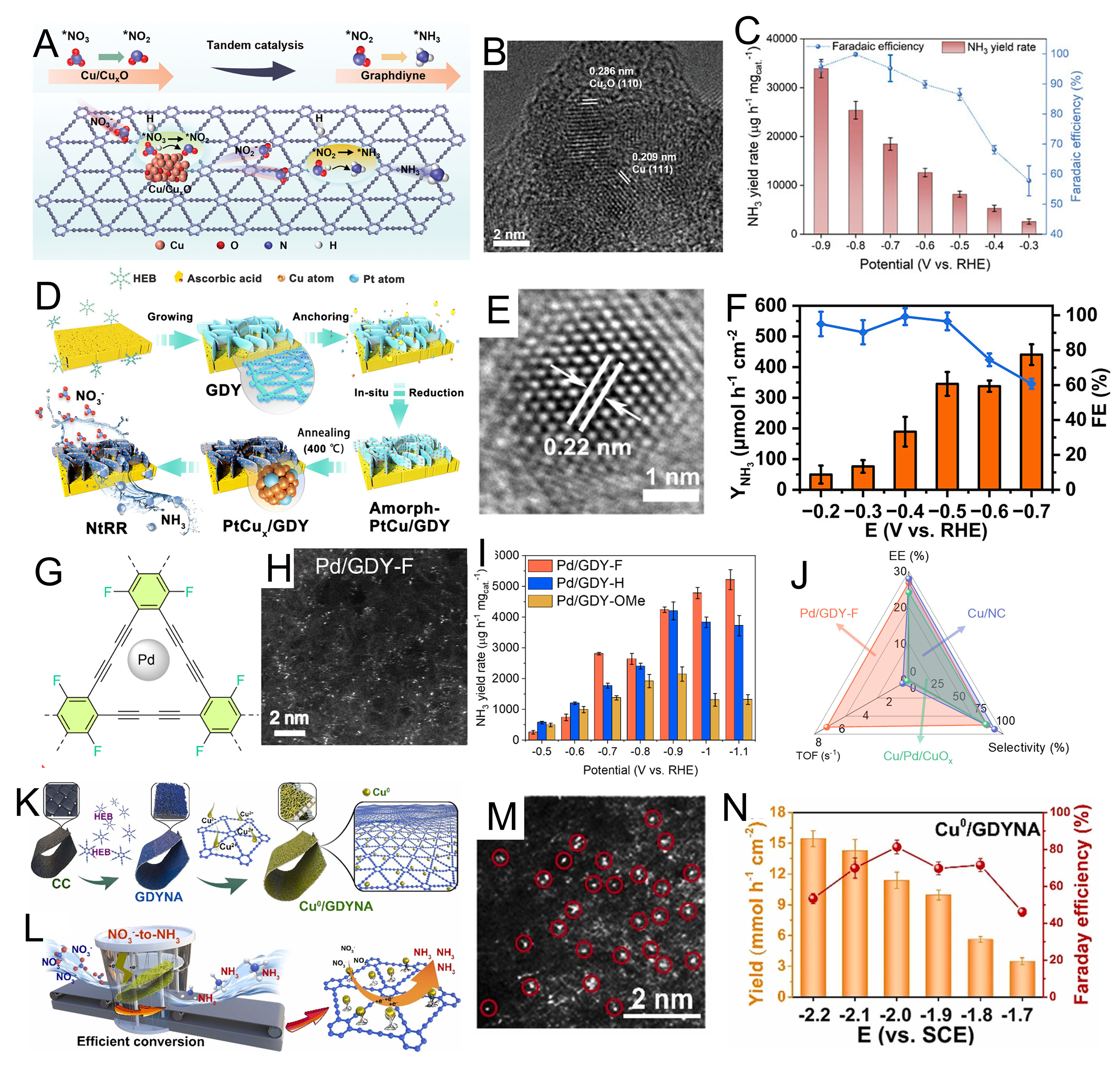
Figure 5. (A) Proposed reaction scheme for the NtRR on Cu/CuxO/GDY; (B) HRTEM image of Cu/CuxO/GDY; (C) YNH3 and FEs of Cu/CuxO/GDY at selected potentials[85];(A-C) are reprinted with permission from reference[85]. Copyright 2024 Wiley-VCH GmbH; (D) Schematic illustration of PtCux/GDY synthesis; (E) HRTEM image of PtCux/GDY; (F) PtCux/GDY YNH3 and FE at varied potentials[86]; (D-F) are reprinted with permission from reference[86]. Copyright 2024 American Chemical Society; (G) Chemical structure of Pd/GDY-F; (H) AC-HAADF-STEM image of Pd/GDY-F; (I) Rate of NH3 production in the NtRR for Pd/GDY-R (R = F, H, OMe); (J) Comparison of catalytic performance between Pd/GDY-F and other catalysts[87]; (G-J) are reproduced without modification from reference[87]. Reproduced under a CC BY-NC-ND 4.0 license; (K) Schematic of the synthesis route and (L) the NtRR process of Cu0/GDYNA; (M) HAADF-STEM image of Cu0/GDYNA; (N) YNH3 and FEs of Cu0/GDYNA catalysts at different potentials[88]; (K-N) are reprinted with permission from reference[88]. Copyright 2022 Elsevier. GDY: Graphdiyne; NtRR: nitrate reduction reaction; RHE: reversible hydrogen electrode; TOF: turnover frequency; EE: energy efficiency; CC: carbon cloth; GDYNN: GDY nanosheets; SCE: saturated calomel electrode; HRTEM: high resolution transmission electron microscopy; FE: Faradaic efficiency; AC-HAADF-STEM: aberration-corrected high-angle annular dark-field scanning transmission electron microscopy.
Zero-valent metal atom arrays offer an alternative approach to single-site catalysis. Zheng et al. constructed a zero-valent copper single-atom array on GDY (Cu0/GDYNA) through in situ coordination and self-reduction of Cu2+ on 3D GDY nanoarrays [Figure 5K and L]. HAADF-STEM [Figure 5M] confirms the presence of dense, monodisperse Cu0 single atoms anchored within acetylenic cavities. At -2.0 V vs. SCE, Cu0/GDYNA delivers a maximum FE of 81.25% [Figure 5N]. The synthesis and application of Cu0/GDYNA catalysts open up a new field of GDY-based ACs[88]. Complementing these experimental efforts, theoretical calculations provide mechanistic insight into overcoming linear scaling relationships across single-atom, dual-atom, and multi-atom configurations. DFT modeling of single-atom Os/GDY[174] indicated that it is an effective NtRR catalyst with a limiting potential as low as -0.37 V and pronounced suppression of competing reactions. In dual-atom configurations such as TiCu@GDY, calculations demonstrate a site-coupling effect: electrophilic Ti promotes nitrate activation, whereas adjacent Cu lowers the water dissociation barrier (ΔGact = 0.64 eV) to supply H, yielding a theoretical limiting potential of -0.20 V[175]. Extending this to multicenter clusters, N-doped carbon-supported trimers (Co2Ni, Co2Cu, and Fe2Ni) show a theoretical limiting potential of 0.00 V vs. RHE without a distinct potential-determining step in NtRR[176]. Moreover, Mn3-GDY clusters induce spin polarization, which triggers a pathway separation mechanism (NO3H → NO2* + OH*), reducing the limiting potential to 0.23 V and lowering the NH3 desorption barrier to 0.18 eV[177]. These studies demonstrate that integrating the sp-hybridized carbon network of GDY with low-dimensional metal centers effectively optimizes intermediate adsorption, reduces rate-limiting energy barriers, and suppresses competing HER during electrocatalytic nitrogenous transformations.
GDY-based heterojunction catalysts for NtRR
Beyond single-component metal/metal compound catalysts, GDY-based heterojunctions offer a particularly powerful platform for NtRR by exploiting synergistic interfacial effects. The sp- and sp2-hybridized carbon network and alkynyl bonds of GDY modulate inorganic phase growth while inducing local strain and defects. This creates efficient interfacial charge-transport pathways that optimize intermediate adsorption and suppress the HER[89,90,92].
Zhang et al. synthesized a Cu3N/GDY catalyst with a nitride/GDY interface that operates via an in situ vacancy generation mechanism [Figure 6A and B][89]. Under an applied potential, GDY accelerates water dissociation to generate reactive hydrogen radicals, which attack the lattice nitrogen of Cu3N to form nitrogen vacancies. The resulting nitrogen-vacancy sites and GDY matrix modulate the local electron density of adjacent Cu atoms, thus promoting NO3- adsorption and hydrogenation, achieving an ammonia yield rate (YNH3) of 35,280 μg·h-1·mgcat.-1 and a FE of 98.1% at -0.9 V vs. RHE [Figure 6C and D]. Figure 6E and F show the synthesis of the Cu2O/GDY composite using electron beam irradiation. Optimizing the Cu loading prevented nanoparticle aggregation while maintaining a high active-site density, enabling the catalyst to achieve an FE of 94% and an NH3 yield of 26,997 μg·h-1·mgcat.-1 at -1.7 V vs. Hg/HgO [Figure 6G and H][90]. Furthermore, CuxO grown on pyridine-nitrogen-dominated nitrogen-doped GDY[91] utilizes the synergistic effect of pyridine nitrogen and CuxO to accelerate H* formation, achieving an 89% FE in a fluidized bed.
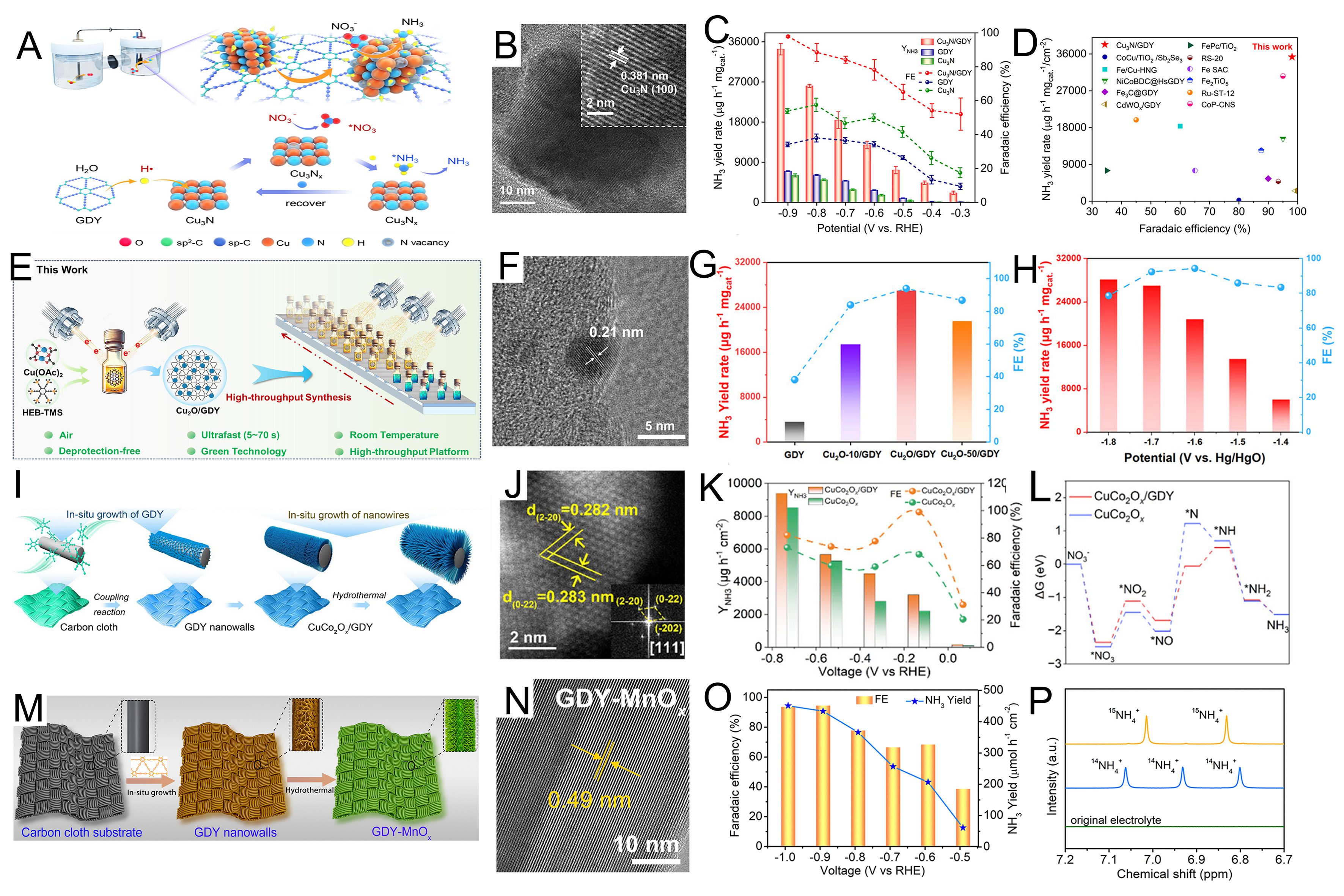
Figure 6. (A) Design and operation of the Cu3N/GDY catalyst for NtRR; (B) HRTEM image of the Cu3N/GDY catalyst; (C) YNH3 and FEs of the Cu3N/GDY and the other samples at different potentials; (D) Comparison of Cu3N/GDY with recently reported catalysts. (The nitrate concentrations of these reports are equal to or exceed 0.1 M)[89]; (A-D) are reprinted with permission from reference[89]. Copyright 2024 American Chemical Society; (E) Electron beam irradiation synthesis; (F) HRTEM image of Cu2O/GDY NtRR performance and mechanistic analysis; (G) NH3 yield rates and FEs at different Cu loadings and (H) for Cu2O/GDY at different potentials[90]; (E-H) are reprinted with permission from reference[90]. Copyright 2025 Wiley-VCH GmbH; (I) Synthesis routes of CuCo2Ox/GDY; (J) HRTEM image showing the lattice fringes and high-angle grain boundaries of CuCo2Ox/GDY; (K) Comparison of YNH3 and FEs of CuCo2Ox and CuCo2Ox/GDY; (L) Free energy diagram for CuCo2Ox/GDY and CuCo2Ox[92]; (I-L) are reprinted with permission from reference[92]. Copyright 2025 Wiley-VCH GmbH; (M) Synthesis routes to GDY-MnOx; (N) HRTEM image of GDY-MnOx; (O) FEs and YNH3 of GDY-MnOx at different potentials; (P) 1H NMR of electrolytes following reduction of 15NO3- and 14NO3-[95]; (M-P) are reprinted with permission from reference[95]. Copyright 2023 The Royal Society of Chemistry. GDY: Graphdiyne; RHE: reversible hydrogen electrode; HEB-TMS: Hexakis-[(trimethylsilyl)ethynyl]benzene; FE: Faradaic efficiency; NtRR: nitrate reduction reaction; HRTEM: high resolution transmission electron microscopy.
Introducing planar defects into one-dimensional structures can accelerate reaction kinetics. Luan et al. synthesized grain boundary-rich one-dimensional CuCo2Ox/GDY nanowires, where the coordination of sp carbon with metal sites induces high-angle grain boundaries and localized strain in the nanowires [Figure 6I and J]. When used for NtRR, CuCo2Ox/GDY achieved ~100% FE and a yield rate of 3,332 μg·cm-2·h-1 in 1.0 M KOH + 0.1 M NO3- aqueous solution at a potential of -0.132 V vs. RHE [Figure 6K]. Mechanistic analysis shows that interfacial defects on CuCo2Ox/GDY could effectively reduce the energy barrier of the deoxygenation step (*NO2 → *NO → *N) from 3.23 to 1.63 eV [Figure 6L][92]. Similarly, Co3O4/GDY nanowires[93] achieved 92.45% FE by utilizing sp-C–Co bonds and incomplete charge transfer to facilitate continuous electron transfer at -1.05 V vs. RHE. GDY heterojunctions can also be extended to manganese-based systems [GDY-MnOx; Figure 6M]. HRTEM [Figure 6N] confirmed that the interplanar spacing of MnOx was 0.49 nm. The charge transfer from sp carbon to Mn reduced the average oxidation state of Mn from 3.74 to 3.52, increasing the proportion of Mn3+ sites. GDY-MnOx achieved 95.4% FE and
Leveraging the inherent properties of GDY, diverse GDY-based heterojunction catalysts (e.g., h-FeCoNiPBA@GDY and Fe3C@GDY) have been rationally fabricated and deployed for electrocatalytic nitrogen fixation toward ammonia synthesis[99]. The integration of GDY with metal coordination nanostructures offers a complementary strategy for constructing high-performance NtRR catalysts. The well-defined porous architecture and abundant coordination sites of metal-organic coordination compounds, when coupled with GDY’s exceptional conductivity and electronic tunability, create interfaces that enhance nitrate-to-ammonia conversion. Zhao et al. developed a hybrid architecture by growing a conformal GDY layer directly on zeolitic imidazolate framework nanocubes (ZIFNC@GDY)[96]. As shown in Figure 7A-C, Co2+ and 2-methylimidazole self-assemble into ZIF-67 nanocubes (ZIFNC) nanocubes, which then serve as a template to catalyze the growth of a GDY shell. ZIFNC and GDY function as the electron acceptor and donor, respectively, linked through covalent sp-C–Co and sp-C–N bonds to establish an efficient charge-transfer channel. This configuration increases the electron density on the GDY surface and enhances nitrate electroreduction activity. High-magnification TEM images [Figure 7D and E] verify the well-defined architecture, showing a crystalline ZIFNC core encapsulated by a uniform GDY layer. The high-resolution image reveals 0.251 nm lattice fringes for the ZIFNC core and a 0.335 nm interlayer spacing for the outer GDY layer [Figure 7E]. In neutral aqueous media, ZIFNC@GDY outperforms bare ZIFNC across the entire potential range [Figure 7F and G], reaching a peak FENH3 of 98.51% ± 0.75% with an ammonia yield rate of 0.40 ± 0.02 mmol·h-1·cm-2 at -1.4 V vs. SCE (-0.745 V vs. RHE).
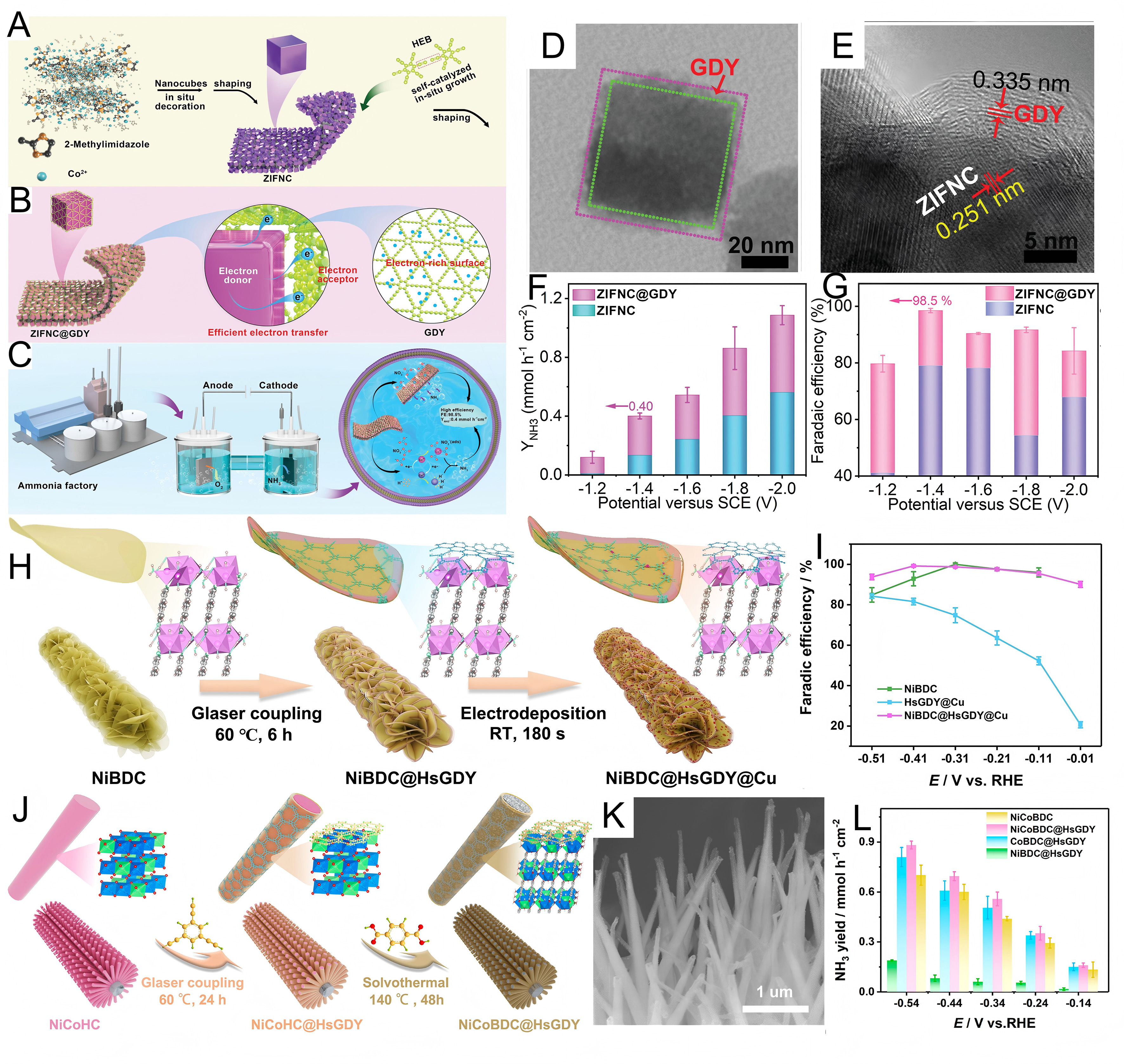
Figure 7. Schemes for (A) ZIFNC preparation, (B) ZIFNC@GDY, and (C) their application to NH3 production; (D and E) HRTEM images of ZIFNC@GDY; (F) YNH3 at different potentials of ZIFNC@GDY and ZIFNC; (G) FEs at different potentials of ZIFNC@GDY and ZIFNC[96]; (A-G) are reprinted with permission from reference[96]. Copyright 2022 Wiley-VCH GmbH; (H) Schematic for integrating Ni-MOF ultrathin nanosheets with few-layer HsGDY-supported Cu single atoms and clusters; (I) Potential-dependent FENH3 of NiBDC, HsGDY@Cu and NiBDC@HsGDY@Cu[97]; (H and I) are reprinted with permission from reference[97]. Copyright 2024 Wiley-VCH GmbH; (J) Scheme for fabrication of NiCoBDC@HsGDY nanowire array; (K) SEM image of the NiCoBDC@HsGDY nanoarray; (L) Potential-dependent YNH3 normalized by geometric area over NiCoBDC, NiCoBDC@HsGDY, CoBDC@HsGDY, and NiBDC@HsGDY[98]; (J-L) are reprinted with permission from reference[98]. Copyright 2023 American Chemical Society. GDY: Graphdiyne; ZIFNC: ZIF-67 nanocubes; SCE: saturated calomel electrode; NiBDC: Ni-benzenedicarboxylic acid; RT: room temperature; RHE: reversible hydrogen electrode.
To address intermediate adsorption mismatches during nitrate reduction, Wang et al. designed a dual-interface tandem catalyst (NiBDC@HsGDY@Cu) by linking ultrathin Ni-BDC MOF nanosheets with HsGDY carrying Cu single atoms and clusters[97]. As illustrated in Figure 7H, ultrathin NiBDC nanosheets are conformally wrapped with a thin HsGDY layer via the Glaser coupling of 1,3,5-triethynylbenzene, followed by the electrodeposition of Cu single atoms/clusters onto the HsGDY framework. Within this 0-3.6 nm interface, HsGDY acts as a conductive bridge. Unsaturated Ni2+ sites promote H2O cleavage to generate active *H species that spill over via HsGDY to Cu sites, while NO2- released from Cu sites diffuses to Ni2+ sites to complete the cascade conversion of NO3- to NH3. In 1 M KOH + 0.1 M KNO3, NiBDC@HsGDY@Cu retained high selectivity (FENH3 > 90%) across a broad window from -0.01 to -0.51 V vs. RHE [Figure 7I], markedly exceeding the performance of individual HsGDY@Cu and NiBDC. At a low overpotential of -0.11 V vs. RHE, the catalyst achieves an FENH3 of 95.5% and a YNH3 of 0.321 mmol·h-1·cm-2.
For bimetallic coordination systems, Ma et al. synthesized a self-supported NiCoBDC@HsGDY nanowire array on carbon paper[98]. As depicted in Figure 7J, NiCo carbonate hydroxide (NiCoHC) nanowires serve as initial templates. A protective HsGDY layer is polymerized on their surface via Glaser coupling, followed by a solvothermal anion-exchange reaction with 1,4-benzenedicarboxylic acid (BDC). The outer HsGDY shell acts as a physical cage that confines the in situ transformation, yielding well-aligned NiCoBDC@HsGDY core-shell nanowires, as shown by the SEM image in Figure 7K. Electronic coupling between Ni2+ and Co2+ drives partial charge transfer from Ni2+ to coordinatively unsaturated Co2+ sites through bridging O2- ligands, simultaneously optimizing NO3- deoxygenation at Co2+ and H2O activation at Ni2+. Consequently, NiCoBDC@HsGDY outperforms its monometallic counterparts (CoBDC@HsGDY and NiBDC@HsGDY) as well as pristine NiCoBDC in terms of geometric yield [Figure 7L], delivering a YNH3 of 0.56 mmol·h-1·cm-2 with an FENH3 of 99.1% at -0.34 V vs. RHE in alkaline media.
These breakthroughs underscore that graphdiyne is a uniquely powerful and versatile platform for engineering advanced NtRR electrocatalysts. By integrating various active domains onto the sp/sp2 carbon matrix of GDY, researchers can trigger synergistic phenomena such as incomplete charge transfer, interfacial strain, and tuned coordination environments. These modifications fundamentally bypass the scaling limitations of single-site catalysts, lower energy barriers for rate-limiting deoxygenation and hydrogenation steps, and effectively eliminate the competitive HER. As a result, GDY-based heterostructured architectures provide a clear roadmap for achieving ultrahigh-rate, selective, and durable nitrate-to-ammonia electrosynthesis, bridging the gap between fundamental catalyst design and practical industrial water treatment/energy conversion applications.
CONCLUSION AND OUTLOOK
Graphdiyne has been demonstrated to be an ideal active carbon platform for selective and efficient nitrogen fixation. Its sp/sp2-cohybridized framework, characterized by intrinsic electronic heterogeneity, fundamentally distinguishes GDY from all other carbon allotropes and provides interconnected advantages for catalyst design, such as electronic modulation through noninteger charge transfer, spatial confinement within intrinsic pores, and interfacial synergy in heterostructures, thereby addressing the core challenges of electrochemical ammonia synthesis. In NRR, GDY-based catalysts have achieved unprecedented activities and selectivities by stabilizing unconventional zero-valent metal states, optimizing d-band centers for N2 activation, and effectively suppressing the competing HER. In NtRR, near-unity Faradaic efficiencies and record-high ammonia yields are realized through nitrate enrichment, decoupling of deoxygenation and hydrogenation steps on distinct active sites, and stabilization of key intermediates. We further emphasize that the reliability and reproducibility of NRR performance data critically depend on the rigorous exclusion of exogenous nitrogen contaminants. The adoption of standardized testing protocols[34], including electrolyte purification, high-purity N2 feedstock, inert-atmosphere control experiments, and routine isotopic labeling
Despite these impressive achievements, the translation of GDY-based catalysts from fundamental breakthroughs to practical, industrial-scale ammonia production confronts substantial challenges, such as scalable synthesis of high-quality GDY, long-term stability under complex industrial conditions, and the lack of operando verification for the dynamic evolution of active sites. Notably, while most research focuses on ambient electrochemical routes, industrial ammonia production remains dominated by the high-temperature, high-pressure Haber-Bosch process. Bridging this gap requires addressing the thermal stability of GDY-based catalysts under harsh reducing conditions, the transferability of mechanistic insights from electrochemical to thermal systems, and the scalability of GDY synthesis for industrial fixed-bed or fluidized-bed reactors. Moreover, scaling GDY synthesis from laboratory to kilogram quantities poses additional engineering challenges distinct from electrochemical cell assembly. Addressing these challenges will require interdisciplinary efforts that combine thermal catalysis with the unique electronic properties of GDY, potentially leading to hybrid thermal-electrocatalytic systems or GDY-based catalysts for photothermal or plasma-assisted ammonia synthesis.
Looking forward, three strategic directions are particularly promising. First, scalable and cost-effective synthesis must transition from laboratory-scale methods to continuous-flow routes using earth-abundant catalysts, preserving crystallinity and electronic properties. Second, deeper mechanistic understanding of GDY as an active support is urgently needed; the dynamic evolution of the GDY framework, including structural rearrangements, metal migration, and alkyne bond participation, remains poorly understood. Advanced operando characterization coupled with machine-learning-accelerated simulations will be essential to establish true structure-activity-selectivity correlations. Third, photocatalytic nitrogen fixation represents an underexplored frontier; GDY’s tunable bandgap and charge-carrier mobility make it ideal for light-driven ammonia synthesis. Integration with plasmonic nanoparticles, semiconductor heterojunctions, or photosensitizers could enable solar-to-chemical conversion, offering a sustainable pathway that bypasses external electrical energy.
In summary, GDY has emerged as a genuinely active carbon platform that redefines the role of carbon in catalysis. The foundational principles established over the past decade have firmly validated its potential for sustainable ammonia synthesis. This review provides a comprehensive framework and a clear roadmap to guide the transition of green ammonia synthesis from laboratory research to practical application, offering new strategies to reduce energy consumption and carbon emissions associated with the traditional Haber-Bosch process.
DECLARATIONS
Authors’ contributions
Made substantial contributions to conception and design of the study: Wang, S.
Performed data acquisition: Wang, G.; Xiao, H.; Wu, H.
Provided administrative, technical, and material support: Xue, Y.
Availability of data and materials
Not applicable.
AI and AI-assisted tools statement
Not applicable.
Financial support and sponsorship
This work was supported by the National Key Research and Development Project of China (No. 2024YFA1509400), the National Natural Science Foundation of China (No. 22575095), and the Natural Science Foundation of Shandong Province (ZR2024ZD02).
Conflicts of interest
All authors declared that there are no conflicts of interest.
Ethical approval and consent to participate
Not applicable.
Consent for publication
Not applicable.
Copyright
© The Author(s) 2026.
REFERENCES
1. Ye, T. N.; Park, S. W.; Lu, Y.; et al. Vacancy-enabled N2 activation for ammonia synthesis on an Ni-loaded catalyst. Nature 2020, 583, 391-5.
3. Mallick, A.; Mayorga-Martinez, C. C.; Pumera, M. Low-dimensional materials for ammonia synthesis. Chem. Soc. Rev. 2025, 54, 5021-80.
4. Liang, J.; Li, Z.; Zhang, L.; et al. Advances in ammonia electrosynthesis from ambient nitrate/nitrite reduction. Chem 2023, 9, 1768-827.
5. Ai, X.; Chen, H.; Liang, X.; et al. Metal-coordinating single-boron sites confined in antiperovskite borides for N2-to-NH3 catalytic conversion. ACS. Catal. 2022, 12, 2967-78.
6. Li, S.; Fu, X.; Nørskov, J. K.; Chorkendorff, I. Towards sustainable metal-mediated ammonia electrosynthesis. Nat. Energy. 2024, 9, 1344-9.
7. Wang, P.; Chang, F.; Gao, W.; et al. Breaking scaling relations to achieve low-temperature ammonia synthesis through LiH-mediated nitrogen transfer and hydrogenation. Nat. Chem. 2017, 9, 64-70.
8. Zhang, N.; Jalil, A.; Wu, D.; et al. Refining defect states in W18O49 by mo doping: a strategy for tuning N2 activation towards solar-driven nitrogen fixation. J. Am. Chem. Soc. 2018, 140, 9434-43.
9. Ye, D.; Tsang, S. C. E. Prospects and challenges of green ammonia synthesis. Nat. Synth. 2023, 2, 612-23.
10. Jiao, F.; Xu, B. Electrochemical ammonia synthesis and ammonia fuel cells. Adv. Mater. 2019, 31, e1805173.
11. Wu, T.; Fan, W.; Zhang, Y.; Zhang, F. Electrochemical synthesis of ammonia: progress and challenges. Mater. Today. Phys. 2021, 16, 100310.
12. Chen, Y.; Guo, R.; Peng, X.; et al. Highly productive electrosynthesis of ammonia by admolecule-targeting single Ag sites. ACS. Nano. 2020, 14, 6938-46.
13. Li, J.; Jiang, Y.; Zhang, Z.; et al. Barium oxynitride electride as highly enhanced promotor for ruthenium catalyst in ammonia synthesis: comparative study with barium oxide. Adv. Energy. Mater. 2023, 13, 2302424.
14. Li, R.; Xiang, K.; Peng, Z.; Zou, Y.; Wang, S. Recent advances on electrolysis for simultaneous generation of valuable chemicals at both anode and cathode. Adv. Energy. Mater. 2021, 11, 2102292.
15. Yu, J.; Xi, Z.; Su, J.; et al. Influence of active hydrogen on pathway selection in electrochemical nitrate reduction. eScience 2025, 5, 100350.
16. Gao, W.; Guo, J.; Wang, P.; et al. Production of ammonia via a chemical looping process based on metal imides as nitrogen carriers. Nat. Energy. 2018, 3, 1067-75.
17. Lan, Y. Y.; Chen, W. X.; Si, D. H.; et al. Metal-organic framework glass-based self-supporting electrodes for efficient electrocatalytic nitrate reduction to ammonia. CCS. Chem. 2026, 8, 1997-2010.
18. Chen, T.; Wang, L.; Liang, C.; et al. Functional nanomaterials with tip effect: synthesis and applications in electrocatalysis. CCS. Chem. 2026, 8, 14-36.
19. Jia, S.; Zhao, K.; Han, L.; et al. Towards green chemistry from transformation of carbon dioxide and dinitrogen to value-added chemicals and fuels. Sci. Bull. 2025, 70, 3420-38.
20. Liu, H.; Guo, X.; Wang, L.; et al. Hydroxide-activated hydrogen spillover-mediated nitrogen reduction pathways for efficient ammonia synthesis. eScience 2026, 6, 100513.
21. Tan, Y.; Zhao, Y.; Chen, X.; et al. Cooperative Cu with defective MXene for enhanced nitrate electroreduction to ammonia. EcoEnergy 2024, 2, 258-67.
22. Feng, Y.; Ren, J. T.; Song, Y. X.; et al. Super-hydrophilic/aerophobic Co(OH)2/NiFe layered double hydroxide heterostructures with moderate work function difference for large-current-density electrochemical ammonia synthesis. CCS. Chem. 2025, 7, 1344-58.
23. Wei, Y.; Cheng, G.; Li, L.; et al. In situ dynamic reconstruction of Co3 Mo electrocatalyst for efficient nitrate reduction to ammonia. Adv. Funct. Mater. 2026, 36, e75762.
24. Singh, A. R.; Rohr, B. A.; Schwalbe, J. A.; et al. Electrochemical ammonia synthesis - the selectivity challenge. ACS. Catal. 2017, 7, 706-9.
25. Wei, X.; Chen, C.; Fu, X. Z.; Wang, S. Oxygen Vacancies-rich metal oxide for electrocatalytic nitrogen cycle. Adv. Energy. Mater. 2023, 14, 2303027.
26. Klein, C. K.; Manthiram, K. Sustainable ammonia synthesis: just around the corner? Joule 2022, 6, 1971-3.
27. Mu, B. S.; Xu, Y.; Tu, Z.; et al. Radiocatalytic ammonia synthesis from nitrogen and water. Natl. Sci. Rev. 2024, 11, nwae302.
28. Fu, Y.; Zhu, S.; Song, Y.; Wei, P.; Wang, G.; Bao, X. Sustainable electrochemical ammonia synthesis mediated by nitrogen oxides. CCS. Chem. 2026, 8, 1780-90.
29. Zhang, L.; Ji, X.; Ren, X.; et al. Electrochemical ammonia synthesis via nitrogen reduction reaction on a MoS2 catalyst: theoretical and experimental studies. Adv. Mater. 2018, 30, e1800191.
30. Wang, Q.; Pan, J.; Guo, J.; et al. Ternary ruthenium complex hydrides for ammonia synthesis via the associative mechanism. Nat. Catal. 2021, 4, 959-67.
31. Weber, J. E.; Mcmillion, N. D.; Hegg, A. S.; et al. Isocyanide ligation enables electrochemical ammonia formation in a synthetic cycle for N2 fixation. J. Am. Chem. Soc. 2024, 146, 33595-607.
32. Chang, F.; Gao, W.; Guo, J.; Chen, P. Emerging materials and methods toward ammonia-based energy storage and conversion. Adv. Mater. 2021, 33, e2005721.
33. Daisley, A.; Hargreaves, J. S. J. Chemical capacitors for ammonia synthesis. Nat. Catal. 2025, 8, 200-1.
34. Andersen, S. Z.; Čolić, V.; Yang, S.; et al. A rigorous electrochemical ammonia synthesis protocol with quantitative isotope measurements. Nature 2019, 570, 504-8.
35. Guo, H.; Zhang, X.; Lyu, J.; et al. Constructing asymmetrically coordinated transition metal single atoms with high loadings for ammonia electrosynthesis. Nat. Synth. 2026, Epub ahead of print.
36. Kibsgaard, J.; Nørskov, J. K.; Chorkendorff, I. The difficulty of proving electrochemical ammonia synthesis. ACS. Energy. Lett. 2019, 4, 2986-8.
37. Bruch, Q. J.; Connor, G. P.; Chen, C.; et al. Dinitrogen reduction to ammonium at rhenium utilizing light and proton-coupled electron transfer. J. Am. Chem. Soc. 2019, 141, 20198-208.
38. Liu, S.; Wang, M.; Ji, H.; Shen, X.; Yan, C.; Qian, T. Altering the rate-determining step over cobalt single clusters leading to highly efficient ammonia synthesis. Natl. Sci. Rev. 2021, 8, nwaa136.
39. Liao, G. Smith Jr., R. L.; Guo, H.; Qi, X. Review of carbon-based catalysts for electrochemical nitrate reduction and green ammonia synthesis. Green. Chem. 2024, 26, 11797-831.
40. Titirici, M. M.; White, R. J.; Brun, N.; et al. Sustainable carbon materials. Chem. Soc. Rev. 2015, 44, 250-90.
41. Valentini, F.; Grigoras, A. M.; Vaccaro, L.; Latterini, L. Sustainable nitrogen photofixation: considerations on the state of the art of non critical carbon materials. Carbon. Energy. 2024, 6, e545.
42. Masood ul Hasan, I. M.; Liu, Y.; Nawaz, M. Z.; et al. Trends and prospects in electrochemical nitrate-to-ammonia conversion: Emphasis on carbon-based metal-free catalysts. Renew. Sustain. Energy. Rev. 2026, 234, 116935.
43. Zhang, G.; Li, Y.; He, C.; Ren, X.; Zhang, P.; Mi, H. Recent progress in 2D catalysts for photocatalytic and electrocatalytic artificial nitrogen reduction to ammonia. Adv. Energy. Mater. 2021, 11, 2003294.
44. Wang, D. Y.; Gong, M.; Chou, H. L.; et al. Highly active and stable hybrid catalyst of cobalt-doped FeS2 nanosheets-carbon nanotubes for hydrogen evolution reaction. J. Am. Chem. Soc. 2015, 137, 1587-92.
45. Wu, K.; Qiu, X.; Luo, Y.; Zhang, C. Oxygen vacancy mediated-bismuth molybdate/graphitic carbon nitride type II heterojunction chemiresistor for efficient NH3 detection at room temperature. ACS. Sens. 2024, 9, 6698-708.
46. Xu, Z.; Deng, W.; Wang, X. 3D Hierarchical carbon-rich micro-/nanomaterials for energy storage and catalysis. Electrochem. Energ. Rev. 2021, 4, 269-335.
47. Zhu, Z.; Men, Y.; Zhang, W.; et al. Versatile carbon-based materials from biomass for advanced electrochemical energy storage systems. eScience 2024, 4, 100249.
48. Zhang, W.; Zhan, S.; Qin, Q.; et al. Electrochemical generation of catalytically active edge sites in C2N-type carbon materials for artificial nitrogen fixation. Small 2022, 18, e2204116.
49. Wu, Q.; Yan, X.; Jia, Y.; Yao, X. Defective carbon-based materials: controllable synthesis and electrochemical applications. EnergyChem 2021, 3, 100059.
50. Li, G.; Li, Y.; Liu, H.; Guo, Y.; Li, Y.; Zhu, D. Architecture of graphdiyne nanoscale films. Chem. Commun. 2010, 46, 3256-8.
51. Sun, Q.; Lu, T.; He, J.; Huang, C. Advances in the study of heteratomic graphdiyne electrode materials. Chem. J. Chinese. Univ. 2021, 42, 366.
52. Ge, C.; Chen, J.; Tang, S.; Du, Y.; Tang, N. Review of the electronic, optical, and magnetic properties of graphdiyne: from theories to experiments. ACS. Appl. Mater. Interfaces. 2019, 11, 2707-16.
53. Zhang, Y.; Huang, P.; Guo, J.; et al. Graphdiyne-based flexible photodetectors with high responsivity and detectivity. Adv. Mater. 2020, 32, e2001082.
54. Gao, X.; Liu, H.; Wang, D.; Zhang, J. Graphdiyne: synthesis, properties, and applications. Chem. Soc. Rev. 2019, 48, 908-36.
55. Fang, Y.; Liu, Y.; Qi, L.; Xue, Y.; Li, Y. 2D graphdiyne: an emerging carbon material. Chem. Soc. Rev. 2022, 51, 2681-709.
56. Li, J.; Gao, X.; Zhu, L.; et al. Graphdiyne for crucial gas involved catalytic reactions in energy conversion applications. Energy. Environ. Sci. 2020, 13, 1326-46.
57. Liang, S.; Deng, H.; Zhou, Z.; Wong, W. Y. Fabrication of graphdiyne and its analogues for photocatalytic application. EcoMat 2022, 5, e12297.
58. Nidhi, H. V.; Koppad, V. S.; Babu, A. M.; Varghese, A. Properties, synthesis and emerging applications of graphdiyne: a journey through recent advancements. Top. Curr. Chem. 2024, 382, 19.
59. Yang, B.; Jin, F.; Jin, Z.; Tsubaki, N. Directional electron transfer via Cu3P-graphdiyne-Ni3SbS6-δ interface: role of ohmic contact and graphdiyne synergy in boosting photocatalytic hydrogen evolution. Appl. Catal. B:. Environ. Energy. 2025, 378, 125624.
60. Jia, Z.; Li, Y.; Zuo, Z.; Liu, H.; Huang, C.; Li, Y. Synthesis and properties of 2D carbon - graphdiyne. Acc. Chem. Res. 2017, 50, 2470-8.
61. Yang, Z.; Zhang, D.; Wang, K.; He, J.; Li, J.; Huang, C. Investigating graphdiyne based materials for rechargeable batteries. Nano. Today. 2022, 46, 101588.
62. Wu, X.; Lu, Y.; Li, P.; et al. Current advances in the synthesis, properties, and biomedical applications of two-dimensional graphdiyne: a review. ACS. Appl. Nano. Mater. 2024, 7, 2461-93.
63. Han, Y. Y.; Lu, X. L.; Tang, S. F.; Yin, X. P.; Wei, Z. W.; Lu, T. B. Metal-free 2D/2D heterojunction of graphitic carbon nitride/graphdiyne for improving the hole mobility of graphitic carbon nitride. Adv. Energy. Mater. 2018, 8, 1702992.
64. Zhao, Y.; Yang, N.; Yu, R.; et al. Unique structural advances of graphdiyne for energy applications. EnergyChem 2020, 2, 100041.
65. Tang, S. F.; Lu, X. L.; Zhang, C.; Wei, Z. W.; Si, R.; Lu, T. B. Decorating graphdiyne on ultrathin bismuth subcarbonate nanosheets to promote CO2 electroreduction to formate. Sci. Bull. 2021, 66, 1533-41.
66. Yu, J.; Cao, C.; Jin, H.; et al. Uniform single atomic Cu1-C4 sites anchored in graphdiyne for hydroxylation of benzene to phenol. Natl. Sci. Rev. 2022, 9, nwac018.
67. Du, Y.; Zhou, W.; Gao, J.; Pan, X.; Li, Y. Fundament and application of graphdiyne in electrochemical energy. Acc. Chem. Res. 2020, 53, 459-69.
68. Kong, Y.; Li, J.; Zeng, S.; Yin, C.; Tong, L.; Zhang, J. Bridging the gap between reality and ideality of graphdiyne: the advances of synthetic methodology. Chem 2020, 6, 1933-51.
69. Qi, R.; Wang, D.; Lu, X. Heterojunction engineering in electrocatalytic nitrate-to-ammonia conversion. Coord. Chem. Rev. 2026, 551, 217483.
70. Khan, K.; Tareen, A. K.; Iqbal, M.; Shi, Z.; Zhang, H.; Guo, Z. Novel emerging graphdiyne based two dimensional materials: Synthesis, properties and renewable energy applications. Nano. Today. 2021, 39, 101207.
71. Hui, L.; Xue, Y.; Yu, H.; et al. Highly efficient and selective generation of ammonia and hydrogen on a graphdiyne-based catalyst. J. Am. Chem. Soc. 2019, 141, 10677-83.
72. Yu, H.; Xue, Y.; Hui, L.; et al. Graphdiyne-based metal atomic catalysts for synthesizing ammonia. Natl. Sci. Rev. 2021, 8, nwaa213.
73. Zou, H.; Rong, W.; Wei, S.; Ji, Y.; Duan, L. Regulating kinetics and thermodynamics of electrochemical nitrogen reduction with metal single-atom catalysts in a pressurized electrolyser. Proc. Natl. Acad. Sci. U. S. A. 2020, 117, 29462-8.
74. Feng, X.; Liu, J.; Chen, L.; et al. Hydrogen radical-induced electrocatalytic N2 reduction at a low potential. J. Am. Chem. Soc. 2023, 145, 10259-67.
75. Feng, B.; Zhang, D.; Han, Z.; et al. Rational synthesis of isomeric graphdiyne frameworks toward single-ruthenium catalysts and high-performance nitrogen reduction. Adv. Mater. 2025, 37, e2502980.
76. Zou, H.; Arachchige, L. J.; Rong, W.; et al. Low-valence metal single atoms on graphdiyne promotes electrochemical nitrogen reduction via M-to-N2 π-backdonation. Adv. Funct. Mater. 2022, 32, 2200333.
77. Fang, Y.; Xue, Y.; Hui, L.; Chen, X.; Li, Y. High-loading metal atoms on graphdiyne for efficient nitrogen fixation to ammonia. J. Mater. Chem. A. 2022, 10, 6073-7.
78. Guo, Y.; Liu, J.; Yang, Q.; et al. Regulating nitrogenous adsorption and desorption on Pd clusters by the acetylene linkages of hydrogen substituted graphdiyne for efficient electrocatalytic ammonia synthesis. Nano. Energy. 2021, 86, 106099.
79. Xing, C.; Wu, C.; Xue, Y.; et al. A highly selective and active metal-free catalyst for ammonia production. Nanoscale. Horiz. 2020, 5, 1274-8.
80. Yang, Q.; Guo, Y.; Gu, J.; et al. Scalable synthesis of 2D hydrogen-substituted graphdiyne on Zn substrate for high-yield N2 fixation. Nano. Energy. 2020, 78, 105283.
81. Zou, H.; Rong, W.; Long, B.; Ji, Y.; Duan, L. Corrosion-induced Cl-doped ultrathin graphdiyne toward electrocatalytic nitrogen reduction at ambient conditions. ACS. Catal. 2019, 9, 10649-55.
82. Fang, Y.; Xue, Y.; Hui, L.; et al. Graphdiyne-induced iron vacancy for efficient nitrogen conversion. Adv. Sci. 2022, 9, e2102721.
83. Fang, Y.; Xue, Y.; Li, Y.; et al. Graphdiyne interface engineering: highly active and selective ammonia synthesis. Angew. Chem. Int. Ed. Engl. 2020, 59, 13021-7.
84. Zhou, X.; Wu, W.; Xu, D.; Liu, C.; Zhang, Z. Bioinspired dual-site photocathode with atomic molybdenum and alkynyl networks for scalable solar ammonia synthesis. ACS. Nano. 2025, 19, 19417-28.
85. Feng, X.; Liu, J.; Kong, Y.; et al. Cu/CuxO/Graphdiyne tandem catalyst for efficient electrocatalytic nitrate reduction to ammonia. Adv. Mater. 2024, 36, e2405660.
86. Wu, H.; Gao, Y.; Zheng, X.; et al. Controlled growth of PtCux quantum dots on graphdiyne for efficient ammonia production. ACS. Mater. Lett. 2024, 6, 2787-93.
87. Wang, C.; Song, T.; Dai, H.; et al. Electronic perturbation of Pd single-atom catalysts on graphdiyne derivatives toward effective electrocatalytic nitrate reduction. ChemPhysMater 2025, 4, 321-9.
88. Zheng, Z.; Qi, L.; Xue, Y.; Li, Y. Highly selective and durable of monodispersed metal atoms in ammonia production. Nano. Today. 2022, 43, 101431.
89. Zhang, Z.; Feng, X.; Zhang, Z.; et al. Graphdiyne enabled nitrogen vacancy formation in copper nitride for efficient ammonia synthesis. J. Am. Chem. Soc. 2024, 146, 14898-904.
90. Kuang, J.; Yu, J.; Zhang, Q.; et al. Graphdiyne production in a flash: high-yield direct synthesis by electron beam irradiation. Adv. Mater. 2025, 37, e2506979.
91. Li, J.; Valenza, R.; Haussener, S. In situ synthesis of CuxO/N doped graphdiyne with pyridine N configuration for ammonia production via nitrate reduction. Small 2024, 20, e2310467.
92. Luan, X.; Qi, L.; Zhao, S.; Chen, Z.; Xue, Y. Controllable assembly of planar defect-rich bimetallic oxide interfaces for efficient ammonia production. Small. Methods. 2026, 10, e2500957.
93. Chen, Z.; Zhao, S.; Luan, X.; Zheng, Z.; Yan, J.; Xue, Y. A Co3O4/graphdiyne heterointerface for efficient ammonia production from nitrates. New. Carbon. Mater. 2024, 39, 142-51.
94. Zheng, X.; Xue, Y.; Zhang, C.; Li, Y. Controlled growth of multidimensional interface for high-selectivity ammonia production. CCS. Chem. 2023, 5, 1653-62.
95. Luan, X.; Qi, L.; Zheng, Z.; et al. In situ growth of a GDY-MnOx heterointerface for selective and efficient ammonia production. Chem. Commun. 2023, 59, 7611-4.
96. Zhao, S.; Zheng, Z.; Qi, L.; Xue, Y.; Li, Y. Controlled growth of donor-bridge-acceptor interface for high-performance ammonia production. Small 2022, 18, e2107136.
97. Wang, B.; Ma, J.; Yang, R.; et al. Bridging nickel-MOF and copper single atoms/clusters with H-substituted graphdiyne for the tandem catalysis of nitrate to ammonia. Angew. Chem. Int. Ed. Engl. 2024, 63, e202404819.
98. Ma, J.; Zhang, Y.; Wang, B.; Jiang, Z.; Zhang, Q.; Zhuo, S. Interfacial engineering of bimetallic Ni/Co-MOFs with H-substituted graphdiyne for ammonia electrosynthesis from nitrate. ACS. Nano. 2023, 17, 6687-97.
99. Gao, Y.; Liu, H.; Zheng, Z.; Luan, X.; Xue, Y.; Li, Y. Controlled growth of a graphdiyne-Prussian blue analog heterostructure for efficient ammonia production. NPG. Asia. Mater. 2023, 15, 12.
100. Ma, J.; Wang, R.; Wang, B.; Luo, J.; Zhang, Q.; Zhuo, S. Hybrid nanoarrays of Cu-MOFs@H-substituted graphdiyne with various levels of Lewis acidity for nitrate electroreduction. Chem. Commun. 2023, 59, 4348-51.
101. Fu, X.; Zhao, X.; Lu, T. B.; Yuan, M.; Wang, M. Graphdiyne-based single-atom catalysts with different coordination environments. Angew. Chem. Int. Ed. Engl. 2023, 62, e202219242.
102. Zheng, X.; Chen, S.; Li, J.; et al. Two-dimensional carbon graphdiyne: advances in fundamental and application research. ACS. Nano. 2023, 17, 14309-46.
103. Wu, R.; Huang, C.; Li, Y. Emerging electrochemical energy conversion materials: graphdiyne. Adv. Mater. 2026, e00027.
104. Zhan, S.; Zhao, Y.; Yang, N.; Wang, D. Pore structure of graphdiyne: design, synthesis and application. Chem. J. Chinese. Univ. 2021, 42, 333.
105. Wang, H.; Zhang, X.; Liu, J.; Chen, C. Modulating the electronic structure of graphdiyne-based nanomaterials for engineering nano-bio interfaces in biomedical applications. Adv. Drug. Deliv. Rev. 2025, 220, 115570.
106. Wu, T.; Sun, M.; Huang, B. Graphdiyne based catalysts for energy applications. Mater. Chem. Front. 2021, 5, 7369-83.
107. Do, D. P.; Lee, E.; Bui, V. Q.; Lee, H. Recent progress in two-dimensional graphdiyne: synthesis, characterization, and applications. ChemPhysMater 2025, 4, 91-107.
108. Ansari, M. Z.; Ansari, S. A.; Parveen, N.; et al. Exploring graphdiyne, MXene, borophene, and phosphorene as advanced 2D materials for next-generation metallic ion batteries. Prog. Mater. Sci. 2026, 158, 101617.
109. Huang, C.; Li, Y.; Wang, N.; et al. Progress in research into 2D graphdiyne-based materials. Chem. Rev. 2018, 118, 7744-803.
110. Yu, H.; Xue, Y.; Li, Y. Graphdiyne and its assembly architectures: synthesis, functionalization, and applications. Adv. Mater. 2019, 31, 1803101.
111. Liu, B.; Xu, L.; Zhao, Y.; Du, J.; Yang, N.; Wang, D. Heteroatoms in graphdiyne for catalytic and energy-related applications. J. Mater. Chem. A. 2021, 9, 19298-316.
112. Chen, H.; Liu, X.; Gong, D.; et al. Ultrahigh-water-flux desalination on graphdiyne membranes. Nat. Water. 2023, 1, 800-7.
113. Xie, H.; Jia, P.; Huang, H. Multidimensional graphdiyne structures and beyond for energy conversion and storage. Adv. Funct. Mater. 2025, 36, e10586.
114. Liu, X.; Zhao, Y.; Du, J.; Wang, D. Recent progress and challenges in crystalline graphdiyne. Sci. China. Mater. 2024, 67, 729-51.
115. Yin, X. P.; Wang, H. J.; Tang, S. F.; et al. Engineering the coordination environment of single-atom platinum anchored on graphdiyne for optimizing electrocatalytic hydrogen evolution. Angew. Chem. Int. Ed. Engl. 2018, 57, 9382-6.
116. Gao, Y.; Xue, Y.; Wu, H.; et al. Self-organized gradually single-atom-layer of metal osmium for an unprecedented hydrogen production from seawater. J. Am. Chem. Soc. 2024, 146, 10573-80.
117. Xue, Y.; Huang, B.; Yi, Y.; et al. Anchoring zero valence single atoms of nickel and iron on graphdiyne for hydrogen evolution. Nat. Commun. 2018, 9, 1460.
118. Zhang, S.; Kong, Y.; Gu, Y.; et al. Strong d-π orbital coupling of Co-C4 atomic sites on graphdiyne boosts potassium-sulfur battery electrocatalysis. J. Am. Chem. Soc. 2024, 146, 4433-43.
119. Zhang, L.; Li, J.; Wei, G.; Yang, H.; Bai, H.; Xi, G. Exploring the fate of copper ions in the synthesis of graphdiyne. Angew. Chem. Int. Ed. Engl. 2024, 63, e202316936.
120. Wu, R.; Fu, X.; Huang, C.; Gao, J.; Yang, J.; Li, Y. Recent progress in the preparation of graphdiyne-based materials. ChemistryEurope 2025, 3, e202500141.
121. Sakamoto, R.; Fukui, N.; Maeda, H.; Matsuoka, R.; Toyoda, R.; Nishihara, H. The accelerating world of graphdiynes. Adv. Mater. 2019, 31, e1804211.
122. Zhang, W.; Xu, J.; Wang, T.; Lin, X.; Wang, F. Graphdiyne as an emerging sensor platform: principles, synthesis and application. J. Adv. Res. 2025, 74, 283-301.
123. Yu, M.; He, J.; Hu, X.; et al. Graphdiyne and its derivatives: a stabilizer for metastable particles. Adv. Compos. Hybrid. Mater. 2025, 8, 377.
124. Yu, S.; Chen, J.; Chen, C.; et al. What happens when graphdiyne encounters doping for electrochemical energy conversion and storage. Coord. Chem. Rev. 2023, 482, 215082.
125. Peng, J.; Tian, Z.; Zhao, T.; Shang, H.; Wu, J. Recent progress in preparations and multifunctional applications towards MOF/GDY composites and their derivative materials. Catalysts 2025, 15, 1041.
126. Zhu, C.; Fu, S.; Shi, Q.; Du, D.; Lin, Y. Single-atom electrocatalysts. Angew. Chem. Int. Ed. Engl. 2017, 56, 13944-60.
127. Han, C.; Zhang, S.; Zhang, H.; et al. Metal-support interaction in single-atom electrocatalysts: a perspective of metal oxide supports. eScience 2024, 4, 100269.
128. Gao, Y.; Wang, D. Atomically dispersed catalysts: precise synthesis, structural regulation, and structure-activity relationship. CCS. Chem. 2024, 6, 833-55.
129. Bi, W.; Shaigan, N.; Malek, A.; Fatih, K.; Gyenge, E.; Wilkinson, D. P. Strategies in cell design and operation for the electrosynthesis of ammonia: status and prospects. Energy. Environ. Sci. 2022, 15, 2259-87.
130. Qing, G.; Ghazfar, R.; Jackowski, S. T.; et al. Recent advances and challenges of electrocatalytic N2 reduction to ammonia. Chem. Rev. 2020, 120, 5437-516.
131. Song, T.; Liu, X.; Zhu, Y. Toward fundamental insights into heterogeneous catalysis by supported atomically precise metal clusters. CCS. Chem. 2026, 8, 1175-203.
132. Ying, Y.; Fan, K.; Qiao, J.; Huang, H. Rational design of atomic site catalysts for electrocatalytic nitrogen reduction reaction: one step closer to optimum activity and selectivity. Electrochem. Energy. Rev. 2022, 5, 6.
133. Tang, T.; Bai, X.; Wang, Z.; Guan, J. Structural engineering of atomic catalysts for electrocatalysis. Chem. Sci. 2024, 15, 5082-112.
134. Zhang, M.; Ji, S.; Zhang, Z.; Zhu, M.; Yao, Q.; Xie, J. Engineering surface structure of atomically precise metal nanoclusters at the molecular level. CCS. Chem. 2026, 8, 37-59.
135. Wong, H.; Lu, Q.; Sun, M.; Huang, B. Rational design of graphdiyne-based atomic electrocatalysts: DFT and self-validated machine learning. Chem. J. Chinese. Univ. 2022, 43, 20220042.
136. Zhao, M.; Jiang, L.; Yu, Q. Environmental applications of single-atom catalysts based on graphdiyne. Catal. Sci. Technol. 2023, 13, 5154-74.
137. Kan, X.; Fan, C.; Wu, C.; Sun, C.; Li, Z.; Zhao, Y. Graphdiyne-supported atomic catalysts: synthesis and applications. ChemPlusChem 2020, 85, 2570-9.
138. Li, B.; Lai, C.; Zhang, M.; et al. Graphdiyne: a rising star of electrocatalyst support for energy conversion. Adv. Energy. Mater. 2020, 10, 2000177.
139. Xiong, S.; Wang, W.; Wang, F.; et al. Thermal catalytic synthesis of ammonia using uranium/graphdiyne composite at mild conditions. Nat. Commun. 2026, 17, 2894.
140. Jin, R.; Xu, X.; Xia, Y.; et al. Robust oxygen reduction electrocatalysis via dioxygen-bridged cobalt diatomic sites scaffolded by hierarchically porous nanoarchitectures. Sci. Bull. 2026, 71, 2012-21.
141. Dong, X. Y.; Jin, Y. J.; Chen, H.; Li, B.; Zang, S. Q.; Cai, J. Atomic-level dynamic spacing engineering in COF-based electrocatalysts for urea synthesis in ultra-low and wide potential ranges. Sci. Bull. 2026, 71, 1380-6.
142. Liu, S.; Lu, J.; Yu, X.; Pang, H.; Zhang, Q.; Park, H. S. Rational design of metal-organic framework-nanoparticle composite electrocatalysts for sustainable nitrogen electrochemistry. eScience 2025, 5, 100378.
143. He, B.; Ren, M.; Zhang, L.; et al. Breaking scaling relations and boosting ammonia synthesis in nitrogen reduction with V-containing heteronuclear double metal atoms. J. Mater. Chem. A. 2025, 13, 2093-104.
144. Wang, X.; Yang, L. Composition engineering opens an avenue toward efficient and sustainable nitrogen fixation. Energy. Environ. Mater. 2023, 7, e12600.
145. Ma, D.; Zeng, Z.; Liu, L.; Jia, Y. Theoretical screening of the transition metal heteronuclear dimer anchored graphdiyne for electrocatalytic nitrogen reduction. J. Energy. Chem. 2021, 54, 501-9.
146. Luo, Y.; Li, M.; Dai, Y.; et al. Transition metal-modified Co4 clusters supported on graphdiyne as an effective nitrogen reduction reaction electrocatalyst. Inorg. Chem. 2021, 60, 18251-9.
147. Jasin Arachchige, L.; Xu, Y.; Dai, Z.; Zhang, X. L.; Wang, F.; Sun, C. Double transition metal atoms anchored on Graphdiyne as promising catalyst for electrochemical nitrogen reduction reaction. J. Mater. Sci. Technol. 2021, 77, 244-51.
148. Ma, D.; Zeng, Z.; Liu, L.; Huang, X.; Jia, Y. Computational evaluation of electrocatalytic nitrogen reduction on TM single-, double-, and triple-atom catalysts (TM = Mn, Fe, Co, Ni) based on graphdiyne monolayers. J. Phys. Chem. C. 2019, 123, 19066-76.
149. Li, M.; Cui, Y.; Zhang, X.; Luo, Y.; Dai, Y.; Huang, Y. Screening a suitable Mo form supported on graphdiyne for effectively electrocatalytic N2 reduction reaction: from atomic catalyst to cluster catalyst. J. Phys. Chem. Lett. 2020, 11, 8128-37.
150. Chen, Z. W.; Chen, L. X.; Jiang, M.; et al. A triple atom catalyst with ultrahigh loading potential for nitrogen electrochemical reduction. J. Mater. Chem. A. 2020, 8, 15086-93.
151. Fu, C.; Li, Y.; Wei, H. Double boron atom-doped graphdiynes as efficient metal-free electrocatalysts for nitrogen reduction into ammonia: a first-principles study. Phys. Chem. Chem. Phys. 2021, 23, 17683-92.
152. Wang, Q. Y.; Xie, X. Y.; Zhou, H.; et al. Efficient NRR on S, N-doped/adsorbed graphdiyne: a density functional theory investigation. Mol. Catal. 2026, 601, 116092.
153. Wang, G.; Cai, W.; Fan, T.; Ji, Y. Nitrogen-doped graphdiyne for efficient electrocatalytic N2 reduction: a first-principles study. Appl. Surf. Sci. 2021, 570, 151109.
154. Cheng, Y.; Chen, W.; He, C.; Zhang, W. New insights into the long-range interaction mechanism of nitrogen reduction. J. Energy. Chem. 2025, 106, 842-51.
155. Feng, Z.; Tang, Y.; Chen, W.; Wei, D.; Ma, Y.; Dai, X. O-doped graphdiyne as metal-free catalysts for nitrogen reduction reaction. Mol. Catal. 2020, 483, 110705.
156. Fu, C.; Li, Y.; Wei, H. Single boron modulated graphdiyne nanosheets for efficient electrochemical nitrogen fixation: a first-principles study. Phys. Chem. Chem. Phys. 2022, 24, 19817-26.
157. Zheng, X.; Gao, X.; Vilá, R. A.; et al. Hydrogen-substituted graphdiyne-assisted ultrafast sparking synthesis of metastable nanomaterials. Nat. Nanotechnol. 2023, 18, 153-9.
158. Cui, C.; Jia, Y.; Zhang, H.; Geng, L.; Luo, Z. Plasma-assisted dinitrogen activation via dual platinum cluster catalysis: a strategy for ammonia synthesis under mild conditions. CCS. Chem. 2023, 5, 682-94.
159. Gao, X.; Li, J.; Zuo, Z. Advanced electrochemical energy storage and conversion on graphdiyne interface. Nano. Res. Energy. 2022, 1, 9120036.
160. Liu, Y.; Xue, Y.; Hui, L.; et al. Porous graphdiyne loading CoOx quantum dots for fixation nitrogen reaction. Nano. Energy. 2021, 89, 106333.
161. Fang, Y.; Xue, Y.; Hui, L.; Yu, H.; Li, Y. Graphdiyne@Janus magnetite for photocatalytic nitrogen fixation. Angew. Chem. Int. Ed. Engl. 2021, 60, 3170-4.
162. Hu, C.; Chen, X.; Jin, J.; et al. Surface plasmon enabling nitrogen fixation in pure water through a dissociative mechanism under mild conditions. J. Am. Chem. Soc. 2019, 141, 7807-14.
163. Li, J.; Zhu, L.; Tung, C. H.; Wu, L. Z. Engineering graphdiyne for solar photocatalysis. Angew. Chem. Int. Ed. Engl. 2023, 62, e202301384.
164. Torres-Pinto, A.; Silva, C. G.; Faria, J. L.; Silva, A. M. T. Advances on graphyne-family members for superior photocatalytic behavior. Adv. Sci. 2021, 8, 2003900.
165. Shandilya, P.; Mandyal, P.; Kumar, V.; Sillanpää, M. Properties, synthesis, and recent advancement in photocatalytic applications of graphdiyne: a review. Sep. Purif. Technol. 2022, 281, 119825.
166. Halder, D.; Sen, S.; Roy, S. Recent advances in mechanistic studies and catalyst development for electrochemical nitrate reduction to ammonia. Commun. Chem. 2025, 9, 58.
167. Yin, Y.; Wang, L.; Shang, H.; Zhang, X.; Chen, W.; Zou, X. Lateral coordination sulfur-modified charge asymmetry Cu-Ru diatomic catalyst for efficient and stable electrochemical nitrate reduction to ammonia. ACS. Nano. 2025, 19, 30338-48.
168. Richa, A.; Touil, S.; Fizir, M. Recent advances in the source identification and remediation techniques of nitrate contaminated groundwater: a review. J. Environ. Manage. 2022, 316, 115265.
169. Yang, M.; Wang, W.; Zhao, Z.; et al. Interfacial microenvironment engineering for electrocatalytic nitrate reduction toward a sustainable nitrogen cycle. Adv. Funct. Mater. 2026, 36, e30516.
170. Bai, J.; Dong, Z.; Jiang, X.; et al. Advancing nitrate-to-ammonia electrocatalysis: strategies in catalyst design, electrolyte engineering, and performance evaluation. Adv. Sci. 2025, 12, e08614.
171. Liu, L.; Long, Z.; Shi, K.; Zhong, H. A general crystallization picture of quantum dots: the underlying physical chemistry. CCS. Chem. 2025, 7, 926-49.
172. Luo, Z.; Castleman, A. W.; Khanna, S. N. Reactivity of metal clusters. Chem. Rev. 2016, 116, 14456-92.
173. Zhang, L.; Banis, M. N.; Sun, X. Single-atom catalysts by the atomic layer deposition technique. Natl. Sci. Rev. 2018, 5, 628-30.
174. Yang, M.; Wang, Z.; Jiao, D.; Li, G.; Cai, Q.; Zhao, J. Tuning single metal atoms anchored on graphdiyne for highly efficient and selective nitrate electroreduction to ammonia under aqueous environments: a computational study. Appl. Surf. Sci. 2022, 592, 153213.
175. Wu, Q.; Wang, Y.; Lin, D.; Li, H.; Zeng, S. Rational design of high-efficiency nitrate reduction catalysts on graphdiyne: synergistic effects in dual-active site configurations via DFT. J. Alloys. Compd. 2026, 1078, 189660.
176. Zhou, X.; Tamtaji, M.; Zhou, W.; Goddard, W. A.; Chen, G. Nonprecious triple-atom catalysts with ultrahigh activity for electrochemical reduction of nitrate to ammonia: a DFT screening. ACS. Appl. Mater. Interfaces. 2025, 17, 4854-64.
Cite This Article
 Open Access
How to Cite
Wang, S.; Wang, G.; Xiao, H.; Wu, H.; Xue, Y. Beyond the Haber-Bosch process: graphdiyne as an active platform for sustainable ammonia synthesis. Catal. Energy Environ. 2026, 1, 5. https://dx.doi.org/10.20517/cee.2026.13
Download Citation
If you have the appropriate software installed, you can download article citation data to the citation manager of your choice. Simply select your manager software from the list below and click on download.
Export Citation File
Type of Import
Tips on Downloading Citation
Citation Manager File Format
Type of Import
Direct Import: When the Direct Import option is selected (the default state), a dialogue box will give you the option to Save or Open the downloaded citation data. Choosing Open will either launch your citation manager or give you a choice of applications with which to use the metadata. The Save option saves the file locally for later use.
Indirect Import: When the Indirect Import option is selected, the metadata is displayed and may be copied and pasted as needed.
About This Article
Copyright

Data & Comments
Data
0







Comments
Comments must be written in English. Spam, offensive content, impersonation, and private information will not be permitted. If any comment is reported and identified as inappropriate content by OAE staff, the comment will be removed without notice. If you have any queries or need any help, please contact us at [email protected].