


Polyoxometalates and their derivatives: structural tuning of versatile electrocatalysts for water splitting
 0
0 
Abstract
Electrocatalytic water splitting is a promising energy-conversion technology for green hydrogen (H2) production. However, the high cost and limited availability of noble-metal catalysts substantially impede its widespread commercialization. Polyoxometalates (POMs) and their derivatives have emerged as versatile and low-cost electrocatalytic alternatives due to their well-defined molecular structures, tunable active centers, reversible redox characteristics, and robust chemical stability. Most existing POM-related reviews merely focus broadly on generalized material applications or independently describe hydrogen evolution reaction (HER) and oxygen evolution reaction (OER) performance separately, without systematically addressing structural-tuning mechanisms or the quantitative catalytic advantages of POM-based water-splitting electrocatalysts. To fill this research gap, this review systematically summarizes the structure-activity relationship of typical POM frameworks (e.g., Keggin, Wells-Dawson, Anderson) for water splitting electrocatalysis. Representative POM-based composites and POM-derived metal compounds exhibit competitive catalytic performance: optimized POM-based electrodes can achieve overpotentials of 80-150 mV for the HER and 150-300 mV for the OER at a current density of 10 mA cm-2. We comprehensively analyze the structural advantages of POMs in modulating electron transfer and optimizing reaction intermediate adsorption, and further discuss core limitations including insufficient intrinsic conductivity, particle aggregation, and structural dissolution during electrocatalysis. Finally, targeted structural tuning and composite engineering strategies are proposed to advance the development of high-performance, versatile POM-based electrocatalysts for efficient water splitting.
Keywords
INTRODUCTION
The energy crisis and environmental degradation have driven advances in clean-energy conversion technologies. Hydrogen (H2), recognized for its substantial energy density and lack of carbon emissions, stands out as a promising substitute for fossil fuels[1,2]. Electrocatalytic water splitting (EWS), which comprises the cathodic hydrogen evolution reaction (hydrogen evolution reaction (HER); 2e- transfer) and the anodic oxygen evolution reaction (oxygen evolution reaction (OER); 4e- transfer), provides an effective pathway for large-scale production of green H2[3]. However, the sluggish kinetics and high overpotentials of both reactions require efficient electrocatalysts to reduce energy consumption[4,5]. Noble-metal-based catalysts exhibit excellent performance but suffer from scarcity and high cost[6], limiting their large-scale utilization in EWS[7-9]. Meanwhile, non-noble metal catalysts have been widely explored, but they face challenges such as low conductivity, limited active sites, poor stability[10,11], and difficulty in catalyzing both HER and OER simultaneously.
Polyoxometalates (POMs), as defined by Herrmann et al.[12], are a class of molecular cluster compounds composed of early transition metals, such as tungsten (W), molybdenum (Mo), and vanadium (V), in high oxidation states [Figure 1], and have attracted increasing attention because of their tunable molecular architectures, abundant redox-active sites, excellent proton/electron transport capabilities, and high chemical stability[13-18]. These features make POMs inherently suitable for EWS, as their metal-oxygen clusters can act as multi-electron reservoirs to facilitate charge transfer and intermediate conversion[19,20]. However, the inferior activity of pristine POMs suffers from low electrical conductivity and severe agglomeration during EWS, which substantially suppress their catalytic performance[21-23]. To overcome these drawbacks, multifunctional modification strategies, including hybridization with conductive carriers (carbon-based substrates, metallic compounds, metal nanoparticles, etc.) and structural regulation (heteroatom doping, interface engineering), have been extensively adopted to reinforce the aqueous stability of POM anionic clusters, while simultaneously boosting electron transport efficiency and exposing sufficient accessible active sites[24-28]. Accordingly, POM-based EWS catalysts are regarded as highly promising candidates for efficient, durable, and low-cost water-splitting catalysis.
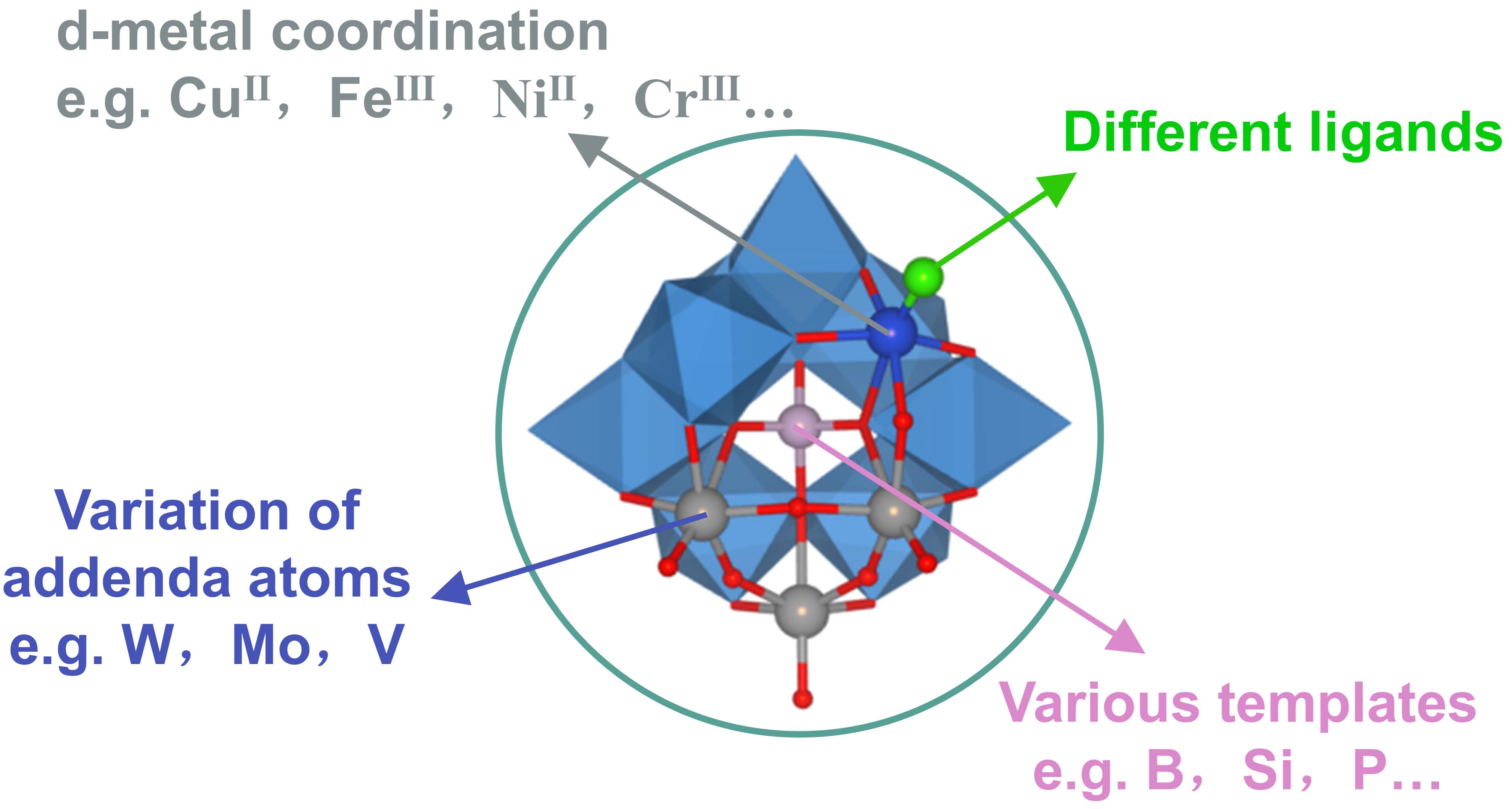
Figure 1. Schematic illustration of the structural features of Keggin-type POMs (Reproduced with permission from[12]. Copyright 2015, Royal Society of Chemistry).
The development of POM-based EWS catalysts can be traced back to 1985, when Keita and Nadjo first reported the HER activity of POMs[12]; subsequent investigations have further validated their considerable potential in EWS systems. Benefiting from tunable molecular structures, reversible redox properties and well-defined active centers, POM-based catalysts have been extensively explored for performance optimization. For example, Feng et al.[29] constructed a “proton shuttle” by encapsulating Pt-POM in single-walled carbon nanotubes (SWCNT), significantly accelerating HER kinetics; Bibi et al.[30] developed a hybrid Anderson-type POMs that exhibits strong bifunctional catalytic performance, with overpotentials of 80 mV for the HER and 111 mV for the OER at a current density of 10 mA cm-2. These studies demonstrate that noble metals with high intrinsic activity can be incorporated into POM skeletons at the atomic level with ultralow loading, thereby maximizing atom utilization and catalytic efficiency. Meanwhile, different categories of POMs display distinct catalytic preferences toward HER and OER. For instance, Keggin-type POMs with compact cluster structures are favorable for the HER owing to their superior proton adsorption capabilities, whereas Wells-Dawson-type POMs with larger frameworks exhibited high OER activity through multi-metal synergy[31,32]. Nevertheless, despite these significant advances, existing reviews lack a systematic analysis of how structural differences among POMs modulate HER/OER selectivity and overall bifunctional electrocatalytic performance.
To date, a large number of review articles have summarized the advances in POM-based electrocatalysis. Most existing works either introduce the versatile applications of POMs in various energy fields or discuss their catalytic performance for HER and OER separately, while few papers systematically compare the structural features of typical POM families and clarify the inherent correlation between POMs architectures and their catalytic selectivity toward different half-reactions. In addition, comprehensive discussions on structural modulation strategies, structure-dependent reaction pathways and practical challenges of POM-based electrocatalysts for water splitting are still lacking. To fill this research gap, this review focuses on the structural specificity of POMs and their derivatives, aiming to elaborate the intrinsic link between classical POM architectures—including Keggin, Wells-Dawson, Anderson structures—and their catalytic functions. We systematically summarize multidimensional modification strategies for POMs, illustrate how diverse structures regulate electronic states and catalytic pathways, and analyze current bottlenecks as well as feasible solutions. This work is expected to provide valuable theoretical guidance for the rational design and development of high-performance POM-based catalysts for EWS.
REACTION MECHANISM OF POM-BASED MATERIALS TOWARD EWS
The superior EWS catalytic performance of heterostructured POM-based materials originates from their unique multifunctional structural and electronic advantages[33-35]. As electron-deficient polyanionic clusters, POMs act as reversible electron reservoirs and charge regulators, which can continuously capture and redistribute interfacial electrons during electrocatalytic reactions, thereby tuning the electronic state of active centers and diminishing the kinetic barriers of both HER and OER. In particular, the strong interfacial electronic coupling between POMs and supporting components effectively modulates the adsorption strength of key water-splitting intermediates (i.e., H*, OH*, and OOH*), avoiding excessive or insufficient intermediate adsorption that commonly occurs in single-component catalysts[36,37]. Meanwhile, the multi-metallic active centers and tunable lattice oxygen species of POMs provide abundant intrinsic catalytic sites, while heterointerfaces formed within the composites further expose accessible surface sites and accelerate mass and electron transport[38]. Such synergistic electronic modulation and structural optimization endow POM-based heterostructures with bifunctional catalytic capability, enabling efficient and stable overall water splitting (OWS) over a broad electrochemical window.
OER mechanism and POM structural preference
OER is a sluggish 4e-/4H+ transfer reaction with high kinetic barriers, and its catalytic mechanism varies with electrolyte pH[39-41]. Yan et al.[42] reported that in alkaline media, hydroxide ions (OH-) participate in the formation of reaction intermediates following the pathway of M-OH → M-O → M-OOH → O2 [Figure 2A], whereas water molecules are directly oxidized under acidic conditions. For POM-based hybrid electrocatalysts, the inherent topological structures of POM components and strong interfacial electronic coupling between POMs and supporting substrates jointly regulate the entire OER catalytic pathway, including intermediate adsorption and conversion[43,44]. POMs with open extended frameworks and abundant polymetallic active sites (Wells-Dawson, Anderson, etc.) exhibit superior structural suitability for OER in composite systems[45]. Their large cluster configurations not only accommodate the multi-step electron transfer of the four-electron OER process, but also work synergistically with the adjacent substrate phase to optimize the adsorption strength of key intermediates (*O, *OH, *OOH) and promote efficient O-O bond coupling[46]. Specifically, Wells-Dawson-type POMs (e.g., [P2Mo18O62]6-) are composed of two Keggin-derived subunits connected by bridging oxygen atoms[47]. When integrated with metal oxides, carbon materials, or metal-organic frameworks (MOFs) to form hybrids, the unique dual-subunit structure strengthens intermetallic synergistic effects at the heterointerface, redistributes interfacial electrons, and further reduces the energy barrier of the rate-limiting O-O bond formation step. Meanwhile, the open skeleton of such POMs exposes more accessible active sites in hybrid systems, avoiding the aggregation of individual POM clusters and maintaining stable adsorption and conversion of OER intermediates. The corresponding OER equations under acidic and alkaline conditions are given in:
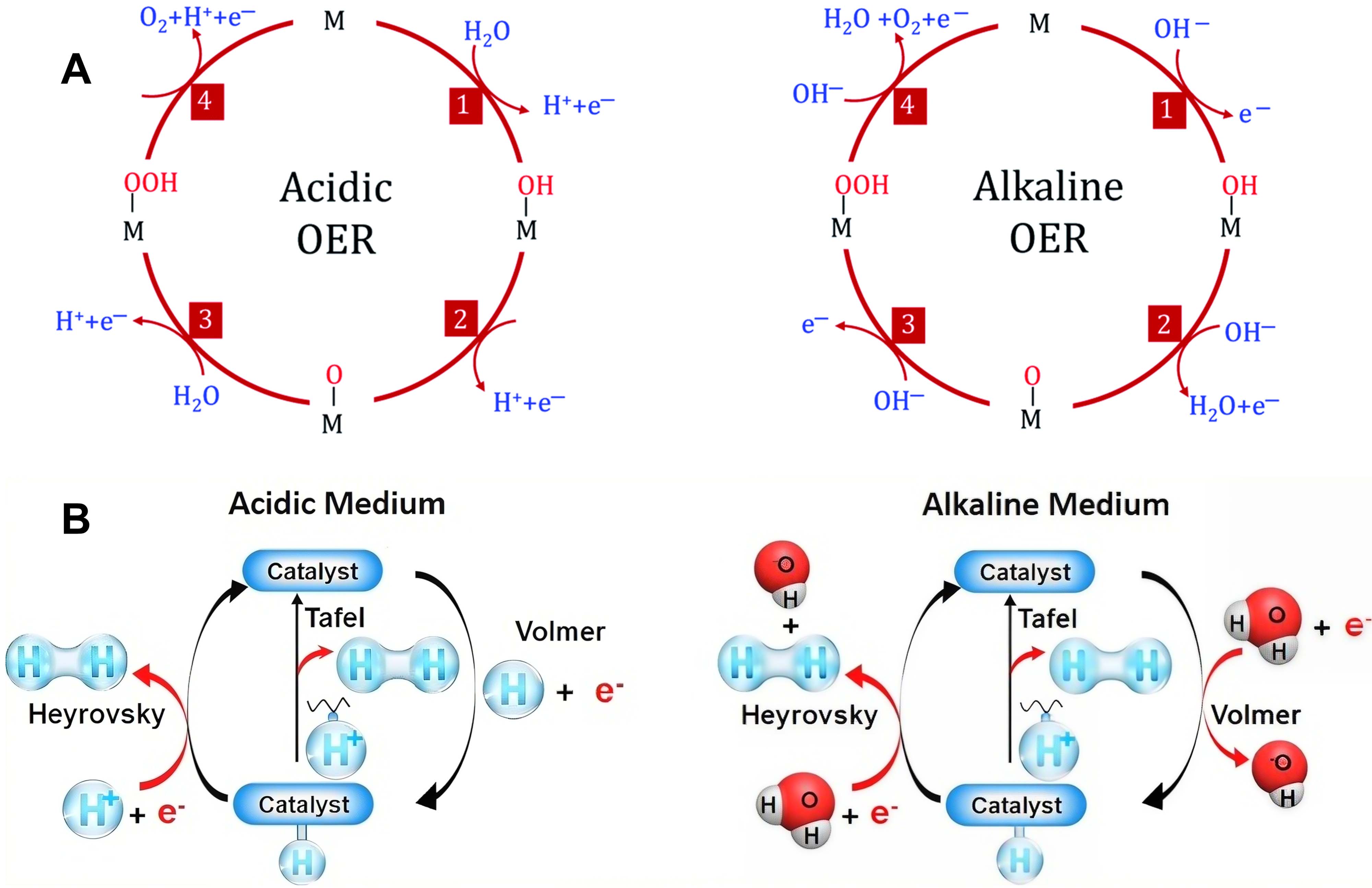
Figure 2. (A) Schematic illustration of feasible OER pathways in acidic and alkaline media (Reproduced with permission from[42]. Copyright 2020, Royal Society of Chemistry). (B) Schematic diagram of potential HER routes in acidic and alkaline media (Reproduced with permission from[49]. Copyright 2025, Wiley-VCH GmbH).
HER mechanism and POM structural preference
HER is a typical 2e-/2H+ reduction reaction via Volmer-Heyrovsky or Volmer-Tafel mechanisms[48].
STRUCTURAL SPECIFICITY OF POMS AND THEIR CATALYTIC ORIENTATION IN EWS
Keggin-type POMs
Keggin-type POMs with the general formula [XM12O40]n- are the most well-known and versatile POM archetype, featuring a central tetrahedral {XO4} heteroatom template (e.g., P, Si, B) encapsulated by 12 edge- and corner-sharing {MO6} octahedra built from addenda metals (e.g., W, Mo, V)[52]. As illustrated in
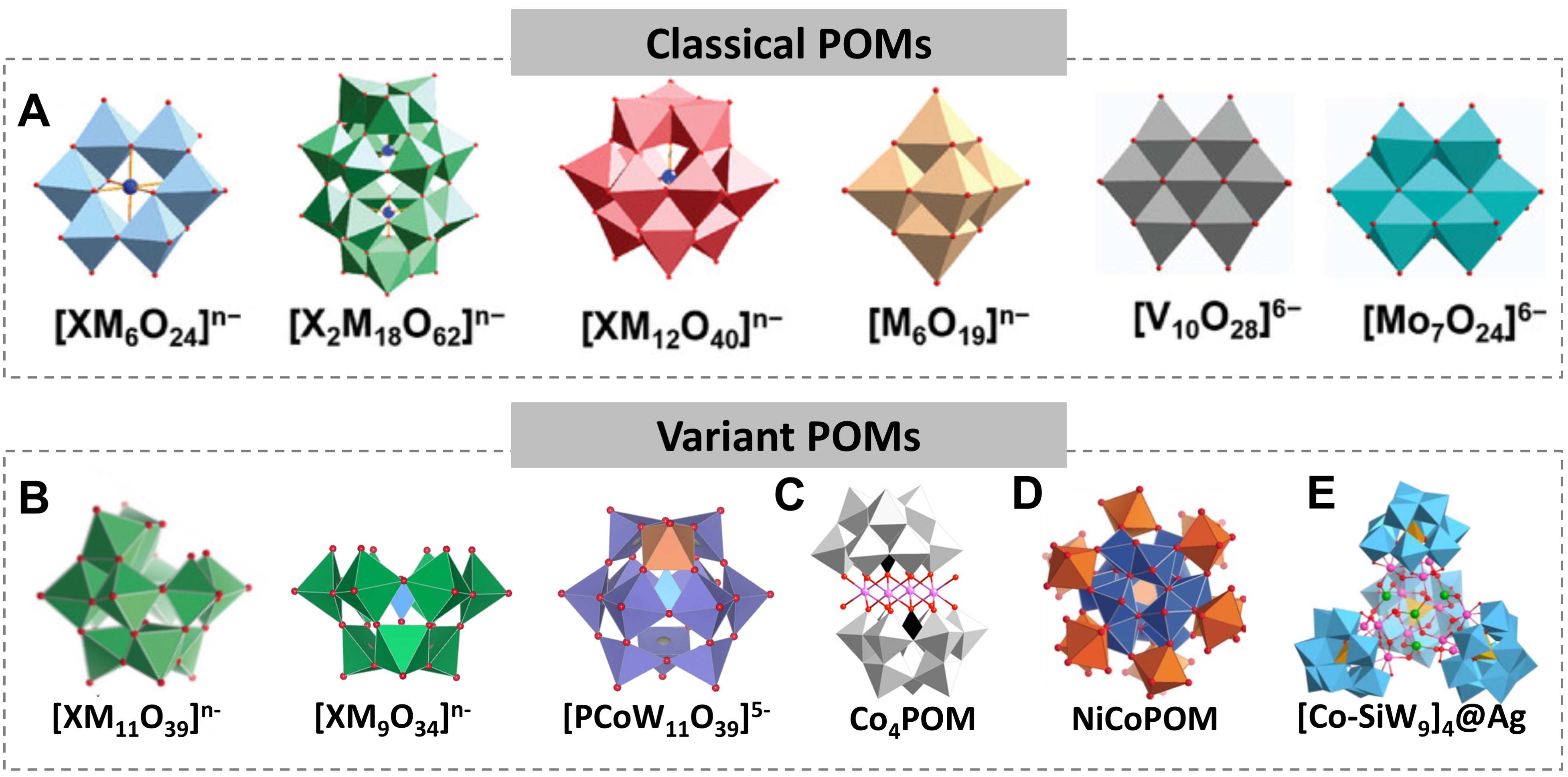
Figure 3. (A) Overview of common POM archetypes (Reproduced with permission from[52]. Copyright 2024, Wiley-VCH GmbH). (B) Schematic structure of lacunary POMs (Reproduced with permission from[53]. Copyright 2019, Wiley-VCH Verlag GmbH & Co. KGaA, Weinheim). (C) The molecular structure of the polyanions Co4-Dawson-Wells (Reproduced with permission from[54]. Copyright 2012, American Chemical Society). (D) Dexter-Silverton polyoxometalate microcrystals (Reproduced with permission from[55]. Copyright 2017, Wiley-VCH Verlag GmbH & Co. KGaA, Weinheim). (E) POM-templated closed Ag clusters (Reproduced with permission from[56]. Copyright 2025, Wiley-VCH GmbH).
Wells-Dawson-type POMs
Wells-Dawson-type POMs are a prominent POM archetype with the general formula [X2M18-nYnO62]n- (X = P, As, Si; M = Mo, W; Y = V, Cr, Co; n = 1-3), formed by two fused trilacunary Keggin fragments[59]. Their rich structural tunability, via central templates, addenda metals, substituted heteroatoms, surface ligands, and counter-cations, enables precise modulation of electronic properties and active sites, making them highly promising for OWS. Their structures can be tailored to simultaneously catalyze HER and OER through optimized proton/electron transfer and intermediate adsorption[60-62].
Anderson-type POMs
Anderson-type POMs, whose general formula is [XM6O24]n- (2 ≤ n ≤ 8, M denotes an addenda atom and X a central heteroatom), belong to the fundamental topological frameworks of the POM family[63] and possess a unique planar hexagonal structure distinct from the aforementioned POM frameworks. Their disc-like skeleton and high structural symmetry endow them with excellent electronic conductivity and abundant redox-active sites[64,65]. For OWS applications, tuning the central heteroatom, addenda metal atoms, or modifying the surface with organic ligands enables precise optimization of the electronic structure and active-site environment[66-68]. These modifications regulate the adsorption/desorption behavior of HER and OER intermediates, accelerate charge-transfer kinetics, and enable efficient and stable bifunctional electrocatalytic performance in EWS.
Other POM structures
In addition to the aforementioned Keggin, Anderson, and Wells-Dawson, the POM family also includes numerous other classical structural archetypes, including Lindqvist, Waugh, and Silverton clusters derived from Dawson skeletons[69,70], as well as distinctive structures such as lacunary, sandwich-type, and wheel-shaped POMs. Lindqvist POMs feature cage-like hexanuclear metal-oxo clusters with high symmetry and simple structural configurations[71-73]; Waugh POMs possess nonanuclear metal-oxo frameworks with unique three-dimensional pore channels[74,75]; Silverton POMs adopt cage architectures containing twelve coordinating heteroatoms, whose central cavities can accommodate bulky heteroatoms[76-78]. Moreover, lacunary POMs (e.g., mono-lacunary and tri-lacunary Keggin/Dawson species) serve as versatile building blocks, which can assemble with metal cations and organic chelates to construct various sandwich-type, extended and wheel-shaped POM clusters.
MODIFICATION STRATEGIES OF POMS
According to the distinctive structural features and catalytic properties of various POM families described above, this section systematically summarizes the research progress of POMs and POM-derived composite catalysts supported on diverse substrates for electrochemical water splitting. By analyzing the catalytic mechanisms of POMs in different reaction systems, the superior performances of POM-based electrocatalysts toward the HER and OER are comprehensively evaluated. Despite these merits, pristine POMs still suffer from intrinsically low electrical conductivity, susceptibility to aggregation, and insufficient structural stability during long-term electrocatalysis, which greatly limit their practical water-splitting efficiency. Under these circumstances, the rational introduction of suitable supporting substrates is essential to modulate the electronic structure, disperse POM active sites, and improve the overall electrode conductivity. Among various matrix materials, carbon-based supports have emerged as the most versatile and effective candidates for the modification and functionalization of POMs, because their unique conductive and structural characteristics can fundamentally remedy the shortcomings of pristine POMs and further boost the interfacial charge transfer and synergistic electrocatalysis of heterostructured POMs.
Carbon-based POMs
Carbon materials are widely adopted as ideal confined substrates and conductive carriers for POMs, owing to their rich structural diversity and electrical conductivities of 102-106 S·cm-1, thereby greatly accelerating electron transfer during EWS. Typical 2D carbon materials including graphene and g-C3N4[79] can anchor POMs via covalent linkage or intercalation confinement. Meanwhile, 3D carbon materials including carbon nanotubes (CNTs)[80] and microporous carbon[81] can be integrated with POMs through spatial encapsulation and surface immobilization. Nevertheless, carbon supports tend to undergo structural corrosion under long-term high-potential oxidation conditions, which inevitably compromises long-term catalytic activity. Heteroatom doping of carbon frameworks has therefore been developed to optimize surface electronic configurations and internal charge distributions, thereby markedly enhancing the long-term operational stability of POMs composites[82].
Graphene oxide
Graphene oxide (GO) possesses outstanding electrical conductivity, a wide electrochemical potential window, and abundant surface binding sites, and serves as an excellent substrate for immobilizing POM species[83]. For example, Li et al.[84] used H3PMo12O40-PPy/reduced graphene oxide (rGO) as sacrificial precursors to synthesize Mo2C encapsulated in N/P-codoped carbon (NPC) on N/P-codoped reduced graphene oxide (NPrGO), denoted Mo2C@NPC/NPrGO [Figure 4A]. Transmission electron microscopy (TEM) showed that PMo12 was evenly distributed on rGO [Figure 4B]. High-resolution TEM (HRTEM) images also showed the unique porous structure of the as-obtained material, where 2-5 nm Mo2C nanoparticles were densely dispersed on rGO nanosheets [Figure 4C]. The carbon coating successfully prevented the aggregation and excessive growth of Mo2C NPs. Furthermore, electrochemical tests in 0.5 M H2SO4 (three-electrode system, 100 mV s-1 indicated that Mo2C@NPC/NPrGO exhibited an onset overpotential of 0 mV and a low overpotential of ~34 mV at 10 mA cm-2, superior to commercial Pt/C
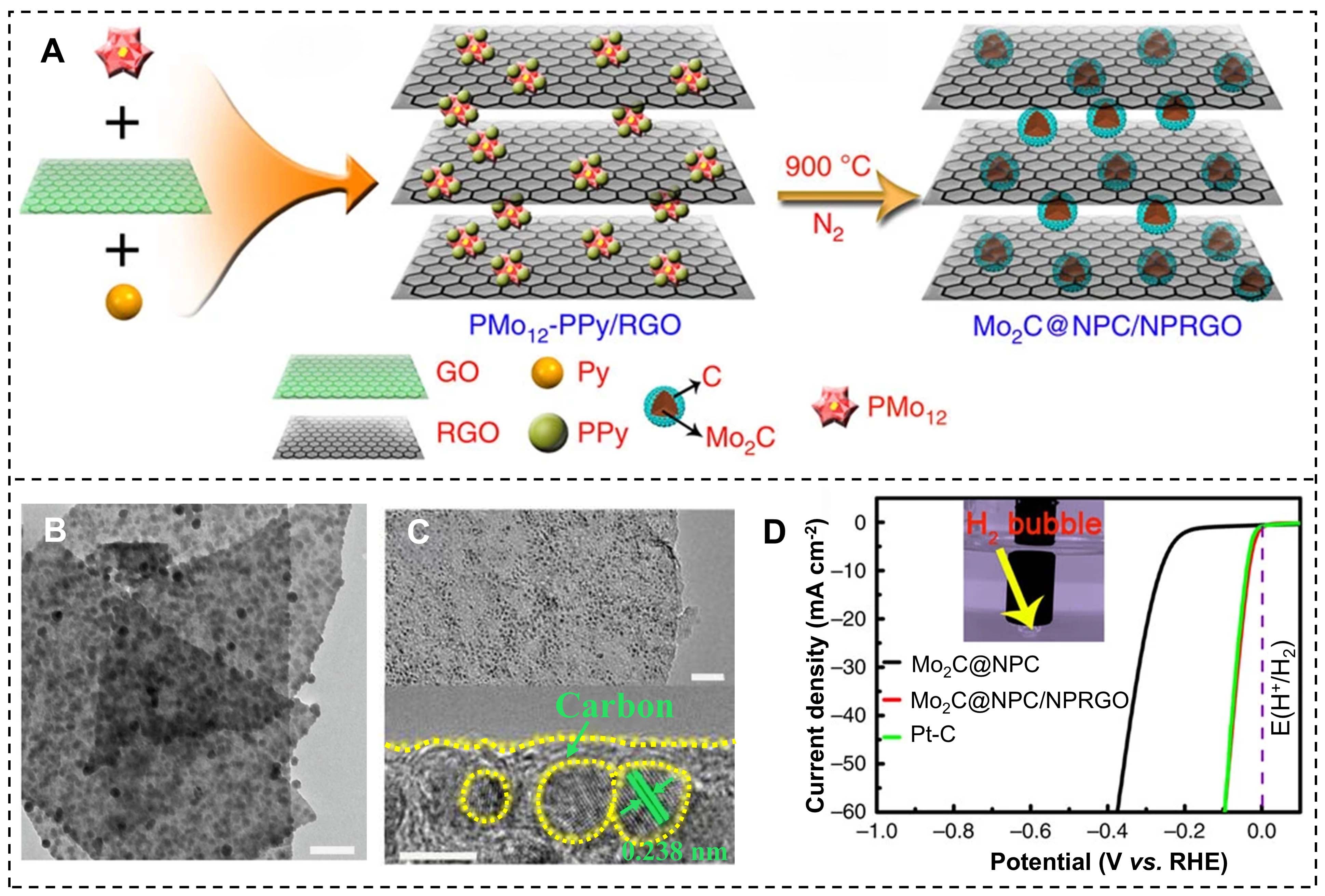
Figure 4. (A) Preparation of PMo12-PPy/rGO and Mo2C@NPC/NPrGO through an eco-friendly one-pot redox relay reaction. (B) TEM image of PMo12-PPy/rGO, and (C) HRTEM image of Mo2C@NPC/NPrGO. (D) Polarization curves of Mo2C@NPC, Mo2C@ NPC/NPrGO and Pt-C for the HER. (Inset: H2 bubble generation on the Mo2C@NPC/NPrGO surface). (A-D) Reproduced with permission from[84]. Copyright 2016, Springer Nature.
Carbon nanotubes
CNTs serve as typical one-dimensional conductive substrates, possessing a large specific surface area, outstanding electrical and thermal conductivity, and excellent mechanical stability. These merits make CNTs ideal hosts for POMs encapsulation and ensure fast multi-electron transfer throughout catalytic processes[85]. Quirós-Díez et al.[86] successfully fabricated the hybrid material 1@CNT by immersing carbon nanotubes in polar solvents to induce the assembly of anionic [V10O28]6- together with Na+ and tris(hydroxymethyl)aminomethane (TRIS+) cations on nanotube surfaces [Figure 5A]. HRTEM images confirmed that the carbon nanotubes were modified with [V10O28]6-, Na+ and TRIS+ both internally and externally [Figure 5B]. The amorphous structure of the as-obtained material provided it with a large specific surface area and high electrochemical activity. Electrochemical tests in acidic media revealed that 1@CNT delivered excellent HER performance with an onset potential of -0.07 V [Figure 5C], approaching the performance of the commercial Pt/C benchmark. For OER, 1@CNT also exhibited a low onset potential (1.45 V) and overpotential (0.34 V) at 10 mA cm-2 [Figure 5D], which outperformed state-of-the-art Ir/C and IrO2/C measured under identical acidic conditions. Combined with the anodic oxidation reaction (AOR) performance and corresponding reaction pathways depicted in Figure 5E, the results demonstrated that the [V10O28]6- moieties on 1@CNT acted as proton sponges to accelerate the OER process. This study identified regulation of crystal interactions through assembly engineering and modulation of counterion electrochemical properties as key strategies for constructing high-performance POM-based electrocatalysts for both HER and OER.
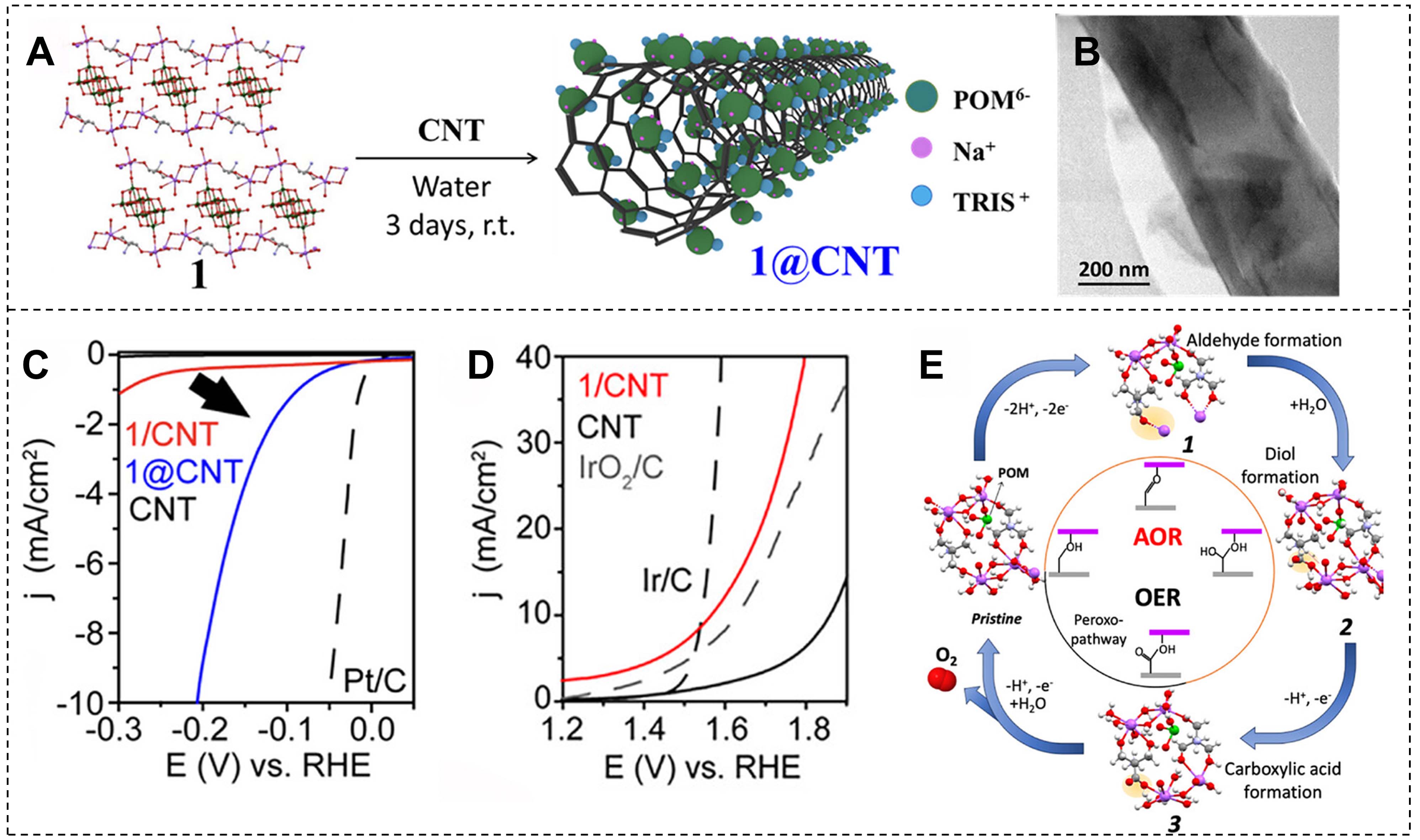
Figure 5. (A) Scheme illustration of the assembly process of [V10O28]6-, Na+ and TRIS+ to form 1@CNT. (B) HRTEM image of 1@CNT acquired at 200 kV. (C) Linear sweep voltammetry (LSV) curves of 1/CNT (red), 1@CNT (blue), CNT (black), and commercial Pt/C benchmark catalyst for the HER. (D) Comparison of the OER catalytic performance of 1/CNT (red) and bare CNT (black), with Ir/C (black dashed line) and IrO2/C as reference electrocatalysts. (E) Proposed mechanism for EWS over compound 1, involving an OER process coupled with the AOR. (A-E) Reproduced with permission from[86]. Copyright 2025, Wiley-VCH GmbH.
Porous carbon
Porous carbon materials are promising supports for POM-based electrocatalysts, featuring a high specific surface area and a 3D interconnected pore structure, excellent conductivity and tunable framework properties[87,88]. For example, Huang et al.[89] synthesized WS2/Co1S@N/S-codoped porous carbon nanocomposite via a one-step vulcanization-carbonization strategy, using phosphotungstic acid (H3PW12O40)-encapsulated ZF-67 as precursors [Figure 6A]. Scanning electron microscopy (SEM) and TEM revealed that the High-temperature carbonization of ZIF-67 generated a 3D porous carbon framework containing mesopores ranging from 1-50 nm, providing a confined space to inhibit aggregation of 5-10 nm metal sulfide particles during thermal treatment [Figure 6B and C]. Meanwhile, N/S co-doping enhanced the electron cloud density of the carbon matrix to promote charge transfer. Electrochemical measurements demonstrated that the as-obtained composite delivered remarkable HER and OER activities. It achieved a HER overpotential of 250 mV in 0.5 M H2SO4 [Figure 6D] and an OER overpotential of 365 mV at 10 mA cm-2 in 1 M KOH [Figure 6E]. Mechanistic studies revealed that the superior catalytic activity stemmed from the uniform distribution of Co1-xS and WS2 nanoparticles within the heteroatom-doped carbon framework. Specifically, WS2 derived from [PW12O40]3- served as an active component for the HER, which significantly increased the density of active sites in the composite. In addition, Cao et al.[90] synthesized Ni3N and Co nanoparticles supported on N-doped porous carbon (PW-NiCo-NC) by calcination, based on the favorable matching of pore and cavity dimensions between ZIF-8/67 and Keggin-type H3PW12O40 [Figure 6F]. A TEM image confirmed that PW-NiCo-NC displayed a typical hollow cage morphology with obvious inner cavities [Figure 6G], in which the active nanoparticles were uniformly dispersed on the carbon cage shells. Electrochemical measurements were carried out using the device shown in Figure 6H. The catalyst achieved superior HER activity in 1 M KOH, with an overpotential of 211 mV and a Tafel slope of 106.9 mV dec-1 at 10 mA cm-2. Remarkably, the excellent HER activity was mainly attributed to the combined merits of POMs and porous carbon, in which POMs served as efficient active centers to regulate interfacial electron distribution and enrich catalytic sites, and the porous hollow carbon structure enlarged the active surface area and shortened ion/electron diffusion pathways, thereby fundamentally optimizing the reaction kinetics of EWS.
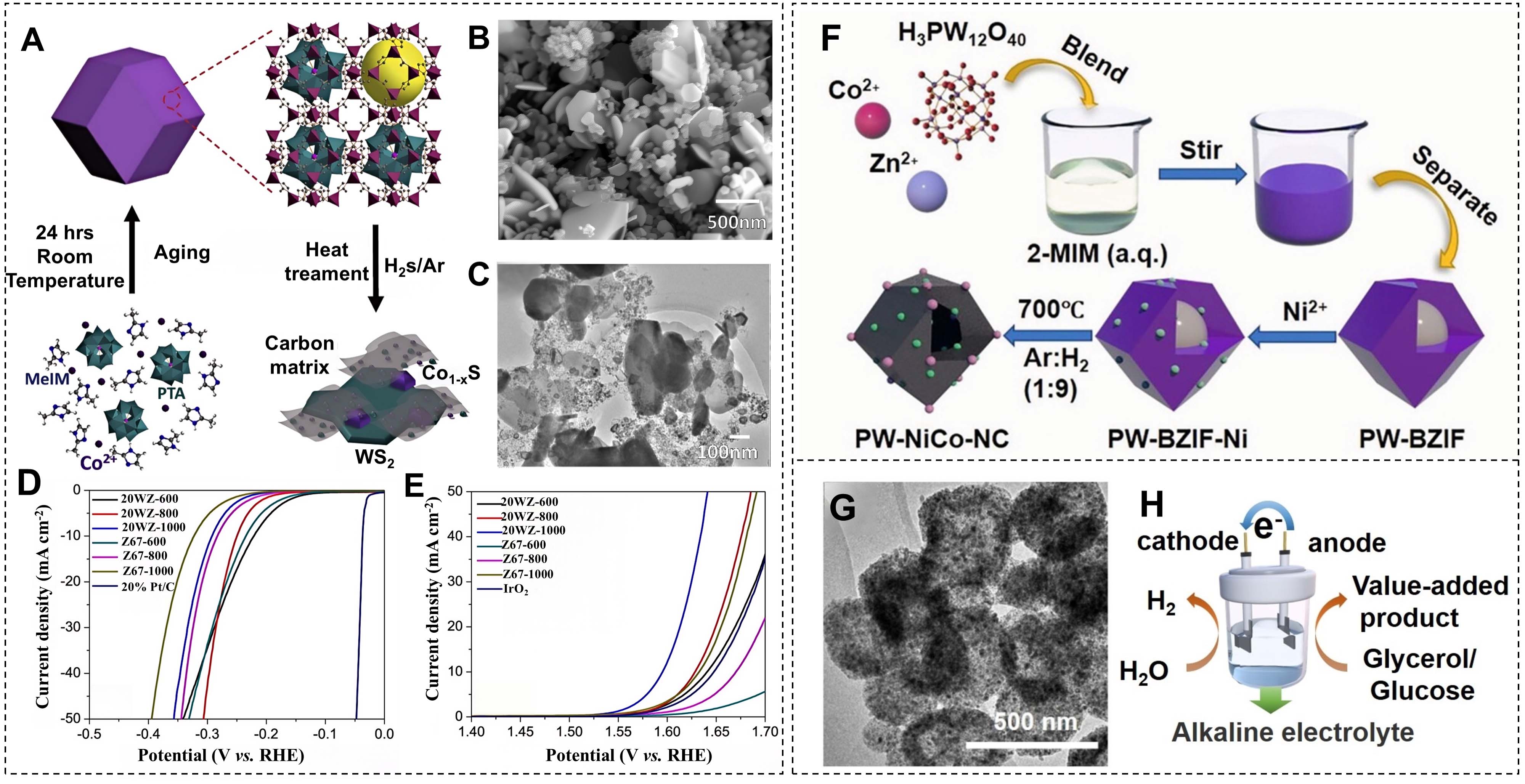
Figure 6. (A) Schematic illustration of the synthesis of WS2/Co1-xS@N/S-codoped carbon nanocomposite. (B) SEM and (C) TEM images of 20WZ-1000, (D) HER polarization curves of benchmark catalyst 20% Pt/C, and (E) OER polarization curves of benchmark catalysts IrO2, carbonized/sulfurized W20@Z67 and ZIF-67 under 600, 800 and 1,000 °C. (A-E) Reproduced with permission from[89]. Copyright 2020, Elsevier Ltd. (F) Synthetic scheme, and (G)TEM image of PW-NiCo-NC. (H) Schematic illustration of the EWS device. (F-H) Reproduced with permission from[90]. Copyright 2023, Wiley-VCH GmbH.
Metal-based POMs
Transition metal compounds have garnered widespread research attention for EWS owing to their natural abundance, low cost, and tailorable catalytic activity[91]. Among them, metal oxides[92], metal sulfides[93], metal phosphides[94], and metal carbides[95] have been widely explored as EWS catalytic materials. These compounds possess abundant surface active sites and adjustable electronic structures, enabling strong interfacial interactions with POMs. As efficient electron reservoirs, POMs can spontaneously modulate interfacial charge distribution, thereby optimizing the adsorption-desorption processes of catalytic intermediates and reinforcing the synergistic effect between heterogeneous phases.
Metal oxides
Metal oxides have emerged as an important class of electrocatalytic materials, benefiting from their robust structural durability, distinctive electronic structures, and adjustable valence state characteristics[96]. However, inherent limitations such as insufficient catalytic activity and ambiguous active site identification persist[97]. Integrating metal oxides with POMs has emerged as an effective strategy to construct rapid charge transfer interfaces and augment active site density[98-100]. Cui et al.[101] synthesized nanoflower-like POM-Fe0.2Ni0.8Co2O4 heterostructures on nickel foam (NF) via an in-situ hydrothermal strategy [Figure 7A and B]. The introduced tri-vanadium-substituted Keggin-type POM clusters (PMo9V3) functioned as electron sponges with abundant reversible redox centers, while the heterogeneous interface between POM and spinel Fe0.2Ni0.8Co2O4 induced strong electronic modulation and optimized interfacial electron distribution. This unique synergy created numerous undercoordinated active sites, accelerated proton-coupled electron transfer, and facilitated the migration as well as adsorption/desorption of reaction intermediates in the EWS process. Meanwhile, the combination of POM and Fe0.2Ni0.8Co2O4 effectively increased the surface roughness and electrochemical active surface area (ECSA) of the composite[52], further exposing accessible active sites and alleviating particle aggregation. Benefiting from these favorable characteristics, the POM-Fe0.2Ni0.8Co2O4/NF catalyst delivers exceptional bifunctional catalytic performance. At a current density of 10 mA cm-2, it required overpotentials of only 89 mV for the HER and 259 mV for the OER, respectively [Figure 7C], outperforming the single-component POM and Fe0.2Ni0.8Co2O4 catalysts as well as commercial noble-metal benchmarks. When integrated into a two-electrode OWS system, the fabricated electrolyzer required a low cell voltage of 1.58 V to attain a current density of 10 mA cm-2, demonstrating its great potential for practical EWS applications.
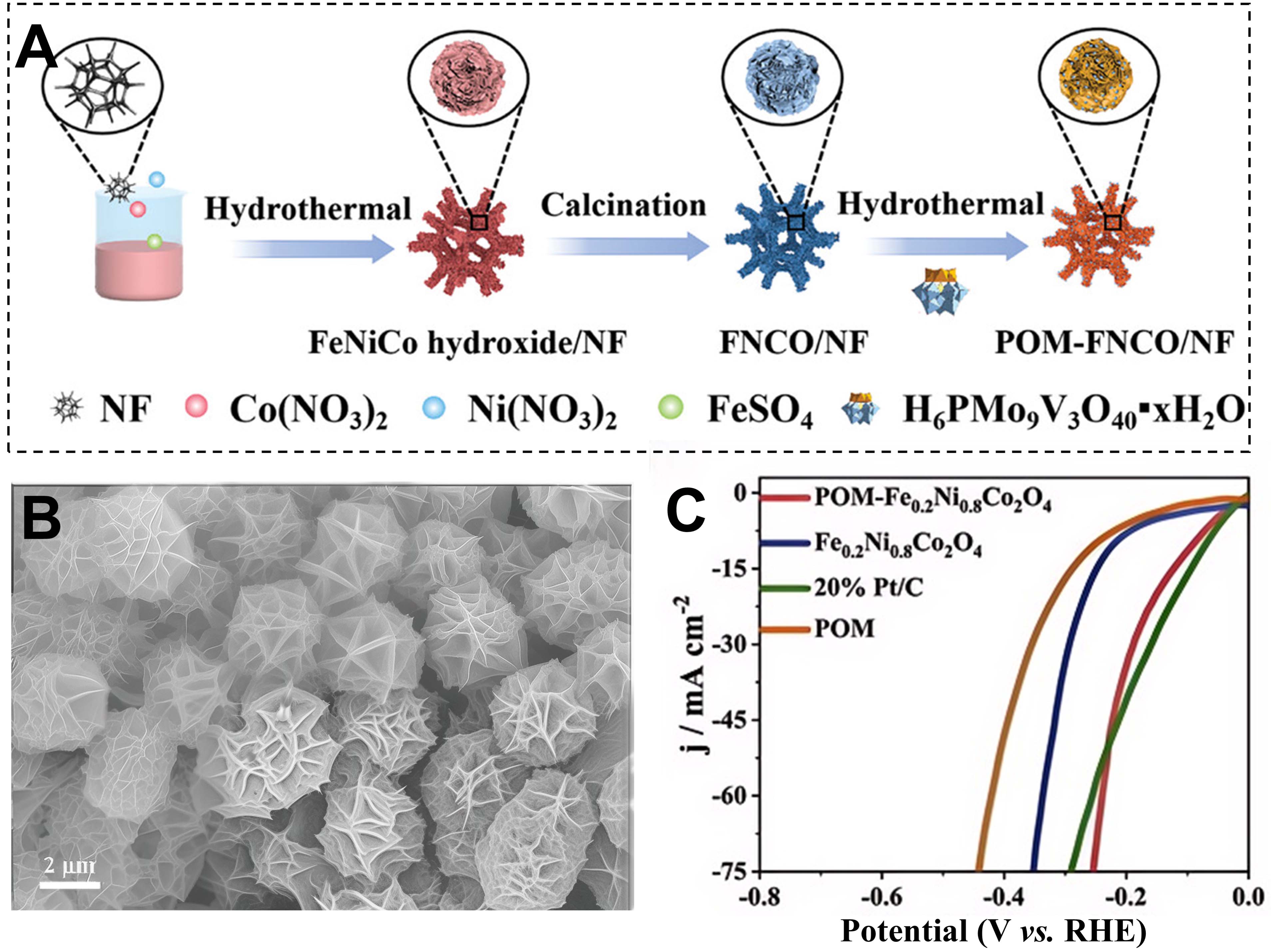
Figure 7. (A) Schematic illustration, (B) SEM image of POM-FNCO/NF. (C) HER LSV curves of POM-Fe0.2Ni0.8Co2O/NF and other reference samples. (A-C) Reproduced with permission from[101]. Copyright 2024, Wiley-VCH GmbH.
Metal sulfides
Metal sulfides suffer from inherently strong metal-sulfur bonding, which limits OER kinetics and hinders their widespread application in EWS[102]. However, incorporating POMs units into metal sulfides has proven effective in modulating their physicochemical properties, introducing abundant transition metal active sites and tailoring charge distribution. Gautam et al.[103] further fabricated a POM-coated Zn-Co sulfide nanowire heterostructure (POM@ZnCoS/NF) on NF via a facile two-step hydrothermal method
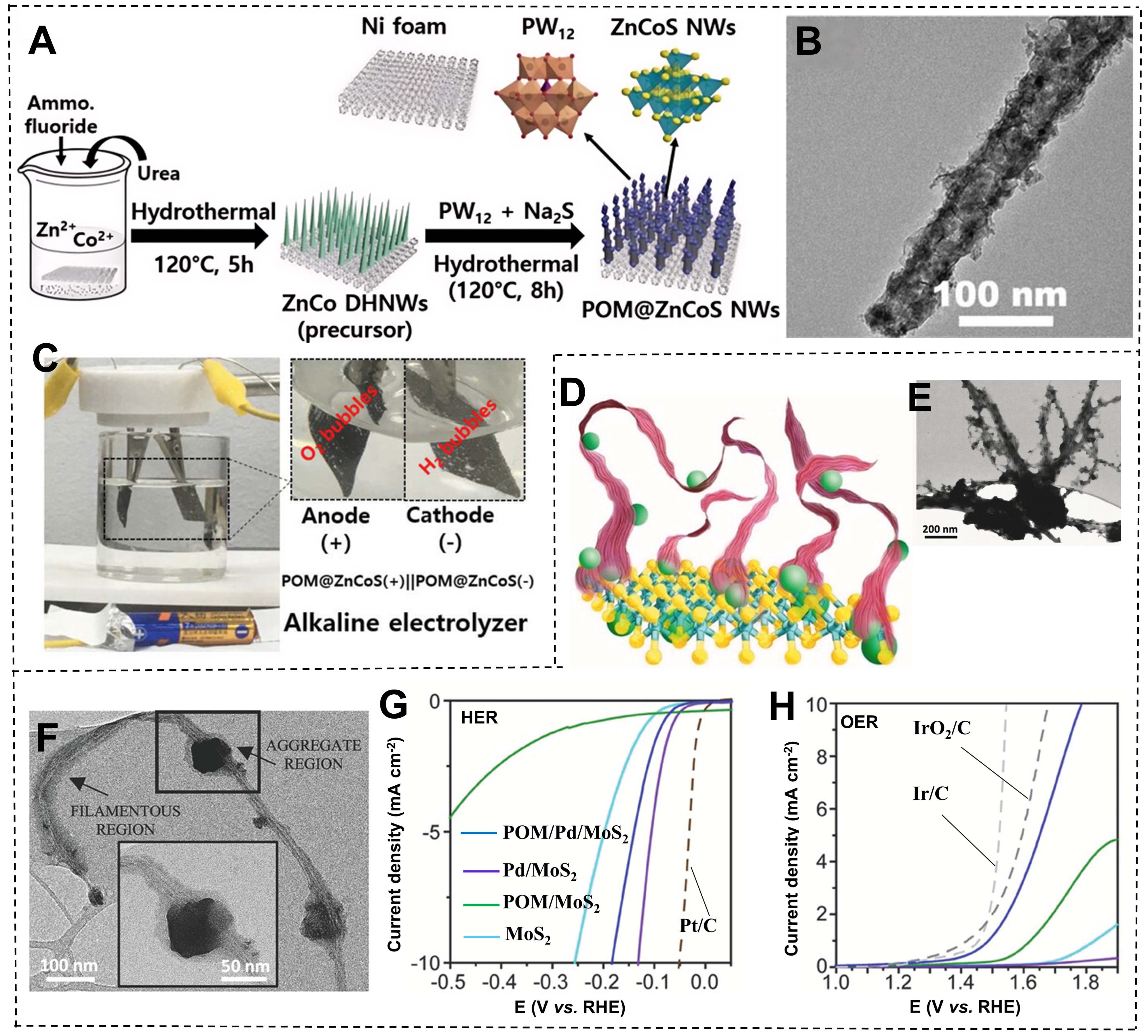
Figure 8. (A) Synthetic route for POM@ZnCoS NWs, (B) TEM image of POM@ZnCoS NWs, (C) Generation of O2 and H2 bubbles on the anode and cathode of the POM@ZnCoS/NF electrode at a cell voltage of 1.5 V. (A-C) Reproduced with permission from[103]. Copyright 2021, Wiley-VCH GmbH. (D) Schematic illustration, (E) Representative field-emission SEM image, (F) HRTEM image of the POM/Pd/MoS2 hybrid composite. (G) HER and (H) OER polarization curves after ohmic drop correction for the prepared catalysts. (D-H) Reproduced with permission from[104]. Copyright 2023, Wiley-VCH GmbH.
Metal phosphides
Metal phosphides exhibit high intrinsic HER activity because phosphorus atoms favor proton adsorption, whereas metal atoms facilitate the adsorption/desorption of hydrogen intermediates[105]. Additionally, they facilitate rapid electron transfer and enhanced OER kinetics[106]. However, transition metal phosphides are often fabricated into working electrodes using binders, which may cause mechanical detachment of active species or chemical instability[107,108]. Owing to the rich surface charge distribution of POMs, their integration with metal phosphides enables controllable formation of electrostatic interactions, hydrogen bonds, or covalent bonds, thereby alleviating the aforementioned issues. Integrating POMs with metal phosphides therefore offers a viable and efficient strategy for the rational design of electrocatalysts with superior activity, long-term stability, and potential for scalable application. Jiao et al.[109] assembled lamellar precursors from PMo12 clusters and egg white through hydrogen bonds. Subsequent high-temperature phosphorization treatment enabled the in situ formation of N/P/S-tripledoped carbon layers, transforming the precursors into porous sheet-structured MoP@NPSC composites [Figure 9A]. HRTEM images showed that well-crystallized MoP nanoflakes were encapsulated and linked by thin carbon layers, and the distinct lattice spacings of 0.210 and 0.278 nm corresponded to the (101) and (100) crystal planes of MoP, confirming the intimate interfacial contact between diverse crystalline facets [Figure 9B and C]. Owing to its distinctive porous nanosheet architecture, the MoP@NPSC composite delivered markedly improved HER catalytic performance. It achieved a low overpotential of 50 mV at 10 mA cm-2, which was much lower than that of pristine MoP
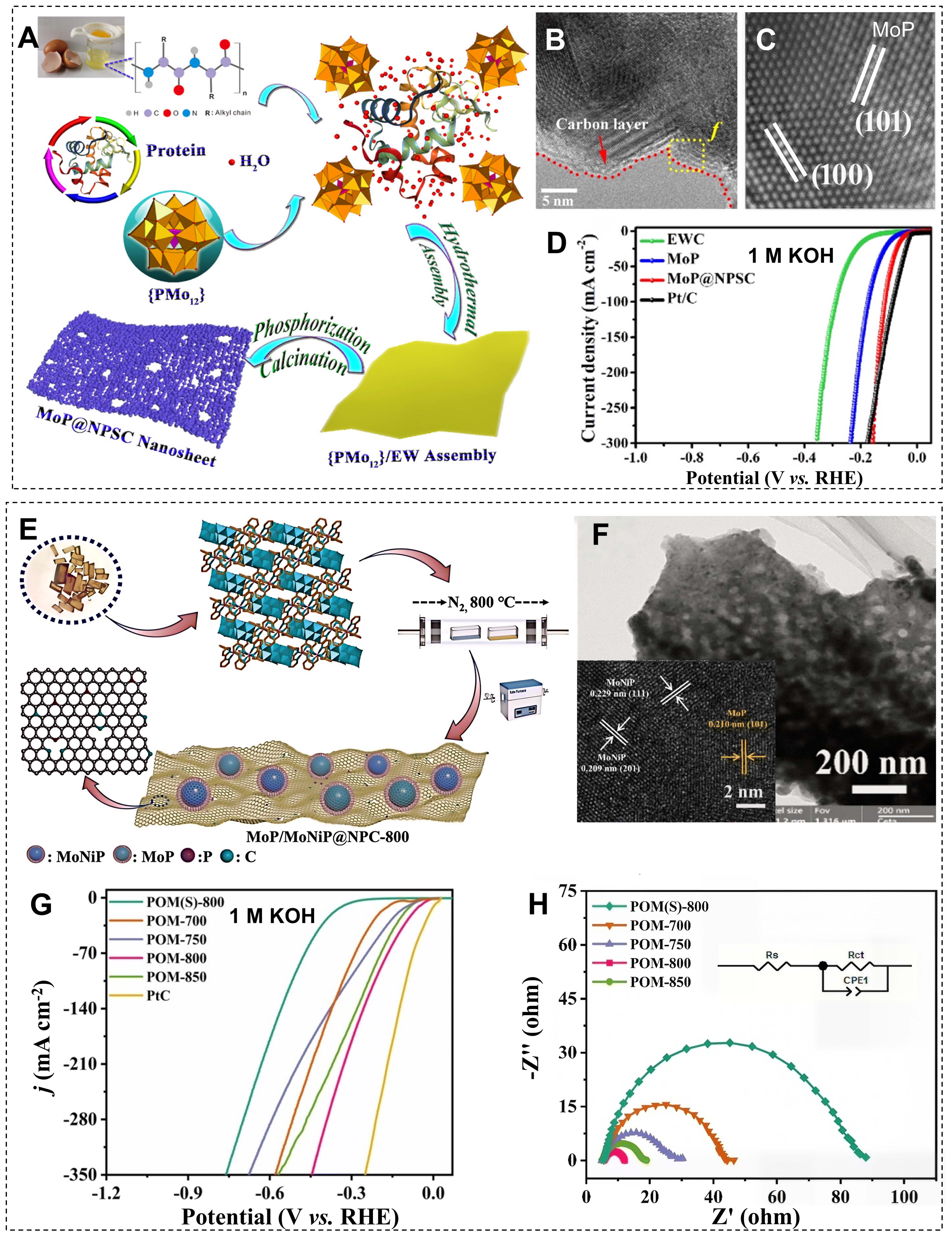
Figure 9. (A) Schematic of the formation mechanism for MoP@NPSC. (B and C) HRTEM images of MoP@NPSC. (D) HER polarization curves of bare EWC, MoP, MoP@NPSC, and Pt/C recorded in 1 M KOH at a scan rate of 5 mV s-1. (A-D) Reproduced with permission from[109]. Copyright 2020, American Chemical Society. (E) Preparation route of the MoP/MoNiP@NPC-800 catalyst via pyrolysis treatment. (F) TEM image of MoP/MoNiP@NPC-800 (inset: corresponding HRTEM image). (G) HER polarization curves in 1 M KOH, (H) EIS Nyquist plots of five POM-derived catalysts tested in 1 M KOH (inset: corresponding equivalent circuit). (E-H) Reproduced with permission from[110]. Copyright 2024, Royal Society of Chemistry.
Layered double hydroxides
Transition-metal-based layered double hydroxides (LDHs) exhibit outstanding bifunctional electrocatalytic activity for HER and OER in alkaline media, primarily due to their favorable nanoarray architectures[111,112]. However, inherent drawbacks such as poor electrical conductivity and limited accessible active sites restrict their further development[113]. Integrating POMs with LDHs has emerged as an effective strategy to address these limitations by constructing synergistic heterostructures. Wang et al.[114] reported an in situ anchoring approach to immobilize [PCoW11O39]5- (Co-POM) nanoparticles onto NiFe-LDH nanosheets via hydrothermal treatment, forming Co-POM@LDH composites [Figure 10A]. TEM and HRTEM lattice analyses confirmed the formation of three-dimensional heterostructures [Figure 10B and C]. Electrochemical tests revealed that Co-POM@LDH/NF delivered HER and OER overpotentials of 220 and 226 mV at
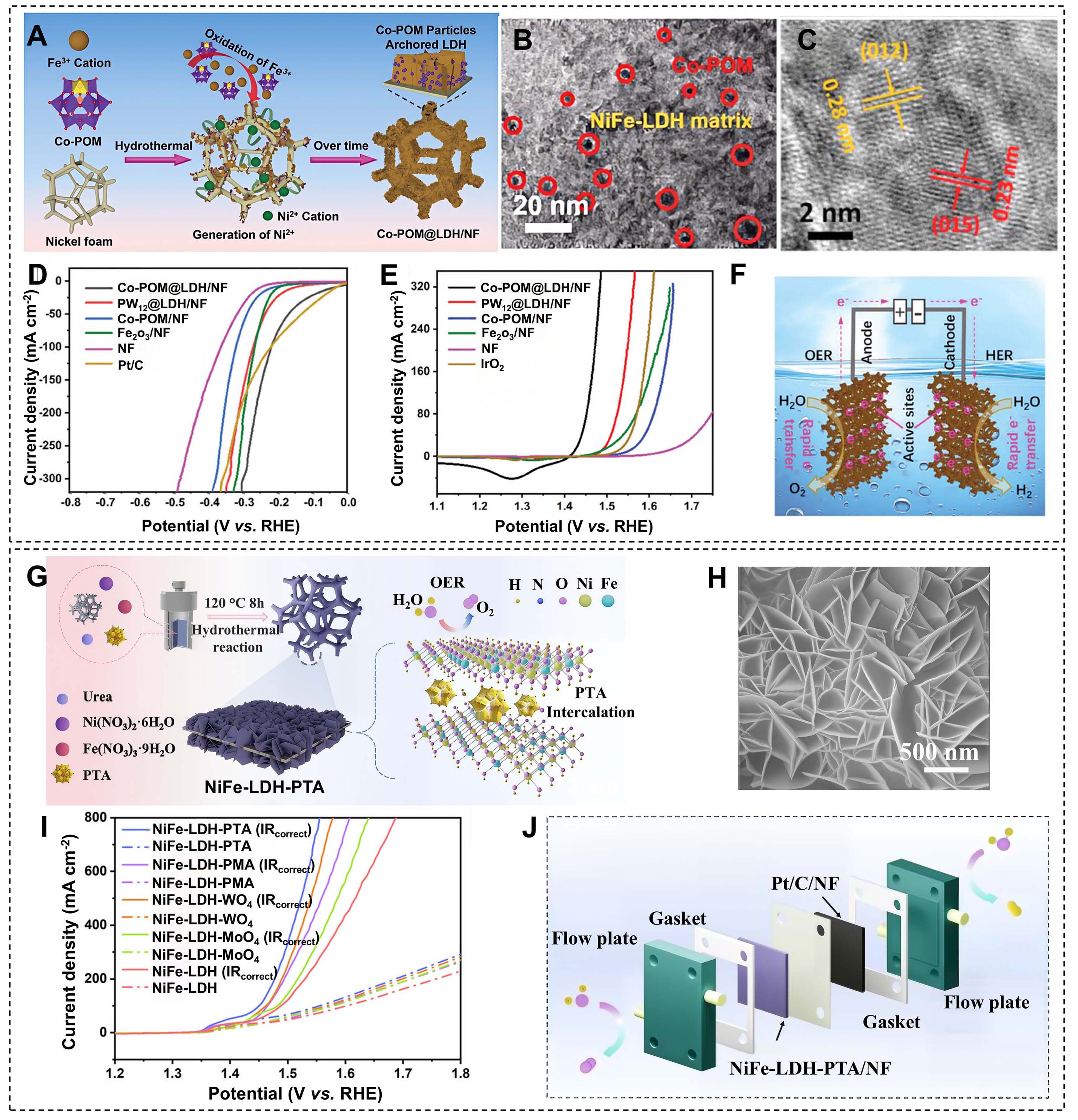
Figure 10. (A) Synthetic schematic of Co-POM@LDH/NF. (B) TEM and (C) HRTEM images of Co-POM@LDH/NF. (D) HER polarization curves of Co-POM@LDH/NF, PW12@LDH/NF, Co-POM/NF, Fe2O3/NF, bare NF and Pt/C at 5 mV s-1. (E) OER polarization curves of Co-POM@LDH/NF, PW12@LDH/NF, Co-POM/NF, Fe2O3/NF, bare NF and IrO2 at 5 mV s-1. (F) Schematic configuration of a two-electrode electrolyzer using Co-POM@LDH/NF. (A-F) Reproduced with permission from[114]. Copyright 2023, Wiley-VCH GmbH. (G) Fabrication schematic of NiFe-LDH-PTA grown on NF. (H) SEM image of NiFe-LDH-PTA. (I) OER polarization curves with and without iR compensation at a scan rate of 2 mV s-1. (J) Schematic illustration of the AEM electrolyzer configuration. (G-J) Reproduced with permission from[115]. Copyright 2025, American Chemical Society.
Metal nanoparticles
Composites of POMs and metal nanoparticles (MNPs) hold great promise for precisely tailoring charge distribution and engineering active sites, with POM clusters serving as core electronic modulators governing the electrocatalytic properties and reaction kinetics of the hybrid system[116,117]. Li et al.[118] synthesized Keggin-type [PW12O40]3- (PW12)/Ag/graphene composites using Ag(H3biim)2 as both a POM-binding ligand and Ag precursor [Figure 11A]. An HRTEM image revealed distinct lattice fringes with an interplanar spacing of 0.234 nm, which corresponded to the (111) crystal plane of face-centered cubic (fcc) silver (Ag) [Figure 11B]. The controlled release of Ag+ from the Ag(H3biim)2 during N,N-dimethylformamide (DMF) reflux effectively suppressed nanoparticle agglomeration, and the presence of PW12 further promoted the uniform dispersion of Ag nanoparticles on graphene. LSV measurements demonstrated that the PW12/Ag/graphene-a catalyst exhibited an overpotential of 540 mV at 10 mA cm-2, surpassing pristine graphene, Ag/graphene, and PW12/graphene counterparts [Figure 11C]. This remarkable OER activity stemmed from the synergistic interplay between PW12 and AgNPs, wherein Ag accelerated interfacial electron transfer, whereas the PW12 cluster functioned as a critical electronic regulator to refine the electronic configuration of Ag and promote H2O activation. Moreover, the multi-oxo bridging skeleton of PW12 offered abundant surface oxygen sites that facilitated O-O bond formation, thus further boosting OER kinetics. Notably, although MNP-decorated POMs were mainly explored for OER catalysis, the intrinsic redox behavior and flexible electronic structure of POMs drove the conversion of MNPs from electron-rich to electron-deficient states, ultimately enhancing their intrinsic catalytic activity. Meanwhile, the graphene support ensured fast electron transport and structural robustness, collectively contributing to the improved electrocatalytic performance.
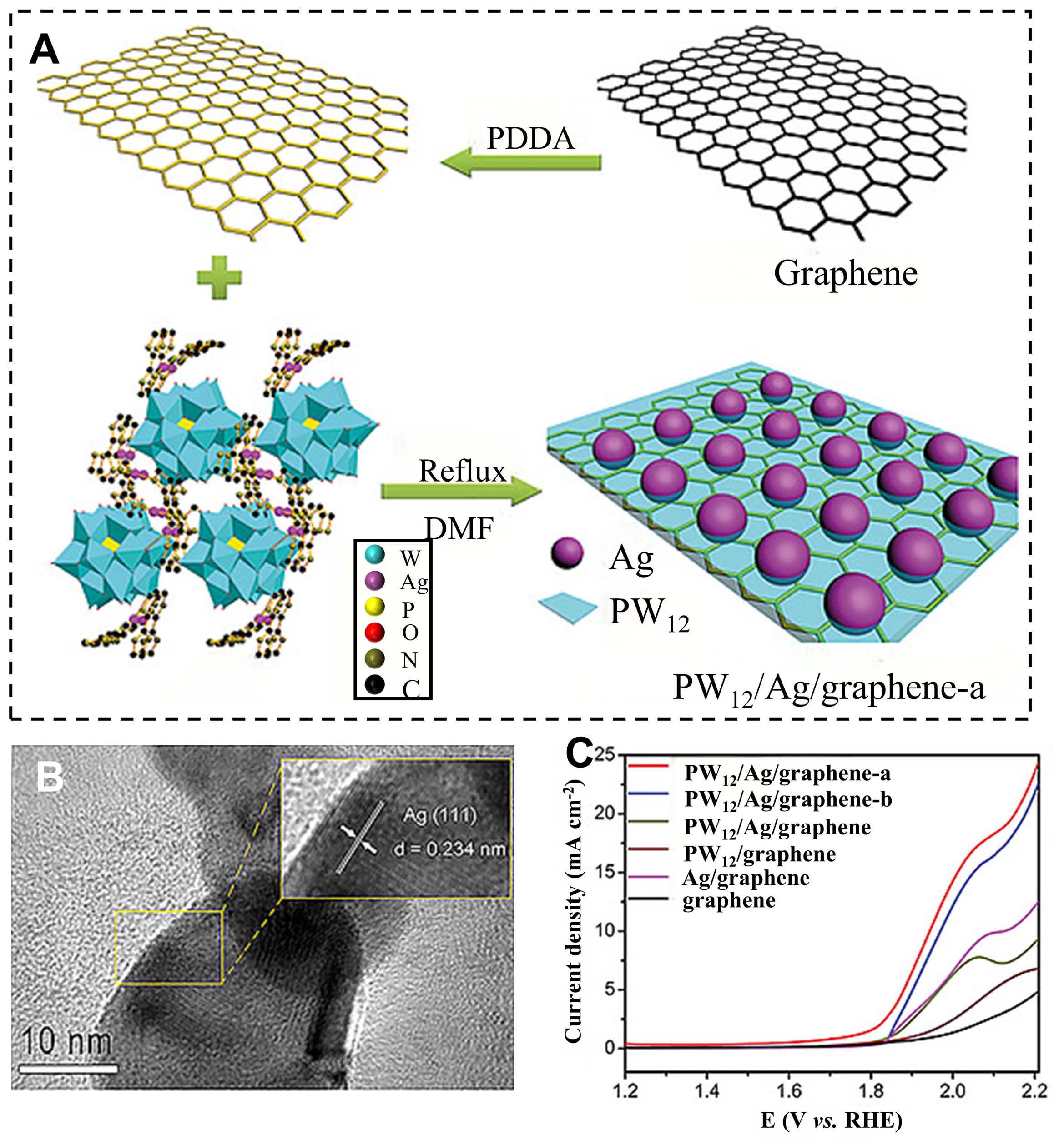
Figure 11. (A) Proposed growth mechanism, (B) HRTEM image of PW12/Ag/graphene-a. (C) LSV curves obtained in 0.1 mol L-1 phosphate-buffered saline (PBS; pH = 7.0) using a glassy carbon electrode (GCE) modified with a series of graphene-based hybrid catalysts. (A-C) Reproduced with permission from[118]. Copyright 2019, Wiley-VCH Verlag GmbH & Co. KGaA, Weinheim.
MOF-based POMs
MOFs have become ideal host materials for constructing POM-MOF hybrids (POMOFs) owing to their inherent merits including tunable porous structures, large specific surface areas and customizable functional sites[119,120]. The strong host-guest interaction between POM clusters and MOF skeletons effectively regulates electronic distribution and accelerates electron transfer, which optimizes the redox behavior of POMs and produces a pronounced greater-than-additive synergistic effect in EWS. A series of typical POM@MOF electrocatalysts have been investigated for the HER and OER. For instance, Zhang et al.[121] encapsulated Keggin-type PMo12 clusters into Co-based MOF-74 via a one-step solvothermal strategy to fabricate PMo12@MOF-74 composites [Figure 12A]. The composite exhibited a distinct nanorod morphology, as observed in Figure 12B. The MoC@CoO catalyst derived from PMo12@MOF-74 showed remarkable HER performance [Figure 12C]. EIS further confirmed its rapid charge transfer capability [Figure 12D]. In addition, Zeb et al.[122] adopted a scalable hydrothermal strategy to synthesize Mo-CuS/NiS/NF on NF using POM-MOF composites as precursors [Figure 12E]. SEM and TEM images verified the successful synthesis of the material, which formed vertically aligned and regularly arranged nanorods on the substrate surface [Figure 12F]. Uniform Mo doping derived from the NiMo6 precursor efficiently tuned the electronic configuration of the composite. Benefiting from the cooperative interactions generated at bimetallic sulfide heterojunctions, the material provided numerous exposed catalytic sites and drastically lowered the kinetic barrier toward hydrogen evolution. When tested at 10 mA cm-2, the electrocatalyst achieved overpotentials of 78, 95 and 111 mV in alkaline medium, artificial seawater, and natural seawater, respectively, which surpassed the catalytic activity of NF loaded with commercial 20% Pt/C [Figure 12G]. Density functional theory (DFT) simulations uncovered the alkaline HER pathway over Mo-CuS/NiS/NF and validated that the catalytic reaction followed the Volmer-Heyrovsky route. As visualized in Figure 12H, the complete catalytic mechanism of HER on Mo-CuS/NiS/NF under alkaline conditions is illustrated, demonstrating that Mo-doped active centers and CuS/NiS heterointerfaces cooperated to facilitate successive reaction steps: water capture, H-O bond cleavage, and the subsequent formation and release of H2.
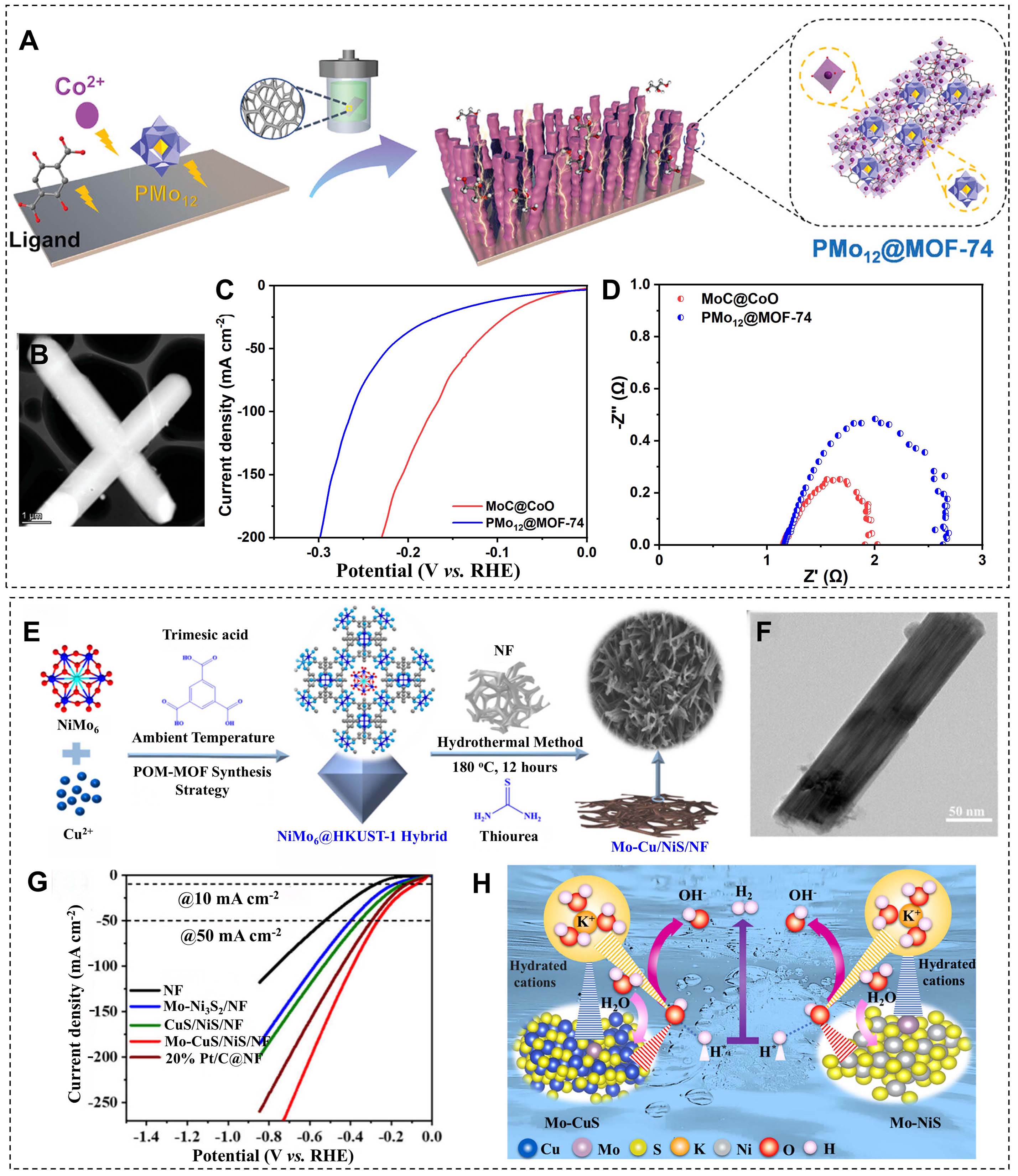
Figure 12. (A) Synthetic schematic diagram, (B) high-angle annular dark-field scanning transmission electron microscopy (HAADF-STEM) image and corresponding elemental distribution mapping of PMo12@MOF-74. (C) LSV curves, (D) Nyquist impedance curves of MoC@CoO and PMo12@MOF-74 for the HER. (A-D) Reproduced with permission from[121]. Copyright 2025, Wiley-VCH GmbH. (E) Synthesis scheme, (F) HRTEM image of Mo-CuS/NiS/NF. (G) LSV curves of the synthesized catalysts compared with 20% Pt/C@NF vs. reversible hydrogen electrode (RHE) for the HER. (H) Illustration of the mechanism of alkaline HER on Mo-CuS/NiS/NF. (E-H) Reproduced with permission from[122]. Copyright 2025, American Chemical Society.
These studies demonstrated that the outstanding electrocatalytic activity of POMOF hybrid composites stemmed from their porous MOF frameworks. Such structural backbones supplied numerous accessible active sites and facilitated rapid mass transport kinetics. Intense electronic coupling at the heterogeneous interfaces between POM clusters and MOF substrates reshaped the electron distribution of active centers and lowered the kinetic barrier of rate-limiting reaction steps. Meanwhile, boosted surface wettability accelerated electrolyte infiltration and the release of gaseous products. All these structural merits provide useful guidance for the rational fabrication and performance optimization of robust POMOF composite electrocatalysts toward efficient EWS.
COMPARISON OF DIFFERENT POM-BASED CATALYSTS IN EWS
Tables 1-3 systematically summarize the electrocatalytic performance of diverse POM-based hybrid composites for HER, OER, and OWS, respectively. Key parameters, including HER and OER overpotentials at 10 mA cm-2, full water-splitting cell voltage, electrolyte type, cycling stability, catalyst morphology, and synthesis strategy, are compared. By correlating these performance indicators with POM molecular structures and corresponding support types, the analysis reveals the dominant effects of cluster topology, metal coordination environment, defect engineering, and interfacial electronic interaction on the electrocatalytic behavior. This comprehensive performance overview provides theoretical support for the rational structural design of highly efficient water-splitting electrocatalysts, and facilitates the practical evaluation of POM-based materials for industrial-scale EWS.
Summary of electrocatalytic HER performance for POM-based materials
| Support | POM | Overpotential at 10 mA cm-2 (η10) (mV vs. RHE) | Tafel slope (mV dec-1) | Electrolyte | Cycling stability (h) | Morphology | Synthesis method | Ref. |
| Ni-Mo2C@N, P co-doped carbon | NiMo6O24 | η500 = 268 | 59 | 0.5 M H2SO4 | 12 | Nanoparticles uniformly distributed on carbon | Supramolecular-confinement pyrolysis strategy | [123] |
| η500 = 295 | 64 | 1 M KOH | ||||||
| Co9S8@MoS2 | PMo12 | 230 | 84 | 1 M KOH | 48 | Assembled nanosheets | One-pot calcination | [124] |
| CoP-WP/rGO | Co8W18 | [125] | ||||||
| 130 | 54 | 0.5 M H2SO4 | 30 | Nanoparticles distributed on the thin graphene layer | Hydrothermal treatment, air calcination, and phosphorization | |||
| C3N4 | Mo7O24 | 164 | 33 | 0.5 M H2SO4 | 48 | Cylinders | Hydrothermal, high-temperature vulcanization | [126] |
| 95 | 62.1 | 1 M KOH | ||||||
| Ni MOF | [MoO4]2- | 35 | 52.5 | 1 M KOH | 120 | Nanosheet array | Hydrothermal, chemical vapor deposition | [127] |
| Ag-H2biim | SiW12 | 112 | 77 | 0.5 M H2SO4 | 10 | Homogeneous fluffy and spongy surfaces | Hydrothermal | [128] |
| P2W18 | 91 | 65 | ||||||
| HMCS | Co4(PW9)2 | 25 | 36 | 0.5 M H2SO4 | 60 | Hollow mesoporous spheres | High-temperature vulcanization | [129] |
| 105 | 43 | 1 M KOH | ||||||
| MoS2@CC | Co2Mo10 | 120 | 64 | 1 M KOH | 24 | Nanoflower | Hydrothermal | [130] |
| 153 | 71 | 0.5 M H2SO4 | 25 | |||||
| Zn/Co ZIF-L | PMo12 | 80.6 | 128 | 1 M KOH | 16 | Hexagram-like porous structure | Self-assembly and high-temperature vulcanization | [131] |
| Ni@PTM | [Mo7O24]6- | 30.1 | 79.4 | 1 M KOH | 100 | Rough layer decorated with uniform nanoparticles | Electrodeposition | [132] |
| HMCS | PW9 | 58 | 69 | 0.5 M H2SO4 | 80 | Hollow mesoporous carbon spheres | Hydrothermal | [133] |
| 60 | 97 | 1 M KOH |
Summary of electrocatalytic OER performance for POM-based materials
| Support | POM | Overpotential at 10 mA cm-2 (η10) (mV vs. RHE) | Tafel slope (mV dec-1) | Electrolyte | Cycling stability (h) | Morphology | Synthesis method | Ref. |
| ZnFe2O4 | P2Mo18 | η20 = 270 | 124.6 | 1 M KOH | 20 | Nanoplates | Hydrothermal | [134] |
| WS2/WO3@C | SiW9 | 610 | 65 | 0.1 M KOH | 8 | Nanosheets decorated with particles and rod-like structures | Vulcanization | [135] |
| IF | H3PMo12O40 | 282 | 45.5 | 1 M KOH | 12 | Nanoflowers | Facile etching | [136] |
| NiO-Ru/RuO2 | [V10O28]6- | 300 | 112 | 1 M KOH | 5.6 | Layered-like structure | Hydrothermal | [137] |
| PCN | [Mo7O24]6- | 340 | 67.4 | 0.1 M KOH | 100 | Single-atom | Pyrolysis | [138] |
| WS2 | Co5W19 | 297 | 55 | 1 M KOH | 72 | Willow catkin-like structure | Hydrothermal treatment and vulcanization | [139] |
| Mg2Al-LDH | [Co4(H2O)2(PW9O34)2]10- | 567 | 275 | 0.1 M sodium phosphate + 1 M NaNO3 | 24 | Hexagonal layered structures | Stirring | [140] |
| 464 | 87 | 0.1 M sodium borate + 1 M NaNO3 | ||||||
| NH2-MIL-101 | Ni4Mo12 | 332.6 | 58 | 1 M KOH | 6 | Nanoparticles | Grinding | [141] |
| Co4Mo12 | 352.6 | 54.8 | ||||||
| ZIF-67 | PW12 | 306 | 54 | 1 M KOH | 15 | Hollow structure | Chemical etching, cation exchange, and thermal annealing | [142] |
| C-Mn2O3 | [TiCoW11O40]7- | 300 | 88 | 1 M KOH | 100 | Waxberry-like shape | Self-assembly | [143] |
Summary of electrocatalytic OWS performance for POM-based materials
| Support | POM | HER overpotential at 10 mA cm-2 (η10) (mV vs. RHE) | OER overpotential at 10 mA cm-2 (η10) (mV vs. RHE) | Overall water- splitting voltage (V) (j = 10 mA cm-2) | Electrolyte | Cyclic stability (h) | Morphology | Synthesis method | Ref. |
| NF | H6PV3Mo9O40 | 89 | 259 | 1.58 | 1 M KOH | 48 | Nanoflower | Hydrothermal | [101] |
| NiFe-LDH | PCoW11 | 70 | 193 | 1.51 | 1 M KOH | 48 | Nanoparticles anchored on nanosheets | Hydrothermal | [114] |
| WO2-W | PW11Ir and PW11Pt | 41 | 250 | 1.46 | 1 M KOH | 100 | Hollow sphere | Organic encapsulation and calcination | [144] |
| ZnFe LDH | P2Mo18 | η20 = 275 | η20 = 330 | 1.54 | 1 M KOH | 40 | Porous nano-clusters | Hydrothermal | [145] |
| Ni(OH)2 | H5PV2Mo10O40 | 32 | 243 | 1.50 | 1 M KOH | 60 | Porous ultrathin nanosheets | Hydrothermal | [146] |
| Ni3S2/NiMo2 | H3O40PW12·xH2O | η100 = 275 | η100 = 338 | 1.53 | 1 M KOH | 20 | Flower-like nanosheets | Hydrothermal | [147] |
| Ni-MOF | [P2W18O62]6- | 68 | 107 | 1.51 | 1 M KOH | 24 | Nanoparticles anchored on hexagonal prisms | Ball-milling | [148] |
| RuO2 | SiW10O36 | 46 | 142 | 1.42 | 0.5M H2SO4 | 100 | Core-shell | Electrodeposition | [149] |
CONCLUSION AND OUTLOOK
This review systematically summarizes the core significance of state-of-the-art progress in POMs and their derivatives for EWS, with emphasis on their structural modulation strategies and the intrinsic relationship between their architectures and bifunctional electrocatalytic activity for water splitting. We comprehensively discuss the synthetic methods for POM composites with various supporting materials, including carbides, metallic compounds, and MOFs, as well as cutting-edge advances in structural construction and rational design of microscale active sites for POM derivatives. Meanwhile, the catalytic pathways and mechanisms of the HER and OER are also discussed in detail.
Nevertheless, despite encouraging progress achieved to date, numerous critical challenges remain to be addressed for POM-based catalytic materials. For instance, pristine POMs inherently suffer from low intrinsic electrical conductivity, facile dissolution and leaching in electrolytes, and insufficient long-term stability under harsh reaction conditions. Meanwhile, the mode of hybridization between POMs and supporting substrates also exerts a substantial influence on the resulting catalytic performance. Consequently, precise manipulation of POM-based composite architectures remains difficult in most studies, leading to poor catalyst uniformity and impeding their scalable industrial application. Furthermore, the interfacial interaction mechanisms between POM clusters and supports remain poorly understood, and structurally analogous composites often display divergent catalytic behaviors, which severely hinder rational development in this field. In addition, the formation pathways of inorganic catalysts derived from POM precursors have rarely been explored, resulting in poor predictability of the morphology, structure, and composition of the final derivatives.
Various in situ characterization techniques, including Fourier-transform infrared spectroscopy (FTIR), X-ray diffraction (XRD), and SEM/TEM, and other relevant testing tools, can not only uncover the microstructural features of POM-based catalysts but also track the structural evolution of POMs during catalytic processes and provide guidance for structural optimization. These techniques help clarify the advantages of atomic-level regulation and uniform distribution of unique active sites in POM building units and supports, facilitating the construction of stable, efficient, and mechanistically well-understood electrocatalytic systems. However, such characterization methods are limited by sophisticated equipment, demanding operational requirements, and restricted experimental environments, which can impede the advancement of related materials. Accordingly, future research directions are proposed as follows.
(1) In situ X-ray absorption fine structure (XAFS) spectroscopy should be combined with DFT calculations to deepen fundamental mechanistic studies of POM-based composites, enabling precise identification of active sites, real-time monitoring of dynamic structural evolution throughout reactions, and quantitative analysis of synergistic interactions between POMs and supports.
(2) Multiple targeted structural tuning approaches, including accurate heteroatom incorporation, vacancy manipulation, and heterostructure construction, should be exploited to synergistically enhance charge-transport capacity and the stability of catalytic centers in POM-derived electrocatalysts for EWS, while fine-tuning the adsorption free energies of critical reactive intermediates.
(3) Data-driven tools such as machine learning should be introduced to establish intelligent frameworks for materials design. Using the extensive performance and structural data summarized in this review and related literature, these approaches can accelerate the screening of optimal POM configurations, suitable support combinations, and ideal synthetic parameters.
(4) Industrial water electrolysis applications require intensified investigations into the practical performance of POM-based catalysts in proton-exchange membrane (PEM) and AEM electrolyzers. By optimizing interfacial electron transport and membrane-electrode compatibility, durability and overall water-splitting efficiency should be systematically evaluated under high current densities and strongly acidic or alkaline conditions. A correlation framework linking half-cell performance to full electrolyzer device performance should be established to advance the real-world application of POM-derived electrocatalysts for large-scale clean hydrogen manufacturing.
In summary, POM-based electrocatalysts, with their abundant raw materials and flexible, precisely tunable structures, are expected to play an important role in renewable energy, biomedicine, and ecological restoration. This review provides a systematic overview of POM-based composite catalysts in EWS research, demonstrating that these materials represent promising candidates to support global carbon-neutrality goals and reduce dependence on fossil fuels. With a deeper understanding of structural regulation principles and catalytic reaction mechanisms of POMs, they are expected to become highly competitive electrocatalysts for EWS and play an important role in industrial catalysis.
DECLARATIONS
Acknowledgments
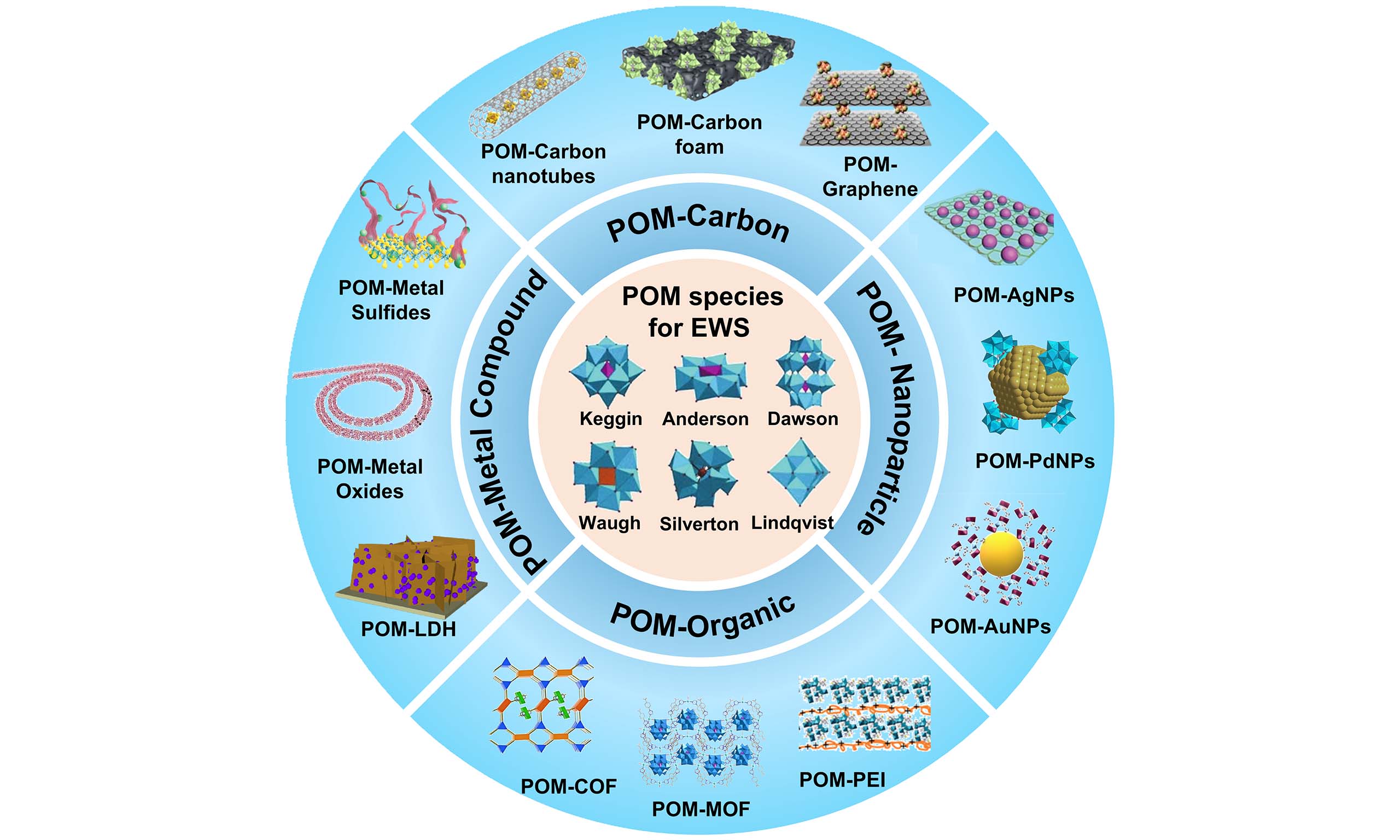
We gratefully acknowledge that all graphical fragments integrated into the Graphical Abstract were reproduced with formal copyright permissions granted by the corresponding publishers. Copyright attributions are listed as follows: Copyright © 2016, The Author(s) (Figure 1A used in POM-Graphene); Copyright © 2019 Wiley-VCH Verlag GmbH & Co. KGaA, Weinheim (Scheme 1 used in POM-AgNPs); Copyright © 2024, Royal Society of Chemistry (Visual Abstract used in POM-PdNPs); Copyright © 2021, American Chemical Society (Scheme 1 used in POM-AuNPs); Copyright © 2023, American Chemical Society (Figure 7 used in POM-PEI); Copyright © 2024, American Chemical Society (Figure 1C used in POM-MOF); Copyright © 2022, American Chemical Society (Scheme 1 used in POM-COF); Copyright © 2023 Wiley-VCH GmbH (Figure 1 used in POM-LDH); Copyright © 2023, American Chemical Society (Figure 1 used in POM-Metal Oxides); Copyright ©2023 The Authors. Advanced Sustainable Systems published by Wiley-VCH GmbH (Figure 3B used in POM-Metal Sulfides); Copyright © 2025 Wiley-VCH GmbH (Figure 1 used in POM-Carbon nanotubes); Copyright ©2025, American Chemical Society (Figure 1C used in POM-Carbon foam); Copyright © 2016 SIOC, CAS, Shanghai & Wiley-VCH Verlag GmbH & Co. KGaA, Weinheim (Figure 1 used in POM species for EWS).
Authors’ contributions
Data sourcing, collection, and original draft writing: Wang, T.
Data sourcing: Wang, W.
Data analysis and interpretation: Ma, X.; Xuan, M.
Editing and supervision: Chen, G.; Labidi, A.
All authors participated in preparing the manuscript.
Availability of data and materials
Not applicable.
AI and AI-assisted tools statement
Not applicable.
Financial support and sponsorship
This work was supported by the National Natural Science Foundation of China (22578100), the Natural Science Foundation of Henan Province (252300421904), the Key Scientific Research Projects of Higher Education Institutions in Henan Province (26A610002, 25A610002), the High-level Talent Research Launch Fund of Henan University of Technology (2024BS050, 2023BS104), and the National Key Research and Development Program of China (2023YFB4203605).
Conflicts of interest
All authors declared that there are no conflicts of interest.
Ethical approval and consent to participate
Not applicable.
Consent for publication
Not applicable.
Copyright
© The Author(s) 2026.
REFERENCES
1. Faizan, M.; Bibi, H.; Aamir, E.; Saeed, R.; Kiong, T. S.; Song, H. Efficient chromium-based transition metal nitrides catalysts for oxygen and hydrogen evolution reactions. Renew. Sustain. Energy. Rev. 2025, 212, 115385.
2. Zhang, Y.; Liang, W.; Yao, S.; Zheng, Z.; Wang, C. Preparation and performance of Co-Mo nano metal oxide electrocatalyst for hydrogen production by electrolysis of water. Fuel 2026, 404, 136253.
3. Sun, X.; Fu, Y.; Chen, R.; et al. FeIIFeIII-prussian blue modulated Fe-vacancies of NiFe-layered double hydroxide for oxygen evolution reaction with high stability. Appl. Surf. Sci. 2025, 703, 163399.
4. Abbas, F.; Talib, S. H.; Mohamed, S.; Wei, Y. Thermodynamic stability, mechanistic evaluation, and electronic properties of polyoxoniobate-based SACs (TM@PONb): a promising multifunctional electrocatalyst for HER/OER/ORR. J. Phys. Chem. C. 2025, 129, 13203-18.
5. Dong, X.; Fang, X.; Li, B.; et al. Solar energy storage in polyoxometalate for on-demand hydrogen transportation and evolution. Adv. Mater. 2025, 38, e19875.
6. Wang, T.; Wang, W.; Zhu, Y.; Zhang, B. Electro-fenton degradation of rhodamine B with in-situ H2O2 generation by Au nanoparticles modified reduced graphene oxide. J. Environ. Chem. Eng. 2025, 13, 115685.
7. Hanan, A.; Lakhan, M. N.; Awan, H. T. A.; Walvekar, R.; Azat, S.; Khalid, M. Advances in magnesium-based non-PGM electrocatalysts for efficient overall water splitting. Int. J. Hydrogen. Energy. 2026, 203, 153043.
8. Yu, M.; Ye, Q.; Wang, F.; et al. Ternary metal NiRuPt partition synergistic relay promotes pH-universal hydrogen evolution. Nano. Res. 2026, 19, 94907879.
9. Zhang, K.; Wang, K.; Chai, S.; et al. Engineering Ru-based electrocatalysts for efficient electrocatalytic water splitting. Nano. Res. 2025, 18, 94907369.
10. Chen, J.; Li, Y. Preparation of lignin derived carbon encapsulating Molybdenum/Nickel bifunctional materials and their application in overall water splitting. Chem. Eng. Sci. 2025, 310, 121528.
11. Chen, T.; Guo, Q.; Ye, J.; Jiang, Q.; Chai, N.; Yi, F. Metal-organic framework-derived bimetallic FeNi sulfide nanostructures for electrolysis of water and urea. ACS. Appl. Nano. Mater. 2025, 8, 2730-40.
12. Herrmann, S.; Ritchie, C.; Streb, C. Polyoxometalate - conductive polymer composites for energy conversion, energy storage and nanostructured sensors. Dalton. Trans. 2015, 44, 7092-104.
13. Zhang, L.; Xu, Q.; Xia, L.; et al. Asymmetrically tailored catalysts towards electrochemical energy conversion with non-precious materials. Chem. Soc. Rev. 2025, 54, 5108-45.
14. Zhang, Y.; Li, R.; Wang, X.; et al. Surface active-site engineering of low-noble-metal-alloyed metallic glass catalyst for boosting water electrolysis. Adv. Funct. Mater. 2024, 34, 2410379.
15. Nandy, A.; Murmu, G.; Rana, A.; Saha, S.; Banerjee, S. Sprayed microdroplets architect a polyoxometalate framework. Angew. Chem. Int. Ed. 2025, 64, e202424745.
16. Shah, W. A.; Dai, X.; Zhai, X.; Zhao, Y.; Zhang, Y.; Li, S. Precise size-matching between guest polyoxometalates and host metal-organic frameworks enables enhanced photocatalytic water oxidation. Commun. Chem. 2025, 9, 29.
17. Xiong, L.; Liu, S.; Chen, W.; et al. Assembly of sandwich-type ruthenium-containing polyoxometalates for efficient construction of C-C bonds. Chem. Commun. 2026, 62, 7353-6.
18. Zhang, T.; Guo, L.; Xie, W.; Hou, S.; Li, S.; Li, Y. Three-dimensionally ordered macro-mesoporous ZrTiO4 supported polyoxometalate-ionic liquid hybrid for efficient biodiesel production from low-quality oils. Appl. Surf. Sci. 2026, 730, 165882.
20. Stamate, A.; Pavel, O. D.; Zavoianu, R.; Marcu, I. Highlights on the catalytic properties of polyoxometalate-intercalated layered double hydroxides: a review. Catalysts 2020, 10, 57.
21. Abdollah Pour Aghdam Sharabiani, S. M. A.; Rezvani, M. A. Synthesis and characterization of new tri- titanum substituted Keggin-type polyoxometalate (PW9Ti3O40) for enhanced photocatalytic water oxidation performance. Inorg. Chim. Acta. 2026, 589, 122949.
22. Huang, Y.; Zhang, D.; Baxter, E. T.; et al. Tunable cation coordination by polyoxometalates enables selective heavy metal separation and critical mineral recovery at redox electrochemical interfaces. Sep. Purif. Technol. 2026, 390, 136885.
23. Lakhanpal, V.; Guillén-Soler, M.; Vilà-Nadal, L.; Long, D.; Cronin, L. Compression of molybdenum blue polyoxometalate cluster rings. J. Am. Chem. Soc. 2025, 147, 10579-86.
24. Alizadeh, M.; Yadollahi, B. Synthesis of nanoscale surfactant-encapsulated silica-supported polyoxometalate [Si/AlO2]@[PWZn]@CTAB and its catalytic application in the oxidation of alcohols. RSC. Adv. 2025, 15, 8777-83.
25. Raabe, J.; Jameel, F.; Stein, M.; Albert, J.; Poller, M. J. Heteroelements in polyoxometalates: a study on the influence of different group 15 elements on polyoxometalate formation. Dalton. Trans. 2024, 53, 454-66.
26. Fu, Y.; Wang, J.; Ma, X.; et al. Ion-exchange strategy for fabricating highly dispersed Co-MoS2 on N-doped graphene for efficient bifunctional electrocatalytic water splitting. Int. J. Hydrogen. Energy. 2024, 59, 116-24.
27. Li, W.; Xu, W.; Sun, Z.; et al. A tungsten polyoxometalate mediated aqueous redox flow battery with high open-circuit voltage up to 2 V. Nat. Commun. 2025, 16, 4654.
28. Singla, R.; Singh, N.; Pandey, R.; Supriya, S. The photochromism of UiO-66 encapsulated polyoxometalate composites. ACS. Appl. Eng. Mater. 2025, 3, 2275-87.
29. Feng, L.; Liu, Q.; Xu, G.; et al. Manipulating the dynamic proton transport in electrocatalysis at the nanoscale. ACS. Catal. 2025, 15, 4394-402.
30. Bibi, R.; Nazir, S.; Shafiq, S.; et al. A novel supramolecular Co-EDTA and Ni-anderson polyoxometalate hybrid as a high-performance electrocatalyst for alkaline water splitting. Mater. Res. Bull. 2025, 186, 113329.
31. Ma, X.; Xiao, H.; Chen, Y.; Lai, Q.; Li, X.; Zheng, S. Polyoxometalate-based macrocycles and their assembly. Coord. Chem. Rev. 2024, 510, 215818.
32. Rani, S.; Nadeem, M.; Alrahili, M. R.; et al. Synergistic reductive catalytic effects of an organic and inorganic hybrid covalent organic framework for hydrogen fuel production. Dalton. Trans. 2024, 53, 10875-89.
33. Schidowski, L.; Friedrich, L. F.; Pawlig, A. H.; Voß, D.; Albert, J. Investigations on the recovery of different structure types of polyoxometalates from aqueous solution using nanofiltration membranes. ACS. Omega. 2026, 11, 23290-301.
34. Wang, Z. D.; Yang, Y. Q.; Chen, J. H.; et al. Proton superhighways enabled by hofmeister-electrostatic synergy in all-inorganic polyoxometalate hydrogels for electronics. Adv. Mater. 2025, 38, e15892.
35. Yuan, X.; Peng, Y.; Zhu, X.; et al. Remote polyoxometalates modulated the d/p-band center proximity in vanadia-based catalyst for simultaneous elimination of NOx and chlorobenzene. ACS. Catal. 2025, 15, 7470-81.
36. Blasco-Ahicart, M.; Soriano-López, J.; Carbó, J. J.; Poblet, J. M.; Galan-Mascaros, J. R. Polyoxometalate electrocatalysts based on earth-abundant metals for efficient water oxidation in acidic media. Nature. Chem. 2017, 10, 24-30.
37. Su, Q.; Liu, Q.; Wang, P.; Ding, J.; Cheng, W.; Huang, Y. Fe doping regulates the surface reconstruction and activates lattice oxygen of NiCr LDH for water oxidation. Chem. Eng. J. 2024, 483, 149383.
38. Craig, M. J.; Coulter, G.; Dolan, E.; et al. Universal scaling relations for the rational design of molecular water oxidation catalysts with near-zero overpotential. Nat. Commun. 2019, 10, 4993.
39. Yang, M.; Zhang, C. H.; Li, N. W.; Luan, D.; Yu, L.; Lou, X. W. Design and synthesis of hollow nanostructures for electrochemical water splitting. Adv. Sci. 2022, 9, 2105135.
40. Lin, Y. X.; Feng, W. J.; Zhang, J. J.; et al. A polyimide nanolayer as a metal-free and durable organic electrode toward highly efficient oxygen evolution. Angew. Chem. Int. Ed. 2018, 57, 12563-6.
41. Zhao, N.; Wang, X.; Zhu, S.; et al. Polyoxometalates-derived self-supporting porous micropillar catalysts for efficient overall water splitting. Inorg. Chem. Commun. 2026, 184, 115939.
42. Yan, Z.; Liu, H.; Hao, Z.; Yu, M.; Chen, X.; Chen, J. Electrodeposition of (hydro)oxides for an oxygen evolution electrode. Chem. Sci. 2020, 11, 10614-25.
43. Woods, E. F.; Yan, L.; Lee, J.; et al. Molecular design and redox behavior of polyoxometalates: structure-property insights for flow battery materials. ACS. Electrochem. 2026, 2, 1038-54.
44. Zhao, Z.; Sui, L.; Wang, Z.; et al. Enhanced electrocatalytic activity of NiCoP/Ni5P4@NiFe-LDH catalysts via Ir doping and oxygen vacancy engineering. Energy. Mater. 2026, 6, 600025.
45. Ahmad, W.; Ahmad, N.; Wang, K.; et al. Electron-sponge nature of polyoxometalates for next-generation electrocatalytic water splitting and nonvolatile neuromorphic devices. Adv. Sci. 2023, 11, 2304120.
46. Dashtian, K.; Shahsavarifar, S.; Usman, M.; et al. A comprehensive review on advances in polyoxometalate based materials for electrochemical water splitting. Coord. Chem. Rev. 2024, 504, 215644.
47. Xu, S. Y.; Shi, W.; Huang, J. R.; et al. Single-cluster functionalized TiO2 nanotube array for boosting water oxidation and CO2 photoreduction to CH3OH. Angew. Chem. Int. Ed. 2024, 63, e202406223.
48. Rheinländer, P. J.; Herranz, J.; Durst, J.; Gasteiger, H. A. Kinetics of the hydrogen oxidation/evolution reaction on polycrystalline platinum in alkaline electrolyte reaction order with respect to hydrogen pressure. J. Electrochem. Soc. 2014, 161, F1448-57.
49. Ahmad, M.; Hussain, M. B.; Mushtaq, M. A.; et al. Advances in electrocatalytic hydrogen evolution coupled with alcohol and aldehyde oxidation: mechanistic insights and economic feasibility. Adv. Mater. 2025, 37, 2502966.
50. Kim, J. H.; Jo, H. J.; Han, S. M.; Kim, Y. J.; Kim, S. Y. Recent advances in electrocatalysts for anion exchange membrane water electrolysis: design strategies and characterization approaches. Energy. Mater. 2025, 5, 500099.
51. Lokare, V. B.; Ledinic, A.; Wehr, N.; Hohenschutz, M. Hydrogels under superchaotropic control: polyoxometalate stabilization and pH-responsive crosslinking in cellulose ether solutions. Angew. Chem. Int. Ed. 2026, 65, e6958664.
52. Ma, T.; Yan, R.; Wu, X.; et al. Polyoxometalate-structured materials: molecular fundamentals and electrocatalytic roles in energy conversion. Adv. Mater. 2024, 36, 2310283.
53. Gao, D.; Liu, R.; Biskupek, J.; Kaiser, U.; Song, Y. F.; Streb, C. Modular design of noble-metal-free mixed metal oxide electrocatalysts for complete water splitting. Angew. Chem. Int. Ed. 2019, 58, 4644-8.
54. Goberna-Ferrón, S.; Vigara, L.; Soriano-López, J.; Galán-Mascarós, J. R. Identification of a Nonanuclear {CoII9} polyoxometalate cluster as a homogeneous catalyst for water oxidation. Inorg. Chem. 2012, 51, 11707-15.
55. Luo, W.; Hu, J.; Diao, H.; Schwarz, B.; Streb, C.; Song, Y. F. Robust polyoxometalate/nickel foam composite electrodes for sustained electrochemical oxygen evolution at high pH. Angew. Chem. Int. Ed. 2017, 56, 4941-4.
56. Feng, Y.; Zhao, M.; Yang, J.; et al. Wearing gigantic silver armor on transition-metal-containing polyoxometalates: formation of supertetrahedral intercluster compounds. Angew. Chem. Int. Ed. 2025, 64, e202505511.
57. Gutiérrez-Barroso, I.; Quintanilla, K. A.; Martínez, M.; Peña-Cabrera, E.; Galván, A.; Vázquez, M. A. Supported Keggin anion catalyst: a study of its multifunctionality in retro-aldol condensation of 2H-chromenes. Dalton. Trans. 2026, 55, 6148-58.
58. Li, J.; Yang, M.; Tian, A.; Cao, X.; Ying, J. Synergistic enhancement of nitrate-to-ammonia conversion and supercapacitor performance by binuclear copper-modified Keggin-type polyoxometalate complex. J. Colloid. Interface. Sci. 2026, 709, 139892.
59. Nowicka, D.; Vadra, N.; Wieczorek-Szweda, E.; Patroniak, V.; Gorczyński, A. Overview of wells-dawson polyoxometalates: from structure and functionalization to application. Coord. Chem. Rev. 2024, 519, 216091.
60. Asif, H. M.; Bi, R. B.; Tariq, M.; et al. Synthesis and characterization of polyvanadium and heteropoly-tungsten based inorganic wells dawson polyoxometalates hybrids. Russ. J. Inorg. Chem. 2021, 66, 340-7.
61. Wang, L.; Li, W.; Wu, L.; Dong, X.; Hu, H.; Xue, G. A new polyanion with Dawson-like constitution: [H2SeW18O60]6-. Inorg. Chem. Commun. 2013, 35, 122-5.
62. Wang, S.; Hwang, J.; Kim, E. Polyoxometalates as promising materials for electrochromic devices. J. Mater. Chem. C. 2019, 7, 7828-50.
63. Li, J.; Wang, X.; Song, G.; Lin, H.; Wang, X.; Liu, G. Various anderson-type polyoxometalate-based metal-organic complexes induced by diverse solvents: assembly, structures and selective adsorption for organic dyes. Dalton. Trans. 2020, 49, 1265-75.
64. Huang, S.; Zhou, Q.; Song, Y.; et al. Electronic modulation of Mo=O sites in Anderson POMs: a molecular platform for rational catalyst design in oxidation desulfurization. Appl. Surf. Sci. 2026, 718, 164988.
65. Wu, P.; Wang, Y.; Huang, B.; Xiao, Z. Anderson-type polyoxometalates: from structures to functions. Nanoscale 2021, 13, 7119-33.
66. Xu, F.; Han, X.; Xu, R.; et al. Hydrogels with negligible hysteresis, enhanced conductivity, and good absorbability enabled by synergistic chain entanglement and polyoxometalates. ACS. Appl. Mater. Interfaces. 2025, 17, 70018-28.
67. Yao, S.; Xu, L.; Ding, X.; Yang, W.; Jiang, Z.; Zhan, C. Remodeling behaviors of polyoxometalate in a flexible chiral complex system. Inorg. Chem. 2025, 64, 9953-60.
68. Yu, Z.; Ma, W.; Xue, E.; et al. Establishing redox flow batteries with polyoxometalate-based redox couples for enhanced hydrogen sulfide splitting. Sustain. Energy. Fuels. 2025, 9, 3278-82.
69. Allada, G.; Matsa, P. K.; Gogoi, K.; Chakraborty, S. Regulating electronic functionality in lindqvist polyoxometalates: a molecular approach to tunable metal oxides. Chem. Mater. 2026, 38, 2549-90.
70. Davas, D. S.; Mallick, L.; Gopalakrishnan, D. K.; Chakraborty, B.; Vaitla, J. Strain-induced benzannulation of oxaquadricyclanes promoted by a polyoxometalate photocatalyst. Angew. Chem. Int. Ed. 2025, 64, e202507189.
71. Li, C.; Cheng, P.; Sun, Q. Integrating polyoxometalates into discrete coordination assemblies: from synthesis to supramolecular functions. Coord. Chem. Rev. 2026, 559, 217842.
72. Li, Y.; Qiu, Q.; Fan, S.; et al. A series of rare-earth phosphine-oxygen complexes containing [PW12O40]3- with highly efficient photocatalytic degradation of MB. CrystEngComm 2024, 26, 5809-19.
73. Liu, Q.; Rabbani, S. M. G.; Hou, Z.; et al. Isolated and H2-reduced Anderson clusters catalyse low-temperature hydrogenation of CO2 to methanol. Nat. Chem. 2026, 18, 1142-50.
74. Du, M. Y.; Xiao, H. P.; Xu, R. F.; et al. A sonosensitive heterometallic polyoxometalate for highly efficient chemo-sonodynamic synergistic cancer therapy. Angew. Chem. Int. Ed. 2025, 64, e202514859.
75. Kozma, K.; Mpacko Priso, G.; Puiggalí-Jou, J.; et al. Super-reduction of polyoxometalates: unlocking the oxidation state of metalate centers down to (III). J. Am. Chem. Soc. 2025, 147, 42926-37.
76. Niu, X.; Zhang, C.; Zhang, C.; Gao, M. Adsorption behavior of ZIF composites with different loading methods of lacunary polyoxometalates towards cationic dyes. CrystEngComm 2025, 27, 6065-73.
77. Raabe, J.; Chitnis, S. S.; Poller, M. J. Synthesis and characterization of Al and Si substituted polyoxometalates. Dalton. Trans. 2025, 54, 9483-8.
78. Sachdeva, G.; Maloul, S.; Zolg, J.; et al. Polyoxometalate aerogels formed by organofunctionalized anderson polyoxometalates as low molecular weight gelators. Adv. Mater. Inter. 2025, 12, e00597.
79. Jiang, J.; Wang, X.; Liu, Y.; et al. Photo-fenton degradation of emerging pollutants over Fe-POM nanoparticle/porous and ultrathin g-C3N4 nanosheet with rich nitrogen defect: degradation mechanism, pathways, and products toxicity assessment. Appl. Catal. B. Environ. 2020, 278, 119349.
80. Wang, T.; Xu, M.; Li, F.; Li, Y.; Chen, W. Multimetal-based nitrogen doped carbon nanotubes bifunctional electrocatalysts for triiodide reduction and water-splitting synthesized from polyoxometalate- intercalated layered double hydroxide pyrolysis strategy. Appl. Catal. B. Environ. 2021, 280, 119421.
81. Li, G.; Yang, F.; Che, S.; et al. Asphalt induced highly dispersed CoP/MoO2 heterojunction embedded in porous N-doped carbon for pH-universal water splitting. Int. J. Hydrogen. Energy. 2024, 80, 440-8.
82. Kou, Z.; Zang, W.; Ma, Y.; et al. Cage-confinement pyrolysis route to size-controlled molybdenum-based oxygen electrode catalysts: from isolated atoms to clusters and nanoparticles. Nano. Energy. 2020, 67, 104288.
83. Yin, D.; Cao, Y.; Chai, D.; et al. A WOx mediated interface boosts the activity and stability of Pt-catalyst for alkaline water splitting. Chem. Eng. J. 2022, 431, 133287.
84. Li, J.; Wang, Y.; Liu, C.; et al. Coupled molybdenum carbide and reduced graphene oxide electrocatalysts for efficient hydrogen evolution. Nat. Commun. 2016, 7, 11204.
85. Miao, J.; Lang, Z.; Zhang, X.; et al. Polyoxometalate-derived hexagonal molybdenum nitrides (MXenes) supported by boron, nitrogen codoped carbon nanotubes for efficient electrochemical hydrogen evolution from seawater. Adv. Funct. Mater. 2018, 29, 1805893.
86. Quirós-Díez, E. P.; Guillén-Soler, M.; Herreros-Lucas, C.; et al. POM-based water splitting catalyst under acid conditions driven by its assembly on carbon nanotubes. Adv. Mater. 2025, e12902.
87. Wang, S.; Cao, Y.; Jia, W.; Lu, Z.; Jia, D. A cage-confinement strategy to fabricate Pt-Mo6Co6C heterojunction for highly efficient PH-universal hydrogen evolution. App. Catal. B. Environ. 2021, 298, 120579.
88. Wang, Y.; Wang, Q.; Wu, J.; et al. Asymmetric atomic sites make different: recent progress in electrocatalytic CO2 reduction. Nano. Energy. 2022, 103, 107815.
89. Huang, Z.; Yang, Z.; Hussain, M. Z.; et al. Polyoxometallates@zeolitic-imidazolate-framework derived bimetallic tungsten-cobalt sulfide/porous carbon nanocomposites as efficient bifunctional electrocatalysts for hydrogen and oxygen evolution. Electrochim. Acta. 2020, 330, 135335.
90. Cao, H.; Wei, T.; Liu, Q.; et al. Hollow carbon cages derived from polyoxometalate-encapsuled metal-organic frameworks for energy-saving hydrogen production. ChemCatChem 2023, 15, e202201615.
91. Huang, H. H.; Li, W.; Hu, C. C.; Sun, X. Q.; Lu, L. G.; Fan, X. F. Role of bonding filling on HER/OER/ORR multifunctional catalytic activity in transition-metals-doped PdPX (X = S, Se, Te). Rare. Metals. 2024, 43, 5126-40.
92. Li, Z.; Abbas, F.; Feng, F.; et al. Electronic states modulation of BiVO4 with transition metal-substituted polyoxometalates to activate lattice oxygen mechanism for efficient water oxidation. J. Am. Chem. Soc. 2025, 147, 39169-80.
93. Xiao, B.; Khan, S. U.; Cui, G.; et al. In situ coupling of MnS-MoS2 bimetallic sulfide on nickel foam by [MnMo9O32]6- platform for advanced hydrogen evolution. Clean. Techn. Environ. Policy. 2023, 25, 2629-38.
94. Zhang, L.; Ding, X.; Cong, M.; Wang, Y.; Zhang, X. Self-adaptive amorphous Co2P@Co2P/Co-polyoxometalate/nickel foam as an effective electrode for electrocatalytic water splitting in alkaline electrolyte. Int. J. Hydrogen. Energy. 2019, 44, 9203-9.
95. Ma, T.; Cao, H.; Li, S.; et al. Crystalline lattice-confined atomic Pt in metal carbides to match electronic structures and hydrogen evolution behaviors of platinum. Adv. Mater. 2022, 34, 2206368.
96. Yuan, S.; Xu, Z.; Du, H.; et al. Transition metal oxide catalysts for acidic oxygen evolution: current status and key strategies toward efficient PEM water electrolysis. Adv. Energy. Mater. 2026, 16, e71024.
97. Li, B.; Wang, T.; Xu, M.; et al. Structuring MoO3-polyoxometalate hybrid superstructures to boost electrocatalytic hydrogen evolution reaction. Chin. Chem. Lett. 2025, 36, 110467.
98. Huang, B.; Ma, Y.; Xiong, Z.; et al. Polyoxometalate-derived Ir/WOx/rGO nanocomposites for enhanced electrocatalytic water splitting. Energy. Environ. Mater. 2020, 4, 681-6.
99. Qiu, Y.; Dai, X.; Wang, Y.; Ji, X.; Ma, Z.; Liu, S. The polyoxometalates mediated preparation of phosphate-modified NiMoO4-x with abundant O-vacancies for H2 production via urea electrolysis. J. Colloid. Interface. Sci. 2023, 629, 297-309.
100. Zhang, X.; Gan, Q.; Zhou, P.; Chen, Z.; Zhang, Z.; Lu, G. Boosting strong metal-support interactions between Ru and sodium titanate nanowire for hydrogenolysis of polyolefins under mild conditions. Appl. Catal. B. Environ. Energy. 2024, 344, 123626.
101. Cui, L. P.; Wang, Y. W.; Yu, K.; Ma, Y. J.; Zhou, B. B. A multi-active site subnano heterostructures catalyst grown in situ POM and Fe0.2Ni0.8Co2O4 onto nickel foam toward efficient electrocatalytic overall water splitting. Adv. Funct. Mater. 2024, 34, 2408968.
102. Wang, Q.; Tian, Z.; Cui, W.; et al. Hierarchical flower-like CoS2-MoS2 heterostructure spheres as efficient bifunctional electrocatalyst for overall water splitting. Int. J. Hydrogen. Energy. 2022, 47, 12629-41.
103. Gautam, J.; Liu, Y.; Gu, J.; et al. Fabrication of polyoxometalate anchored zinc cobalt sulfide nanowires as a remarkable bifunctional electrocatalyst for overall water splitting. Adv. Funct. Mater. 2021, 31, 2106147.
104. Guillen-Soler, M.; Vassilyeva, N. V.; Quirós-Díez, E. P.; Vila-Fungueiriño, J. M.; Forment-Aliaga, A.; Gimenez-Lopez, M. D. C. A hierarchical polyoxometalate/Pd/Mos2 hybrid: developing an efficient novel bifunctional catalyst for water splitting. Adv. Sustain. Syst. 2023, 8, 2300607.
105. Ding, M.; Wei, Z.; Zhao, W.; et al. Bimetallic NixCoxP carbon nanofibers network: solid-solution alloy nano-architecture as efficient electrocatalyst for water splitting. Green. Chem. 2024, 26, 7789-98.
106. Liu, D.; Xu, G.; Yang, H.; Wang, H.; Xia, B. Y. Rational design of transition metal phosphide-based electrocatalysts for hydrogen evolution. Adv. Funct. Mater. 2022, 33, 2208358.
107. Zhao, D.; Sun, K.; Cheong, W. C.; et al. Synergistically interactive pyridinic-N-MoP sites: identified active centers for enhanced hydrogen evolution in alkaline solution. Angew. Chem. Int. Ed. 2019, 59, 8982-90.
108. Liu, B.; Li, H.; Cao, B.; Jiang, J.; Gao, R.; Zhang, J. Few layered N, P dual-doped carbon-encapsulated ultrafine MoP nanocrystal/MoP cluster hybrids on carbon cloth: an ultrahigh active and durable 3D self-supported integrated electrode for hydrogen evolution reaction in a wide pH range. Adv. Funct. Mater. 2018, 28, 1801527.
109. Jiao, Y.; Yan, H.; Wang, R.; et al. Porous plate-like MoP assembly as an efficient pH-universal hydrogen evolution electrocatalyst. ACS. Appl. Mater. Interfaces. 2020, 12, 49596-606.
110. Zhao, Y.; Wen, J.; Li, P.; et al. Polyoxometalate derived bimetallic phosphide electrocatalysts for high-efficiency hydrogen evolution reaction. Inorg. Chem. Front. 2024, 11, 7512-24.
111. Gu, H.; Shi, G.; Chen, H.; et al. Strong catalyst-support interactions in electrochemical oxygen evolution on Ni-Fe layered double hydroxide. ACS. Energy. Lett. 2020, 5, 3185-94.
112. Jiang, H.; Yu, Y.; Duan, X.; et al. Heterostructured MoO3 anchored defect-rich NiFe-LDH/NF as a robust self-supporting electrocatalyst for overall water splitting. Small 2023, 20, 2307797.
113. Loganathan, P.; Sunajadevi, K. R. P.; Muthukumar, D. Keggin-type H5PMo10V2O40 intercalated MgAl-LDH: structural integrity and bifunctional electrocatalytic activity. Inorg. Chem. 2026, 65, 4548-68.
114. Wang, W.; Cai, M.; Wang, T.; et al. Cobalt polyoxometalates anchored on nife-LDH nanoplates as highly active and stable bifunctional catalysts for overall water splitting. Adv. Mater. Technol. 2023, 9, 2301607.
115. Zhang, J.; Zhang, X.; Ma, Z.; et al. POM-intercalated NiFe-LDH as enhanced OER catalyst for highly efficient and durable water electrolysis at ampere-scale current densities. ACS. Catal. 2025, 15, 6486-96.
116. Quan, Q.; Li, X.; Song, C.; et al. Polyoxometalate-derived bi-functional crystalline/amorphous interfaces with optimized d-electron configuration for efficient self-powered hydrazine-seawater splitting. Chem. Eng. J. 2024, 488, 150897.
117. Xia, K.; Yamaguchi, K.; Suzuki, K. Recent advances in hybrid materials of metal nanoparticles and polyoxometalates. Angew. Chem. Int. Ed. 2022, 62, e202214506.
118. Li, Y.; Chang, X. R.; Sang, X. J.; et al. Keggin-type polyoxometalate modified Ag/graphene composite materials for electrocatalytic water oxidation. Eur. J. Inorg. Chem. 2019, 2019, 3597-604.
119. Yue, K.; Lu, R.; Gao, M.; et al. Polyoxometalated metal-organic framework superstructure for stable water oxidation. Science 2025, 388, 430-6.
120. Yu, T.; Gao, P.; Du, H.; Dong, L. Promoting electrocatalytic water oxidationvia crafting Co-O-W bridge bonds on an amorphous core/shell NiCo-ZIF@POM catalyst. Inorg. Chem. Front. 2024, 11, 6661-70.
121. Zhang, J.; Zhang, X.; Fang, K.; et al. Efficient glycerol oxidation on PMo12-encapsulated MOF-74 electrocatalyst coupled with hydrogen evolution at industrial-level current density. Adv. Funct. Mater. 2025, 35, 2502616.
122. Zeb, Z.; Liu, Y.; Khan, N.; et al. Engineering Mo-doped sulfide heterointerfaces from POM-MOFs for enhanced alkaline seawater hydrogen evolution. Inorg. Chem. 2025, 64, 24601-14.
123. Lu, Y.; Yue, C.; Li, Y.; et al. Atomically dispersed Ni on Mo2C embedded in N, P co-doped carbon derived from polyoxometalate supramolecule for high-efficiency hydrogen evolution electrocatalysis. Appl. Catal. B. Environ. 2021, 296, 120336.
124. He, L.; Huang, S.; Liu, Y.; et al. Multicomponent Co9S8@MoS2 nanohybrids as a novel trifunctional electrocatalyst for efficient methanol electrooxidation and overall water splitting. J. Colloid. Interface. Sci. 2021, 586, 538-50.
125. Jiao, Y.; Yan, H.; Wang, D.; et al. Multi-touch cobalt phosphide-tungsten phosphide heterojunctions anchored on reduced graphene oxide boosting wide pH hydrogen evolution. Sci. China. Mater. 2022, 65, 1225-36.
126. Wang, Y.; Wang, T.; Xu, M.; et al. Polyoxometalate superlattices derived bimetallic sulfides to accelerate acidic and alkaline hydrogen evolution reaction. J. Colloid. Interface. Sci. 2025, 679, 760-8.
127. Qi, Q.; Shao, D.; Zhou, Y.; Wang, Q.; Yu, X. Plasma-induced implanting of active species in metal-organic frameworks for efficient hydrogen evolution reaction. J. Mater. Chem. A. 2023, 11, 15663-9.
128. Li, S.; Li, J.; Zhu, H.; et al. Development of polyoxometalate-based Ag-H2 biim inorganic-organic hybrid compounds functionalized for the acid electrocatalytic hydrogen evolution reaction. Dalton. Trans. 2023, 52, 15725-33.
129. Yue, C.; Sun, F.; Liu, N.; et al. High phase purity of stable 1T-phase Co-doped WS2 for full pH hydrogen evolution reaction in water and seawater. Fuel 2024, 357, 129668.
130. Ma, C.; Zhu, S.; Zhao, Y.; et al. CoS2-MoS2 nanoflower arrays for efficient hydrogen evolution reaction in the universal pH range. Langmuir 2023, 40, 744-50.
131. Yang, X.; Cheng, J.; Li, H.; et al. “Tip effect” of hexagram-like Co-doped MoC heterostructure for hydrogen evolution reaction. Appl. Surf. Sci. 2023, 627, 157284.
132. Liao, M.; Shen, H.; Lin, X.; et al. Interfacial engineering of POM-stabilized Ni quantum dots on porous titanium mesh for high-rate and stable alkaline hydrogen production. Dalton. Trans. 2024, 53, 5084-8.
133. Sun, F.; Bao, W.; Feng, C.; et al. Construction of ultrafine and highly dispersed RuSe2 on WOx by “atom-to-cluster” strategy for efficient hydrogen evolution reaction. Fuel 2024, 370, 131815.
134. Gautam, J.; Kannan, K.; Meshesha, M. M.; et al. Heterostructure of polyoxometalate/zinc-iron-oxide nanoplates as an outstanding bifunctional electrocatalyst for the hydrogen and oxygen evolution reaction. J. Colloid. Interface. Sci. 2022, 618, 419-30.
135. Kar, A.; Swain, R. K.; Halder, A.; Pradeep, C. P. Self-sulfuration and carbonization of a mixed-metal aryl sulfonium polyoxometalate hybrid: a path to electrocatalytically active ternary composite. ACS. Appl. Energy. Mater. 2024, 7, 1828-41.
136. Li, B.; Zhang, X.; Hong, L.; et al. Embedded CoMo-POM@IF nanoflower by facile room temperature etching as an enhanced electrocatalyst for oxygen evolution reaction. Mol. Catal. 2024, 564, 114338.
137. Pathak, N.; Khanam, S. A.; Kim, D.; Park, Y.; Bania, K. K. NiO-Ru/RuO2@polyoxovanadate for the catalytic MOR and OER in an alkaline medium. Energy. Fuels. 2025, 39, 4494-506.
138. Wu, Y.; Niu, S.; Wei, Z.; Meng, L.; Wei, W. Steric construction and modulation of Co-Nx single-atom electrocatalysts via polyoxometalate clusters integration. Appl. Catal. B. Environ. Energy. 2024, 352, 124014.
139. Wang, J.; Ling, Q.; Yao, Y.; et al. Willow catkin-like Co4S3-WS2 nanostructured electrocatalyst for efficient overall alkaline water splitting. ACS. Appl. Nano. Mater. 2024, 7, 24408-16.
140. Soriano-López, J.; Quirós-Huerta, J.; Seijas-Da, Silva. Á.; et al. Elucidation of the activity and pH stability limits of polyoxometalate-intercalated layered double hydroxide nanocomposites toward water oxidation catalysis. Inorg. Chem. 2025, 64, 3242-55.
141. Huang, X.; Kang, H.; Wang, H.; Zhang, D.; Yang, L.; Zhou, Z. Enhanced electrocatalytic capacity of two POM@NH2-MIL-101(Fe) composites for oxygen evolution reaction. ChemCatChem 2024, 17, e202401594.
142. Zhao, Y.; Gao, D.; Liu, S.; et al. POM@ZIF derived mixed metal oxide catalysts for sustained electrocatalytic oxygen evolution. Chem. A. Eur. J. 2023, 29, e202203220.
143. Zubair, M.; Shen, L.; Hyeong Lee, T.; Qian, Y.; Joon Kang, D. Stabilizing polyoxometalate for enhanced OER performance using a porous manganese oxide support. ChemSusChem 2025, 18, e202402294.
144. He, P.; Wang, W.; Cai, M.; Hou, S.; Liu, H.; Wang, X. Polyoxometalates-derived lattice-confined atomically dispersed catalysts for water electrolysis. Nano. Res. 2026, 19, 94908188.
145. Krishnamoorthy, K.; Pazhamalai, P.; Swaminathan, R.; Mohan, V.; Kim, S. J. Unravelling the Bi-functional electrocatalytic properties of {Mo72Fe30} polyoxometalate nanostructures for overall water splitting using scanning electrochemical microscope and electrochemical gating methods. Adv. Sci. 2024, 11, 2401073.
146. Wang, G.; Li, X.; Wang, J.; et al. Vanadium-modulated molybdenum/nickel-based multi-heterostructures finely tailoring d-band centers for electrocatalytic water splitting. J. Colloid. Interface. Sci. 2025, 693, 137543.
147. Fang, J.; Qian, X.; Xia, J.; et al. Heterostructure engineering of self-supported bimetallic sulfide as an efficient bifunctional electrocatalyst for overall water splitting. J. Alloys. Compd. 2023, 937, 168339.
148. Cui, H.; Gong, L.; Wang, J.; et al. POM@TM-MOFs prism-structures as a superior bifunctional electrocatalyst for overall water splitting. J. Solid. State. Chem. 2024, 331, 124550.
Cite This Article
 Open Access
How to Cite
Download Citation
Export Citation File:
Type of Import
Tips on Downloading Citation
Citation Manager File Format
Type of Import
Direct Import: When the Direct Import option is selected (the default state), a dialogue box will give you the option to Save or Open the downloaded citation data. Choosing Open will either launch your citation manager or give you a choice of applications with which to use the metadata. The Save option saves the file locally for later use.
Indirect Import: When the Indirect Import option is selected, the metadata is displayed and may be copied and pasted as needed.
About This Article
Special Topic
Copyright

Data & Comments
Data
0











Comments
Comments must be written in English. Spam, offensive content, impersonation, and private information will not be permitted. If any comment is reported and identified as inappropriate content by OAE staff, the comment will be removed without notice. If you have any queries or need any help, please contact us at [email protected].