



Hydrofluorocarbon solvents for low-temperature batteries
 0
0 
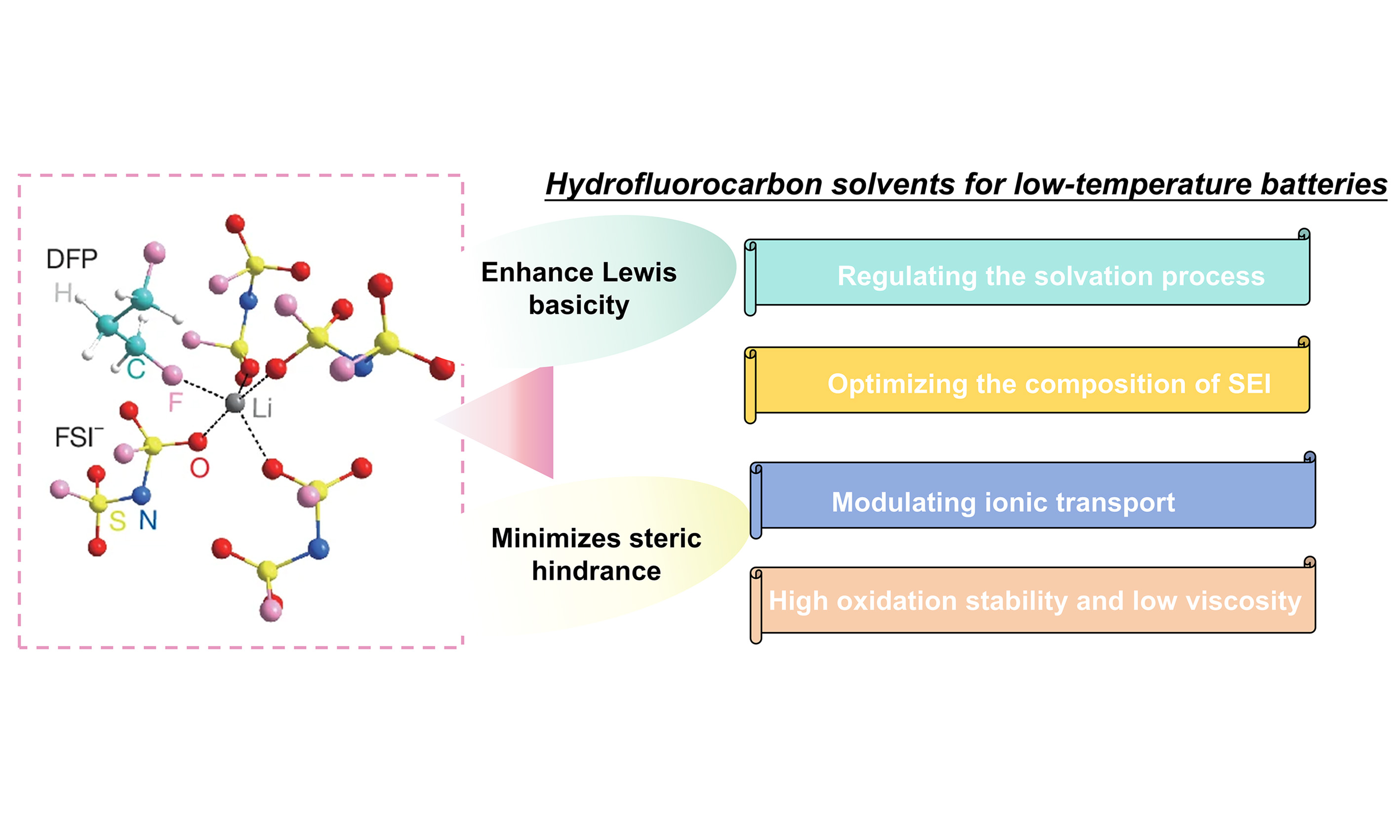
The electrolyte is tasked with both charge transport and the construction of the electrode-electrolyte interphase in high-energy-density lithium metal batteries (LMBs)[1]. Oxygen- and nitrogen-based solvents have been widely used due to their strong dipole-ion interactions with Li+ to completely and uniformly dissolve salts[2,3]. Nevertheless, the strong coordination imposes a huge desolvation barrier at the interface, restricting battery performance, particularly under fast-charging and subzero environments. Strategies for reducing the Lewis basicity of these solvents by introducing bulky substituents cause viscosity enhancement that hampers ion migration, which gives rise to elevated internal resistance and a decline in Coulombic efficiency (CE)[4,5].
Hydrofluorocarbon (HFC) is regarded as a promising solvent for LMBs due to superior fluidity and high anodic stability, but weak F-Li+ coordination affinity has prevented it from dissolving lithium salts effectively[6]. It is generally accepted that a higher affinity for Li+ can be achieved by increasing the electron density around the fluorine atom, and lowering steric hindrance[7,8]. Wu and co-workers demonstrated that the applicability of a novel HFC solvent (1, 3-difluoropropane, DFP) employed by the monofluorinated approach was attributed to its high Li salt solubility of 2 mol L-1, a viscosity as low as 0.38 cp, and an oxidative stability above 4.9 V[6]. The monofluorinated -CH2F group possesses a higher electron cloud density than -CHF2 or -CF3 moieties, which enhances the Lewis basicity of the fluorine atom [Figure 1A]. The DFP includes an electron-withdrawing CH2F group at each terminus while its linear carbon chain minimizes steric hindrance [Figure 1B], affording a boost in the solvation of Li+. The viability of DFP as a potential substitute for the conventional ether solvent dimethoxypropane (DMP) in LMBs is evaluated by measuring its key properties under high-voltage operating conditions with 1 M lithium bis(fluorosulfonyl)imide (LiFSI) as the Li salt. DFP exhibits the weak Li+ coordination [Figure 1C] and low viscosity [Figure 1D] while maintaining high electrochemical stability, when compared with conventional ether- and carbonate-based electrolyte solvent counterparts. Across a wide temperature range (from room temperature to -70 °C), the solvent stands out for a high lithium-ion transference number (0.71) and excellent ionic conductivity (3.9 mS cm-1 at 25 °C and 0.29 mS cm-1 at -70 °C), which may promote more uniform and dense lithium deposition. With a temperature drops from 25 °C to -70 °C, the plated Li grains in DFP electrolyte are reduced from 7 μm to 1.7 μm, which is associated with the higher polarization at low temperatures [Figure 1E]. The size reduction leads to a decreased interfacial area exposed to the electrolyte, promotes the development of a denser passivation layer, thereby curbing the electrolyte consumption. In general, it should be noticed that the enhanced cycling stability and sustained high CE are achieved in the repeated charge/discharge measurements. The enhanced cycling performance of lithium anode is attributable to fast lithium desolvation kinetics and the presence of a higher Li2S content within the passivation layer, whereas the formation of other undesirable interfacial species is excluded for the DFP solvent. The unique solvation structure is suggested to affect the composition and morphology of the solid-electrolyte interphase (SEI), thereby governing the long-term stability of the lithium metal anode. With an anodic stability as high as 4.9 V, the DFP electrolyte is capable of meeting the stringent requirements of LiNi0.8Mn0.1Co0.1O2 (NMC811) cathodes, whereas the non-fluorinated DMP electrolyte falls short at only 4.5 V. Despite the use of a thin lithium foil (50 μm), the DFP electrolyte enables a Li/NMC811 battery to achieve stable cycling up to 115 cycles at temperatures ranging from 25 °C to -70 °C[6]. It should be attributed to the fact that the DFP-based electrolyte is capable of preserving high reversibility of the lithium metal anode, whereas its low viscosity coupled with superior wettability serves to facilitate the efficient deintercalation and intercalation of Li+ within the NMC active material. When assessed under more practical conditions, a 13 Ah pouch cell assembled with a lean lithium anode (20 μm ultrathin lithium anode) with an electrolyte to cathode ratio of 0.48 g Ah-1 gives evidence of an initial energy density exceeding 700 Wh kg-1. It is worth noting that, even at -50 °C, this pouch cell is capable of delivering an energy density of approximately 400 Wh kg-1, which approaches that of current commercial lithium-ion batteries operating at room temperature.
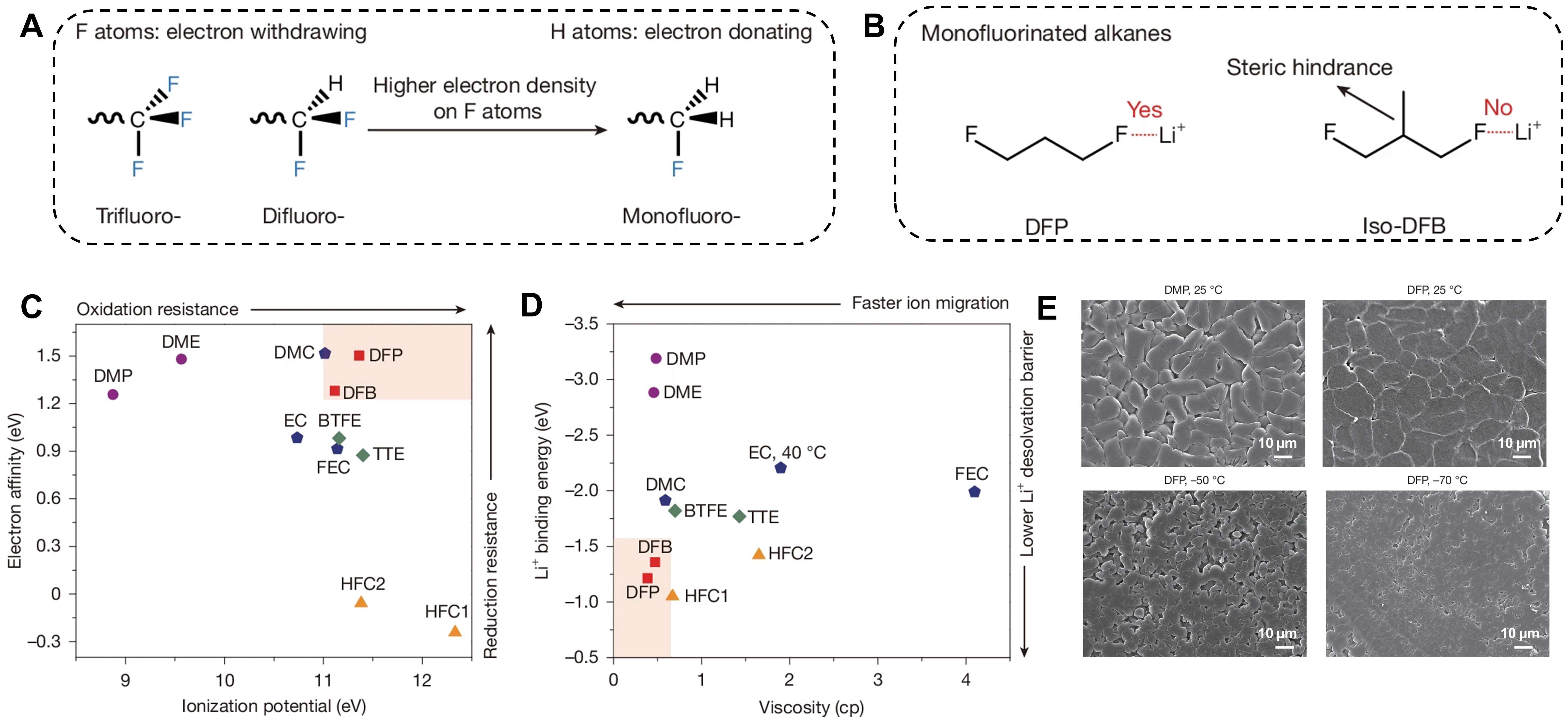
Figure 1. (A) Comparison of electron density on -CF3, -CHF2 and -CH2F group. (B) Chemical structure of DFP with low steric hindrance patterns. Comparison in (C) ionization potential and (D) viscosity of DFP with conventional solvents for LMBs. (E) Top-view SEM images of DMP and DFP electrolytes at different temperatures as indicated. A-E are reproduced with permission from [6], Copyright (2026) Springer Nature. DFP: 1, 3-difluoropropane; DFB: 1,4-difluoro-butane; DMP: dimethoxypropane; DME:1,2-dimethoxyethane; DMC:dimethyl carbonate; EC:ethylene carbonate' BTFE: bis(2,2,2-trifluoroethyl)ether; FEC: fluoroethylene carbonate; TTE:1,1,2,2-tetrafluoroethyl-2,2,3,3-tetrafluoropropylether HFC: hydrofluorocarbon; LMB: lithium metal battery; SEM: scanning electron microscopy.
Of particular note, the low boiling point of DFP (48°C) makes it highly volatile at room temperature, which hinders its practicality for high-temperature applications. Although extending the carbon chain and introducing additional fluorine atoms can raise the boiling point, excessive chain elongation leads to longer C-F bonds, as seen in 1,5-difluoro-pentane (DFPT) and 1,6-difluoro-hexane (DFH) electrolytes, which triggers side reactions and corrosion of the lithium foil. The 1, 3, 5-trifluoropentane (TFPT) electrolyte overcomes this trade-off by incorporating a -FCHCH2CHF- segment, thereby enhancing thermal stability (boiling point of 125 °C) while avoiding side effects and preserving high ionic conductivity (5.67 mS cm-1 at 90 °C and 0.16 mS cm-1 at -40 °C). Specifically, a wide operating window from 80 °C to -40 °C is achievable for the Li/NMC811 battery, with reversible capacities of 216 mAh g-1 and 165 mAh g-1 at the respective temperature extremes. Most importantly, the feasibility of TFPT electrolyte can also be verified across a wide temperature range (80 ~ -40 °C) in lithium-ion batteries (graphite/NMC811) and sodium-metal batteries (Na/NaNi1/3Mn1/3Fe1/3O2).
What makes this work significant is not only the extended operating temperature range, but the balance between salt solubility and Li+-F coordination achieved by regulating the steric hindrance and fluorine electron density in HFC electrolytes. High-concentration electrolytes typically used for low-temperature operation exhibit faster desolvation owing to weaker solvation, but their higher viscosity restricts ion diffusion. In contrast, HFC solvents combine fast desolvation, low viscosity and high ionic conductivity, all of which are conducive to more efficient ion transport at low temperatures. This finding makes it clear that maximizing energy density and low-temperature performance does not always require strengthening ion-solvent interactions. Instead, judiciously weakening these interactions to accelerate desolvation offers an equally effective route.
DECLARATIONS
Authors’ contributions
Investigation: Li, X.
Conceptualization: Yuan, C.
Writing - original draft: Li, X.
Validation: Hou, L.; Yuan, C.
Writing - review & editing: Yuan, C.
Supervision: Yuan, C.
Formal analysis: Yuan, C.
Funding acquisition: Li, X.; Hou, L.; Yuan, C.
Availability of data and materials
Not applicable.
AI and AI-assisted tools statement
Not applicable.
Financial support and sponsorship
This work was supported by the financial support from National Natural Science Foundation of China (No. U22A20145, 52271218, 52402259, 52572228), Major Program of Shandong Province Natural Science Foundation (No. ZR2023ZD43), Natural Science Foundation of Shandong Province (No. ZR2021ZD05, ZR2024QE140, ZR2024QE151, ZR2025MS717), Science and Technology Program of University of Jinan (No. XKY2119, XKY2304, XBS2410), and Young Talent of Lifting engineering for Science and Technology in Shandong (SDAST2026QTB039).
Conflicts of interest
Yuan, C. is the Guest Editor for the Special Topic “Solar Energy Conversion and Storage” in Energy Materials. Yuan, C. was not involved in any part of the editorial process, including reviewer selection, manuscript handling, or decision-making. The other authors declare that they have no conflicts of interest.
Ethical approval and consent to participate
Not applicable.
Consent for publication
Not applicable.
Copyright
© The Author(s) 2026.
REFERENCES
1. Zhang, J.; Xu, W.; Xiao, J.; Cao, X.; Liu, J. Lithium metal anodes with nonaqueous electrolytes. Chem. Rev. 2020, 120, 13312-48.
2. Li, G.; Kou, R.; Nguyen, A.; et al. Long-cycling lithium-metal batteries via an integrated solid-electrolyte interphase promoted by a progressive dual-passivation coating. Nat. Energy. 2025, 10, 941-50.
3. Zhang, H.; Tian, W.; Guo, Y.; Chen, D.; Shi, F. Solid electrolyte interphase and interface effect on the nucleation of lithium pitting. ACS. Nano. 2026, 20, 3565-73.
4. Sun, Q.; Yang, B.; Zhang, D.; et al. Molecular engineering of weak intermolecular interactions for regulating solvation and interface in cyclic ether electrolytes enabling robust lithium metal batteries. Nano. Energy. 2026, 149, 111744.
5. Cheong, D. S.; Kwon, M.; Jung, P. S.; et al. Lithium-ion conduction through frozen phase of organic electrolytes for lithium batteries. Adv. Mater. 2026, 38, e12268.
6. Wu, L.; Zhang, J.; Li, Y.; et al. Hydrofluorocarbon electrolytes for energy-dense and low-temperature batteries. Nature 2026, 651, 383-9.
7. Rustomji, C. S.; Yang, Y.; Kim, T. K.; et al. Liquefied gas electrolytes for electrochemical energy storage devices. Science 2017, 356, eaal4263.
Cite This Article
 Open Access
How to Cite
Download Citation
Export Citation File:
Type of Import
Tips on Downloading Citation
Citation Manager File Format
Type of Import
Direct Import: When the Direct Import option is selected (the default state), a dialogue box will give you the option to Save or Open the downloaded citation data. Choosing Open will either launch your citation manager or give you a choice of applications with which to use the metadata. The Save option saves the file locally for later use.
Indirect Import: When the Indirect Import option is selected, the metadata is displayed and may be copied and pasted as needed.
About This Article
Special Topic
Copyright

Data & Comments
Data
0











Comments
Comments must be written in English. Spam, offensive content, impersonation, and private information will not be permitted. If any comment is reported and identified as inappropriate content by OAE staff, the comment will be removed without notice. If you have any queries or need any help, please contact us at [email protected].