


Dermal exposure to Pergafast 201 in thermal paper: from absorption data to spatial metabolomics
 0
0 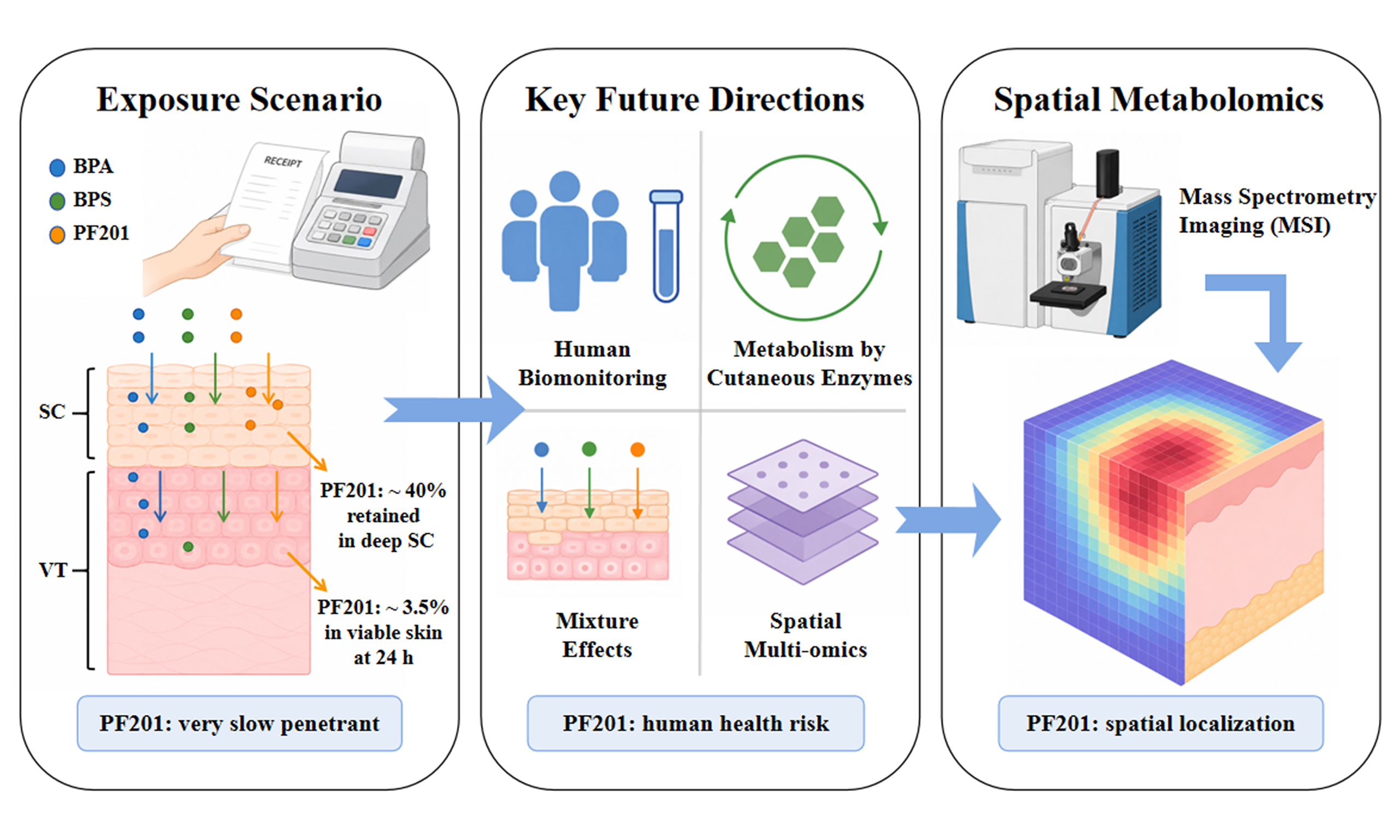
INTRODUCTION
Bisphenol A (BPA), a prototypical endocrine disruptor, has received intense regulatory scrutiny over the past two decades. The European Union (EU) first imposed a ban on BPA in baby bottles in 2011[1], and restriction limiting BPA to
Dermal contact is an important exposure route of BPA for occupationally exposed individuals such as cashiers[11]. Color developers in thermal paper are present as free (unreacted) monomers, readily transferable to fingers. A single contact can transfer 0.05-6.0 μg of BPA, BPS, and PF201[12]. More concerning, the bisphenols are not confined to thermal paper; paper recycling introduces them into newspapers, napkins, toilet paper, and they have even been detected in infant clothing, diapers, and feminine hygiene products[11,13,14]. Therefore, assessing the percutaneous absorption and skin metabolism of these alternatives is a prerequisite for precision risk assessment.
It is against this background that Tsykhotska et al. published “Assessment of Pergafast 201 absorption and metabolism in viable human skin: A comparative study with bisphenol A and bisphenol S” in Environment International in 2026[2]. Using tritium labelled compounds and the ex vivo human skin Franz diffusion cell system, the authors achieved for the first time a complete mass balance for PF201 (97.0% ± 5.9% recovery) and systematically compared the 24 h absorption and dermal retention of PF201 and compared with those of BPA and BPS[2]. Their study fills a critical data gap and provides key parameters for risk ranking of the alternative. The present commentary primarily highlights their research findings and contributions, and proposes possible future research directions.
MAJOR CONTRIBUTIONS AND DISCUSSION
As reported by the authors[2], mass balance calculations showed that all skin explants had recoveries falling within the 90%-110% range and the mean absorbed dose (the percentage of the applied dose reaching the receptor fluid) was 5.1% for BPA, 0.53% for BPS, and only 0.20% for PF201 at equal molar dose
Despite minimal PF201 reaching the receptor fluid (< 0.5%), approximately 3.5% of the applied dose remained in the viable skin explant, and about 40% was retained in the deep stratum corneum (tape strips 3-20). This suggests that repeated occupational exposure (e.g., cashiers handling dozens of receipts daily) could lead to progressive accumulation of the chemical in the skin. Such a reservoir effect has been reported for BPA and BPS[15,16], while the higher lipophilicity (LogP: 2.6 vs. 1.2) and molecular weight (460.52 vs. 250.27 g/mol) of PF201 than BPS may prolong the residence time of PF201 in the skin. The authors assumed that PF201 could continue to release into the systemic circulation long after exposure ceases, which warrants longer-term ex vivo studies, physiologically based pharmacokinetic (PBPK) modelling, as well as human intervention studies to directly test this.
In their study, radio-HPLC profiling of skin extracts showed PF201 predominantly as the parent compound (mean: > 99%), with only trace (mean: 3.3%) m-aminophenyl tosylate (AMT, a known by-product) detected in 28.6% samples (two out of seven explants). No N-(p-tosyl)carbamic acid methyl ester (MTC) or conjugated metabolites were found. Positive control experiments using 14C-7-hydroxycoumarin confirmed the activity of phase II xenobiotic metabolizing enzymes including sulfotransferases (SULT) and UDP-glucuronosyltransferases (UGT) in all skin explants. The authors observed that PF201 undergoes no significant metabolism or degradation in skin. While this conclusion seems simplifying toxicokinetic modeling (only the parent compound reaches systemic circulation), two caveats need to be considered. First, tissue homogenization and extraction may dilute or destroy low abundance metabolites; radio-detection is sensitive while lacks structural information. Second, human skin expresses a broad array of phase I enzymes including cytochromes P450 (CYPs), epoxide hydrolase, esterases and amidases[17,18]. PF201, being a urea derivative, contains an amide bond that could theoretically be hydrolyzed by cutaneous amidases or esterases, yielding aromatic amine metabolites. Although the authors did not detect significant accumulation of AMT (compound 2), other products or intermediates might have been missed due to lack of radiolabelled standards [Figure 1]. Thus, no major pathway was observed under the current detection conditions for PF201 rather than absolute biological inertness as the authors indicated. Other possible metabolites also remain worthy of investigation.
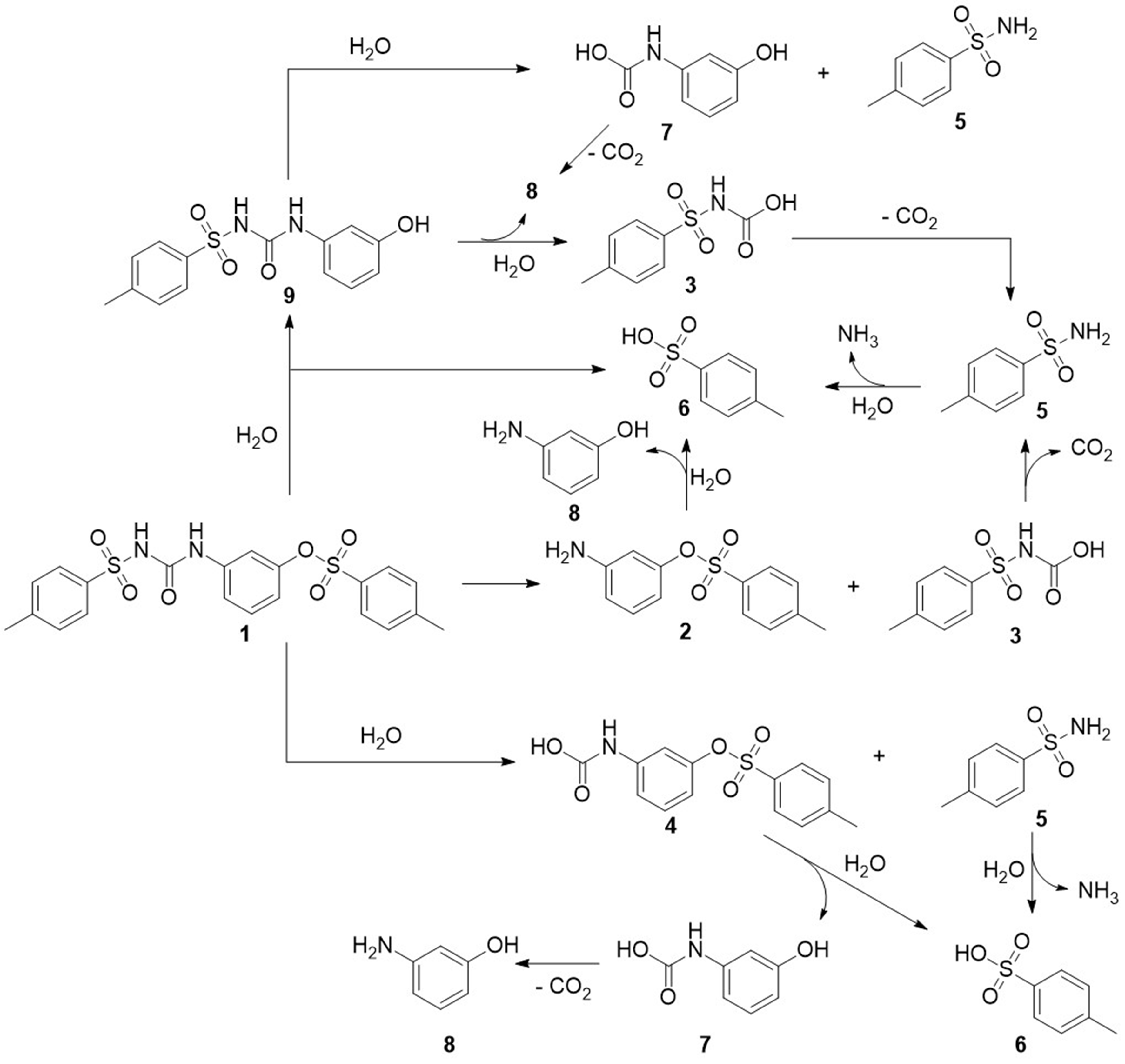
Figure 1. The molecular structure of PF201 and possible metabolites. PF201: Pergafast 201.
FROM MACROSCOPIC PARAMETERS AND CONVENTIONAL HOMOGENIZATION METABOLISM TO SPATIAL METABOLOMICS
This study provides a solid quantitative foundation for PF201 skin risk assessment. To truly understand its health implications, we think there are several directions require further exploration.
(1) Human biomonitoring and exposure markers
Ex vivo data need in vivo validation. Biomonitoring studies in cashiers or other occupationally exposed populations should be conducted, measuring PF201 and its potential metabolites (e.g., hydrolysis product AMT, oxidative or glutathione conjugates) in urine and blood. Given the expected very low absorbed doses, highly sensitive high performance liquid chromatography-tandem mass spectrometry (HPLC-MS/MS) methods (detection limits at pg/mL) are required. Controlled human volunteer studies (hand exposure to thermal paper with timed blood/urine collection) would provide human toxicokinetic parameters and allow comparison with ex vivo data to validate the Franz diffusion cell extrapolation. In addition, data from other in vitro models, such as human hepatic in vitro models[19], regarding the metabolic fate of PF201 would also be required in order to identify metabolites that can be screened for in a human biomonitoring study.
(2) Systematic evaluation of PF201 metabolism by cutaneous enzymes
As aforementioned, multiple phase I and II enzymes are expressed in skin, with different profiles across skin layers (e.g., the lipophilic stratum corneum and the hydrophilic viable tissue). While the authors confirmed phase II activity using 7-hydroxycoumarin, the more relevant questions are whether PF201 can be transformed by phase I enzymes including cutaneous amidases, esterases or CYPs as aforementioned.
(3) Mixture exposure and joint skin absorption by PF201 and other bisphenols
In addition, although the present study focused solely on PF201, thermal paper often contains BPA, BPS, and PF201 together, with variable ratios. Their study tested each compound singly, but under mixture conditions competitive penetration (sharing stratum corneum lipid pathways) or barrier disruption (one component altering skin integrity and facilitating penetration of others) could occur. The potential combined effects of dermal co-exposure to these bisphenols should therefore also be performed to calculate whether the absorbed fraction of each component differs significantly from single compound exposure.
(4) Spatial metabolomics by spatial mass spectrometry imaging (MSI)
All the above directions rely on conventional homogenization extraction quantification methods. While precise, these methods completely lose spatial information on compound distribution within the heterogeneous tissue microarchitecture. Skin is a highly heterogeneous organ, with distinct microstructures that differ enormously in their permeability and retention properties. Spatial MSI is a revolutionary tool for skin exposure research and it might unlock this “black box”. Basically, matrix assisted laser desorption/ionization (MALDI-), secondary ion mass spectrometry (SIMS-), or desorption electrospray ionization (DESI-) MSI can directly detect and localize exposure compounds and their metabolites or metabolites of endogenous substances produced by the toxic chemical exposure on tissue sections at spatial resolutions, generating ion density maps[20-23]. For example, more than 1,500 metabolites in organ can be visualized in an untargeted analysis by a sensitive air flow-assisted desorption electrospray ionization (AFADESI-) MSI method[23]. The technique does not require radiolabelling and can simultaneously detect parent compounds and multiple metabolites. Spatial metabolomics can accurately identify and locate the spatial distribution of multiple metabolites including endogenous metabolic products and enable downstream metabolomic analysis resulted from PF201 exposure. The application of MSI technology can achieve a multi-dimensional correlation of the transdermal behavior, metabolic transformation, and toxic endpoints, such as skin function damage, effects on lipid metabolism[24-26], for PF201 considering its absorption in the skin although its absorption and metabolism are weak. Simultaneously, it can be compared with the toxicological data of BPA to explain that even with a lower skin absorption rate, long-term accumulation may still cause adverse health effects through low-dose long-term exposure making the risk discussion more complete.
Of course, MSI applied to skin exposure research is still in its early stages, facing challenges in sample preparation, ion suppression, and quantitative accuracy. Nevertheless, successful precedents exist, such as for drugs[27]. For example, Arancibia et al. reported a novel MSI-based automated workflow enables rapid visualization and evaluation of active pharmaceutical ingredient distribution across skin layers[28]. Sjövall
CONCLUSIONS
Tsykhotska et al. provide, with rigorous design and complete data, the first comprehensive picture of the absorption kinetics and metabolic fate of PF201 in human skin[2]. They demonstrate that PF201 has much lower dermal absorption than BPA, yet it does penetrate and persist in the skin (mainly in stratum corneum). However, low absorption is not synonymous with no risk. The potential for long term skin reservoir accumulation, the likelihood of enhanced penetration under real world conditions, and the lack of systemic toxicological data all call for more studies. Future research should integrate human biomonitoring, systematic evaluation of skin enzyme-mediated metabolism, mixture effects with other bisphenols, and spatial MSI, which has the potential to elevate skin exposure studies from macroscopic mass balance to microscale fate maps, and associated adverse health risk. This would provide unprecedented insights into the fate of PF201 or more emerging contaminants, the situations encountered, the cells and enzymes encountered, and the toxic mechanisms of the toxicants using metabolomics.
DECLARATIONS
Authors’ contributions
Methodology, literature collection and draft preparation: Chen, C.
Data collection: Lin, Y.
Metabolite prediction: Huang, Y.
Design, reviewing and editing: Yu, Y.
Availability of data and materials
Not applicable.
AI and AI-assisted tools statement
During the preparation of this manuscript, the AI tool DeepSeek (version V3) was used solely for language editing. The tool did not influence the study design, data collection, analysis, interpretation, or the scientific content of the work. All authors take full responsibility for the accuracy, integrity, and final content of the manuscript.
Financial support and sponsorship
The study was supported by the open research funds from the Affiliated Qingyuan Hospital (Qingyuan People’s Hospital), Guangzhou Medical University (202301-104), Guangdong-Hong Kong-Macao Joint Laboratory for Contaminants Exposure and Health (2020B1212030008).
Conflicts of interest
Yu, Y. is an Editorial Board Member and a Guest Editor of the Special Issue “Topic: The Impact of Bisphenol Exposure on Human Health” of the journal Journal of Environmental Exposure Assessment. Yu, Y. was not involved in any steps of editorial processing, notably including reviewers’ selection, manuscript handling and decision making. The other authors declare that there are no conflicts of interest.
Ethical approval and consent to participate
Not applicable.
Consent for publication
Not applicable.
Copyright
© The Author(s) 2026.
REFERENCES
1. European Union. Commission Directive 2011/8/EU of 28 January 2011 amending Directive 2002/72/EC as regards the restriction of use of Bisphenol A in plastic infant feeding bottles Text with EEA relevance. 2011. http://data.europa.eu/eli/dir/2011/8/oj. (accessed 2026-06-11).
2. Tsykhotska, O.; Valleix, M.; Bruel, S.; et al. Assessment of Pergafast 201 absorption and metabolism in viable human skin: a comparative study with bisphenol A and bisphenol S. Environ. Int. 2026, 210, 110191.
3. Yang, Y.; Yang, Y.; Zhang, J.; Shao, B.; Yin, J. Assessment of bisphenol A alternatives in paper products from the Chinese market and their dermal exposure in the general population. Environ. Pollut. 2019, 244, 238-46.
4. Miller, G. Z.; Pitzzu, D. T.; Sargent, M. C.; Gearhart, J. Bisphenols and alternative developers in thermal paper receipts from the U.S. market assessed by Fourier transform infrared spectroscopy. Environ. Pollut. 2023, 335, 122232.
5. Demierre, A. L.; Reinhard, H.; Zeltner, S.; Frey, S. Evaluating the efficiency of the 2020 ban of BPA and BPS in thermal papers in Switzerland. Regul. Toxicol. Pharmacol. 2024, 146, 105526.
6. Iskandarani, L.; Bayen, S.; Hales, B. F.; Robaire, B. High-content imaging and transcriptomic analyses of the effects of bisphenol S and alternative color developers on KGN granulosa cells. Toxicol. Sci. 2025, 207, 401-14.
7. Xu, Z.; Goodyer, C. G.; Hales, B. F.; Bayen, S. Global survey of bisphenol color developers in thermal food labels and a study of the role of food packaging materials in preventing color developer migration into food. Food. Packag. Shelf. Life. 2026, 53, 101687.
8. Goldinger, D. M.; Demierre, A. L.; Zoller, O.; et al. Endocrine activity of alternatives to BPA found in thermal paper in Switzerland. Regul. Toxicol. Pharmacol. 2015, 71, 453-62.
9. Franko, N.; Markovič, T.; Žižek, P.; Kodila, A.; Mlinarič Raščan, I.; Sollner Dolenc, M. Unravelling immunomodulatory effects of bisphenol A substitutes on human macrophages, T and B lymphocytes using in vitro models. Ecotoxicol. Environ. Saf. 2025, 300, 118406.
10. Franko, N.; Kodila, A.; Sollner Dolenc, M. Adverse outcomes of the newly emerging bisphenol A substitutes. Chemosphere 2024, 364, 143147.
11. Liao, C.; Kannan, K. Widespread occurrence of bisphenol A in paper and paper products: implications for human exposure. Environ. Sci. Technol. 2011, 45, 9372-9.
12. Eckardt, M.; Simat, T. J. Bisphenol A and alternatives in thermal paper receipts - a German market analysis from 2015 to 2017. Chemosphere 2017, 186, 1016-25.
13. Chabowska, A.; Jatkowska, N.; Kubica, P.; Płotka-Wasylka, J. Exposure scenario and risk assessment of infants and newborns to bisphenols and their derivatives from diapers. Ecotoxicol. Environ. Saf. 2023, 262, 115351.
14. Herrero, M.; Souza, M. C. O.; González, N.; et al. Dermal exposure to bisphenols in pregnant women’s and baby clothes: risk characterization. Sci. Total. Environ. 2023, 878, 163122.
15. Toner, F.; Allan, G.; Dimond, S. S.; Waechter, J. M. Jr.; Beyer, D. In vitro percutaneous absorption and metabolism of bisphenol A (BPA) through fresh human skin. Toxicol. In. Vitro. 2018, 47, 147-55.
16. Marquet, F.; Champmartin, C.; Seiwert, C.; et al. Human in vitro percutaneous absorption of bisphenol S: assessment of the skin reservoir and occlusion effects. Toxicol. In. Vitro. 2024, 99, 105886.
17. Kazem, S.; Linssen, E. C.; Gibbs, S. Skin metabolism phase I and phase II enzymes in native and reconstructed human skin: a short review. Drug. Discov. Today. 2019, 24, 1899-910.
18. Yang, Y.; Hou, Y.; Liao, Y.; et al. Percutaneous penetration of typical Organophosphate esters under catalysis by Carboxylesterase: characteristics, mechanism and prediction model. Environ. Int. 2025, 198, 109419.
19. Gütter, L.; Tsykhotska, O.; Person, E.; et al. P19-30 Biotransformation of the colour developer Pergafast 201 in human in vitro models. Toxicol. Lett. 2025, 411, S248.
20. Bian, Y.; He, M. Y.; Ling, Y.; et al. Tissue distribution study of perfluorooctanoic acid in exposed zebrafish using MALDI mass spectrometry imaging. Environ. Pollut. 2022, 293, 118505.
21. Sun, C.; Wang, A.; Zhou, Y.; et al. Spatially resolved multi-omics highlights cell-specific metabolic remodeling and interactions in gastric cancer. Nat. Commun. 2023, 14, 2692.
22. Vo, P. H. N.; Hamilton, B. R.; Wepf, R. A.; et al. Visualization of the distribution of PFOS and PFHxS in concrete by DESI MSI. Environ. Sci. Technol. Lett. 2023, 10, 446-51.
23. He, J.; Sun, C.; Li, T.; et al. A sensitive and wide coverage ambient mass spectrometry imaging method for functional metabolites based molecular histology. Adv. Sci. 2018, 5, 1800250.
24. Kim, J.; Yu, S.; Choo, J.; Lee, H.; Hwang, S. Y. Per- and polyfluoroalkyl substance-induced skin barrier disruption and the potential role of calcitriol in atopic dermatitis. Int. J. Mol. Sci. 2025, 26, 7085.
25. Zhao, X.; Han, Y.; Fu, M.; et al. In vitro assessment of dermal penetration and skin barrier impairment by per- and polyfluoroalkyl substances (PFASs) from consumer products. Environ. Pollut. 2025, 385, 127049.
26. Zhou, Y.; Xing, Y.; Zhang, X.; et al. Childhood exposure to per- and polyfluoroalkyl substances in educational environments: arising from stationery and implications for health. Environ. Chem. Ecotoxicol. 2026, 8, 511-20.
27. Liu, W.; Pan, M.; Pan, S.; Dai, W.; Li, Z.; Chu, X. Advances in research methods for the mechanisms of transdermal drug absorption. J. Drug. Deliv. Sci. Technol. 2026, 118, 108055.
28. Yakobi Arancibia, R.; Bentov-Arava, E.; Morshin, A.; et al. A rapid assessment approach for skin stratum-targeted drug delivery systems using mass spectrometry imaging and spatial clustering. Small. Sci. 2025, 5, 2500061.
Cite This Article
 Open Access
How to Cite
Download Citation
Export Citation File:
Type of Import
Tips on Downloading Citation
Citation Manager File Format
Type of Import
Direct Import: When the Direct Import option is selected (the default state), a dialogue box will give you the option to Save or Open the downloaded citation data. Choosing Open will either launch your citation manager or give you a choice of applications with which to use the metadata. The Save option saves the file locally for later use.
Indirect Import: When the Indirect Import option is selected, the metadata is displayed and may be copied and pasted as needed.
About This Article
Special Topic
Copyright

Data & Comments
Data
0










Comments
Comments must be written in English. Spam, offensive content, impersonation, and private information will not be permitted. If any comment is reported and identified as inappropriate content by OAE staff, the comment will be removed without notice. If you have any queries or need any help, please contact us at [email protected].