



Prenatal PFAS and longitudinal neurodevelopmental trajectories in preschoolers aged 3-7: effect modification by bile acid metabolism
 0
0 Abstract
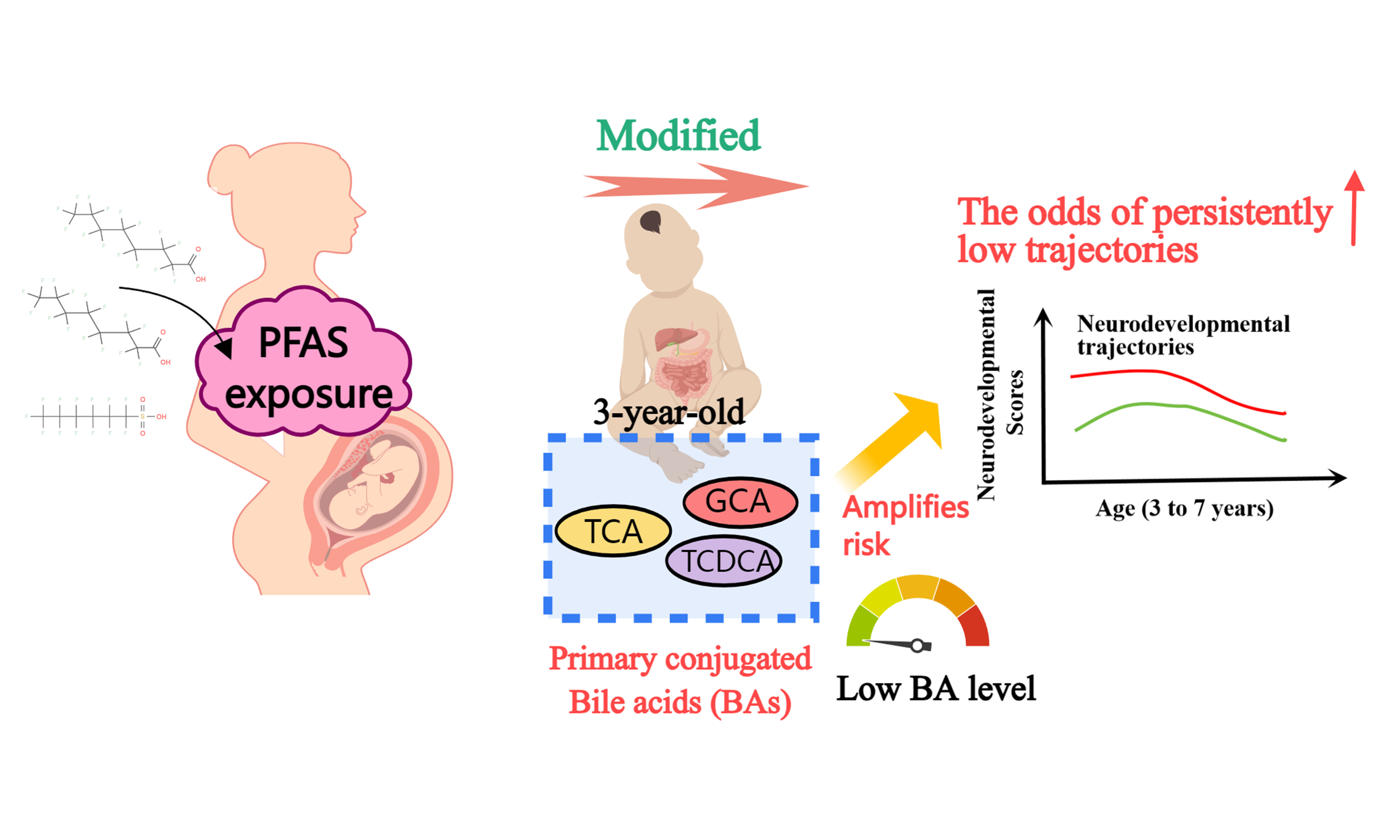
Bile acids (BAs) are crucial signaling molecules in neurodevelopment, and per- and polyfluoroalkyl substances (PFAS) exposure has been linked to adverse neurodevelopmental outcomes. However, the role of specific BAs in modifying the association between PFAS and longitudinal neurodevelopmental trajectories remains unknown. We quantified 32 PFAS in maternal serum and 17 BAs in serum from 3-year-old children in the Maoming Birth Cohort. Neurodevelopment was repeatedly evaluated using age-standardized instruments. PFAS effects were evaluated by logistic regression and grouped weighted quantile sum (GWQS). Random forest analysis identified six primary conjugated BAs associated with low neurodevelopmental trajectories, and their interactions with PFAS were assessed. Group-based trajectory modeling identified two neurodevelopmental trajectories: persistently high (n = 242) and low (n = 36). Higher prenatal levels of legacy PFAS were associated with low neurodevelopmental trajectories. GWQS regression revealed mixture effects for legacy PFAS [odds ratio (OR) = 2.18, 95% confidence interval (CI): 1.01-4.73]. Primary conjugated BAs [e.g., taurocholic acid (TCA), taurochenodeoxycholic acid (TCDCA)] modified the observed associations. The odds of perfluorooctane sulfonate-associated low neurodevelopmental trajectories were greater for children with lower TCDCA levels (OR = 2.70; 95%CI: 1.02-7.17; Pfor interaction = 0.0063) than for those with higher levels. Children with higher TCA levels exhibited lower odds of low neurodevelopmental trajectories than those with lower levels (Pfor interaction = 0.0088). Our findings provide longitudinal evidence on PFAS-related lower neurodevelopment and identify primary conjugated BAs as significant effect modifiers. The mechanisms underlying this effect modification require further investigation.
Keywords
INTRODUCTION
Per- and polyfluoroalkyl substances (PFAS) comprise a diverse class of over 4,700 fluorinated compounds extensively used in a wide range of consumer and industrial products due to their physicochemical properties[1,2]. Human exposure to PFAS primarily occurs via ingestion of contaminated food and water, as well as inhalation of polluted air and household dust[3]. PFAS have been widely detected in maternal blood[4], breast milk, and umbilical cord serum[5] across diverse populations. PFAS can cross the placental barrier[6,7], thereby posing a potential risk of fetal exposure during critical windows of early development.
The developing brain undergoes critical phases of neural migration, rapid proliferation, and synapse formation[8], during which prenatal PFAS exposure may interfere with neurodevelopmental processes. Although the neurodevelopmental toxicity of PFAS is well established in animal models - including learning and memory deficits in male mice following lactational perfluorooctane sulfonate (PFOS) exposure[9], as well as behavioral alterations accompanied by transcriptional changes in genes related to the nervous and muscular systems in zebrafish embryos[10] - findings from human epidemiological studies remain inconsistent. A comprehensive systematic review of 31 birth cohort studies indicated that prenatal PFAS exposure is associated with poorer cognitive and behavioral outcomes, with over half of the studies reporting significant cognitive or neurobehavioral effects[11]. To date, epidemiological studies have predominantly employed cross-sectional designs to investigate associations between prenatal PFAS exposure and isolated neurodevelopmental outcomes, such as attention problems[12], behavioral dysregulation[13,14], and cognitive deficits[15,16]. Moreover, most studies assessed neurodevelopment at a single time point, without longitudinal tracking across early developmental stages.
Although several longitudinal studies have reported associations between prenatal PFAS exposure and early neurodevelopmental trajectories[17-20], most have been confined to infancy or toddlerhood (< 36 months), leaving a critical knowledge gap in understanding neurodevelopmental effects beyond infancy. The preschool period is characterized by significant neurobiological processes, including synaptic pruning, cortical maturation, and heightened metabolic activity, which are essential for the emergence of higher-order cognitive and behavioral functions[21,22]. Despite its neurodevelopmental importance, this period remains understudied in PFAS-related research. To address this gap, longitudinal monitoring of neurodevelopmental trajectories throughout the preschool years is essential.
Emerging evidence suggests that metabolic disruption may underlie PFAS-related neurodevelopmental effects. For example, the MARBLES study reported that prenatal PFAS exposure may affect child neurodevelopment via alterations in maternal metabolic pathways[23]. In particular, bile acids (BAs) - essential hepatic metabolites involved in lipid, cholesterol, and xenobiotic metabolism - have recently been implicated in the development and function of the nervous system[24]. Some BAs, such as taurocholic acid (TCA), tauroursodeoxycholic acid (TUDCA), and glycoursodeoxycholilc acid (GUDCA), have been reported to exert neuroprotective effects[25], while others, including certain primary conjugated BAs, may contribute to neurotoxic processes[26]. Moreover, prenatal PFAS exposure has been associated with alterations in primary BA profiles in children at age 3[27]. Given that BAs are signaling molecules capable of crossing the blood-brain barrier and modulating neuroinflammation and neuronal survival[28,29] - with some exerting neuroprotection and others neurotoxicity - we reasoned that the variation in childhood BA levels may be a critical factor underlying differential susceptibility to PFAS-related neurodevelopmental deficits. However, to our knowledge, no epidemiological study has systematically investigated which specific BA species modify the association between prenatal PFAS exposure and neurodevelopmental trajectories, or the nature of this effect modification.
To address this gap, we hypothesized that the association between prenatal PFAS exposure and neurodevelopmental trajectories is modified by the serum concentrations of specific BA species. This study aimed to: (1) prospectively evaluate the longitudinal relationship between prenatal PFAS exposure and neurodevelopmental trajectories in preschool children; and (2) identify and quantify the effect modification exerted by specific childhood BA species. To our knowledge, this study is among the first to investigate specific BA species as potential effect modifiers of the association between prenatal PFAS exposure and neurodevelopmental outcomes, providing new insights into the role of BA metabolites in PFAS-related neurodevelopmental deficits.
EXPERIMENTAL
Study population
All participants were enrolled from the ongoing Chinese Maoming Birth Cohort Study (2015-2018), as previously described[30]. Written informed consent was obtained from the parents or legal guardians of all participating children prior to inclusion in the study, and standardized questionnaires were used to collect information on demographic characteristics, maternal lifestyle factors, and reproductive characteristics. Maternal blood samples were collected during the third trimester, along with infant birth data. Children were followed up regularly, with blood sample collection and guardian-completed questionnaires at each visit. Based on predefined inclusion and exclusion criteria[31], we excluded children who were lost to follow-up, failed to provide blood samples, or had multiple pregnancies. For the primary longitudinal trajectory modeling, we included children with two or more repeated neurodevelopmental assessments between 33-84 months of age, yielding a final sample of 278 children. From this longitudinal cohort, 225 pairs with available 3-year blood samples (range: 30-36 months; median: 34 months) were included to assess the modifying effect of BAs on PFAS-neurodevelopment associations. Details of the sample selection process, including a cross-sectional sample for ancillary analyses, are provided in Supplementary Figure 1 and Supplementary Text 1. This study was approved by the Committee of Human Sciences of Sun Yat-sen University (approval no. SYSU-2016-018) and was conducted in accordance with the principles of the Declaration of Helsinki.
PFAS measurement
Maternal serum was collected during the third trimester, immediately centrifuged at 1,500 rpm for 20 min, and the separated serum was stored at -80 °C until subsequent analysis. A total of 32 PFAS were identified and quantified, and the detailed analytical method has been described previously[32]. Briefly, serum PFAS concentrations were quantified using an ultra-performance liquid chromatograph coupled to an Agilent 6410 Triple Quadrupole mass spectrometer (UPLC-MS/MS; Agilent, USA). The full chemical names, limits of detection (LODs), and concentration distributions of all PFAS are presented in Supplementary Table 1. PFAS concentrations below the LOD were replaced with LOD/√2[33,34]. Our statistical analysis focused on 12 PFAS with detection rates ≥ 70%[35] to ensure analytical robustness while covering key emerging compounds. These PFAS were further classified into legacy and alternative groups based on production history and chemical structure[17,36,37]. Legacy PFAS refers to long-chain perfluoroalkyl acids that have been largely phased out, such as perfluorooctanoic acid (PFOA) and PFOS. Alternative PFAS include short-chain or novel fluorinated compounds used as their replacements. Accordingly, the 12 PFAS were divided into two groups: four alternative PFAS - 6:2 chlorinated polyfluorinated ether sulfonate acid (6:2 Cl-PFESA), 8:2 Cl-PFESA, perfluoro-n-nbutanoic acid (PFBA), and perfluoro-n-hexanoic acid (PFHxA) - and eight legacy PFAS - linear perfluoro-1-hexane sulfonate (linear PFHxS), PFOS, PFOA, perfluoro-n-nonaoic acid (PFNA), perfluoro-n-decanoic acid (PFDA), perfluoro-n-undecanoic acid (PFUnDA), perfluoro-n-dodecanoic acid (PFDoDA), and perfluoro-n-tridecanoic acid (PFTrDA).
BAs measurements
Given that gut microbiota and BA profiles stabilize by 3 years of age[38,39], and this stage represents a critical window of susceptibility to environmental chemical exposures[40], serum BAs at 3 years can reflect metabolic status during early developmental periods. Therefore, we identified and quantified BAs in the serum of 3-year-old children (range: 30-36 months; median: 34 months), as described in our previous study[27]. Briefly, 17 types of BA species were identified using ultra-performance liquid chromatography-multiple reaction monitoring mass spectrometry (UPLC/MRM-MS). Subsequently, 15 BAs with detection rates exceeding 75% were selected for analysis to ensure high data quality[27]. BAs are categorically classified as primary, synthesized from cholesterol in the liver, or secondary, derived from bacterial metabolites[41]. The analytical method encompassed 15 BAs, which were classified into primary and secondary categories. The primary BAs comprised 3 unconjugated species [cholic acid (CA), chenodeoxycholic acid (CDCA), and hyocholic acid (HCA)] and 6 conjugated forms [TCA, glycohyocholic acid (GHCA), glycocholic acid (GCA), taurochenodeoxycholic acid (TCDCA), glycochenodeoxycholic acid (GCDCA), and taurohyocholic acid (THCA)]. The secondary BAs included 2 unconjugated types [deoxycholic acid (DCA) and ursodeoxycholic acid (UDCA)] and 4 conjugated types [GUDCA, glycodeoxycholic acid (GDCA), glycolithocholic acid (GLCA), and taurodeoxycholic acid (TDCA)]. Concentrations below the LOD were substituted with LOD/√2. Detailed information regarding full names, detection rates, classifications, and LODs is provided in Supplementary Table 2.
Neurodevelopment assessments
Neurodevelopment was assessed at 33, 36, 42, 48, 54, 60, 72, and 84 months of age, with each participant completing at least one follow-up. Age-appropriate instruments were used for evaluation: the Ages & Stages Questionnaire, Third Edition (ASQ-3) was administered for children aged 2-66 months, covering five domains - communication, gross motor, fine motor, problem-solving, and personal-social skills[17]. For children aged 60 to 83 months, cognitive function was assessed using the Wechsler Preschool and Primary Scale of Intelligence–Fourth Edition (WPPSI-IV), which includes 10 core subtests contributing to five indices and Full-Scale IQ (FSIQ)[42,43]. At 84 months and older, cognitive performance was assessed using the Wechsler Intelligence Scale for Children–Fourth Edition (WISC-IV), which provides standardized scores across four domains and a composite FSIQ[44]. All assessments were performed by trained physicians in a controlled environment. Neurodevelopmental scores on the age-standardized scales were calculated based on the ASQ-3, WPPSI-IV, and WISC-IV criteria. Scores across different ages and testing modes exhibit substantial comparability[45], indicating that consistent and comparable outcomes can be obtained. We applied a scale transformation to harmonize neurodevelopmental scores across ages and assessment tools, enabling consistent comparison and facilitating trajectory modeling. This approach is consistent with recent longitudinal studies that have combined cognitive scores from multiple instruments to model developmental trajectories across early childhood[46]. A detailed rationale for this approach, including its scientific basis and the importance of ensuring comparability across assessment methods, is provided in Supplementary Text 2.
Covariates
Based on prior research on PFAS exposure and neurodevelopment[15,17], we constructed a directed acyclic graph (DAG) to identify potential confounding variables [Supplementary Figure 2]. Trained staff collected covariate data using structured questionnaires during follow-up, including maternal age (years), pre-pregnancy body mass index (BMI, kg/m2), parity (primiparous or multiparous), parental education (≤ high school; > high school), family income (< 30,000; 30,000-100,000 and ≥ 100,000 CNY/year), maternal passive smoking before pregnancy, alcohol consumption, and folic acid or vitamin supplementation during pregnancy (yes or no for all)[47]. Breastfeeding duration was categorized as 0, ≤ 6, or > 6 months[17]. Additional perinatal data were extracted from medical records, including gestational age (weeks), birthweight (g), delivery method (vaginal or cesarean), and child sex.
Statistical analysis
Demographic and clinical characteristics were summarized as means ± standard deviations (SDs) for continuous variables and as numbers (percentages) for categorical variables. Missing data were present for several covariates, and no missing values were observed for the primary exposure (PFAS), outcome (trajectory group), or BA modifiers. PFAS and BA concentrations were natural-log transformed due to their skewed distributions and were analyzed as continuous variables. Pearson correlation was used to examine associations among PFAS. Statistical analyses were performed using R (version 4.3.1) and STATA (version 18.0), with statistical significance set at P < 0.05.
Main analysis
Multiple linear regression models were first employed to evaluate the associations of maternal serum PFAS concentrations and child serum BA levels (at 3 years) with neurodevelopmental outcomes across various domains assessed between 33 and 84 months of age. Each PFAS was modeled as a continuous variable per natural-log (ln) unit increase.
Group-based trajectory modeling
Group-based trajectory modeling (GBTM) was used to characterize longitudinal patterns of neurodevelopment from 33 to 84 months of age, using repeated cognitive assessments at 33, 36, 42, 48, 54, 60, 72, and 84 months. Individual trajectories were constructed using the ‘traj’ package in STATA (version 18.0)[48]. To ensure model robustness, only children with at least two assessments were included. Models specifying 1-5 latent trajectories with linear, quadratic, or cubic terms were evaluated based on Bayesian Information Criterion (BIC), average posterior probabilities (AvePP ≥ 0.7), and interpretability[49]. The technical details of GBTM have been previously described[50]. A two-group solution was selected, with the lower neurodevelopmental scores group defined as high-risk. Details on model specification and selection criteria are provided in Supplementary Texts 3 and 4 and Supplementary Table 3.
Logistic regression and grouped weighted quantile sum models
Logistic regression models with multivariable adjustment were applied to estimate the associations between prenatal PFAS exposure and neurodevelopmental trajectories, comparing the low-trajectory (high-risk) group against the high-trajectory (reference) group.
To evaluate the joint effects of PFAS mixtures, we employed grouped weighted quantile sum (GWQS) regression models, following our previously described methodologies[17]. PFAS were classified into legacy and alternative categories based on their distinct industrial histories and regulatory status[36,37]. This framework has been successfully applied in prior epidemiological studies on neurodevelopment[17]. Within the GWQS framework, we constructed the legacy and alternative PFAS indices sequentially, running the GWQS model separately for each PFAS subset. Odds ratios (ORs) with 95% confidence intervals (CIs) were estimated to assess the risk of persistently low neurodevelopmental trajectories.
Exploratory analysis
To identify BAs most predictive of low neurodevelopmental trajectories, we first applied a random forest (RF) model. RF algorithm is an ensemble learning method that constructs a multitude of decision trees and aggregates their predictions, offering high predictive accuracy, the ability to model complex nonlinear relationships, and robustness against overfitting[51,52]. Its utility in identifying key features from high-dimensional biological data has been demonstrated in recent meta-analyses and data-mining studies[53,54]. We implemented a permutation-based RF approach for critical feature selection. The input matrix comprised log-transformed concentrations of 15 BAs, with binary classification of neurodevelopmental trajectories (high vs. low) as the outcome. Feature importance was quantified using the percentage increase in mean squared error (%IncMSE), and then ranked. Detailed methodological specifications are provided in Supplementary Text 5. %IncMSE was calculated as Equation (1):
Where %IncMSEi is the importance of the i-th feature, MSEoriginal is the mean squared error of the model with the original data, and MSEb(i) is the MSE after permuting the i-th feature in the b-th permutation, averaged over 1,500 permutations.
Combining variable importance from RF with associations from multiple linear regression models linking BA levels to neurodevelopmental scores across age, we selected six primary conjugated BAs (TCA, GHCA, TCDCA, GCDCA, GCA, and THCA) for further analysis. These BAs were dichotomized into high and low groups based on median concentrations. We then assessed the interaction between prenatal PFAS exposure and BA levels using logistic regression models with interaction terms. Subgroup analyses were subsequently performed to explore the effects of prenatal PFAS exposure on neurodevelopmental trajectories across different BA concentration profiles. By comparing these effects under various profiles, we aimed to elucidate the potential regulatory role of primary BAs in the relationship between prenatal PFAS exposure and child neurodevelopment. For this exploratory interaction analysis, a P-value of < 0.1 was pre-defined as nominally significant to increase sensitivity for detecting novel biological interactions, consistent with prior environmental health studies[19].
Sensitivity analyses
To evaluate the robustness of our findings, we conducted several sensitivity analyses. First, we adjusted for delivery method (vaginal vs. cesarean) in a separate sensitivity model to further control for potential confounding. Given that breastfeeding may contribute to postnatal PFAS exposure[55,56], we further adjusted our model by including breastfeeding duration (0 months, ≤ 6 months, and > 6 months) as a covariate. Second, we re-estimated neurodevelopmental trajectories using GBTM over a broader age range (0-84 months) to determine whether the trajectory patterns identified in the main analysis (33-84 months) were robust to the inclusion of earlier developmental data. Third, to assess whether trajectory identification was unduly influenced by the use of specific assessment tools, we performed additional GBTM analyses by sequentially excluding later-age instruments. Specifically, we refitted the models using: (i) data from ASQ-3 and WPPSI-IV only (33-72 months), excluding the WISC-IV; and (ii) data from ASQ-3 only (33-60
RESULTS AND DISCUSSION
Characteristics of participants
A total of 278 children with at least two repeated neurodevelopmental assessments were included in the primary longitudinal trajectory analysis. Their demographic characteristics are summarized in Table 1. The participating mothers had a mean age of 29.5 years and a pre-pregnancy BMI of 21.1 kg/m2. More than half (55.4%) were primiparous, and 52.0% had an education level beyond high school. Among the children, the average gestational age was 37.4 weeks, with a mean birth weight of 2,852.9 g. When comparing the two trajectory groups, children in the low-trajectory group were more likely to have mothers with lower maternal education levels (73.5% vs. 44.0% with ≤ high school, P = 0.003), lower paternal education (P = 0.043), and a higher proportion of male children (P = 0.016). Selective loss to follow-up is a common concern in longitudinal birth cohorts, as it may affect the representativeness of the analytic sample. However, methodological studies have shown that even substantial non-participation in cohort studies does not necessarily translate into meaningful bias in exposure–outcome associations[57]. Nonetheless, replication in larger and more diverse populations would further strengthen the generalizability of our findings. A total of 821 repeated neurodevelopmental assessments were conducted from 33 to 84 months of age. The distribution of scores across these timepoints is detailed in Supplementary Table 4. A comparison of baseline characteristics between the longitudinal trajectory sample (n = 278) and the cross-sectional sample (n = 460, used only for ancillary analyses) is provided in Supplementary Table 5.
Baseline characteristics of the study population stratified by neurodevelopmental trajectory groups (n = 278) [mean ± SD/N(%)]c
| Variable | Children aged 3-7 years with at least two neurodevelopmental assessments (n = 278) | High neurodevelopmental trajectory (n = 242) | Low neurodevelopmental trajectory (n = 36) | P valuee | |
| Mother | |||||
| Maternal age (years) | 29.54 ± 5.22 | 29.53 ± 5.11 | 29.61 ± 5.97 | 0.934 | |
| Pre-pregnancy BMI (kg/m2)a,c | 21.13 ± 3.54 | 21.23 ± 3.61 | 20.48 ± 3.06 | 0.253 | |
| parityb | |||||
| Primiparous | 153 (55.4) | 135 (56.2) | 18 (50.0) | 0.6 | |
| Multiparous | 123 (44.6) | 105 (43.8) | 18 (50.0) | ||
| Maternal educationb | |||||
| ≤ High school | 120 (48.0) | 95 (44.0) | 25 (73.5) | 0.003 | |
| > High school | 130 (52.0) | 121 (56.0) | 9 (26.5) | ||
| Paternal educationb | |||||
| ≤ High school | 133 (53.0) | 109 (50.2) | 24 (70.6) | 0.043 | |
| > High school | 118 (47.0) | 108 (49.8) | 10 (29.4) | ||
| Family income (CNY/year)b,d | |||||
| < 30,000 | 66 (28.4) | 57 (28.5) | 9 (28.1) | 0.981 | |
| 30,000-100,000 | 98 (42.2) | 84 (42.0) | 14 (43.8) | ||
| > 100,000 | 68 (29.3) | 59 (29.5) | 9 (28.1) | ||
| Maternal passive smoking before pregnancyb | Yes | 123 (49.2) | 106 (49.1) | 17 (50.0) | 1 |
| Alcohol drinkingb | Yes | 7 (2.8) | 6 (2.8) | 1 (2.9) | 1 |
| Folic acid or vitamin supplementation during pregnancyb | Yes | 231 (91.7) | 200 (91.7) | 31 (91.2) | 1 |
| Child | |||||
| Gestational age (weeks) | 37.42 ± 2.65 | 37.48 ± 2.58 | 37.06 ± 3.07 | 0.372 | |
| Delivery methodb | |||||
| Vaginal delivery | 152 (55.1) | 133 (55.4) | 19 (52.8) | 0.907 | |
| Cesarean delivery | 124 (44.9) | 107 (44.6) | 17 (47.2) | ||
| Sexb | |||||
| Boy | 145 (52.2) | 119 (49.2) | 26 (72.2) | 0.016 | |
| Girl | 133 (47.8) | 123 (50.8) | 10 (27.8) | ||
| Birthweight (g)a | 2,852.90 ± 615.81 | 2,869.79 ± 592.49 | 2,740.28 ± 753.36 | 0.24 | |
| Breastfeeding durationb | |||||
| 0 month | 19 (8.1) | 17 (8.2) | 2 (7.1) | 0.05 | |
| ≤ 6 months | 71 (30.2) | 57 (27.5) | 14 (50.0) | ||
| > 6 months | 145 (61.7) | 133 (64.3) | 12 (42.9) | ||
Concentrations of maternal serum PFAS and children’s serum BAs
Supplementary Table 6 presents the detection rates and serum concentrations of the target PFAS. All 12 PFAS had detection rates exceeding 72.61%, with PFOS, PFOA, PFNA, and PFDA showing the highest rates (all ≥ 99.78%). The median total concentration of legacy PFAS was 7.54 ng/mL [interquartile range (IQR): 5.45-11.01 ng/mL], compared to 1.59 ng/mL (IQR: 0.86-2.68 ng/mL) for alternative PFAS. Among legacy PFAS, median concentration ranged from 0.04 to 4.28 ng/mL, with PFOS exhibiting the highest median concentration
As shown in Supplementary Table 7, primary conjugated BAs predominated in children’s serum, with GCDCA [median concentration: 2,140.00 nmol/L (nM)], GCA (595.00 nM), and TCDCA (480.50 nM) showing the highest concentrations. This predominance of primary conjugated BAs - specifically GCDCA, GCA, and TCDCA - is consistent with the physiological BA profile in early life, primarily driven by robust hepatic conjugation and an immature gut microbiota with limited capacity for converting primary to secondary BAs[62,63]. Among secondary BAs, GUDCA was most abundant (494.00 nM), while others were detected at lower levels.
Longitudinal associations between PFAS (individual and mixtures) exposure and neurodevelopmental trajectories in preschool children
ASQ scores across five developmental domains (communication, gross motor, fine motor, problem-solving, and personal-social) at 33-60 months are summarized in Supplementary Tables 8-13. Supplementary Tables 14 and 15 display the FSIQ and its subdimension results as assessed by the WPPSI-IV and WISC-IV for children aged 72-84 months. In covariate-adjusted multivariable linear regression models, most prenatal PFAS exposures were adversely associated with neurodevelopmental outcomes at 33, 42, 48, 54, 72, and 84 months, except for 8:2 Cl-PFESA, linear PFHxS, PFOS, PFDoDA, and PFTrDA. However, these associations varied inconsistently across ages. The relationship between prenatal PFAS exposure and child intelligence development remains complex in the literature, with studies reporting negative associations[64,65], no significant relationships[14,47], mixed associations[66,67], or even positive effects[68]. In our study, prenatal exposure to certain PFAS compounds (e.g., PFHxA, PFDA, PFUnDA) was negatively associated with Total ASQ and FSIQ from 33 to 84 months, whereas other compounds (e.g., 8:2 Cl-PFESA) exhibited positive associations. These findings are partly consistent with previous studies[14,17]. The observed heterogeneity across different ages may stem from the dynamic vulnerability of the developing brain[69], the differing sensitivity of assessment tools[13], the cumulative effects of PFAS[70], and the increasing influence of postnatal environmental factors - such as family socioeconomic status, education, nutritional status, and mental well-being - over time[14].
Overall, the mixed directional associations underscore the potential for mixture effects and the variation of PFAS impacts across developmental stages. Cross-sectional analyses, while informative, may obscure dynamic changes and fail to capture evolving trajectories over time. Therefore, longitudinal approaches are essential to better understand how prenatal PFAS exposure affects neurodevelopmental outcomes across early childhood. The trajectory-based analysis in the following section further addresses this need.
To date, only five recent studies have examined the relationship between prenatal PFAS exposure and neurodevelopmental trajectories using GBTM, all focusing on children under 40 months of age[17-20,71]. However, most of these studies have focused on infancy or toddlerhood (< 36 months), leaving a significant gap in understanding how PFAS exposure impacts neurodevelopment beyond infancy. The preschool period represents a critical window for neurodevelopment, characterized by substantial neurobiological processes, including synaptic pruning, cortical maturation, and the development of higher-order cognitive functions such as problem-solving and communication[21,22]. Despite its neurodevelopmental importance, no prior study has applied trajectory-based methods to investigate PFAS impacts on this distinct developmental window.
To address this methodological and temporal gap, our study used GBTM to characterize neurodevelopmental trajectories from age 3 to 7 years and assess their association with prenatal PFAS exposure. After converting age-standardized total ASQ and IQ scores into a 100-point scale (hereafter referred to as neurodevelopmental scores; Figure 1A), we categorized these scores into two trajectory groups (n = 36 vs. 242) using the GBTM model. Unlike cross-sectional designs that capture static snapshots, GBTM uniquely identifies heterogeneous subgroups with shared longitudinal patterns, enabling us to detect how PFAS may shift children toward persistently low developmental pathways and to characterize dynamic neurodevelopmental processes, including potential delayed or cumulative effects of exposure[71-73]. The estimated trajectories are presented in Figure 1B. The high-trajectory group maintained relatively stable scores over time, whereas the low-trajectory group showed a pronounced decline at 60 months. We speculate that this critical juncture, coinciding with school entry, places heightened cognitive and behavioral demands on children[74]. Those already on a lower developmental trajectory - potentially due to prenatal insults such as PFAS exposure[75] - may lack the cognitive reserves to adapt efficiently, a challenge that could be compounded by underlying neurodevelopmental disruptions (e.g., synaptic pruning inefficiency)[76]. This divergence identifies 60-72 months as a vulnerable window for identification and monitoring, aligning with the “Matthew effect” in neurocognitive development[48,77].
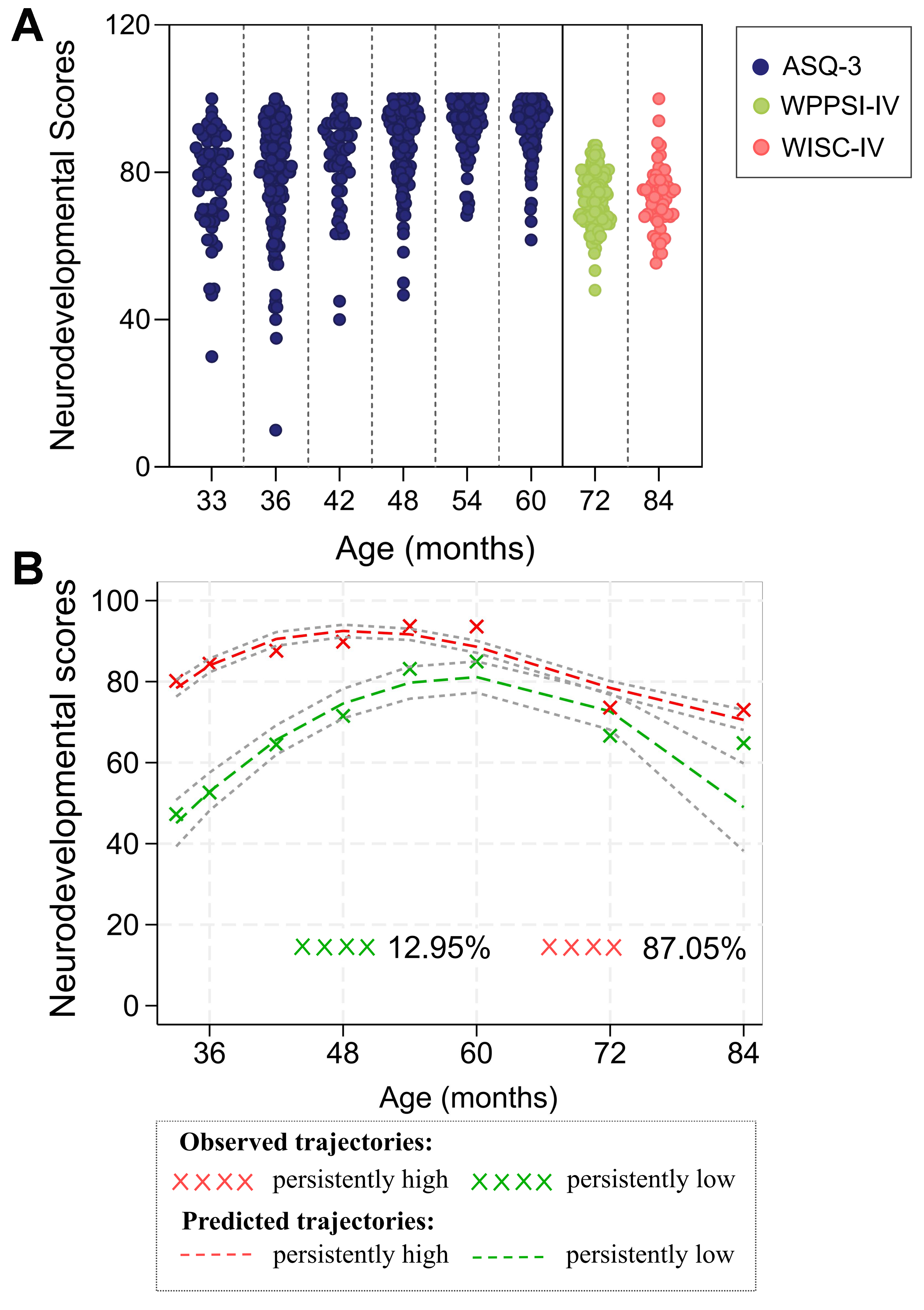
Figure 1. Neurodevelopmental trajectories of children aged 33-84 months (n = 278), modeled using GBTM. (A) Age-dependent changes in neurodevelopmental scores. Neurodevelopmental scores are normalized based on the ASQ total score and the Wechsler IQ total score obtained between 33-84 months of age. A detailed rationale for this approach is provided in Supplementary Text 2, where we explain its scientific basis and the importance of ensuring comparability across assessment methods; (B) Predicted trajectories (dashed lines: red for high, green for low) and observed data (symbols: red crosses for high, green crosses for low). Based on the maximum posterior probability rule, 36 children (12.95%) were classified into the persistently low group and 242 children (87.05%) into the persistently high group for subsequent analyses. Trajectory groups were named according to their initial values and subsequent trends. GBTM: Group-based trajectory modeling; ASQ-3: Ages & Stages Questionnaires, Third Edition; WPPSI-IV: Wechsler Preschool and Primary Scale of Intelligence–Fourth Edition; WISC-IV: Wechsler Intelligence Scale for Children–Fourth Edition.
The low-trajectory group comprised 12.95% of the sample. In covariate-adjusted logistic regression models, several legacy PFAS were associated with increased odds of belonging to the persistently low trajectory group, with the high-score group as the reference [Figure 2A and Supplementary Table 16]. Extending prior findings focused on infancy and toddlerhood[17,71], we observed that prenatal exposure to legacy PFAS (PFDA, PFDoDA, and PFUnDA) remained significantly associated with low neurodevelopmental trajectories even as children transitioned into the preschool years. Specifically, a per ln-unit increase in prenatal concentration of PFDA concentration was associated with a 138% increase in the odds of low neurodevelopmental trajectories (OR = 2.38; 95%CI: 1.05-5.37). Similarly, significant positive associations were observed for PFDoDA (OR = 1.66; 95%CI: 1.10-2.52) and PFUnDA (OR = 2.36; 95%CI: 1.00-5.54). Similar associations have been reported in other trajectory-based studies during infancy, where elevated prenatal levels of PFDA, PFDoDA, and PFUnDA were linked to increased risks of adverse neurodevelopmental outcomes, including low communication and problem-solving trajectories[17,18]. However, our study is the first to reveal that these associations extend into the critical preschool period. This suggests that prenatal PFAS exposure may act as a latent risk factor, predisposing children to suboptimal developmental pathways even years after birth. The observed association with low trajectories may be partly explained by PFAS interfering with critical periods of neurodevelopment in the preschool years. Experimental studies indicate that PFAS can disrupt synaptic pruning, glutamatergic signaling, and neurotransmitter systems[78-80], mechanisms essential for the cortical maturation that underlies higher-order cognitive functions.
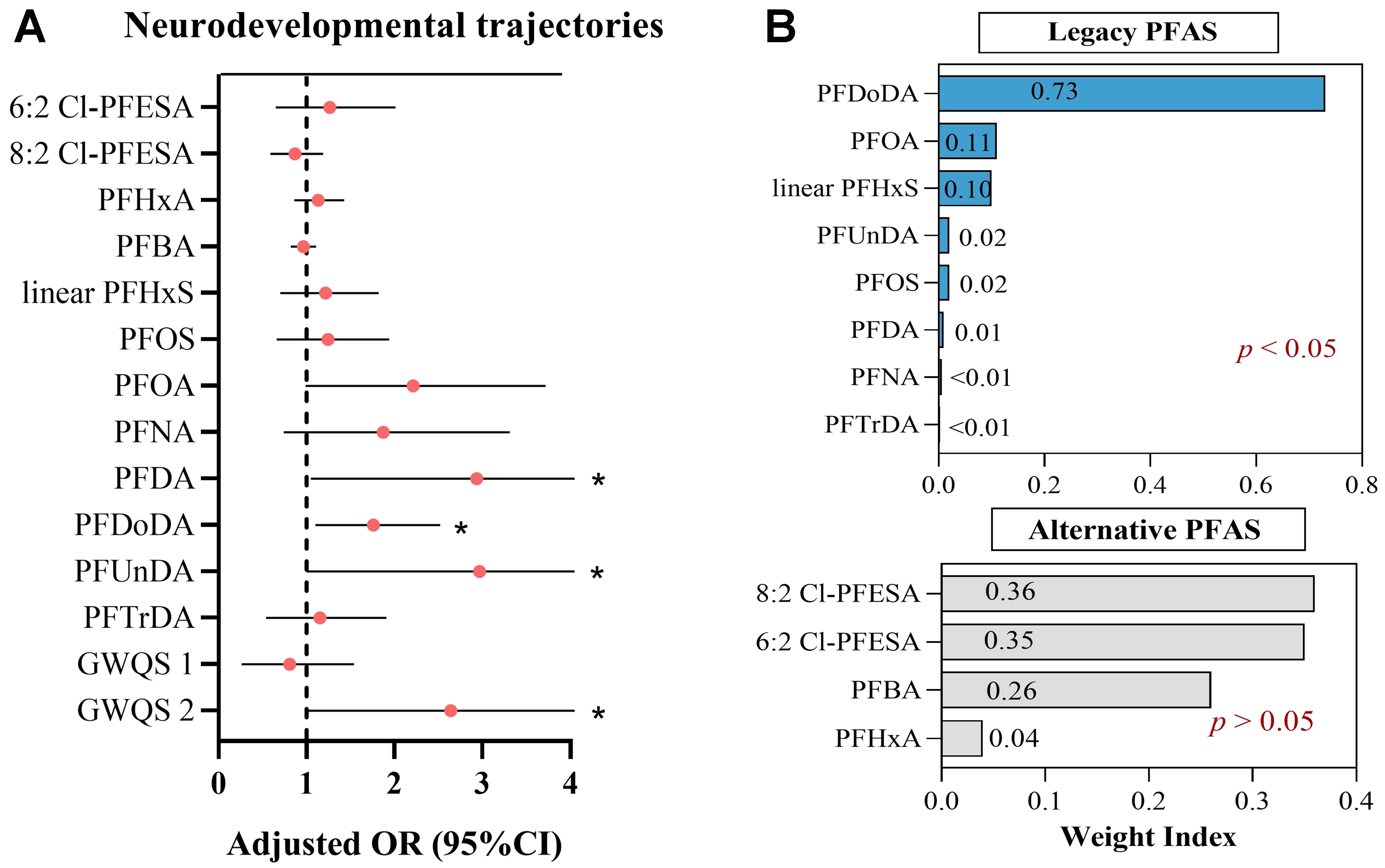
Figure 2. Associations of third-trimester maternal PFAS exposure (individual and mixture) with neurodevelopmental trajectories in preschool children (33-84 months). (A) Associations between maternal serum concentrations of individual PFAS compounds (ng/mL) and neurodevelopmental trajectories in preschool-aged children, measured by neurodevelopmental scores. ORs and 95%CIs were calculated through logistic regression and GWQS regression models to compare children in the persistently low trajectory group with those in the persistently high trajectory group (n = 278). *P < 0.05. Two GWQS indices were created: GWQS 1 for exposure to alternative PFAS (6:2 Cl-PFESA, 8:2 Cl-PFESA, PFHxA, PFBA), and GWQS 2 for exposure to legacy PFAS (PFDoDA, PFOA, linear PFHxS, PFUnDA, PFOS, PFDA, PFNA, and PFTrDA). The GWQS indices for each group were evaluated, where a one-unit increase in the GWQS index signified a quartile increase in the PFAS mixture of each group; (B) Relative weights of individual PFAS within the mixture models in GWQS regression. Mean weights and selection frequencies were estimated from 100 bootstrap samples. Legacy PFAS GWQS model: coefficient = 0.779 (SE = 0.395, P = 0.048); Alternative PFAS GWQS model: coefficient = -0.455 (SE = 0.452, P = 0.314). The top panel shows legacy PFAS, and the bottom panel shows alternative PFAS. Larger weight indices indicate greater contributions of specific PFAS compounds to the mixture’s overall effect on neurodevelopmental trajectories. All models were controlled for maternal age, pre-pregnancy BMI, parity, maternal education, family income, maternal passive smoking before pregnancy, alcohol drinking, folic acid or vitamin supplementation during pregnancy, child sex, and gestational age. PFAS: polyfluoroalkyl substances; ORs: odds ratios; CIs: confidence intervals; GWQS: grouped weighted quantile sum; 6:2 Cl-PFESA: 6:2 chlorinated polyfluorinated ether sulfonate acid; 8:2 Cl-PFESA: 8:2 chlorinated polyfluorinated ether sulfonate acid; PFHxA: perfluoro-n-hexanoic acid; PFBA: perfluoro-n-nbutanoic acid; PFDoDA: perfluoro-n-dodecanoic acid; PFOA: perfluorooctanoic acid; PFHxS: perfluoro-1-hexane sulfonate; PFUnDA: perfluoro-n-undecanoic acid; PFOS: perfluorooctane sulfonate; PFDA: perfluoro-n-decanoic acid; PFNA: perfluoro-n-nonaoic acid; PFTrDA: perfluoro-n-tridecanoic acid; SE: standard error; BMI: body mass index; PFDA: perfluoro-n-decanoic acid.
In addition, a significant association was observed between the legacy PFAS mixture and the persistently low neurodevelopmental trajectory group (P < 0.05). Specifically, each quartile increase in the legacy PFAS GWQS index was associated with increased odds of belonging to the persistently low neurodevelopmental trajectory group (OR = 2.18, 95%CI: 1.01-4.73). Consistent with these findings, PFDoDA (0.73) and PFOA (0.11) were assigned the highest weights in the mixture analysis [Figure 2B]. The high weights of these specific compounds in the GWQS model, a finding corroborated by their adverse trends in our single-exposure analyses, may be attributed to their distinct and potent toxicological profiles. PFDoDA, a long-chain PFAS, likely exerts its dominant influence through its exceptional bioaccumulation potential[81]. PFOA, in contrast, is a well-established developmental toxicant known for efficient placental transfer and its role as a PPARα agonist[61], which can directly interfere with neuronal differentiation and lipid metabolism in the developing brain[55]. This pattern, where specific compounds with strong individual toxicities drive the overall mixture effect, aligns with previous mixture studies that also identified PFOA as a key contributor[17]. Oh et al. demonstrated through principal component analysis that a principal component comprising PFOS, PFOA, PFHxS, and PFNA was positively associated with an increased odds of autism spectrum disorder (ASD) [relative risk (RR) = 1.10; 95%CI: 0.97-1.25][82]. Similarly, another study reported that PFAS mixture exposure was negatively correlated with nonverbal working memory (β = -0.08; 95%CI: -0.12~-0.03)[66]. In the study by Li et al.[17], the GWQS regression was employed to evaluate the combined effects of PFAS mixtures, revealing that legacy PFAS mixtures were positively associated with the risk of low trajectories in gross motor function and problem-solving ability, primarily contributed by PFOS and PFOA. Given the real-world co-exposure to multiple environmental chemicals, future research should further explore their cumulative impact on neurodevelopment.
Our findings further reinforce the significant association between prenatal exposure to legacy PFAS and adverse neurodevelopmental trajectories, highlighting the importance of early exposure assessment and providing novel insights into the underlying mechanisms.
Regulatory role of primary conjugated BAs in the association between PFAS and neurodevelopment
In an exploratory analysis, we evaluated serum levels of 15 BAs in 3-year-old children (Median: 34 months) to investigate the interaction effect of BAs on the association between PFAS and neurodevelopment. An RF model identified several BAs as important predictors of low neurodevelopmental trajectories, with TCA, GHCA, TCDCA, and GCDCA showing the highest relative importance [Figure 3A]. Notably, six of these eight top-ranked BAs were primary conjugated BAs (TCA, GHCA, TCDCA, GCDCA, GCA, and THCA). These findings were supported by multivariable linear regression analyses.
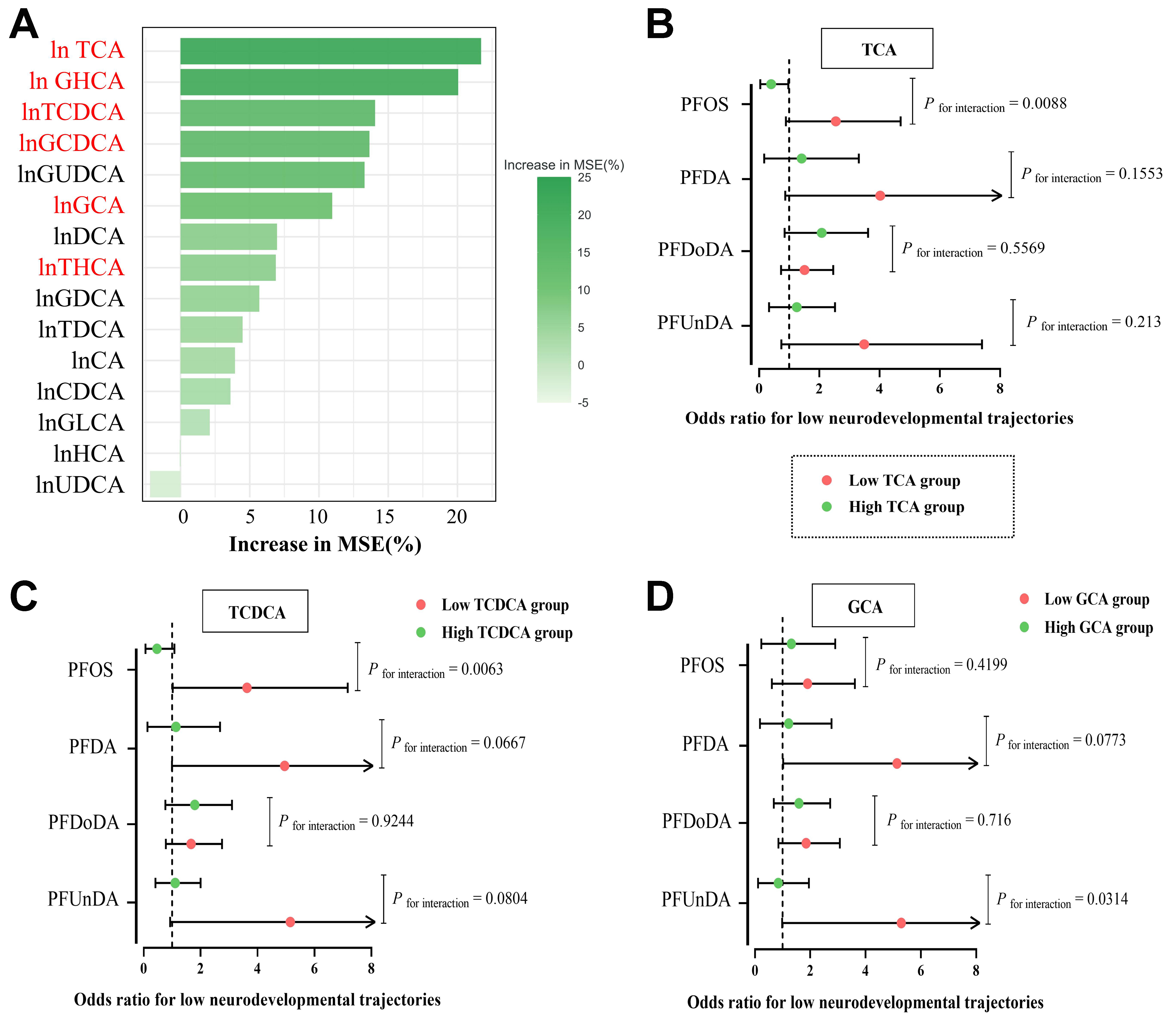
Figure 3. Regulatory role of primary conjugated BAs in the association between prenatal PFAS exposure and neurodevelopmental trajectories (n = 225). (A) Identification of key primary conjugated BAs predictive of neurodevelopment. RF analysis ranked BAs by their importance in predicting children’s neurodevelopmental trajectories (%IncMSE). Six of these eight top-ranked BAs were primary conjugated BAs (TCA, GHCA, TCDCA, GCDCA, GCA, and THCA); (B-D) Logistic regression models were employed to estimate the associations (ORs and 95%CIs) between maternal serum PFAS concentrations during pregnancy and children’s neurodevelopmental trajectories, stratified by child TCA, TCDCA, and GCA levels (high vs. low, median split). Interaction P-values reflect effect modification. For interaction terms, we considered P < 0.1 as nominally significant. The ORs indicate the likelihood of a child being in the persistently low neurodevelopmental trajectory group, with the persistently high group as the reference. All models were controlled for maternal age, pre-pregnancy BMI, parity, maternal education, family income, maternal passive smoking before pregnancy, alcohol drinking, folic acid or vitamin supplementation during pregnancy, child sex, and gestational age. Detailed estimates are presented in Supplementary Tables 17-22. BAs: Bile acids; PFAS: per- and polyfluoroalkyl substances; RF: random forest; %IncMSE: percentage increase in mean squared error; TCA: taurocholic acid; GHCA: glycohyocholic acid; TCDCA: taurochenodeoxycholic acid; GCDCA: glycochenodeoxycholic acid; GCA: glycocholic acid; THCA: taurohyocholic acid; ORs: odds ratios; CIs: confidence intervals; BMI: body mass index; GUDCA: glycoursodeoxycholilc acid; DCA: deoxycholic acid; GDCA: glycodeoxycholic acid; TDCA: taurodeoxycholic acid; CA: cholic acid; CDCA: chenodeoxycholic acid; GLCA: glycolithocholic acid; HCA: hyocholic acid; UDCA: ursodeoxycholic acid; PFOS: perfluorooctane sulfonate; PFDA: perfluoro-n-decanoic acid; PFDoDA: perfluoro-n-dodecanoic acid; PFUnDA: perfluoro-n-undecanoic acid.
Since primary conjugated BAs showed significant relevance to neurodevelopment, we further investigated their interactions with PFAS exposure. We stratified six primary conjugated BA levels into two groups based on the median concentrations. In an exploratory analysis, stratified logistic regression analyses were conducted to identify potential interactions (all Pfor interaction < 0.1) between PFOS, PFDA, and PFUnDA exposure and primary conjugated BA levels. For example, among children with high TCA concentrations, each 1-ln unit increase in prenatal PFOS concentration was associated with 80% lower odds of low neurodevelopmental trajectories (OR = 0.20; 95%CI: 0.04-0.97; Pfor interaction = 0.0088), whereas the opposite pattern was observed in the low TCA group [Figure 3B and Supplementary Table 17]. Consistent findings were observed for TCDCA [Figure 3C and Supplementary Table 18]. In children with lower TCDCA levels, each ln unit of PFOS was significantly associated with 170% increased odds of low neurodevelopmental trajectories (OR = 2.70; 95%CI: 1.02-7.17), while these associations were markedly reversed in children with higher TCDCA levels (Pfor interaction = 0.0063).
Moreover, we detected statistically significant interactions between GCA and PFDA (Pfor interaction = 0.0773), as well as between GCA and PFUnDA (Pfor interaction = 0.0314) and between TCDCA and PFUnDA (Pfor interaction = 0.0804) [Figure 3C and D, Supplementary Tables 18 and 19]. This established context provides a critical foundation for interpreting our central observation: that specific primary conjugated BAs - most notably TCA and TCDCA, which showed robust interaction with PFOS (all Pfor interaction < 0.01) - significantly modify the association between maternal PFAS exposure and neurodevelopmental trajectories in preschool-aged children. Our interaction analyses revealed that lower circulating levels of these BAs amplified the adverse associations of prenatal PFOS and PFDA exposure with low neurodevelopmental trajectories. This pattern raises the possibility that a reduced capacity of this specific BA profile could be associated with exacerbated neurodevelopmental susceptibility to PFAS.
We also observed similar modifying trends for other primary conjugated BAs (GCDCA, GHCA, and THCA) in the exploratory analyses, as shown in Supplementary Figure 4 and Supplementary Tables 20-22. The biological plausibility of this finding is supported by converging evidence from BA neurobiology and PFAS toxicology. The ability of BAs to function as multifunctional signaling molecules stems from their amphipathic nature and extensive structural diversity, which enables specific interactions with a range of receptors[83]. This structure-activity relationship underlies the ability of different BA species to exert specialized effects on a wide range of processes, including inflammatory responses, metabolic homeostasis, intestinal barrier function, and nervous system health via the gut-brain axis[84]. In particular, primary conjugated BAs, including TCA and TCDCA, have been implicated in key neuroprotective processes, and evidence suggests that they mediate these and other systemic effects - such as the regulation of inflammation, maintenance of intestinal barrier integrity, and modulation of metabolic homeostasis - primarily through the farnesoid X receptor (FXR)[85,86].
Beyond these systemic roles, emerging evidence suggests that primary conjugated BAs such as TCA and TCDCA may play unique roles in supporting neuronal health. For instance, experimental studies have shown that these BAs can modulate intracellular calcium signaling and mitochondrial function, which are critical for neuronal survival and activity[87]. Additionally, TCA levels in the brain have been reported to be significantly lower in patients with Alzheimer’s disease[88], implying a possible association between reduced primary conjugated BA levels and neurodegenerative processes. This evidence further reinforces our research findings.
PFAS exposure has also been associated with disruption of the metabolic environment in which BAs function. Experimental studies have shown that PFAS can perturb BA metabolism by inhibiting key synthesis enzymes (e.g., CYP7A1, CYP27A1)[89] and activating the PPARα pathway[90,91]. Additionally, PFAS exposure has been linked to alterations in gut microbiota composition, which may contribute to gut barrier dysfunction, oxidative stress, and chronic neuroinflammation - pathways that have been implicated in neurodevelopmental impairments[80,92]. Importantly, while BA profiles may reflect upstream alterations in gut microbiota composition[38,39], systemic metabolic status[41], or nutritional factors[39], accumulating evidence also supports their potential functional role in PFAS-associated pathophysiology. Animal studies demonstrate that PFAS exposure directly perturbs BA homeostasis - elevating circulating BAs and altering ileal apical sodium-dependent bile acid transporter (ASBT) expression[89] - consistent with disrupted enterohepatic recirculation. Concurrently, BAs act as signaling molecules via FXR and TGR5, which regulate metabolic, inflammatory, and neuroactive
When interpreting the effect modification by BAs, the temporal relationship between the measurement at age 3 and neurodevelopment through age 7 warrants consideration. Evidence suggests the gut-microbiota-BA axis matures to a more stable, adult-like state around age 3 compared to infancy[38,39]. The lagged analyses, adjusting for 33-month baseline scores, revealed consistent associations between early-childhood BA levels and subsequent neurodevelopmental scores. These findings support that this metabolic phenotype is a relevant and persistent modifier during early childhood, corroborating evidence from prospective birth cohort studies[93].
Collectively, the observed pattern - where higher levels of specific primary conjugated BAs (e.g., TCA, TCDCA) were associated with an attenuation of the adverse PFAS-neurodevelopment association - is consistent with a metabolic profile that may reflect a homeostatic or adaptive response. This interpretation is speculative and offered as a plausible hypothesis. It synthesizes our epidemiological finding with separate lines of evidence indicating that such a BA profile possesses anti-inflammatory and cell-protective properties[24,87], whereas PFAS exposure has been linked to pro-inflammatory and disruptive biological processes[94,95]. Consequently, higher primary conjugated BA levels were associated with lower odds of low neurodevelopmental trajectories, compatible with the idea that this metabolic profile might attenuate the adverse neurodevelopmental associations of PFAS exposure in an observational context. This interaction might align with known roles of BAs in modulating gut barrier function, inflammatory tone, and neural homeostasis - pathways implicated in neurodevelopment[96].
While previous epidemiological studies have primarily reported suppressive effects of PFAS on overall BA levels[27], our study advances the field by identifying that the relative abundance of specific primary conjugated BAs can modify the neurodevelopmental risks posed by prenatal PFAS exposure. This underscores the importance of evaluating not just BA concentrations, but their functional roles in the context of environmental toxicants.
Finally, a potential alternative explanation is reverse causality, whereby a child’s neurodevelopmental trajectory could influence subsequent dietary patterns, potentially creating an indirect association with BA metabolism. This consideration is supported by previous studies indicating that children with neurodevelopmental disorders, such as autism, often exhibit food selectivity, which can shape gut microbial composition[97,98]. Given the established role of gut microbiota in converting primary to secondary BAs[99], a theoretical pathway from neurodevelopment to diet and then to BA pool composition is plausible. However, the specific BA metabolites we identified as significant effect modifiers were primary conjugated BAs, such as TCA and TCDCA. The homeostasis of these primary BAs is governed by hepatic synthesis and enzymatic conjugation - processes under tight host control[100,101]. Consequently, their systemic levels are more stable and less susceptible to dietary influence than those of secondary BAs. Our lagged analyses further support this interpretation, demonstrating that BA levels at age 3 predict subsequent neurodevelopmental changes after controlling for baseline status at 33 months [Supplementary Figures 5 and 6]. Moreover, mechanistic evidence indicates that BAs act as signaling molecules influencing neuronal health through nuclear receptors, with reduced TCA levels linked to neurodegenerative pathology[24,88]. Crucially, BA levels were measured at age 3, before the assessment of neurodevelopmental trajectories from 33-84 months. This temporal sequence, combined with the specific biology of primary BAs and the supporting evidence from our lagged analyses and mechanistic studies, makes it unlikely that reverse causality is the primary explanation for our observations, although bidirectional gut-brain axis effects cannot be entirely ruled out. Future studies should integrate experimental models with large-scale population data to further elucidate the mechanisms underlying BA-PFAS interactions in neurodevelopment. Specifically, experimental models are needed to determine whether targeted BA modulation (e.g., ASBT inhibition or FXR/TGR5 agonism) can attenuate PFAS-induced neurodevelopmental deficits in vivo or in vitro.
Sensitivity analysis
The robustness of the primary findings was confirmed through sensitivity analyses. After adjusting for delivery method and breastfeeding duration, the associations between key legacy PFAS and the low neurodevelopmental trajectory remained stable. The association for PFDA was nearly identical (sensitivity analysis OR = 2.38, 95%CI: 1.05-5.39; primary analysis OR = 2.38, 95%CI: 1.05-5.37). Similarly, the associations for PFDoDA and PFUnDA also remained statistically significant in the sensitivity analysis [Supplementary Table 23]. Our sensitivity analyses further showed consistent associations between BA levels at age 3 and neurodevelopmental scores at later time points. In lagged analyses adjusting for the 33-month baseline neurodevelopmental score, higher levels of primary conjugated BAs - particularly GCA, TCA, and TCDCA - remained significantly associated with higher neurodevelopmental scores across subsequent time points (42-84 months) [Supplementary Figures 5 and 6]. To further validate the robustness of our results, we conducted a sensitivity analysis by comparing the neurodevelopmental trajectories between ages 0-84 months with those from 33-84 months. The trajectory patterns were highly consistent with those obtained from the main analysis (33-84 months), with comparable group structures and developmental trends observed across both timeframes [Supplementary Figures 7 and 8]. Additionally, we assessed the stability of the trajectory classification itself by sequentially excluding later-age cognitive assessments. The identification of the “low neurodevelopmental trajectory” group proved highly robust, with consistent trajectory shapes and stable group membership (> 90% agreement) across models that utilized different subsets of the assessment instruments [Supplementary Table 24]. Together, these analyses provide evidence that the identified developmental phenotype is not dependent on any single tool used in the assessment battery.
Strengths
This study has several notable strengths. First, to our knowledge, this study provides novel longitudinal evidence on the modifying role of specific primary conjugated BA profiles (e.g., TCA, TCDCA, and GCA) in the association between maternal PFAS exposure and neurodevelopmental trajectories among preschool-aged children (33-84 months). While previous epidemiologic studies have separately examined the associations between maternal PFAS exposure and neurodevelopmental trajectories, as well as the links between PFAS and primary BA profiles, the modifying effects of primary BA profiles on the association between maternal PFAS exposure and neurodevelopmental trajectories have not been explored[17,27,71]. Our findings reveal that BAs may act as critical mediators in this relationship, highlighting a novel pathway for future investigation. Second, unlike most previous studies that employed cross-sectional designs or static analyses to assess neurodevelopment at a single time point, our study applied a GBTM approach to follow children longitudinally from age 3 to 7. This innovative method enabled us to capture the dynamic evolution of neurodevelopment over time, rather than providing a static snapshot. By identifying distinct developmental trajectories, GBTM allowed us to characterize heterogeneous neurodevelopmental patterns, evaluate potential delayed or cumulative effects of maternal PFAS exposure, and pinpoint sensitive windows during the preschool period[71-73]. Third, previous longitudinal studies have predominantly focused on infancy or toddlerhood (i.e., under 36 months)[17,71]. The preschool period is a key developmental window characterized by significant neurobiological changes[21,22], which remains underexplored in PFAS-related research. Our study uniquely addresses this gap by prospectively following children from 33 to 84 months of age, thus comprehensively covering the entire preschool period and providing novel insights into the long-term neurodevelopmental outcomes associated with maternal PFAS exposure. Fourth, by integrating GWQS regression, we assessed the mixture effects of both legacy and emerging PFAS, and found that legacy PFAS mixtures were more strongly associated with lower neurodevelopmental trajectories. The use of GWQS allowed us to address the real-world scenario of simultaneous exposure to multiple PFAS compounds and to quantify their joint effects, which has been underexplored in pediatric populations[17,102,103]. Together, these approaches offered a more comprehensive and refined assessment of PFAS exposures, contributing to a better understanding of their cumulative impact on neurodevelopment during the preschool period.
Limitations
Our study has several limitations. First, although this study provides longitudinal evidence on PFAS-related neurodevelopmental trajectories, the sample size is relatively modest. However, we rigorously evaluated the risk of overfitting using established model selection criteria (BIC, AvePP > 0.70, entropy), post-hoc power analyses, and bootstrap validation, which collectively support the robustness of the two-group trajectory solution. Our findings should be considered exploratory, and replication in larger, independent cohorts is warranted. Second, we cannot rule out residual confounding from unmeasured exposures to other neurotoxicants[75], such as heavy metals and microplastics, or from more detailed aspects of maternal nutrition[47]. Future studies with comprehensive biomonitoring of multiple contaminant and nutrient profiles, coupled with multi-omics approaches, are warranted to better understand these potential interactive effects on neurodevelopment within a broader systemic context. Third, while epidemiological evidence suggests BAs may modify PFAS neurotoxicity, the observational design cannot establish causality. BA alterations may reflect gut microbiota composition[38,39], metabolic status[41], or nutritional factors[39], rather than direct mechanistic effectors. Although PFAS-induced BA shifts correlate with metabolic outcomes[27] and animal studies demonstrate direct perturbation of enterohepatic circulation, causal involvement in neurotoxicity requires validation via neural organoids, targeted animal models, and multi-omics integration. Given the logistical challenges and lack of longitudinal BA data in early childhood, this design represents a practical and hypothesis-generating approach. Correspondingly, the evidence for PFAS-BA interactions presented here is preliminary and exploratory. Our analyses used a nominal significance level (P < 0.1) to improve the detection of potential signals, and the wide CIs indicate limited precision. Future research with larger cohorts is needed to apply stricter multiple testing corrections and robustly validate these preliminary findings. Fourth, BA concentrations in our study were measured cross-sectionally at age 3, whereas neurodevelopmental outcomes were assessed longitudinally from ages 3 to 7. This temporal misalignment may raise concerns, particularly given the potential for BA profiles to vary across developmental stages. However, existing studies suggest that pediatric BA profiles remain relatively stable in the absence of hepatobiliary or intestinal disease[38,39]. Additionally, previous literature indicates that early-life metabolic profiles can predict long-term neurodevelopment[23], reinforcing the value of age-3 BA measurements as biologically meaningful markers. Given the logistical challenges and lack of longitudinal BA data in early childhood, this design represents a practical and scientifically justified approach. We acknowledge that a single BA measurement cannot capture potential temporal fluctuations, and future studies with repeated BA sampling across childhood would further strengthen causal inference. Lastly, our study focused on neurodevelopmental trajectories from 33 to 84 months of age, excluding the earlier period from 0 to 33 months. This may limit the comprehensiveness of our findings across the full early childhood developmental window. However, this design aimed to capture exposure effects during the preschool years - a critical window for higher-order cognitive, language, and socioemotional development. Importantly, supplementary analyses of 0-84-month trajectories showed high concordance with the 33-84-month sub-trajectories [Supplementary Figure 8], supporting the robustness of our findings. Although the ASQ-3 exhibits a ceiling effect in older children (a well-documented psychometric property), our sensitivity analyses demonstrated greater than 91% agreement in trajectory classification between the ASQ-only model and the primary full model [Supplementary Table 24].
CONCLUSION
In summary, this longitudinal study identifies primary conjugated BAs - particularly TCA and TCDCA - as effect modifiers of prenatal PFAS–neurodevelopment associations. Higher childhood levels of these BAs were associated with attenuated adverse effects of legacy PFAS. These findings suggest that BA profiles may facilitate risk stratification or early identification of vulnerable children, though validation in independent cohorts is needed. Future research should also explore whether nutritional or microbial strategies that promote a favorable BA profile could mitigate PFAS-related neurodevelopmental risks, and clarify the underlying mechanisms, potentially involving the gut-brain axis.
DECLARATIONS
Authors’ contributions
Conceptualization: Zhang, Q.; Li, Y. X.; Chen, H. L.; Lin, H. C.; He, C. W.; Hou, C. Y.; Zheng, C. L.; Cai, D.; Dong, G. H.; Zeng, X. W.
Data curation: Zhang, Q.; Li, Y. X.; Chen, J.; Zeng, X. W.
Formal analysis: Zhang, Q.; Li, Y. X.; Chen, H. L.
Methodology: Zhang, Q.; Li, Y. X.; Chen, H. L.; Ma, H. M.
Visualization: Zhang, Q.; Lin, H. C.; Qu, F. F.; Tan, S. Q.
Writing - original draft: Zhang, Q.; Li, Y. X.
Writing - review and editing: Zhang, Q.; Chen, H. L.; Zeng, X. W.
Supervision: Chen, J.; Zeng, X. W.
Resources: Chen, J.; Zeng, X. W.
Project administration: Zeng, X. W.
Funding acquisition: Dong, G. H.; Zeng, X. W.
All authors approved the final manuscript.
Availability of data and materials
The original contributions presented in this study are included in the article/Supplementary Materials. Further inquiries can be directed to the corresponding authors.
AI and AI-assisted tools statement
Not applicable.
Financial support and sponsorship
This work was supported by the National Key Research and Development Program of China (2024YFC3712003), the National Natural Science Foundation of China (No. 42107468), the Natural Science Foundation of Guangdong Province (No. 2024A1515010655, 2023A1515011425), the Guangzhou Science and Technology Project (No. 2024A04J6476) and the Fundamental Research Funds for the Central Universities (21625310). We are grateful to all participants and investigators involved in this project.
Conflicts of interest
Zeng, X. W. is an Editorial Board Member of the journal Journal of Environmental Exposure Assessment and a Guest Editor of the Special Issue “Exposure to PFAS and Other Emerging Contaminants: Health Effects and Molecular Mechanisms” in the same journal. Zeng, X. W. was not involved in any steps of editorial processing, notably including reviewer selection, manuscript handling, and decision-making. The other authors declare that there are no conflicts of interest.
Ethical approval and consent to participate
This study was approved by the Committee of Human Sciences at Sun Yat-sen University (approval no. SYSU-2016-018) and conducted in accordance with the Declaration of Helsinki. Written informed consent was obtained from the parents or legal guardians of all participating children prior to inclusion in the study.
Consent for publication
Not applicable.
Copyright
© The Author(s) 2026.
Supplementary Materials
REFERENCES
1. Banyoi, S.; Porseryd, T.; Larsson, J.; Grahn, M.; Dinnétz, P. The effects of exposure to environmentally relevant PFAS concentrations for aquatic organisms at different consumer trophic levels: systematic review and meta-analyses. Environ. Pollut. 2022, 315, 120422.
2. Wang, Z.; Dewitt, J. C.; Higgins, C. P.; Cousins, I. T. A never-ending story of per- and polyfluoroalkyl substances (PFASs)? Environ. Sci. Technol. 2017, 51, 2508-18.
3. Sunderland, E. M.; Hu, X. C.; Dassuncao, C.; Tokranov, A. K.; Wagner, C. C.; Allen, J. G. A review of the pathways of human exposure to poly- and perfluoroalkyl substances (PFASs) and present understanding of health effects. J. Expo. Sci. Environ. Epidemiol. 2018, 29, 131-47.
4. Bjerregaard-Olesen, C.; Bossi, R.; Liew, Z.; et al. Maternal serum concentrations of perfluoroalkyl acids in five international birth cohorts. Int. J. Hyg. Environ. Health. 2017, 220, 86-93.
5. Cariou, R.; Veyrand, B.; Yamada, A.; et al. Perfluoroalkyl acid (PFAA) levels and profiles in breast milk, maternal and cord serum of French women and their newborns. Environ. Int. 2015, 84, 71-81.
6. Fei, C.; Mclaughlin, J. K.; Tarone, R. E.; Olsen, J. Perfluorinated chemicals and fetal growth: a study within the Danish national birth cohort. Environ. Health. Perspect. 2007, 115, 1677-82.
7. Ma, D.; Lu, Y.; Liang, Y.; et al. A critical review on transplacental transfer of per- and polyfluoroalkyl substances: prenatal exposure levels, characteristics, and mechanisms. Environ. Sci. Technol. 2021, 56, 6014-26.
8. Rice, D.; Barone, S. Critical periods of vulnerability for the developing nervous system: evidence from humans and animal models. Environ. Health. Perspect. 2000, 108, 511-33.
9. Mshaty, A.; Haijima, A.; Takatsuru, Y.; et al. Neurotoxic effects of lactational exposure to perfluorooctane sulfonate on learning and memory in adult male mouse. Food. Chem. Toxicol. 2020, 145, 111710.
10. Wang, X.; Shi, X.; Zheng, S.; et al. Perfluorooctane sulfonic acid (PFOS) exposures interfere with behaviors and transcription of genes on nervous and muscle system in zebrafish embryos. Sci. Total. Environ. 2022, 848, 157816.
11. Gao, X. X.; Zuo, Q. L.; Fu, X. H.; Song, L. L.; Cen, M. Q.; Wu, J. Association between prenatal exposure to per- and polyfluoroalkyl substances and neurodevelopment in children: evidence based on birth cohort. Environ. Res. 2023, 236, 116812.
12. Itoh, S.; Yamazaki, K.; Suyama, S.; et al. The association between prenatal perfluoroalkyl substance exposure and symptoms of attention-deficit/hyperactivity disorder in 8-year-old children and the mediating role of thyroid hormones in the Hokkaido study. Environ. Int. 2022, 159, 107026.
13. Vuong, A. M.; Webster, G. M.; Yolton, K.; et al. Prenatal exposure to per- and polyfluoroalkyl substances (PFAS) and neurobehavior in US children through 8 years of age: the HOME study. Environ. Res. 2021, 195, 110825.
14. Carrizosa, C.; Murcia, M.; Ballesteros, V.; et al. Prenatal perfluoroalkyl substance exposure and neuropsychological development throughout childhood: the INMA Project. J. Hazard. Mater. 2021, 416, 125185.
15. Xie, Z.; Liang, H.; Miao, M.; et al. Prenatal exposure to perfluoroalkyl substances and cognitive and neurobehavioral development in children at 6 years of age. Environ. Sci. Technol. 2023, 57, 8213-24.
16. Zhang, B.; Wang, Z.; Zhang, J.; et al. Prenatal exposure to per- and polyfluoroalkyl substances, fetal thyroid function, and intelligence quotient at 7 years of age: findings from the Sheyang Mini Birth Cohort Study. Environ. Int. 2024, 187, 108720.
17. Li, Q.; Huang, J.; Cai, D.; et al. Prenatal exposure to legacy and alternative per- and polyfluoroalkyl substances and neuropsychological development trajectories over the first 3 years of life. Environ. Sci. Technol. 2023, 57, 3746-57.
18. Zhou, Y.; Li, Q.; Wang, P.; et al. Associations of prenatal PFAS exposure and early childhood neurodevelopment: evidence from the Shanghai Maternal-Child Pairs Cohort. Environ. Int. 2023, 173, 107850.
19. Zhang, B.; Wang, Z.; Zhang, J.; et al. Prenatal perfluoroalkyl substances exposure and neurodevelopment in toddlers: findings from SMBCS. Chemosphere 2023, 313, 137587.
20. Oh, J.; Shin, H.; Nishimura, T.; Rahman, M. S.; Takahashi, N.; Tsuchiya, K. J. Perfluorooctanoate and perfluorooctane sulfonate in umbilical cord blood and child cognitive development: Hamamatsu Birth Cohort for Mothers and Children (HBC Study). Environ. Int. 2022, 163, 107215.
21. National Research Council (US) and Institute of Medicine (US) Committee on Integrating the Science of Early Childhood Development. From neurons to neighborhoods: the science of early childhood development. Washington (DC): National Academies Press; 2000.
22. Brown, T. T.; Jernigan, T. L. Brain development during the preschool years. Neuropsychol. Rev. 2012, 22, 313-33.
23. Choi, J. W.; Parenti, M.; Slupsky, C. M.; Tancredi, D. J.; Schmidt, R. J.; Shin, H. Maternal serum and placental metabolomes in association with prenatal exposure to per- and polyfluoroalkyl substances and their relevance to child neurodevelopment in an ASD-enriched cohort. Environ. Pollut. 2025, 383, 126811.
24. Kiriyama, Y.; Nochi, H. The biosynthesis, signaling, and neurological functions of bile acids. Biomolecules 2019, 9, 232.
25. Wu, Y.; Qiu, Y.; Su, M.; Wang, L.; Gong, Q.; Wei, X. Activation of the bile acid receptors TGR5 and FXR in the spinal dorsal horn alleviates neuropathic pain. CNS. Neurosci. Ther. 2023, 29, 1981-98.
26. Ren, Z.; Zhao, L.; Zhao, M.; et al. Increased intestinal bile acid absorption contributes to age-related cognitive impairment. Cell. Rep. Med. 2024, 5, 101543.
27. Guo, Y.; Huang, J.; Xue, J.; et al. Intrauterine exposure to long-chain perfluorocarboxylic acids (PFCAs) were associated with reduced primary bile acids in three-year-old children: findings from a prospective birth cohort study. Environ. Pollut. 2024, 360, 124583.
28. Wu, M.; Cheng, Y.; Zhang, R.; et al. Molecular mechanism and therapeutic strategy of bile acids in Alzheimer’s disease from the emerging perspective of the microbiota–gut–brain axis. Biomed. Pharmacother. 2024, 178, 117228.
29. Zhang, Y.; Li, J.; Li, J.; et al. Cross-sectional and longitudinal associations of circulating bile acids and dementia: a systematic review. GeroScience 2025, 48, 4789-804.
30. Cai, D.; Li, S.; Guo, Y.; et al. Effects of serum insulin and insulin-like growth factor 1 levels on the association between fetal growth and per- and polyfluoroalkyl substance exposure based on a nested case–control study. Environ. Sci. Technol. 2025, 59, 3841-52.
31. Li, J.; Cai, D.; Chu, C.; et al. Transplacental transfer of per- and polyfluoroalkyl substances (PFASs): differences between preterm and full-term deliveries and associations with placental transporter mRNA expression. Environ. Sci. Technol. 2020, 54, 5062-70.
32. Cai, D.; Li, Q.; Chu, C.; et al. High trans-placental transfer of perfluoroalkyl substances alternatives in the matched maternal-cord blood serum: evidence from a birth cohort study. Sci. Total. Environ. 2020, 705, 135885.
33. Hornung, R. W.; Reed, L. D. Estimation of average concentration in the presence of nondetectable values. Appl. Occup. Environ. Hyg. 1990, 5, 46-51.
34. Sjödin, A.; Wong, L.; Jones, R. S.; et al. Serum concentrations of polybrominated diphenyl ethers (PBDEs) and polybrominated biphenyl (PBB) in the United States population: 2003-2004. Environ. Sci. Technol. 2008, 42, 1377-84.
35. Wang, Y.; Rogan, W. J.; Chen, P.; et al. Association between maternal serum perfluoroalkyl substances during pregnancy and maternal and cord thyroid hormones: Taiwan maternal and infant cohort study. Environ. Health. Perspect. 2014, 122, 529-34.
36. Xiao, F. Emerging poly- and perfluoroalkyl substances in the aquatic environment: a review of current literature. Water. Res. 2017, 124, 482-95.
37. Calafat, A. M.; Kato, K.; Hubbard, K.; Jia, T.; Botelho, J. C.; Wong, L. Legacy and alternative per- and polyfluoroalkyl substances in the U.S. general population: paired serum-urine data from the 2013-2014 National Health and Nutrition Examination Survey. Environ. Int. 2019, 131, 105048.
38. Cheng, S.; Zhu, L.; Faden, H. S. Interactions of bile acids and the gut microbiota: learning from the differences in Clostridium difficile infection between children and adults. Physiol. Genomics. 2019, 51, 218-23.
39. Laursen, M. F. Gut microbiota development: influence of diet from infancy to toddlerhood. Ann. Nutr. Metab. 2021, 77, 21-34.
40. Tian, Y.; Rimal, B.; Gui, W.; et al. Early life short-term exposure to polychlorinated biphenyl 126 in mice leads to metabolic dysfunction and microbiota changes in adulthood. Int. J. Mol. Sci. 2022, 23, 8220.
41. Collins, S. L.; Stine, J. G.; Bisanz, J. E.; Okafor, C. D.; Patterson, A. D. Bile acids and the gut microbiota: metabolic interactions and impacts on disease. Nat. Rev. Microbiol. 2022, 21, 236-47.
42. Wechsler, D. Wechsler Preschool and Primary Scale of Intelligence. Fourth Edition (WPPSI-IV). 2012. https://www.pearsonassessments.com/en-us/store/professional-assessments/cognition-%26-neuro/wechsler-preschool-and-primary-scale-of-intelligence-%7c-fourth-edition/p/100000102?productId=0150012608&tab=faqs. (accessed on 17 Aug 2026).
43. Tong, J.; Liang, C.; Wu, X.; et al. Prenatal serum thallium exposure and cognitive development among preschool-aged children: a prospective cohort study in China. Environ. Pollut. 2022, 293, 118545.
44. Wechsler, D. Wechsler Intelligence Scale for Children, Fourth Edition (WISC-IV). APA PsycTests; 2003.
45. Bonham, K. S.; Fahur Bottino, G.; Mccann, S. H.; et al.; The RESONANCE Consortium. Gut-resident microorganisms and their genes are associated with cognition and neuroanatomy in children. Sci. Adv. 2023, 9, eadi0497.
46. Black, M.; Adjei, N. K. Longitudinal analysis of cognitive development across childhood and adolescence: evidence from the UK Millennium Cohort Study. Lancet 2022, 400, S23.
47. Wang, H.; Luo, F.; Zhang, Y.; et al. Prenatal exposure to perfluoroalkyl substances and child intelligence quotient: evidence from the Shanghai birth cohort. Environ. Int. 2023, 174, 107912.
48. Nagin, D. S.; Odgers, C. L. Group-based trajectory modeling in clinical research. Annu. Rev. Clin. Psychol. 2010, 6, 109-38.
49. Wieczorek, M.; Rotonda, C.; Coste, J.; et al. Trajectory analysis combining pain and physical function in individuals with knee and hip osteoarthritis: results from the French KHOALA cohort. Rheumatology 2020, 59, 3488-98.
50. Nagin, D. S.; Jones, B. L.; Passos, V. L.; Tremblay, R. E. Group-based multi-trajectory modeling. Stat. Methods. Med. Res. 2016, 27, 2015-23.
52. Hooda, S.; Mondal, P. Predictive modeling of plastic pyrolysis process for the evaluation of activation energy: explainable artificial intelligence based comprehensive insights. J. Environ. Manage. 2024, 360, 121189.
53. Zhan, L.; Zou, D.; Ma, L.; et al. Meta-analysis of the fate and transformation of heavy metals during pyrolysis process via data-mining the literature and machine learning. J. Anal. Appl. Pyrolysis. 2025, 190, 107169.
54. Cheng, Y.; Gu, K.; Ji, W.; Hu, Z.; Yang, Y.; Zhou, Y. Two-year hypertension incidence risk prediction in populations in the desert regions of Northwest China: prospective cohort study. J. Med. Internet. Res. 2025, 27, e68442.
55. Harris, M. H.; Oken, E.; Rifas-Shiman, S. L.; et al. Prenatal and childhood exposure to per- and polyfluoroalkyl substances (PFASs) and child cognition. Environ. Int. 2018, 115, 358-69.
56. Mogensen, U. B.; Grandjean, P.; Nielsen, F.; Weihe, P.; Budtz-Jørgensen, E. Breastfeeding as an exposure pathway for perfluorinated alkylates. Environ. Sci. Technol. 2015, 49, 10466-73.
57. Nohr, E. A.; Frydenberg, M.; Henriksen, T. B.; Olsen, J. Does low participation in cohort studies induce bias? Epidemiology 2006, 17, 413-8.
58. Meng, Q.; Inoue, K.; Ritz, B.; Olsen, J.; Liew, Z. Prenatal exposure to perfluoroalkyl substances and birth outcomes; an updated analysis from the Danish national birth cohort. Int. J. Environ. Res. Public. Health. 2018, 15, 1832.
59. Sagiv, S. K.; Rifas-Shiman, S. L.; Fleisch, A. F.; et al. Early-pregnancy plasma concentrations of perfluoroalkyl substances and birth outcomes in Project Viva: confounded by pregnancy hemodynamics? Am. J. Epidemiol. 2018, 187, 793-802.
60. Hjermitslev, M. H.; Long, M.; Wielsøe, M.; Bonefeld-Jørgensen, E. C. Persistent organic pollutants in Greenlandic pregnant women and indices of foetal growth: the ACCEPT study. Sci. Total. Environ. 2020, 698, 134118.
61. Lau, C.; Anitole, K.; Hodes, C.; Lai, D.; Pfahles-Hutchens, A.; Seed, J. Perfluoroalkyl acids: a review of monitoring and toxicological findings. Toxicol. Sci. 2007, 99, 366-94.
62. Niijima, S. Studies on the conjugating activity of bile acids in children. Pediatr. Res. 1985, 19, 302-7.
63. Zöhrer, E.; Resch, B.; Scharnagl, H.; et al. Serum bile acids in term and preterm neonates: a case–control study determining reference values and the influence of early-onset sepsis. Medicine 2016, 95, e5219.
64. Beck, I. H.; Bilenberg, N.; Möller, S.; et al. Association between prenatal and early postnatal exposure to perfluoroalkyl substances and IQ score in 7-year-old children from the Odense child cohort. Am. J. Epidemiol. 2023, 192, 1522-35.
65. Goodman, C. V.; Till, C.; Green, R.; et al. Prenatal exposure to legacy PFAS and neurodevelopment in preschool-aged Canadian children: the MIREC cohort. Neurotoxicol. Teratol. 2023, 98, 107181.
66. Skogheim, T. S.; Villanger, G. D.; Weyde, K. V. F.; et al. Prenatal exposure to perfluoroalkyl substances and associations with symptoms of attention-deficit/hyperactivity disorder and cognitive functions in preschool children. Int. J. Hyg. Environ. Health. 2020, 223, 80-92.
67. Spratlen, M. J.; Perera, F. P.; Lederman, S. A.; et al. The association between prenatal exposure to perfluoroalkyl substances and childhood neurodevelopment. Environ. Pollut. 2020, 263, 114444.
68. Vuong, A. M.; Yolton, K.; Xie, C.; et al. Prenatal and childhood exposure to poly- and perfluoroalkyl substances (PFAS) and cognitive development in children at age 8 years. Environ. Res. 2019, 172, 242-8.
69. Ames, J. L.; Sharma, V.; Lyall, K. Effects of early-life PFAS exposure on child neurodevelopment: a review of the evidence and research gaps. Curr. Envir. Health. Rep. 2025, 12, 9.
70. Currie, S. D.; Benson, D. B.; Xie, Z.; Wang, J.; Tang, L. Utilization of artificial intelligence coupled with a high-throughput, high-content platform in the exploration of neurodevelopmental toxicity of individual and combined PFAS. J. Xenobiot. 2025, 15, 24.
71. Oh, J.; Schmidt, R. J.; Tancredi, D.; et al. Prenatal exposure to per- and polyfluoroalkyl substances and cognitive development in infancy and toddlerhood. Environ. Res. 2021, 196, 110939.
72. Dayimu, A.; Qian, W.; Fan, B.; et al. Trajectories of haemoglobin and incident stroke risk: a longitudinal cohort study. BMC. Public. Health. 2019, 19, 1395.
73. Gao, Y.; Luo, J.; Zhang, Y.; et al.; for the Shanghai Birth Cohort. Prenatal exposure to per- and polyfluoroalkyl substances and child growth trajectories in the first two years. Environ. Health. Perspect. 2022, 130, 037006.
74. Hackman, D. A.; Farah, M. J. Socioeconomic status and the developing brain. Trends. Cogn. Sci. 2009, 13, 65-73.
75. Grandjean, P.; Landrigan, P. J. Neurobehavioural effects of developmental toxicity. Lancet. Neurol. 2014, 13, 330-8.
76. Shaw, P.; Greenstein, D.; Lerch, J.; et al. Intellectual ability and cortical development in children and adolescents. Nature 2006, 440, 676-9.
77. Campbell, F. A.; Ramey, C. T.; Pungello, E.; Sparling, J.; Miller-Johnson, S. Early childhood education: young adult outcomes from the Abecedarian Project. Appl. Dev. Sci. 2010, 6, 42-57.
78. Mahapatra, A.; Gupta, P.; Suman, A.; Ray, S. S.; Malafaia, G.; Singh, R. K. Unraveling the mechanisms of perfluorooctanesulfonic acid-induced dopaminergic neurotoxicity and microglial activation in developing zebrafish. Sci. Total. Environ. 2023, 887, 164030.
79. Li, Z.; Liu, Q.; Liu, C.; et al. Evaluation of PFOS-mediated neurotoxicity in rat primary neurons and astrocytes cultured separately or in co-culture. Toxicol. In. Vitro. 2017, 38, 77-90.
80. Wu, K.; Tang, A.; Zhang, X.; et al. Relationship between PFAS and attention-deficit/hyperactivity disorder or autism spectrum disorder: epidemiological and experimental evidence. Ecotoxicol. Environ. Saf. 2025, 302, 118519.
81. Xu, Y.; Fletcher, T.; Pineda, D.; et al. Serum half-lives for short- and long-chain perfluoroalkyl acids after ceasing exposure from drinking water contaminated by firefighting foam. Environ. Health. Perspect. 2020, 128, 077004.
82. Oh, J.; Bennett, D. H.; Calafat, A. M.; et al. Prenatal exposure to per- and polyfluoroalkyl substances in association with autism spectrum disorder in the MARBLES study. Environ. Int. 2021, 147, 106328.
83. Fleishman, J. S.; Kumar, S. Bile acid metabolism and signaling in health and disease: molecular mechanisms and therapeutic targets. Sig. Transduct. Target. Ther. 2024, 9, 97.
84. Wahlström, A.; Sayin, S. I.; Marschall, H.; Bäckhed, F. Intestinal crosstalk between bile acids and microbiota and its impact on host metabolism. Cell. Metab. 2016, 24, 41-50.
85. Wang, K.; Zhang, P.; Sun, H.; et al. Dual-function natural products: farnesoid X receptor agonist/inflammation inhibitor for metabolic dysfunction-associated steatotic liver disease therapy. Chin. J. Nat. Med. 2024, 22, 965-76.
86. Ge, X.; Huang, S.; Ren, C.; Zhao, L. Taurocholic acid and glycocholic acid inhibit inflammation and activate farnesoid X receptor expression in LPS-stimulated zebrafish and macrophages. Molecules 2023, 28, 2005.
87. Kiriyama, Y.; Nochi, H. Role of microbiota-modified bile acids in the regulation of intracellular organelles and neurodegenerative diseases. Genes 2023, 14, 825.
88. Pan, X.; Elliott, C. T.; Mcguinness, B.; et al. Metabolomic profiling of bile acids in clinical and experimental samples of Alzheimer’s disease. Metabolites 2017, 7, 28.
89. Yu, X.; Zhang, Y.; Cogliati, B.; et al. Distinct bile acid alterations in response to a single administration of PFOA and PFDA in mice. Toxicology 2024, 502, 153719.
90. Fragki, S.; Dirven, H.; Fletcher, T.; et al. Systemic PFOS and PFOA exposure and disturbed lipid homeostasis in humans: what do we know and what not? Crit. Rev. Toxicol. 2021, 51, 141-64.
91. Sadrabadi, F.; Alarcan, J.; Sprenger, H.; Braeuning, A.; Buhrke, T. Impact of perfluoroalkyl substances (PFAS) and PFAS mixtures on lipid metabolism in differentiated HepaRG cells as a model for human hepatocytes. Arch. Toxicol. 2023, 98, 507-24.
92. Guo, C.; Zhang, S.; Zhang, H.; et al. Per- and polyfluoroalkyl substances (PFAS) disrupt gut microbiome composition and metabolism in metabolic syndrome: evidence from a host-free in vitro colonic model. Environ. Pollut. 2025, 386, 127189.
93. Ahrens, A. P.; Hyötyläinen, T.; Petrone, J. R.; et al. Infant microbes and metabolites point to childhood neurodevelopmental disorders. Cell 2024, 187, 1853-73.e15.
94. Omoike, O. E.; Pack, R. P.; Mamudu, H. M.; et al. Association between per and polyfluoroalkyl substances and markers of inflammation and oxidative stress. Environ. Res. 2021, 196, 110361.
95. Wielsøe, M.; Long, M.; Ghisari, M.; Bonefeld-Jørgensen, E. C. Perfluoroalkylated substances (PFAS) affect oxidative stress biomarkers in vitro. Chemosphere 2015, 129, 239-45.
96. Staley, C.; Weingarden, A. R.; Khoruts, A.; Sadowsky, M. J. Interaction of gut microbiota with bile acid metabolism and its influence on disease states. Appl. Microbiol. Biotechnol. 2016, 101, 47-64.
97. Compañ-Gabucio, L.; Torres-Collado, L.; García-de-la-Hera, M. Dietary patterns in children with neurodevelopmental disorders. Nutrients 2024, 16, 2460.
98. Esposito, M.; Mirizzi, P.; Fadda, R.; et al. Food selectivity in children with autism: guidelines for assessment and clinical interventions. Int. J. Environ. Res. Public. Health. 2023, 20, 5092.
99. Ridlon, J. M.; Kang, D.; Hylemon, P. B. Bile salt biotransformations by human intestinal bacteria. J. Lipid. Res. 2006, 47, 241-59.
101. Hofmann, A. F.; Hagey, L. R. Key discoveries in bile acid chemistry and biology and their clinical applications: history of the last eight decades. J. Lipid. Res. 2014, 55, 1553-95.
102. Braun, J. M.; Gennings, C.; Hauser, R.; Webster, T. F. What can epidemiological studies tell us about the impact of chemical mixtures on human health? Environ. Health. Perspect. 2016, 124, A6-9.
Cite This Article
 Open Access
How to Cite
Download Citation
Export Citation File:
Type of Import
Tips on Downloading Citation
Citation Manager File Format
Type of Import
Direct Import: When the Direct Import option is selected (the default state), a dialogue box will give you the option to Save or Open the downloaded citation data. Choosing Open will either launch your citation manager or give you a choice of applications with which to use the metadata. The Save option saves the file locally for later use.
Indirect Import: When the Indirect Import option is selected, the metadata is displayed and may be copied and pasted as needed.
About This Article
Special Topic
Copyright

Data & Comments
Data
0










Comments
Comments must be written in English. Spam, offensive content, impersonation, and private information will not be permitted. If any comment is reported and identified as inappropriate content by OAE staff, the comment will be removed without notice. If you have any queries or need any help, please contact us at [email protected].