

Artificial intelligence for toxicokinetic parameterization in environmental exposure assessment
 0
0 
Graphical Abstract
Abstract
Toxicokinetics (TK) characterizes the absorption, distribution, metabolism, and excretion (ADME) of chemicals in the body and connects exposure with internal dose and potential toxicity. Because in vivo and in vitro TK assays are costly and low-throughput, and demand for emerging chemicals is growing, artificial intelligence and machine learning (AI/ML) offer alternative tools to predict ADME profiles for data-poor chemicals. This review examines recent developments in AI-based TK parameterization with relevance to environmental exposure assessment. First, we outline the essential elements of AI-based TK parameterization paradigms, including data sources, molecular representations, and commonly used ML algorithms. Second, the recent applications of AI/ML models across four ADME processes are introduced. Third, we discuss current limitations and future perspectives, including model reliability, interpretability, data availability for environmental chemicals, and integrating AI-predicted TK parameters into mechanistic models, such as physiologically based pharmacokinetic (PBPK) models and other downstream modeling frameworks. Although many existing studies rely on pharmaceutical or mixed chemical datasets, these approaches could support TK parameterization and exposure assessment for environmental chemicals. Further progress will depend on improved data quality, broader environmental chemical coverage, and more rigorous model validation and uncertainty evaluation.
Keywords


 Download PDF
INTRODUCTION
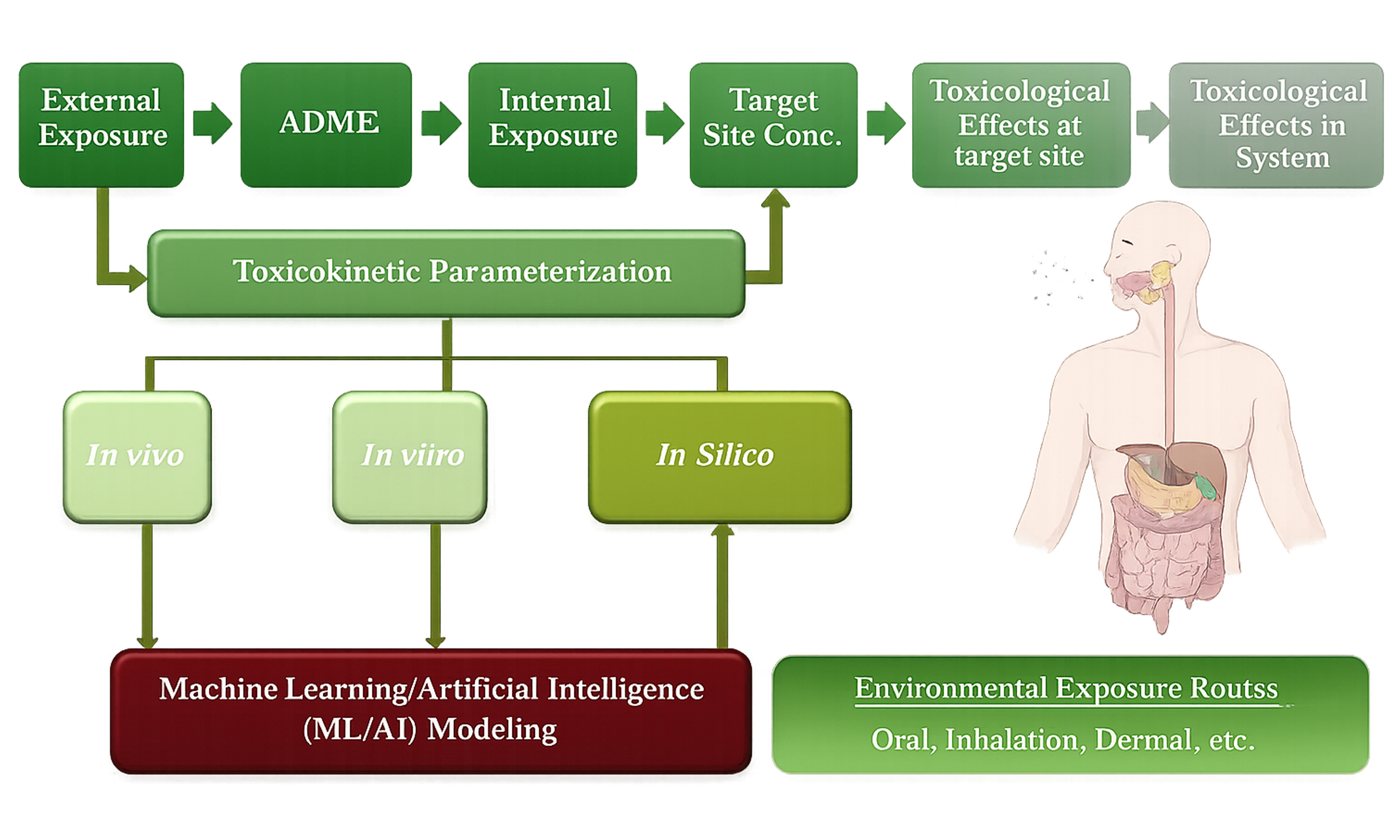
Quantitative exposure assessment of environmental chemicals relies on characterizing how exogenous substances are absorbed, distributed, metabolized, and excreted (ADME) within the human body[1,2]. Specific toxicokinetic (TK) parameters, such as the fraction unbound in plasma, intrinsic hepatic clearance, volume of distribution, oral bioavailability, tissue-to-plasma partition coefficients, and renal clearance, collectively determine the internal dose at target tissues and consequent toxicity[3]. TK parameters thus serve as a critical link between environmental exposure estimates and biologically relevant internal doses.
Conventionally, determining these TK parameters relies on a suite of costly and time-intensive in vivo or in vitro assays, which typically push per-chemical costs into the hundreds of thousands or millions of dollars, with timelines spanning months to years[4]. Compounding this challenge is the continuously expanding chemical landscape, which makes the existing data gap even more evident. The US EPA’s Toxic Substances Control Act chemical inventory lists approximately 86,000 substances in commerce, yet fewer than a few hundred possess comprehensive in vivo TK datasets in humans[5-7]. While the ToxCast and Tox21 libraries collectively contain 9,404 unique chemicals, human in vivo and in vitro TK data are only available for approximately 7% and 11% of these chemicals, respectively[8]. This critical data gap hampers the identification of hazardous substances and the characterization of complex exposure patterns, both key challenges in modern environmental exposure science.
To fill these data gaps, researchers have turned to computational methods to estimate TK parameters across large numbers of chemicals. Early efforts centered on simple quantitative structure-activity relationship (QSAR) paradigms that relied on manually selected molecular features (such as octanol-water partition coefficients and hydrogen bond donor/acceptor counts) coupled with linear statistical methods, such as linear regression, partial least squares, and logistic regression. Although these models provided valuable estimates for specific endpoints, they were constrained by a narrow application scope, high reliance on linear assumptions, and poor generalization to new chemical classes. Machine learning (ML) methodologies move beyond traditional linear QSAR and capture complex relationships between chemical structures and biological endpoints[9]. By introducing different input features, such as physicochemical descriptors, ML models achieved marked improvements in predictive performance and interpretability. The emergence of deep learning (DL) architectures further advanced this field by enabling end-to-end learning of molecular representations directly from raw data[10]. These advancements signal a transformative expansion of the methodological toolkit available for in silico TK parameter estimation.
Despite this rapid methodological progress, persistent challenges remain in domain transferability, data availability, model interpretability, and real-world applicability. This review provides a comprehensive assessment of artificial intelligence and machine learning (AI/ML) approaches for predicting TK parameters for environmental chemicals, including industrial chemicals, pesticides, consumer product constituents, and emerging contaminants. Literature searches were conducted in PubMed (https://pubmed.ncbi.nlm.nih.gov/) and Google Scholar (https://scholar.google.com/) between December 2025 and May 2026, with no restriction on publication year. The literature search was last updated in September 2026. Three thematic term groups were used: (1) (“artificial intelligence” OR “machine learning”); (2) (“toxicokinetics” OR “pharmacokinetics” OR “ADME” OR “physiologically based pharmacokinetic modeling”); and (3) individual toxicokinetic parameters, such as absorption rate, bioavailability, permeability, distribution, transplacental transfer efficiency (TTE), metabolism, and renal/biliary clearance. The search was conducted using the combination of group (1) AND group (2), or group (1) AND group (3). Reference lists of relevant reviews and primary studies were also screened to identify additional publications. Studies were included if they applied AI/ML approaches to predict quantitative or categorical ADME/TK endpoints, TK parameters, or concentration–time profiles. We prioritized studies involving environmental chemicals or demonstrating potential relevance to environmental exposure assessment. Studies focused exclusively on toxicity prediction without a direct connection to ADME or TK processes were excluded. To clarify the scope of AI-based TK parameterization, the endpoints reviewed here are distinguished by their relationship to quantitative TK modeling. These include direct TK parameters that can be incorporated into mechanistic models, quantitative surrogate endpoints that characterize specific kinetic processes but may require further translation before model implementation, and qualitative or categorical endpoints that provide supporting information for ADME characterization and TK model development. Direct prediction of concentration–time profiles may also be considered. First, it examines potential data sources, curated databases, and molecular input representations requisite for robust AI/ML model development. Second, it reviews current AI/ML methodologies and relevant examples across ADME processes, including direct TK parameters, quantitative surrogate endpoints, qualitative/supporting endpoints, and related concentration–time profile prediction applications. The value and representativeness of AI/ML in TK information should not be judged solely by improvements in predictive performance, but by its ability to generate biologically meaningful TK parameters that can support quantitative internal-dose reconstruction and mechanistic exposure modeling. Accordingly, we evaluate current AI/ML applications not only by model accuracy (ACC), but also by endpoint relevance, validation and chemical-space coverage, model reliability, and integration with TK mechanistic models. Finally, this review discusses some essential challenges and potential applications of these AI/ML model predictions. By synthesizing these domains, this review provides a clear roadmap for advancing AI/ML from an emerging computational tool to a robust, scientifically auditable foundation for modern environmental risk assessment.
GENERAL CONSIDERATIONS FOR AI-BASED ADME/TK MODELING
AI/ML modeling for TK parameterization generally follows a common workflow in which experimental or curated data are first assembled, translated into molecular representations and descriptors, and subsequently used for model development and evaluation [Figure 1][11]. Model performance depends not only on algorithm selection but also on data quality and comparability, the appropriateness of input representations, endpoint harmonization, and the rigor of model validation and applicability domain (AD) assessment[12]. This section summarizes these general methodological components underlying AI-based ADME/TK modeling.
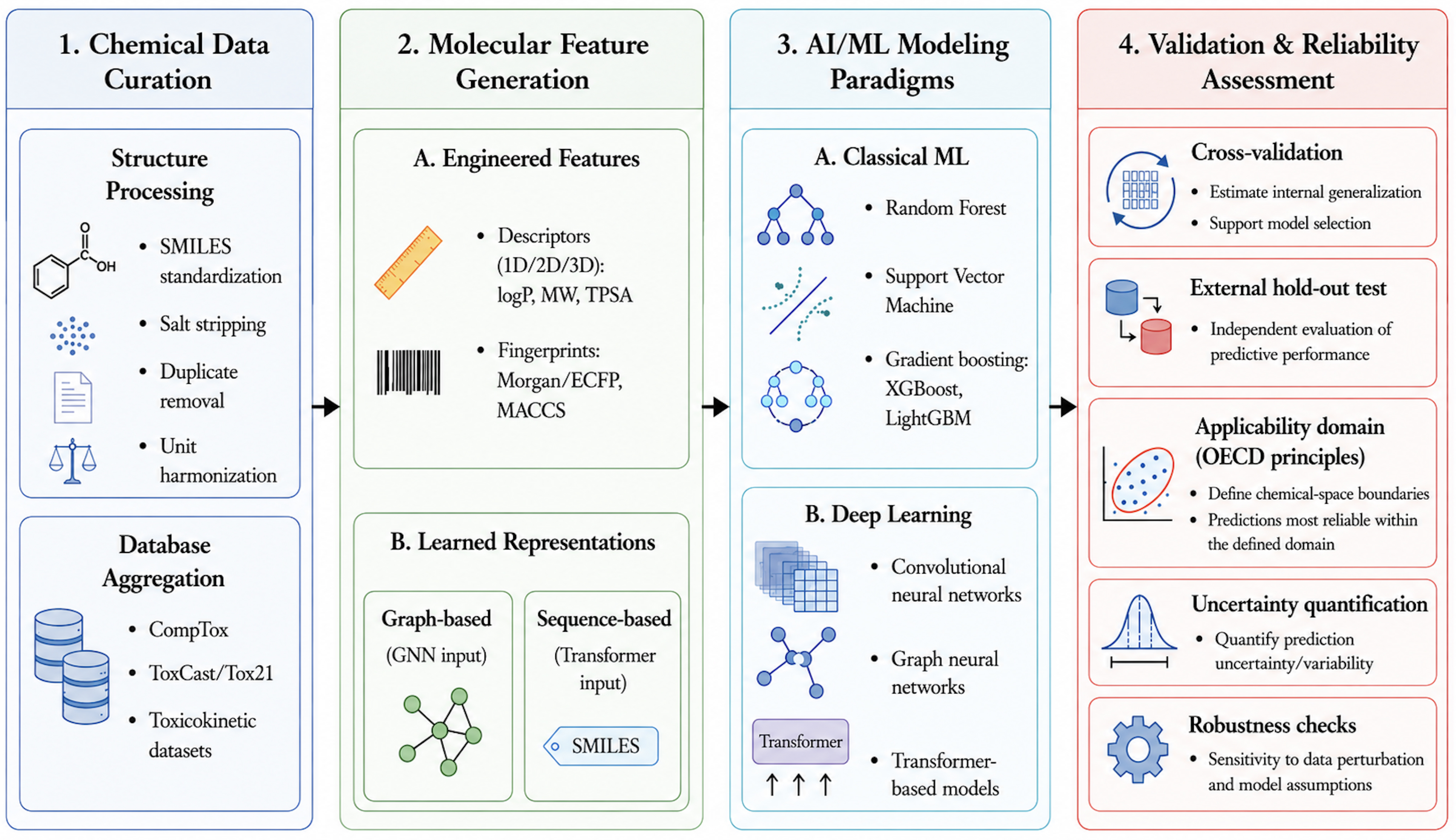
Figure 1. General workflow of AI/ML-based ADME prediction, including (1) chemical data curation; (2) molecular feature generation; (3) AI/ML model development; and (4) rigorous model validation [Created in BioRender. Zhang, Z. (2026) https://BioRender.com/86v7eo1]. AL/ML: Artificial intelligence and machine learning; ADME: absorption, distribution, metabolism, and excretion; SMILES: simplified molecular-input line-entry system; MW: molecular weight; TPSA: topological polar surface area; ECFP: extended-connectivity fingerprint; MACCS: molecular access system; GNN: graph neural network; OECD: Organisation for Economic Co-operation and Development.
Experimental and curated data sources
AI-based TK parameterization depends on high-quality data that integrate chemical structure, biological activity, and measured or inferred ADME/TK endpoints. The common principle of “garbage in, garbage out” is particularly relevant because prediction errors may arise not only from model limitations but also from noisy, limited, inconsistent, or poorly curated input data[13]. Compared with pharmaceutical ADME datasets, environmental TK datasets are often more heterogeneous because of the diverse chemical structures, population-specific TK profiles, and limited experimental coverage[14]. Inconsistent experimental designs, endpoint definitions, and study conditions can substantially reduce cross-study comparability.
TK data are typically obtained from in vivo experiments and supplemented by in vitro ADME assays[15]. In vivo studies provide time–concentration profiles in plasma, blood, urine, feces, and tissues following oral, intravenous, dermal, inhalation, or other exposure routes. These data can be used to estimate TK parameters such as clearance, half-life, bioavailability, volume of distribution, and tissue partition coefficient[16]. A major strength of in vivo TK studies is that they can reflect the integrated TK behavior of a given chemical in a biological system rather than considering specific TK characteristics separately[17]. However, as noted above, these datasets are often heterogeneous and limited for generalization because reported TK values may vary by species, sex, dose, sample size, analytical method, and model-fitting assumptions. For example, the mean half-life of perfluorooctanoic acid (PFOA) was reported to be approximately 0.15-0.19 days in female rats, while 1.6-18 days in males[18]. In practice, this variability may influence reported TK values as strongly as chemical structure itself[19]. Moreover, due to the interspecies ADME differences, the TK parameters from in vivo animal experiments may cause systematic bias when extrapolated for human exposure assessment. Therefore, when using TK parameters from in vivo experiments for AI/ML modeling, record these sources of variability as metadata for model development and interpretation.
Compared with in vivo experimental data, in vitro ADME assays facilitate standardization of experimental settings and support high-throughput chemical testing. Common endpoints of in vitro assays may include intestinal permeability, plasma protein binding, fraction unbound, intrinsic clearance in microsomes or hepatocytes, metabolic stability, and transporter-related activity[20]. Compared with animal-based in vivo tests for TK parameters, a key strength of in vitro assays is the adoption of human cells for testing, which can reduce interspecies TK variability and improve the reliability of results for human exposure assessment[21]. Moreover, as in vitro assays can quantify individual TK processes, they can support targeted screening of specific TK parameters across diverse chemicals, which greatly benefits AI/ML modeling and structural generalization for data-poor chemicals and chemical families, thereby accelerating exposure characterization of emerging environmental chemicals. Nevertheless, it needs to be careful when merging in vivo and in vitro TK data into a single database due to the two systems reflecting different biological contexts and exposure conditions. In contrast to TK parameters derived from in vivo experiments, in vitro outcomes such as effective doses have to be extrapolated to in vivo equivalent doses via a reverse dosimetry approach, which introduces extra uncertainty and variability into the compiled database[6].
Beyond individual experiments, AI/ML-based TK parameterization generally relies on curated databases that integrate measurements across multiple compounds, studies, and experimental conditions. The quantity and quality of these data can substantially impact the prediction ACC and model robustness[22]. A representative example is the U.S. EPA’s httk R package, which includes human in vitro TK parameters (plasma protein binding and hepatic clearance), structure-derived physicochemical properties, and species-specific physiological data[23]. Combined with a generic physiologically-based toxicokinetic (PBTK) model for in vitro- in vivo extrapolation, researchers can predict in vivo TK profiles or parameters [e.g., maximum concentration (Cmax) and area under concentration curves over 24 h (AUC24h), mean concentration (Cmean)] for diverse chemicals in humans and animals[23,24]. Additional resources, such as PubChem and OPERA, can support chemical standardization, descriptor generation, and access to physicochemical and ADME-related properties[25,26].
Besides these general-purpose resources, class-specific databases have also been developed for emerging contaminants whose physicochemical and toxicokinetic characteristics may not be adequately represented by conventional chemical datasets. For example, microplastic/nanoparticle TK profiles can be influenced not only by chemical composition, but also by particle-specific properties, such as size, shape, and surface chemistry[27]. General-purpose chemical databases or molecular representations cannot adequately capture the particle-specific concentration-time curves and the determinants of ADME properties, thereby reducing the transferability and mechanistic relevance of AI-based TK parameterization for this class of microplastics. To address this limitation, a few databases tailored to microplastics/nanoparticles have been established in recent years, facilitating AI/ML development for TK estimation and improving explainability[28-30].
In practice, researchers often need to curate and integrate datasets from multiple studies to meet specific modeling objectives. Before data merging, chemical identifiers, endpoint definitions, measurement units, species, sex, life stage, exposure route, dose, sampling time, and other biological and experimental variables should be harmonized to ensure that records represent comparable biological and chemical quantities. Following harmonization, numerical features and continuous TK endpoints may require transformation and scaling because real-world datasets often contain variables with substantially different distributions and magnitudes. Without appropriate scaling, variables with larger numerical ranges may disproportionately influence model optimization and reduce prediction reliability, particularly for scale-sensitive algorithms, such as k-nearest neighbors (KNNs), support vector machines (SVMs), and neural networks. Common approaches include min-max normalization and z-score standardization[31]. Min–max normalization rescales values to a predefined range, whereas z-score standardization centers each feature around its mean and scales it by its standard deviation. Additional preprocessing strategies, including logarithmic transformation, robust scaling, and categorical variable encoding, may also be applied depending on the dataset characteristics and modeling objectives[31]. A proper scaling strategy can help ML algorithms converge faster during training, avoid bias toward large magnitude variables, improve numerical stability, and produce more reliable predictions[32].
Input representations and descriptors
The predictive performance of AI/ML models depends not only on data availability, but also on how chemical and biological information is represented for model development. In AI-based ADME/TK modeling, input representations convert chemicals into machine-readable formats, whereas molecular descriptors provide quantitative variables derived from these representations to encode structural and physicochemical properties[33]. The choice of input representation can substantially influence prediction performance and model transferability, as different molecular representations may capture distinct structural information and perform differently across datasets and endpoints[34]. Major input representations and descriptors are summarized in Table 1.
Input representations and descriptors used in AI-based TK modeling
| Input type | Examples | TK/ADME relevance | Ref. |
| Molecular descriptors | Molecular weight, logP/logD, pKa, TPSA, H-bond donors/acceptors, rotatable bonds, charge | Related to permeability, solubility, protein binding, metabolic stability, and clearance | Handa et al., 2025[35] |
| Molecular fingerprints | MACCS keys, Morgan/ECFP fingerprints | Encode structural fragments associated with ADME properties | Ryu et al., 2023[36] |
| Graph-based features | Atom–bond graphs, GNN embeddings | Capture molecular connectivity and local chemical environments | Xu et al., 2017 Jiang et al., 2021[37,38] |
| Physicochemical properties | Solubility, ionization state, lipophilicity, vapor pressure, Henry’s law constant | Influence absorption, distribution, partitioning, and exposure route-specific behavior | Noga and Jurowski, 2025[39] |
| Biological context variables | Species, tissue composition, plasma protein levels, enzyme/transporter expression, life stage, sex | Modify distribution, metabolism, clearance, and internal dose | Li et al., 2024[40] |
| Experimental metadata | Dose, administration route, dosage form, sampling time, and experimental conditions | Explains variability in measured TK endpoints | Fuhrer et al., 2024[41] |
Traditional molecular descriptors remain the most widely used inputs for TK-related prediction. These descriptors typically include molecular weight, logP/logD, pKa, hydrogen bond donors and acceptors, topological polar surface area, rotatable bonds, formal charge, and solubility. Their main advantage is interpretability, since many of these variables are mechanistically related to the key ADME properties, such as membrane permeability, tissue binding, plasma protein binding, metabolic clearance, and excretion behavior[35]. In addition to descriptors, molecular fingerprints, such as molecular access system (MACCS) keys and extended-connectivity fingerprints (ECFP), are frequently used to encode structural fragments and substructures into a machine-readable form[42]. These representations are particularly useful for nonlinear machine-learning models because they capture local structural patterns efficiently, although they are generally less interpretable than descriptor-based inputs and may be more sensitive to chemical-domain mismatch.
More recently, graph-based representations have become attractive because they model molecules directly as atoms and bonds, without requiring predefined descriptors. In this framework, graph neural networks (GNNs) can learn structure-property relationships from molecular topology and local chemical environments, potentially capturing higher-order structural features relevant to ADME endpoints[43]. For example, Ng and Lu evaluated GNNs combined with transfer learning for oral bioavailability prediction, achieving a final average ACC of 0.797, an F1 score of 0.840, and an area under the receiver operating characteristic curve (AUC-ROC) of 0.867, which outperformed previous studies using traditional molecular descriptors and fingerprints with the same test dataset[44].
In addition, biological context variables are also important for TK prediction. Factors such as tissue composition, gastrointestinal physiology, renal function, sex, age, and life stage can strongly influence ADME behavior[21,45]. For this reason, hybrid input strategies that combine chemical descriptors with biological and experimental metadata are often more informative than structure-only representations, particularly when the goal is to support physiologically based pharmacokinetic (PBPK) modeling and exposure assessment.
AI/ML modeling and evaluation
Following the translation of chemical structure and physicochemical features into numerical representations, AI/ML models can be developed to predict ADME- and TK-related endpoints. The current algorithmic landscape falls into two major paradigms: classical ML and DL. The representative model architectures are summarized in Figure 2.
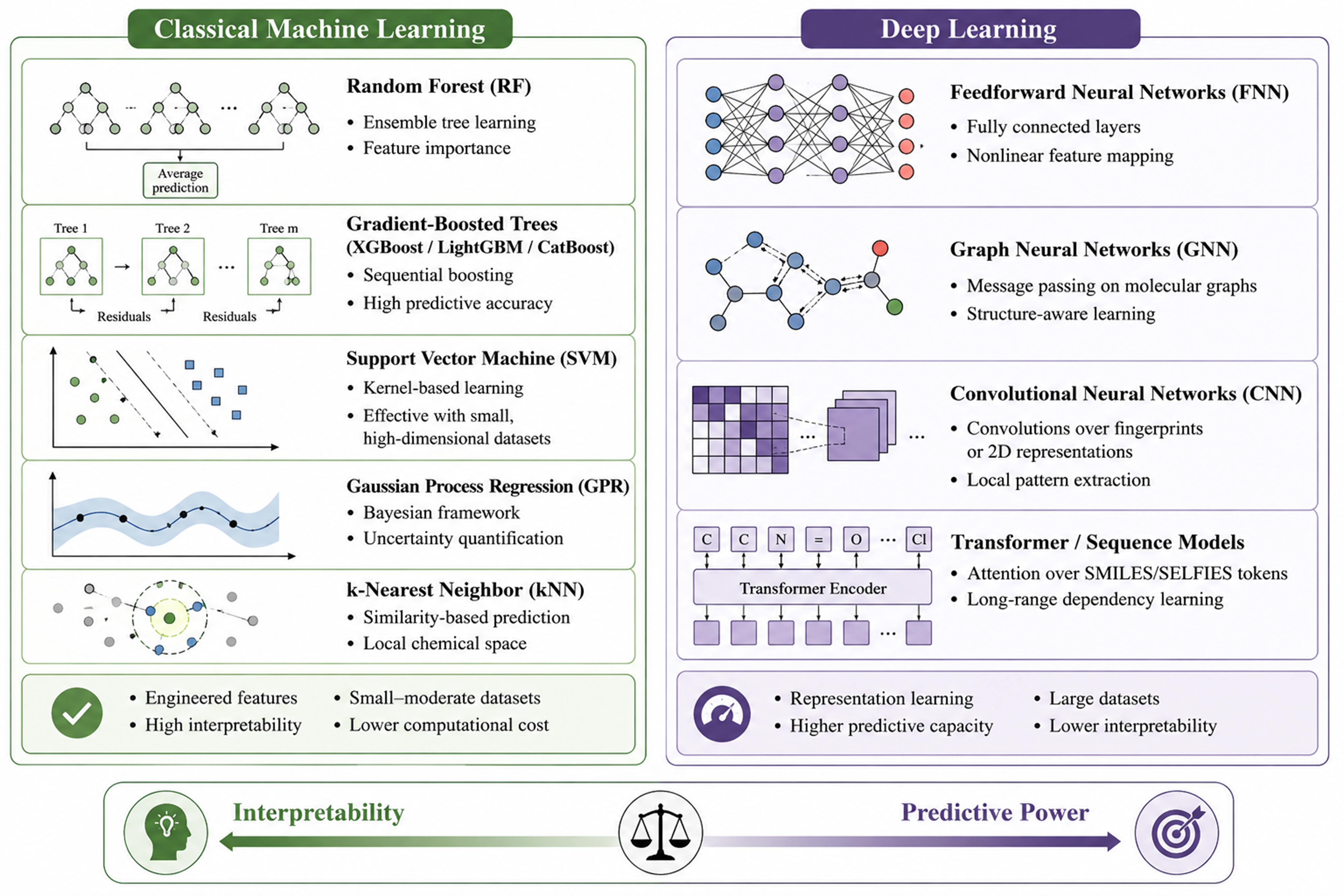
Figure 2. Representative AI/ML model architectures used for toxicokinetic parameterization [Created in BioRender. Zhang, Z. (2026) https://BioRender.com/mdf4f4m]. AI/ML: Artificial intelligence and machine learning; SMILES: simplified molecular-input line-entry system; SELFIES: self-referencing embedded strings.
Among classical ML methods, ensemble tree-based algorithms are widely applied in ADME/TK prediction. Random forests (RFs) are ensembles of decorrelated decision trees trained on bootstrap samples with random feature subsets. They offer robust performance, natural resistance to overfitting in high-dimensional spaces, and built-in feature importance estimation[46]. Gradient-boosted decision trees (e.g., XGBoost, LightGBM, and CatBoost) construct sequential ensembles where each successive tree corrects the residual errors of its predecessor[47]. These models typically achieve superior ACC on moderate-sized datasets, though they are highly sensitive to model tuning. SVMs with radial basis function or Tanimoto kernels remain competitive for regression on continuous TK endpoints, particularly when training sets are small and high-dimensional[48]. Gaussian process regression provides a principled Bayesian framework yielding both point predictions and predictive uncertainty estimates, though its cubic scaling with dataset size limits applicability to large training corpora[49]. The KNN algorithm is conceptually straightforward but foundational. It underpins the US EPA’s OPERA suite, where it combines property forecasting with AD assessments based on local chemical similarity[50]. Overall, these classical algorithms pair naturally with the engineered feature representations and remain the algorithms of choice when dataset sizes are modest (hundreds to low thousands of compounds) or when maximal interpretability is required.
The DL paradigm extends beyond classical methods by learning hierarchical feature representations directly from molecular inputs. Different neural-network structures can be paired with different molecular representations, such as fixed-length descriptors or fingerprints, molecular graphs, and sequence-based representations[33,34]. Early deep-learning applications to ADME/TK prediction commonly used feedforward neural networks (FNNs), including multilayer artificial neural networks (ANNs) and their deeper variants, deep neural networks (DNNs), which typically operate on fixed-length molecular descriptors or fingerprints[51]. These models retained the descriptor-based input pipeline of classical ML, but replaced linear or shallow nonlinear estimators with multilayer architectures capable of capturing higher-order interactions among descriptors. Convolutional neural networks (CNNs) use convolutional operations to learn local patterns from structured molecular encodings and can support automatic feature extraction[52]. Using graph-based descriptors as we discussed in the last section, GNN architectures aggregate local atomic environments into expressive molecular embeddings through iterative message passing and attention-weighted readout functions[53]. For sequence-based molecular representations, transformer-based models such as ChemBERTa and MoLFormer process sequence-based simplified molecular-input line-entry system (SMILES) inputs through multi-head self-attention layers, capturing long-range token dependencies that recurrent architectures handle less effectively[54,55]. Additionally, these models are not always applied independently and can be integrated into hybrid models to exploit complementary molecular representations and learning strategies. For example, Limbu et al. developed a hybrid CNN-FNN model (HNN) to predict the toxicity of thousands of chemicals[56]. The HNN model consisted of a CNN processing one-hot-encoded SMILES and an FNN processing molecular descriptors[56]. Such integration allows structure-derived features and engineered physicochemical descriptors to contribute jointly to prediction and may improve model robustness when information from one representation is limited.
The choice of modeling strategy should ultimately depend on dataset size, endpoint characteristics, and the required balance between ACC and interpretability. As schematically illustrated in Figure 2, simpler models are often favored when datasets are small or when greater transparency is required, whereas more flexible deep-learning models may improve predictive performance when sufficiently large and diverse datasets are available[57]. However, this increase in flexibility may also reduce interpretability and increase the risk of overfitting or poor extrapolation to novel chemical classes. Based on the task type (classification or regression), different metrics for model evaluation were used. Continuous endpoints, such as intrinsic clearance, fraction unbound, or volume of distribution, are commonly assessed using the coefficient of determination (R2), root mean squared error (RMSE), and mean absolute error (MAE). Categorical endpoints, such as CYP inhibition or substrate classification, are typically evaluated using ACC, sensitivity, specificity, the AUC-ROC, and the Matthews correlation coefficient (MCC).
After training the models with an existing database and tuning it for good performance, the selected models still demand validation at different levels: internal cross-validation, external hold-out testing, and an AD assessment[58]. Internal validation through k-fold cross-validation (typically 5-fold or 10-fold) provides a baseline estimate of model performance but can yield optimistically biased results when applied to datasets with structural redundancy or activity[59,60]. External hold-out testing provides the most informative measure of true predictive ability. This process evaluates the trained model on an entirely independent dataset withheld from all stages of model development. Furthermore, AD assessment identifies the specific region of chemical space where a model’s predictions are considered reliable. This assessment is a mandatory component of the Organisation for Economic Co-operation and Development (OECD) validation principles for regulatory QSAR models[61]. It is especially critical when applying models to the highly diverse structural landscape of environmental chemicals. Common AD methods include leverage-based approaches (Williams plots), distance-to-model metrics in descriptor space, local density estimation, and conformal prediction frameworks that provide prediction-specific confidence levels[62]. The US EPA’s OPERA suite exemplifies the integration of AD assessment into routine ADME prediction by providing per-chemical reliability indices alongside property estimates, enabling users to distinguish high-confidence predictions from extrapolations[50].
Finally, the selected model will be examined for mechanistic interpretation, uncertainty quantification, and downstream integration strategies with the aim of translating these validated ADME predictions into actionable exposure estimates.
APPLICATION OF AI MODELING FOR ADME PARAMETERIZATION
AI for absorption
Absorption is the process by which a chemical enters systemic circulation following external exposure. Environmental chemicals can be mainly absorbed through oral ingestion, inhalation, and dermal contact. Among these routes, oral absorption has been the most commonly studied in current AI/ML-based TK parameterization, largely because oral exposure is the most common route for conventional drugs and many tested chemicals, resulting in greater data availability and more established assay systems. Typically, oral absorption is characterized using parameters such as intestinal permeability, oral bioavailability, and the absorption rate constants. Oral bioavailability has received considerable attention, particularly from pharmaceutical research, as this parameter is a key determinant of the success or failure of candidate drugs. Multiple predictive approaches, including QSAR models, PBPK-based models, and more recent AI/ML algorithms, along with various software, have been developed for predicting oral bioavailability[63]. Similarly, researchers have developed a few models for other oral absorption-related parameters [Table 2]. For example, Ng and Lu evaluated a GNN combined with transfer learning to predict oral bioavailability. In their framework, the model was first pretrained on a solubility prediction task using graph-based molecular representations, and then fine-tuned for oral bioavailability classification. The best transfer-learning model achieved an ACC of 0.797, an F1 score of 0.840, and an AUC-ROC of 0.867, outperforming traditional ML models using descriptor- and fingerprint-based representations[44]. Shapley Additive exPlanations (SHAP) analysis further reported the most important factor in the quantitative estimation of drug-likeness (QED)[44]. This study illustrates the potential advantage of learned molecular representations and knowledge transfer for improving prediction when endpoint-specific datasets are limited. However, whether this improvement generalizes to structurally diverse environmental chemicals requires further validation because the AD analysis of the transfer model suggested the absence of distinctly out-of-domain compounds in the test set. In another instance, Kamiya et al. developed a lightGBM model to predict influx and efflux apparent permeability (Papp) across Caco-2 monolayers for 218 disparate chemicals by integrating in vitro permeability coefficients with 17 and 19 descriptors, respectively, such as logD, logP, topological polar surface area, molecular weight, and basic group count[65]. Their best lightGBM models achieved correlation coefficients of 0.83-0.84 for influx and efflux Papp (log-transformed, nm/s) prediction, indicating that AI/ML models can provide reasonably accurate estimates of intestinal permeability for structurally diverse chemicals.
Selected AI/ML studies to predict chemical absorption parameters
| Parameter (transformation; unit; endpoint type) | Input features | Chemicals | Model | Results | Ref. |
| Oral | |||||
| HIA (classification: highly absorbed > 30% vs. poorly < 30%; unitless; qualitative/supporting endpoint) | 10 optimal descriptors (selected from 1,529 features using DRAGON and TSAR) | 844 highly absorbed (Ntrain = 489, Ntest = 355), 398 poorly absorbed (Ntrain = 256, Ntest = 142)a | SVM, ANN, KNN, PNN, PLS, and LDA | Best performance of SVM model (10-fold cross-validation ACC = 90.38%, ACCtest = 91.54%, ROC-AUC = 0.885) | Kumar et al., 2017[64] |
| Oral bioavailability (classification: high ≥ 50%, low < 50%; unitless; qualitative/supporting endpoint) | ♦ Pretraining: graph-based representations ♦ RF model: 45 molecular descriptors and fingerprints (Morgan FP, RDKit FP, MACCS keys) from chemical structures | Pretraining: 9,940 molecules Present study: 1,447 chemicals (Ntrain = 1,157, Ntest = 290)b | GNN & Transfer model, RF | ♦ RF with molecular descriptors had the best performance among all RF models ♦ SHAP analysis suggested that molecules with higher quantitative drug-likeness estimates exhibited higher oral bioavailability ♦ The transfer learning model showed the highest prediction performance among all models (ACC = 79.7%, AUC-ROC = 0.867) | Ng and Lu, 2023[44] |
| Intestinal permeability coefficient (log-transformed; nm/s; quantitative surrogate endpoint) | 17 (A → B)/19 (B → A) descriptors, including logD, logP, MW, topological polar surface area, etc. | 219 disparate chemicalsa | Trivariate linear regression, LightGBM | Trivariate regression showed significant correlations between observed and predicted logPapp using molecular weight and pH-dependent logD values (A → B: r = 0.76, n = 198; B → A: r = 0.77, n = 202). LightGBM further improved prediction ACC, reaching r = 0.83-0.84 (P < 0.001) for influx and efflux logPapp prediction | Kamiya et al., 2021[65] |
| Caco-2 permeability coefficient (log-transformed, cm/s; quantitative surrogate endpoint) | 0-2D PaDEL descriptors (Morgan fingerprint, RDKit2D, molecular graphs) | 5,654 compounds; an additional 67 compounds from Shanghai Qilu’s in-house collection and 271 ChEMBL compounds for external validationb | RF, XGBoost, SVM, GBM, DMPNN, and CombinedNet | R 2 values ranged from ~0.4 to ~0.65 for the test set XGBoost model with combined molecular representations (all three types) had the best performance (R2 = 0.622, RMSE = 0.487) | Wang et al., 2025[66] |
| PAMPA permeability coefficient (log-transformed, cm/s; quantitative surrogate endpoint) | 2,792 molecular descriptors | 393 molecules (train: test ratio = 8:2)b | ANN, SVM | ANN model showed the best performance (R2 = 0.84 for the external test set) | Racz et al., 2023[67] |
| Dermal | |||||
| Partition coefficients for the stratum corneum and viable epidermis/dermis (KSC and KVED; log-transformed; unitless; direct TK parameter) Diffusion coefficients in two skin layers (DSC and DVED; log-transformed; cm2/h; direct TK parameter) | Physicochemical descriptors, including molecular weight, lipophilicity, and HOMO/LUMO-related electronic descriptors | 54 chemicals (Ntrain = 43, Ntest = 11)b | Gradient boosting tree | Test-set prediction: R2 = 0.776 ± 0.009 (logKSC), 0.776 ± 0.019 (logDSC), 0.912 ± 0.006 (logKVED), and 0.754 ± 0.021 (logDVED) | Narita et al., 2025[68] |
| Dermal absorption (%; quantitative surrogate endpoint) | 11 descriptors (logP, molecular weight, water-based formulation, dilution concentration, etc.) | ProHuma/ECPA dataset: 248 active substances from 25 formulation types at different concentrationsa | Bayesian additive regression trees | Log Pow and molecular weight have the highest importance | Sarti et al., 2025[69] |
| Inhalation | |||||
| Isolated perfused lung absorption rate constant (min-1; direct TK parameter) | Seven selected molecular descriptors; shared permeability information from Caco-2 permeability, Calu-3 permeability, and isolated perfused lung absorption datasets | ♦ IPL dataset: 29 chemicals with KaIPL data ♦ Caco-2 dataset: 960 chemicals with in vitro PappCaco-2 data ♦ Calu-3 dataset: 73 chemicals with in vitro Pappcalu3 datab | Extremely randomized trees and a multitask learning extension, MT-ExtraTrees, in the ExtraTrees package | The model achieved a correlation coefficient of r = 0.84 between predicted and observed KaIPL values in the independent test set | Chiu et al., 2024[70] |
| Blood concentration–time profiles (concentration–time profile prediction) | Airborne VOC concentration, exposure time, initial blood concentration, and longitudinal blood concentration data | DBM and MCF exposure experimentsb | Neural ODE | For DBM, Neural ODEs achieved a MAPE of 6.56% at 10,000 ppm, outperforming PBPK at low-to-moderate exposure levels. Neural ODEs yielded a MAPE of 25.55% for MCF at 10,000 ppm, though ACC declined at lower concentrations, such as 10 ppm | Simon, 2025[71] |
Besides oral absorption, inhalation and dermal absorption have received less attention in current AI/ML-based parameterization due to limited availability of curated datasets. Nevertheless, these routes are highly relevant for environmental exposure assessment, especially for volatile chemicals, aerosols, consumer product ingredients, and occupational exposures. A few studies have begun to explore AI/ML approaches for inhalation- and dermal-related TK characterization using relatively small datasets. For example, Chiu et al. developed an Extra Trees-based multitask learning model to predict the isolated perfused lung absorption rate constant (ka,IPL, min-1) for a dataset of 29 chemicals. To address the limited pulmonary absorption data, the model jointly learned from the larger Caco-2 and Calu-3 permeability datasets and achieved a correlation coefficient of r = 0.84 between the predicted and observed ka,IPL values in the independent test set[70]. Compared with single-task learning approaches, this study illustrates the advantages of multi-task learning to address limited endpoint-specific data availability by jointly learning from auxiliary tasks (i.e., Caco-2 and Calu-3 permeability in this study)[70]. The effectiveness of such multitask learning largely depends on the biological relevance and similarity of auxiliary tasks to the target task. In another instance, Simon applied a neural ordinary differential equation (ODE) model to predict blood concentration–time profiles of two volatile organic compounds (VOCs) following inhalation exposure[71]. In this approach, neural ODEs learn the chemical concentration changes by parameterizing the rate of change as a continuous function of time, providing a potential AI-based approach for environmental TK modeling, where chemical-specific kinetic parameters and large-scale training datasets are often limited.
For dermal exposure, Narita et al. developed a gradient boosting tree model to predict four skin permeation parameters: partition coefficients for the stratum corneum and viable epidermis/dermis (KSC and KVED) and diffusion coefficients in these two skin layers (DSC and DVED)[68]. The predicted parameters were subsequently incorporated into a two-layer diffusion model to estimate finite-dose dermal permeation profiles. The model showed generally reasonable agreement with observed profiles for the evaluated chemicals. However, additional external validation is needed before broader application of this model in dermal pharmaceutical development and exposure assessment for topically exposed chemicals. In future applications, AI-based dermal absorption models could be used to evaluate the effectiveness of chemical neutralization and decontamination products, such as reactive skin decontamination lotion[72]. These models could incorporate decontamination efficiency, treatment timing, chemical reactivity, and residual dermal absorption to support exposure assessment following hazardous-material incidents.
AI for distribution
Following absorption through different exposure routes, chemicals are transported from the systemic circulation into tissues, organs, and biological barriers. In exposure assessment, this process is important because toxicity is often driven more directly by target-site concentrations than by external exposure dose alone.
AI modeling for distribution mainly focuses on predicting relevant parameters, including tissue: plasma partition coefficients, apparent volume of distribution, fraction unbound in plasma, and barrier permeability [Table 3]. For example, Dawson et al. developed QSAR models to predict in vitro fraction unbound in plasma for 2,057 compounds [1,308 pharmaceuticals and 749 compounds from the U.S. EPA Toxicity Forecaster (ToxCast) program][73]. The best model integrated four open-source chemical descriptors, including PaDEL, OPERA, ToxPrints, and MACCS, into an RF model and achieved an R2 of 0.591 with an RMSE of 0.187[73]. This study is particularly relevant to environmental TK modeling because the predicted parameters were designed to support HTTK applications and internal dose estimation for data-poor chemicals. For highly protein-bound contaminants such as per- and polyfluoroalkyl substance (PFAS), uncertainty in predicting the unbound fraction affects the assessment of persistence and internal exposure.
Selected AI/ML studies to predict chemical distribution parameters
| Parameter (transformation; unit; endpoint type) | Input features | Chemicals | Model | Results | Ref. |
| General distribution | |||||
| Fraction unbound in plasma (square-root transformation; unitless; direct TK parameter) | Open-source molecular descriptors from PaDEL, OPERA, ToxPrints, and MACCS fingerprints. Recursive feature elimination with five-fold cross-validation | 2,057 chemicals [training: 1,305 chemicals (650 ToxCast and 655 pharmaceuticals); external test sets: drug I (189), drug II (432), and ToxCast (97)]a | RF regression | ♦ The optimal RF model: 30 selected descriptors; Q2 = 0.58 in five-fold cross-validation ♦ External validation: R2 = 0.56 (drug I), 0.61 (drug II), and 0.59 (ToxCast) | Dawson et al., 2021[73] |
| Delivery efficiency at 24 h (%ID; quantitative surrogate endpoint) | Physicochemical properties and experimental conditions | Tumor 403; heart 252; liver 341; spleen 312; lung 274; kidney 298b | LR, SVR, RF, XGBoost, LightGBM, DNN | ♦ Best model: DNN ♦ test R2: tumor 0.41, heart 0.42, liver 0.45, spleen 0.79, lung 0.87, kidney 0.83; test performance was similar to 5-fold CV | Mi et al., 2024[74] |
| BBB | |||||
| BBB permeability (binary classification: Yes/No; unitless; qualitative/supporting endpoint) | Nine molecular fingerprints calculated from SMILES using PaDEL-Descriptor (EState, MACCS, PubChem, FP4, KR, AP2D, FP4C, KRC, and APC2D) | 1,757 chemicals for training, 213 for external validationb | RF, SVM, XGBoost; ensemble model (Ensemble Top-9) | ♦ Ensemble Top-9: 5-fold CV, AUC = 0.966 ± 0.011, ACC = 0.930 ± 0.013, SEN = 0.964 ± 0.013, SPE = 0.839 ± 0.037; external validation, AUC = 0.849, ACC = 0.784, SEN = 0.812, SPE = 0.712 ♦ Lower external-validation ACC suggests potential overfitting | Liu et al., 2021[75] |
| BBB permeability: (binary classification: Yes/No; unitless Log-transformed for continuous endpoints; unitless; qualitative/supporting endpoint) | 3D geometry-aware weighted colored subgraph features encoding atom-type-specific spatial interactions, combined with RDKit-derived atomic features | Three benchmark datasets: MoleculeNet classification (1,560 BBB+, 479 BBB-); B3DB classification (4,905 BBB+, 2,835 BBB-); B3DB regression (n = 1,047). All datasets were scaffold-split into training/validation/test sets at 8:1:1b | GMC-MPNN | ♦ Classification: AUC-ROC = 0.947 ± 0.011 (MoleculeNet) and 0.9212 ± 0.0261 (B3DB). Regression: RMSE = 0.5628 ± 0.0651 and Pearson r = 0.6947 ± 0.0515 ♦ GMC-MPNN outperformed the evaluated baseline GNN models across all three datasets | Nguyen et al., 2026[76] |
| BBB permeability: (binary classification: Yes/No; unitless; qualitative/supporting endpoint Log-transformed for continuous endpoints; unitless; quantitative surrogate endpoint) | SMILES-derived molecular embeddings from pretrained MegaMolBART; Morgan fingerprints (2,048 bits) as baseline representation | B3DB database: 7,807 compounds, including 1,058 with measured logBB CMUH-NPRL: 2,499 compounds (binary) Train: validation: test = 8:1:1b | MegaMolBART (pretrained LLM) molecular encoder combined with XGBoost | ♦ Final combined classification model achieved AUC = 0.88 on the held-out test set ♦ MegaMolBART embeddings outperformed Morgan fingerprints for logBB regression | Huang et al., 2024[77] |
| Placental | |||||
| TTE (unitless; direct TK parameter) | 15 molecular descriptors (9 constitutional descriptors, 1 molecular property, 2 2D atom pairs, 1 2D matrix-based descriptor, 2 edge adjacency indices) | 51 environmental chemicalsc | OLS regression with stepwise | ♦ Model 1 (10 selected descriptors): Radj2 = 0.67 ♦ Model 2 (5 descriptors): Radj2 = 0.61 | Li et al., 2021[78] |
| Fetal/maternal ratio (unitless; quantitative surrogate endpoint) | 4 fingerprints (Morgan fingerprint, RDKit fingerprint, Hashed atom pair fingerprint, MACCS keys) | 212 chemicals (environmental chemicals and 153 drugs; randomly split into training, test, and validation sets at 8:1:1)b | 12 models: LR, decision tree, RF, SVM, KNN, XGBoost, DNN, MLP, CNN, RNN, LSTM, and transformer | ♦ Retrained LSTM achieved R2 = 0.91, 0.68, and 0.56 for the training, test, and validation sets, respectively ♦ In vivo evaluation of four screened chemicals showed F/M ratios > 0.3; oxybenzone had a measured F/M of 0.79 ± 0.06 vs. a predicted value of 0.77 | Chen et al., 2024[79] |
| Probability score to cross the placental barrier (0-0.8: low-potential; 0.8-0.9: moderate-potential; 0.9-1: high-potential; unitless; qualitative/supporting endpoint) | 9 selected input features (PaDEL molecular descriptors, pathway activation score) | 307 chemicals for model development; 18 compounds for external validation; 259 environmental chemicals for prospective predictionb | XGBoost, RF, SVM, LR, NB, and 2 ensemble models | ♦ Best model: XGBoost (ACCtest: 0.94; F1: 0.97; AUC: 1) ♦ High-potential structures: aromatic rings and hydrophobic groups, which enhance lipid solubility ♦ Low-potential structures: nitrogen-containing carbon chains and nitrogen-containing aromatic rings, leading to lower lipid solubility ♦ The model was applied to 259 environmental chemicals to identify high-potential chemicals to transfer the placental barrier ♦ AD: evaluated using Euclidean distance-based chemical space analysis | Guan et al., 2024[80] |
| Binding affinity to GST/NAT2 (kcal/mol; qualitative/supporting endpoint) | Molecular weight, total energy, binding energy, energy gap, ionization energy, chemical hardness, chemical softness | 10 PFAS (90% training; 10% test)c | Multilayer perceptron-based ANN (additional molecular docking and density functional theory analyses) | ♦ The ANN results showed a regression coefficient of 0.866 for GST and 0.966 for NAT2 ♦ For GST binding affinity prediction, molecular weight is the most influential factor, followed by total energy, binding energy, and other factors ♦ For NAT2 binding affinity prediction, binding energy is the most important, followed by total energy, energy gap, and other factors | Duru et al., 2023[81] |
| Lactational | |||||
| Milk-to-plasma ratio transfer risk (binary classification; high risk: M/P ≥ 1, low risk: M/P < 1; qualitative/supporting endpoint) | 5 sets of 1D & 2D molecular descriptors (MOE, DS, Mold2, RDKit, and Chemopy); fingerprints (PaDEL) | 573 chemicals with experimental M/P ratios (125 high-risk, 250 low-risk); external validation: 198 chemicals detected in human milkb | BRF, EEC (base: AdaBoost), BBC (base: GBDT, lightGBM, XGBoost, SVM, and MLP) | ♦ MOE+DS_GA_84/BRF (ACC: 81%; MCC: 61.41%; ACCexternal: 86.36%) ♦ Chemopy_GA_101/BRF (ACC: 78.67%; ACCexternal: 78.28%) ♦ SHAP analysis suggested the most important features of molecular hydrophobicity/hydrophilicity, π-electron, molecular polarizability, charge distribution, and conformational features | Huang et al., 2025[82] |
| Milk-to-plasma AUC (binary classification: ≥ 1 or < 1; unitless; qualitative/supporting endpoint) | 254 candidate molecular descriptors from the ADMET predictor (SMILES as the input for ADMET) | 403 compoundsa | ANN, SVM | ♦ ANN: ACCtest: 0.929; SENtest: 0.833 ♦ SVM: ACCtest: 0.938; SENtest: 0.677 ♦ High contributions of charge-based descriptors in both models | Maeshima et al., 2023[83] |
| Milk-to-plasma concentration ratio (binary classification: Class 1: M/P ≤ 0.1; Class 2: M/P > 0.1; unitless; qualitative/supporting endpoint) | Initially 400 descriptors for 126 drugs. Stepwise variable selection method selected the 5 most important ones [n-Octanol–water partition coefficient, Randic index (order 2), Max. partial charge for a C atom, Min. e–e repulsion for a C–C bond, and Min. coulombic interaction for a C–C bond] | 126 drugs (96 training, 30 test; 9 external compounds without measured M/P values)a | SVM, LDA | ♦ Best model: SVM ♦ SVM model: the classification accuracies for the training set and test set were 90.63 and 90.00%, respectively | Zhao et al., 2006[84] |
Unlike general tissue partitioning, AI/ML models have also been applied to predict chemical transport across physiological barriers that regulate access to specific compartments. Blood–brain barrier (BBB) penetration is one of the most important specialized barriers, involving tight junctions, selective transport, and active efflux mechanisms. The BBB can prevent 98% of circulating molecules from entering the brain. Traditional experimental methods make it difficult to assess BBB penetration rates. AI/ML models can identify key features influencing BBB permeability, supporting TK characterization and exposure assessment. Early BBB-prediction models relied on traditional structural and physicochemical features, such as molecular weight, lipophilicity, and hydrogen-bonding properties[85]. For example, Liu et al. developed ML and ensemble models to predict BBB permeability for 1,757 chemicals using structure-derived molecular fingerprints. They input the SMILES descriptor of chemicals into the PaDEL-Descriptor software to calculate molecular fingerprints. Combining three types of ML models, including RF, SVM, and XGBoost models, this study achieved an ACC of 0.910, an ROC-AUC of 0.957, a sensitivity (SEN) of 0.927, and a specificity of 0.867 for predicting BBB permeability[75]. Recent advancements have applied more sophisticated DL methods, such as graph- and image-based models[86]. For example, Nguyen et al. developed a geometric multi-color message-passing graph neural network (GMC-MPNN) for BBB permeability prediction, incorporating three-dimensional geometric information and atom-type-specific subgraphs into the graph representation[76]. Their model achieved AUC-ROC values of 0.947 ± 0.011 and 0.9212 ± 0.0261 for BBB permeability classification on the MoleculeNet and B3DB benchmark datasets, respectively. For continuous permeability prediction using the B3DB dataset, the model achieved an RMSE of 0.5628 ± 0.0651 and a Pearson correlation coefficient of 0.6947 ± 0.0515, demonstrating the strong potential of graph-based DL for BBB-related pharmacokinetic (PK) characterization[76]. For BBB permeability of environmental chemicals, AI/ML models can help prioritize chemicals with potential central nervous system exposure. However, current models are mainly developed using pharmaceutical compounds, and their applicability to environmental chemicals remains unclear due to differences in chemical space and exposure-relevant chemical characteristics.
Another important biological barrier that determines chemical distribution is the placenta. AI-based predictions of placental transfer have been developed to estimate maternal-to-fetal chemical distribution for both pharmaceutical compounds and environmental chemicals. Li et al. developed a QSAR model to predict TTE, defined as the cord blood-to-maternal blood concentration ratio, using structural descriptors from 51 environmental chemicals, including organochlorine pesticides, PAHs, PCBs, PBDEs, and PFASs. The model identified molecular descriptors associated with placental transfer prediction and achieved moderate predictive performance, with an adjusted R2 of 0.67 for the 10-descriptor model and 0.61 for the 5-descriptor model[78]. More recently, Guan et al. incorporated placental pathway-related features (pathway activation scores derived from a placental gene network) together with molecular descriptors to classify 307 chemicals, both pharmaceutical compounds and environmental chemicals, with high or low placental barrier crossing potential, achieving high predictive performance in external validation (ACCtest: 0.94; F1: 0.97; AUC: 1)[80]. The study further evaluated model applicability using Euclidean distance-based chemical space analysis, showing that the prediction test set fell within the chemical space represented by the training dataset. This model showed high potential to predict the transplacental potential of environmental chemicals. However, current AI-based placental transfer models mainly predict transfer ratios or classification outcomes rather than mechanistic placental TK parameters, and the limited availability of environmentally relevant placental kinetic datasets remains a major challenge for broader application in exposure assessment.
Beyond gestation, some toxicologists have also constructed a few AI/ML models to predict relevant parameters for the chemical transmission process during lactation[87]. During this process, chemicals in maternal circulation can partition into breast milk and subsequently contribute to infant exposure. For example, Huang et al. developed an explainable ML model to classify chemicals with high milk-transfer risk (defined as milk-to-plasma concentration ratios ≥ 1) for 375 chemicals, with an external validation set of 198 chemicals[82]. Using molecular descriptors and fingerprints to represent physicochemical characteristics and chemical structures, respectively, the balanced RF classifier achieved the best predictive performance with an AUC of 0.87, and an ACC of 82.67% on the internal test set and 86.36% on the external test set[82]. The SHAP analysis further identified hydrophobicity/hydrophilicity, π-electron characteristics, pH-dependent lipophilicity, charge distribution, and conformational features as the key predictors of chemical milk-transfer risks. In particular, higher fractional hydrophobic surface area increased transfer possibility, whereas greater π-electron delocalization reduced it[82].
AI for metabolism
The chemical hazard may be determined not only by the parent compound itself, but also by the formation, persistence, and activity of its metabolites. In TK, metabolism occurs primarily in the liver. Depending on the chemical and exposure route, it can also occur in the intestine, kidney, lung, skin, and placenta[88]. Typically, these processes are mediated by phase I and phase II enzymes, among which cytochrome P450 enzymes, UDP-glucuronosyltransferases (UGTs), sulfotransferases (SULTs), and esterases are particularly important for the metabolic fate of xenobiotics.
AI-based prediction of metabolism-related processes requires not only characterization of enzyme–chemical interactions but also quantitative estimation of metabolic capacity that determines systemic exposure [Table 4]. Current models regarding metabolism-related TK parameters have mainly focused on endpoints such as enzyme affinity or interaction, intrinsic clearance, and metabolic stability[95]. Compared with other ADME processes, metabolism-related prediction is more strongly shaped by enzyme-specific recognition and catalytic transformation. In addition to general structural and physicochemical features, metabolism is often influenced by the accessibility of reactive sites, steric hindrance, electronic properties, and the presence of functional groups susceptible to oxidation or conjugation[96]. A representative example is the study by Sun et al., who developed QSAR models to predict CYP activity profiles of environmental chemicals using models built on drug-like compounds and then applied them to the environmental chemical space[89]. Using the activity/inhibition data across different CYP isoforms for 17,143 drug-like compounds from PubChem, the researchers developed an SVM model to predict the CYP isozymes and applied it to Tox21 compounds. The predictions were largely accurate for CYP1A2, CYP2C9, and CYP3A4 isozymes with AUC-ROC ranging between 0.82 and 0.84[89].
Selected AI/ML studies to predict chemical metabolism parameters
| Parameter (transformation; unit) | Input features | Chemicals | Model | Results | Ref. |
| CYP activity/inhibition (binary classification; unitless; qualitative/supporting endpoint) | Atom types and correction factors | Training: 17,143 drug-like compounds from PubChem; Test: Tox21 chemicalsa | SVM | Largely accurate for CYP1A2, CYP2C9, and CYP3A4 isozymes (AUC-ROC = 0.82-0.84) AD: evaluated using k-NN structural similarity. A large fraction of Tox21 compounds fell outside the original drug-derived AD; atom-type decomposition increased AD coverage | Sun et al., 2012[89] |
| CYP450 SoM (atomic-site classification; unitless; qualitative/supporting endpoint) | 2D topological circular fingerprints encoding SYBYL atom types at different topological distances from each candidate atom | Publicly available curated CYP3A4, CYP2D6, and CYP2C9 metabolism datasetsb | PRW, NB, and RASCAL probabilistic classifiers | ♦ PRW identified a true SoM among the top two predictions for 85%, 91%, and 88% of CYP3A4, CYP2D6, and CYP2C9 compounds, respectively; RASCAL: 83%, 91%, and 88%; NB showed lower performance (51%, 73%, and 74%) ♦ Both models had better performance than NB. PRW had a lower computational expense than RASCAL | Tyzack et al., 2014[90] |
| CYP450 SoM for nine human CYP isoforms (atomic-site classification; unitless; qualitative/supporting endpoint) | Nine atom descriptors and four bond descriptors | Training: EBoMD (679 compounds) Test: EBoMD2 (98 compounds)b | D-CyPre: two D-MPNNs + XGBoost | Precision mode: Jaccard = 0.497, F1 = 0.660, precision = 0.737; recall mode: Jaccard = 0.506, F1 = 0.669, recall = 0.720. D-CyPre outperformed BioTransformer for all nine CYP isoforms and CyProduct for 5/9 isoforms | Yang et al., 2024[91] |
| Human liver microsomal metabolic stability (binary classification: stable ≥ 50% remaining at 30 min; unstable < 50%; unitless; qualitative/supporting endpoint) | 1,249 mordred molecular descriptors calculated from SMILES; RF selected 200 descriptors | 1,917 experimentally measured compounds (1,049 stable, 868 unstable); Train: test = 8:2; additional experimentally measured external test set N = 61b | ANN, kNN, LR, NB, RF, SVM | ♦ Best model: RF ♦ Five-fold CV AUC-ROC = 0.73 ♦ Internal test: ACC = 0.68, MCC = 0.34, SEN = 0.76, SPE = 0.57 ♦ External test: ACC = 0.74, MCC = 0.48, SEN = 0.70, SPE = 0.86, PPV = 0.94, NPV = 0.46 ♦ Chemical-space/generalizability: external compounds were intentionally structurally distinct from training compounds; maximum Tanimoto similarity was only 0.53 | Ryu et al., 2022[92] |
| Metabolic stability & CYP inhibition category (classification; unitless; qualitative/supporting endpoint) | Molecular structural descriptors combined with features related to prediction confidence and structural similarity | 26,138 compounds for metabolic stability 16,613 compounds for CYP inhibitionb | Hybrid ML framework with a separate AD classifier | ♦ Models trained on public datasets transferred poorly to structurally different in-house compounds ♦ AD: structural similarity and prediction probability; a separate ML model classified new compounds as inside or outside the AD | Sasahara et al., 2021[93] |
| Hepatic intrinsic clearance (log-transformed; direct TK parameter) | 17-65 descriptors derived from 1,710 structural and physicochemical descriptors (RDKit and Mordred) | 212 chemicalsa | LightGBM | ♦ r = 0.77 (P < 0.01, AAFE = 3.28) ♦ Applying the predicted values of CLh,int and two other parameters (absorption rate constants and volumes of the systemic circulation) to a simplified PBPK model, the r for logCmax and logAUC were 0.85 and 0.80, respectively | Kamiya et al., 2022[94] |
| Intrinsic clearance, CLint (categorical; μL/min/106 cells; qualitative/supporting endpoint) | PaDEL, OPERA, ToxPrints, and MACCS descriptors/fingerprints | 3,713 chemicals from ToxCast and ChEMBL; Ntrain = 1,600 with independent ToxCast and ChEMBL test setsa | RF classification | Best 3-bin model: test ACC = 0.704 for ToxCast and 0.469 for ChEMBL after AD filtering | Dawson et al., 2021[73] |
AI methods have also been applied to more mechanistic metabolism endpoints, such as site-of-metabolism and metabolite prediction. For example, Tyzack et al. developed probabilistic classifiers for CYP450 site-of-metabolism prediction using 2D topological fingerprints, showing that machine-learning approaches can identify likely metabolic sites at the atomic level[96]. More recently, deep-learning models have been used to predict likely metabolite structures and reaction outcomes, extending metabolism modeling beyond simple clearance-related endpoints toward explicit biotransformation prediction[97]. Yang et al. developed D-CyPre, a deep-learning framework, to predict the metabolic sites across nine human CYP450 isoforms[91]. This model used directed message-passing neural networks to integrate atom-, bond-, and molecular-level structural information, achieving F1 scores of 0.66-0.67 on the test set and outperformed several existing metabolism predictors[91]. These approaches provide mechanistic insights into potential metabolic pathways and may help identify metabolites with different persistence or toxicity profiles. Nevertheless, prediction of metabolite formation remains challenging because of the diversity of enzyme systems, multiple competing metabolic pathways, and limited availability of experimentally characterized metabolite datasets.
Beyond enzyme-level activity and metabolite formation, AI/ML approaches have also been applied to predict quantitative metabolism-related TK parameters, particularly hepatic intrinsic clearance (CLint,h), which is a key determinant of hepatic metabolism and systemic exposure in TK models. This parameter is particularly important because it reflects the intrinsic metabolic capacity of the liver independent of hepatic blood flow and plasma protein binding[98]. It is primarily determined by the activity and abundance of hepatic drug-metabolizing enzymes and therefore represents the rate at which the liver can metabolically eliminate a chemical when delivery to the liver is not limiting. Under nonsaturating conditions, CLint,h is commonly combined with hepatic blood flow and the fraction unbound in blood or plasma to estimate hepatic clearance in mechanistic TK and PBPK modeling. Because CLint,h is chemical-specific but often unavailable experimentally for many environmental chemicals, it has become an important target for in silico and AI-based prediction. For example, Kamiya et al. predicted the hepatic intrinsic clearance of 212 chemicals (both environmental xenobiotics and medicines), along with absorption rate constants and the systemic circulation volumes, using 17-65 structural and physicochemical descriptors selected from 1,710 calculated descriptors[94]. The LightGBM model achieved a correlation coefficient of 0.77 and an average absolute fold error of 3.28 for hepatic intrinsic clearance. The three predicted parameters were subsequently incorporated into a simplified PBPK model. The maximum plasma concentrations and areas under the concentration–time curve generated using the in silico-estimated parameters were correlated with those generated using traditionally determined parameters, with correlation coefficients of 0.85 and 0.80, respectively[94]. Rather than treating model outputs as standalone predictions, this study’s workflow showed that the predicted parameters can be incorporated into a mechanistic TK or PBPK framework, where their combined impact can be evaluated against observed concentration–time data of environmental chemicals.
AI for excretion
Chemical excretion is the irreversible removal of xenobiotics or their metabolites from the body and is a key determinant of overall TK behavior[99]. Environmental chemicals are excreted through renal and biliary pathways in the general population. Other routes may include exhalation, saliva, mucosal, and sweat, depending on the compound’s physicochemical properties[16].
The primary excretion pathway depends on the chemical molecular structure and physicochemical features. For polar and ionizable environmental chemicals, renal excretion is typically the dominant pathway, which involves glomerular filtration, active tubular secretion, and reabsorption processes[100]. Besides the physiological features common to the other three processes, several specific molecular determinants may influence renal clearance, such as interaction efficiencies with organic cation transporter 2 (OCT2), organic anion transporters (OAT1/3), and multidrug and toxin extrusion proteins (MATEs)[100-103]. For example, the chemicals within the PFAS family exhibit substantial variability in renal elimination rates, driven by differences in carbon chain length, protein-binding fractions, and interactions with transporters[104].
In contrast, some chemicals are primarily eliminated through the biliary pathway, particularly those with relatively large molecular weight (typically > 300-500 Da) and higher lipophilicity (e.g., logP > 2-3). A statistically derived threshold suggests that compounds with molecular weight above approximately 350 Da are more likely to undergo significant biliary elimination[105]. This process requires active secretion of chemicals and/or their metabolites from hepatocytes into bile, followed by elimination in feces, which is mediated by hepatic transporters and influenced by molecular weight, polarity, and conjugation status[106-108].
These mechanistic determinants form the basis for AI-driven prediction of excretion-related parameters. Renal excretion has received comparatively more attention, with models developed for quantitative renal clearance (CLR) and the fraction of a chemical excreted unchanged in urine (fe). For example, Paine et al. developed 3 statistical models [partial least squares, RF, as well as classification and regression trees (CARTs)] to predict the human renal clearance rate of 349 compounds [acids (N = 59), bases (N = 124), zwitterions (N = 112), and neutral (N = 54)][109]. Using the molecular structures of these compounds, a total of 195 molecular descriptors were generated to characterize the key molecular features, including lipophilicity, hydrogen-bonding, size, charge/polarity, and topology. Among the tested models, the RF model showed moderate to high predictive performance across compound classes, with particularly strong performance for acids and zwitterions (robf2 = 0.79). Top influencing descriptors included lipophilicity-based and positive charge-related descriptors[109]. A later study developed a two-stage in silico framework for human renal excretion using datasets of 411 compounds for fe and 401 compounds for CLR[110]. The first model classified whether a compound was predominantly renally excreted, achieving a balanced ACC of 0.74. The subsequent models further separated compounds by renal excretion type and incorporated the fraction unbound in plasma (fu,p) as an additional descriptor. Inclusion of measured or predicted fu,p improved quantitative clearance prediction, with 78.6% of compounds in the high-CLR group predicted within twofold error when predicted fu,p was used[110]. This example illustrates the advantage of incorporating a physiologically relevant TK parameter into structure-based renal clearance prediction rather than relying on molecular structure alone.
Compared with renal clearance, AI-based prediction of biliary excretion remains less developed, partly because quantitative human biliary-excretion data are relatively limited and transporter-mediated processes are difficult to characterize experimentally[111]. One representative QSAR study predicted the percentage of biliary excretion of 217 compounds using molecular descriptors. A simple regression tree model generated using the CART algorithm provided the best predictive performance (MAEtest = 0.373), and model interpretation indicated that larger molecular size, ionic character, and moderate lipophilicity favored biliary excretion. The study also identified a statistically supported molecular-weight threshold of approximately 348 Da for significant biliary excretion and found poorer model performance for compounds with extreme lipophilicity (logP > 5.35) or molecular weight below approximately 280 Da.
Overall, current AI applications for excretion appear more mature for renal endpoints than for biliary elimination. Renal models benefit from relatively well-defined quantitative endpoints such as renal clearance and fraction excreted unchanged in urine, whereas biliary excretion involves sequential hepatic uptake, intracellular handling, transporter-mediated canalicular secretion, and possible enterohepatic recirculation, making a single structure–endpoint relationship more difficult to establish. In addition, most existing models were developed primarily from pharmaceutical datasets, and their generalizability to environmental chemical space remains insufficiently evaluated. Future models may therefore benefit from integrating molecular descriptors with transporter-specific information and other mechanistically relevant TK parameters rather than relying on chemical structure alone.
PERSPECTIVE AND FUTURE DIRECTIONS
As described above, AI/ML approaches are increasingly used to improve TK parameterization and expand prediction coverage for chemicals lacking experimental data. By enabling more efficient description and estimation of ADME processes, these approaches help bridge the gap between external exposure and internal dose, thereby not only speeding up TK parameterization but also facilitating the understanding of the toxicological impacts. However, as the field moves from parameter prediction toward practical application in exposure reconstruction and risk assessment, several methodological and application-related challenges must be addressed to ensure that AI/ML-derived TK predictions are reliable and practically useful.
A key methodological consideration is whether AI/ML models can provide reliable predictions beyond the datasets on which they were developed. Similar statistical performance can represent very different levels of practical confidence depending on the validation strategy, chemical-space coverage and AD, uncertainty characterization, and, where relevant, downstream TK/PBPK evaluation. We therefore compared these features, together with environmental relevance, across representative studies in Table 5.
Evaluation of model reliability in representative AI/ML applications for environmental TK
| TK parameter (ADME) | Database environmental relevance | External validation | AD/chemical-space assessment | Uncertainty assessment | Mechanistic integration | Key consideration for model reliability |
| Oral bioavailability (Absorption)[44] | Indirect - Primarily drug-like compounds | Repeated 5-fold CV, independent test set | t-SNE analysis train/test within same chemical space; No OOD test | NR | No | Transfer learning improved predictive performance, but generalizability to structurally distinct environmental chemicals remains insufficiently evaluated |
| Fraction unbound in plasma (Distribution)/intrinsic clearance (Metabolism)[73] | Mixed - pharmaceutical and ToxCast chemicals | Independent pharmaceutical and ToxCast test sets | Standardized descriptor ranges | Assay/model/exposure uncertainty discussed | Httk reverse dosimetry/BER | Independent testing together with explicit AD assessment provides stronger evidence for application to data-poor environmental chemicals |
| BBB permeability (Distribution)[76] | Indirect - drug-oriented benchmark dataset | 5 scaffold-based 8:1:1 splits | NR | Mean ± SD across 5 splits | No | Strong structural generalization test |
| Placental barrier crossing (Distribution)[80] | Mixed/direct application - mixed model-development set followed by prediction of environmental chemicals | Independent external validation set (n = 18) | Euclidean distance | NR | No | Combines external validation with chemical-space analysis and prospective application to environmental chemicals |
| CYP activity/inhibition (Metabolism)[89] | Mixed/ direct application - drug-like training data applied to Tox21 chemicals | Tox21 chemicals used to evaluate model transfer | Assessment using structural similarity | NR | No | Acceptable predictive performance; incomplete AD coverage |
| Hepatic intrinsic clearance (Metabolism)[94] | Mixed - environmental chemicals and medicines | No independent environmental external set reported | NR | Prediction error reported (e.g., AAFE) | Yes - a simplified PBPK model integration | Downstream PBPK evaluation provides additional evidence that parameter-level predictions can support concentration–time simulation |
| Human renal clearance (Excretion)[109] | Indirect - primarily pharmaceutical compounds | Hold-out testing across chemical classes | PCA; train/test property-space overlap | Y-permutation tests | No | Robust internal validation; OOD generalization untested |
| Dermal partition and diffusion parameters (Absorption)[68] | Direct - 43 environmental chemicals | 80:20 train/test + 11-chemical experimental validation | Limited chemical space; no full external AD assessment | Mean ± SD; factor-of-2 comparison | Yes - mechanistic diffusion model | Predicted parameters were evaluated through downstream dermal permeation simulations, but broader external validation is still needed |
| NP tumor kinetic parameters (Distribution)[112] | Indirect - Drug-loading NPs | Nested 5-fold CV + independent test set | NR | CV variability + prediction error | Yes - PBPK integration | QSAR and PBPK components were developed from the same dataset with consistent parameter definitions, allowing direct integration of predicted parameters into the PBPK model |
| Nanoparticle tissue concentration at 24 h (Distribution)[74] | Indirect - Drug-loading NPs | 80:20 independent test + 5-fold CV | NR | CV variability + prediction error | No | Consistent CV/test performance; multi-tissue validation |
Among these considerations, overfitting remains an important source of reduced model reliability and generalizability. High predictive performance obtained from random train–test splits or conventional cross-validation does not necessarily indicate that a model will perform well for structurally distinct chemicals, particularly when closely related analogs occur in both training and test sets. Therefore, assessment of AI/ML-based TK models should extend beyond conventional performance metrics and consider validation design, chemical-space overlap, AD, and prediction uncertainty. These considerations are consistent with OECD guidance for QSAR model validation, which emphasizes the need for a defined AD and appropriate measures of model robustness and predictivity[61]. Several studies reviewed here illustrate different approaches to this issue. For oral bioavailability prediction, Ng and Lu used repeated five-fold cross-validation and early stopping to reduce overfitting during GNN training. However, the model’s robustness for compounds outside the training chemical space remained insufficiently evaluated, indicating that controlling overfitting during training does not necessarily ensure reliable extrapolation to structurally distinct chemicals[44]. Beyond internal strategies for controlling overfitting, some studies used more stringent data-splitting approaches to evaluate model generalizability. Obrezanova et al. used a temporal test split to predict rat in vivo PK parameters and further examined scaffold overlap between the training and test sets[113]. Dawson et al. explicitly defined the AD of their QSAR models using standardized ranges of training-set descriptors and removed out-of-domain test chemicals before calculating independent test-set performance[73]. Similarly, Sun et al. evaluated the transfer of CYP models developed primarily from drug-like compounds to Tox21 environmental chemicals and showed that a substantial proportion of Tox21 compounds fell outside the original model AD, illustrating that acceptable overall predictive performance can coexist with incomplete chemical-space coverage[89]. Together, these examples indicate that controlling overfitting during model development and evaluating model generalizability after development are related but distinct requirements. Internal approaches such as cross-validation, regularization, and early stopping can reduce overfitting, whereas scaffold- or cluster-based splitting, temporal validation, independent external testing, and explicit AD analysis provide more informative evidence of whether a model can be applied beyond its training chemical space.
Beyond model reliability and generalizability, another important consideration is interpretability and explainability of AI/ML models. Interpretability should be viewed as a prerequisite for future environmental TK modeling because the “black box” nature of AI/ML models can limit the understanding of how predictions are generated and decisions are made, and subsequently hinder regulatory and scientific acceptance. To address this limitation, a key future need for AI-based TK parameterization in environmental exposure assessment is to improve model explainability. Because different scientific communities have different prediction tasks, no universal criteria exist for interpretable ML[114]. In the context of TK parameterization and exposure assessment, we consider that model explainability can be advanced through two complementary forms of interpretability proposed by Tjoa and Guan: perceptive interpretability and interpretability by mathematical structure[115,116]. Perceptive interpretability can be achieved through saliency-based approaches that explain model decisions by assigning values reflecting the relative importance of input features[115]. In AI/ML models for TK parameterization, these approaches help identify which input structural and physicochemical features drive the prediction. For example, in the human milk transfer model discussed above, explainability analysis (SHAP analysis) suggested that hydrophobicity/ hydrophilicity and pH-dependent lipophilicity were among the major features influencing the predictions of milk transfer risks[82]. However, SHAP and similar feature-attribution methods explain how inputs influence model predictions but do not establish biological causality or provide direct evidence of underlying mechanisms. In contrast, interpretability can be improved through mathematical structure by using models that explicitly describe relationships between input features and predicted outcomes or incorporate known biological processes, such as additive response functions, symbolic equations, or mechanistically structured hybrid models[115]. This type of interpretability is particularly valuable for TK parameterization because it can further quantify how a given input descriptor, such as a structural or physicochemical feature, relates to predicted ADME property values and subsequent internal exposure in humans or specific populations. More broadly, several related strategies have been developed and applied in TK- and PK-oriented AI/ML modeling to improve these two forms of model interpretability, such as feature attribution, functional extraction, hybrid mechanistic-ML models, and uncertainty-aware modeling with domain adaptation[45,114]. Nevertheless, model explainability alone is insufficient for regulatory acceptance, which also requires external validation, a clearly defined AD, uncertainty characterization, and a specified context of use.
Another important future consideration is the continued expansion of data resources, specifically for TK modeling of environmental chemicals. As described above and shown in Tables 2 and 3, more than half of the studies developed AI/ML models using PK data, partly because both public and in-house data resources are much more abundant in the pharmaceutical setting than those in environmental toxicology. TK data for environmental chemicals remain relatively limited, fragmented, and often less standardized. Except for a few government databases, researchers would struggle to build large-scale TK databases, which would limit AI/ML model development and reduce the model’s predictive capacity. Although TK and PK share many underlying ADME principles, TK parameterization studies focus more on environmental exposure scenarios, along with the chemical itself. As a result, PK-based databases cannot always capture the chemical space, dose ranges, biological matrices, and toxicity-relevant endpoints that are more informative for environmental TK assessment. Future progress in AI-based TK parameterization will benefit not only from larger databases, but also from more TK-specific curation strategies that better represent environmental chemicals and exposure-relevant contexts.
Finally, integrating AI/ML prediction results, such as AI-derived TK parameters, into downstream mathematical modeling will support environmental assessment by translating data-driven predictions into mechanistically interpretable exposure assessments. For example, AI-predicted TK parameters, such as clearance, fraction unbound, permeability-related metrics, and partition coefficients, can be incorporated into PBPK models to simulate the concentration-time changes of environmental chemicals in different tissues. In such applications, AI models primarily serve as tools to estimate the key parameters, while the integrated PBPK model can provide a mechanistic framework to integrate these parameters with physiological processes and predict chemical concentrations in target tissues. When AI models are trained using in vivo-derived TK parameters, the predicted values may be incorporated directly into PBPK models after evaluating data quality and confirming compatibility with the corresponding PBPK parameter definitions and model requirements. In contrast, when AI models predict parameters from in vitro datasets, these parameters generally require in vitro-to-in vivo extrapolation or other biological scaling approaches before being used as PBPK inputs. Therefore, the reliability of AI–PBPK modeling depends not only on the ACC of individual parameter predictions but also on appropriate parameter translation, uncertainty characterization, physiological consistency, and validation against observed kinetic profiles. A few studies have developed AI/ML-based PBPK models for PK profile simulation[45,65,94,117-119]. For example, Chou et al. developed an AI-based PBPK model in which a QSAR model predicted four critical nanoparticle kinetic parameters in the tumor microenvironment, and these predicted values were incorporated into a pre-validated PBPK model[112]. In this study, the QSAR and PBPK components were developed from the same underlying kinetic dataset, ensuring consistency in parameter definitions and modeling context and thereby allowing the QSAR-predicted parameters to be directly used as PBPK inputs. The PBPK model simulation of drug concentration in the target tissue (i.e., the tumor) was used for the AI model evaluation because these four parameters were not readily measured[45]. More recently, Mi et al. applied an AI-assisted PBPK model to derive nanoparticle tumor-delivery kinetics under administration regimens used in pharmacodynamic experiments. ML-predicted tumor-related PBPK parameters and administration regimens were incorporated into the PBPK model to simulate tumor concentration–time profiles and derive PK metrics, including AUCtumor, DE24, and DEmax[30]. These PK metrics were then combined with nanoparticle physicochemical and experimental features in ML models for antitumor efficacy prediction, illustrating an integrated AI–PBPK–PD workflow. In the future, when AI-predicted TK parameters are integrated into human PBPK models to simulate chemical exposure over time, population variability should be further considered by incorporating inter-individual differences in physiological characteristics (e.g., body weight, organ volumes, and blood flows) and toxicokinetic processes (e.g., metabolic capacity, renal clearance, and protein binding).
CONCLUSION
In summary, AI/ML modeling is increasingly being used for TK parameterization and environmental exposure assessment. By enabling scalable prediction of ADME-related parameters, AI/ML approaches can help address the major data gap caused by the large number of environmental chemicals and the limited throughput of conventional in vivo and in vitro assays. As summarized in this review, recent progress has expanded from classical descriptor-based models to advanced DL architectures and has been applied across the major ADME processes, with increasing applicability to environmental chemicals across exposure routes. These developments are particularly valuable in environmental exposure science, where the number and diversity of chemicals greatly exceed the capacity of conventional experiments for TK characterization.
Nevertheless, the broader impact of AI-based TK parameterization on environmental exposure assessment will depend on whether these models can move beyond isolated prediction tasks and support mechanistic insights. Currently, the maturity of AI-derived TK parameters for practical application varies substantially across different endpoints. Predictions for relatively well-established parameters, such as clearance, fraction unbound, permeability-related metrics, and partition coefficients, are closer to practical application because of greater data availability and clearer links to established mechanistic models. However, AI applications for other less-characterized parameters and more complex TK processes involving multiple interacting biological mechanisms remain largely exploratory due to limited datasets, heterogeneous experimental conditions, and challenges in model validation. Future progress will require continued improvement in data quality and curation, better representation of environmental chemicals and exposure-relevant covariates, stronger model interpretability and uncertainty quantification, and more effective integration of AI-predicted parameters into PBPK and related downstream frameworks. With these advances, AI/ML has the potential not only to accelerate TK parameter estimation, but also to strengthen the linkage between external exposure, internal dose, and toxicological outcomes, thereby contributing to a more efficient and scientifically grounded paradigm for environmental risk assessment.
DECLARATIONS
Acknowledgments
We thank BioRender.com for providing the platform used to create the graphical abstract [Created in BioRender. Zhang, Z. (2026) https://BioRender.com/ei8i3j5].
Authors’ contributions
Conceptualization, outline development, writing - original draft: Wu, X.
Writing the original draft: Zhang, Z.
Draft revision: Mi, K.
Conceptualization, outline development, writing - original draft, writing - review and editing: Chen, Q.
Availability of data and materials
Not applicable.
AI and AI-assisted tools statement
Not applicable.
Financial support and sponsorship
None.
Conflicts of interest
Chen, Q. is the Assistant Guest Editor of the Special Issue “AI in Environmental Exposure and Health” of the journal Journal of Environmental Exposure Assessment. Chen, Q. was not involved in any steps of editorial processing, notably including reviewers’ selection, manuscript handling and decision-making. The other authors declare no conflicts of interest.
Ethical approval and consent to participate
Not applicable.
Consent for publication
Not applicable.
Copyright
© The Author(s) 2026.
REFERENCES
1. National Research Council. Toxicity testing in the 21st century: a vision and a strategy. National Academies Press; 2007.
2. Chen, Q.; Chou, W. C.; Lin, Z. Integration of toxicogenomics and physiologically based pharmacokinetic modeling in human health risk assessment of perfluorooctane sulfonate. Environ. Sci. Technol. 2022, 56, 3623-33.
3. Wambaugh, J. F.; Hughes, M. F.; Ring, C. L.; et al. Evaluating in vitro-in vivo extrapolation of toxicokinetics. Toxicol. Sci. 2018, 163, 152-69.
5. U.S. EPA. TSCA chemical substance inventory. https://www.epa.gov/tsca-inventory. (accessed 2026-09-21).
6. Wambaugh, J. F.; Wetmore, B. A.; Pearce, R.; et al. Toxicokinetic triage for environmental chemicals. Toxicol. Sci. 2015, 147, 55-67.
7. Breen, M.; Ring, C. L.; Kreutz, A.; Goldsmith, M. R.; Wambaugh, J. F. High-throughput PBTK models for in vitro to in vivo extrapolation. Expert. Opin. Drug. Metab. Toxicol. 2021, 17, 903-21.
8. Isaacs, K. K.; Egeghy, P.; Dionisio, K. L.; et al. The chemical landscape of high-throughput new approach methodologies for exposure. J. Expo. Sci. Environ. Epidemiol. 2022, 32, 820-32.
9. Vamathevan, J.; Clark, D.; Czodrowski, P.; et al. Applications of machine learning in drug discovery and development. Nat. Rev. Drug. Discov. 2019, 18, 463-77.
10. Koirala, M.; Yan, L.; Mohamed, Z.; DiPaola, M. AI-integrated QSAR modeling for enhanced drug discovery: from classical approaches to deep learning and structural insight. Int. J. Mol. Sci. 2025, 26, 9384.
11. Chou, W. C.; Li, M.; Lin, Z. Chapter 4 - Application of machine learning and artificial intelligence methods in physiologically based pharmacokinetic modeling. In Machine learning and artificial intelligence in toxicology and environmental health. Elsevier; 2026. pp. 99-138.
12. Ajisafe, O. M.; Adekunle, Y. A.; Egbon, E.; Ogbonna, C. E.; Olawade, D. B. The role of machine learning in predictive toxicology: a review of current trends and future perspectives. Life. Sci. 2025, 378, 123821.
14. Wang, H.; Chen, J.; Liu, W.; et al. Using machine learning for green substitution of industrial chemicals: integrating functionality, hazard, and life cycle impact. Chem. Rev. 2026, 126, 841-94.
15. Fu, X.; Wojak, A.; Neagu, D.; Ridley, M.; Travis, K. Data governance in predictive toxicology: a review. J. Cheminform. 2011, 3, 24.
16. Deepika, D.; Kumar, V. The role of “physiologically based pharmacokinetic model (pbpk)” new approach methodology (nam) in pharmaceuticals and environmental chemical risk assessment. Int. J. Environ. Res. Public. Health. 2023, 20, 3473.
17. Claire, T.; Sean, H. Integrating toxicokinetics into toxicology studies and the human health risk assessment process for chemicals: Reduced uncertainty, better health protection. Regul. Toxicol. Pharmacol. 2022, 128, 105092.
18. Kim, S. J.; Heo, S. H.; Lee, D. S.; Hwang, I. G.; Lee, Y. B.; Cho, H. Y. Gender differences in pharmacokinetics and tissue distribution of 3 perfluoroalkyl and polyfluoroalkyl substances in rats. Food. Chem. Toxicol. 2016, 97, 243-55.
19. Karmaus, A. L.; Kreutz, A. L.; Oyetade, O.; et al. Perspectives on variability of in vivo toxicology studies: considerations for next-generation toxicology. Front. Toxicol. 2026, 8, 1778353.
20. Napoli, J. A.; Reutlinger, M.; Brandl, P.; Wang, W.; Hert, J.; Desai, P. Multitask deep learning models of combined industrial absorption, distribution, metabolism, and excretion datasets to improve generalization. Mol. Pharm. 2025, 22, 1892-900.
21. Kreutz, A.; Chang, X.; Hogberg, H. T.; Wetmore, B. A. Advancing understanding of human variability through toxicokinetic modeling, in vitro-in vivo extrapolation, and new approach methodologies. Hum. Genomics. 2024, 18, 129.
22. Alves, V. M.; Auerbach, S. S.; Kleinstreuer, N.; et al. Curated data in - trustworthy in silico models out: the impact of data quality on the reliability of artificial intelligence models as alternatives to animal testing. Altern. Lab. Anim. 2021, 49, 73-82.
23. Pearce, R. G.; Setzer, R. W.; Strope, C. L.; Wambaugh, J. F.; Sipes, N. S. httk: R package for high-throughput toxicokinetics. J. Stat. Softw. 2017, 79, 1-26.
24. Wambaugh, J. F.; Wetmore, B. A.; Ring, C. L.; et al. Assessing toxicokinetic uncertainty and variability in risk prioritization. Toxicol. Sci. 2019, 172, 235-51.
25. Mansouri, K.; Martin, T.; Chang, X.; Williams, A. J.; Allen, D.; Kleinstreuer, N. 4.18.T-01 - OPERA: open-source QSAR models for regulatory support. 2023. https://studio.m-anage.com/setac/sna2023/meetingapp.cgi/Paper/17094. (accessed 2026-09-21).
26. Chakraborty, S.; Boyina, H. K.; Mitta, R.; Nayaka, R. , In silico toxicokinetics. In Computer simulations in the pharmaceutical industry. CRC Press; 2026. pp. 199-220.
27. Chen, C. Y.; Lin, Z. Exploring the potential and challenges of developing physiologically-based toxicokinetic models to support human health risk assessment of microplastic and nanoplastic particles. Environ. Int. 2024, 186, 108617.
28. Wilhelm, S.; Tavares, A. J.; Dai, Q.; et al. Analysis of nanoparticle delivery to tumours. Nat. Rev. Mater. 2016, 1, 16014.
29. Chen, Q.; Yuan, L.; Chou, W. C.; et al. Meta-analysis of nanoparticle distribution in tumors and major organs in tumor-bearing mice. ACS. Nano. 2023, 17, 19810-31.
30. Mi, K.; Chen, Q.; Yuan, L.; et al. Analysis of pharmacokinetic-pharmacodynamic relationships of nanoparticles against tumors. ACS. Nano. 2026, 20, 22485-504.
31. Alexandropoulos, S. A. N.; Kotsiantis, S. B.; Vrahatis, M. N. Data preprocessing in predictive data mining. Knowl. Eng. Rev. 2019, 34, e1.
32. Cabello-Solorzano, K.; Ortigosa de Araujo, I.; Peña, M.; Correia, L.; Tallón-Ballesteros, A. J. The impact of data normalization on the accuracy of machine learning algorithms: a comparative analysis. In 18th International Conference on Soft Computing Models in Industrial and Environmental Applications (SOCO 2023). Springer, Cham; 2023. pp. 344-53.
33. David, L.; Thakkar, A.; Mercado, R.; Engkvist, O. Molecular representations in AI-driven drug discovery: a review and practical guide. J. Cheminform. 2020, 12, 56.
34. Deng, J.; Yang, Z.; Wang, H.; Ojima, I.; Samaras, D.; Wang, F. A systematic study of key elements underlying molecular property prediction. Nat. Commun. 2023, 14, 6395.
35. Handa, K.; Hirano, M.; Kageyama, M.; Bender, A. Computational approaches to DMPK: a realistic assessment of current methods and their practical impact. Part I: Physicochemical and in vitro properties. Drug. Discov. Today. 2025, 30, 104422.
36. Ryu, J. Y.; Jang, W. D.; Jang, J.; Oh, K. S. PredAOT: a computational framework for prediction of acute oral toxicity based on multiple random forest models. BMC. Bioinformatics. 2023, 24, 66.
37. Xu, Y.; Pei, J.; Lai, L. Deep learning based regression and multiclass models for acute oral toxicity prediction with automatic chemical feature extraction. J. Chem. Inf. Model. 2017, 57, 2672-85.
38. Jiang, J.; Wang, R.; Wei, G. W. GGL-Tox: geometric graph learning for toxicity prediction. J. Chem. Inf. Model. 2021, 61, 1691-700.
39. Noga, M.; Jurowski, K. Preliminary prediction of toxicologically relevant physicochemical properties of Novichoks: the first comparative in silico studies. Chem. Biol. Interact. 2025, 419, 111644.
40. Li, T.; Chen, X.; Tong, W. Bridging organ transcriptomics for advancing multiple organ toxicity assessment with a generative AI approach. NPJ. Digit. Med. 2024, 7, 310.
41. Führer, F.; Gruber, A.; Diedam, H.; Göller, A. H.; Menz, S.; Schneckener, S. A deep neural network: mechanistic hybrid model to predict pharmacokinetics in rat. J. Comput. Aided. Mol. Des. 2024, 38, 7.
42. Wu, X.; Wu, P. Y.; Chou, W. C.; Tell, L. A.; Lin, Z. A machine learning-empowered quantitative structure-activity relationship model for predicting the plasma half-life of drugs in dogs. AAPS. J. 2025, 28, 22.
43. Fan, N.; Chen, J.; Wang, J.; Chen, Z. S.; Yang, Y. Bridging data and drug development: machine learning approaches for next-generation ADMET prediction. Drug. Discov. Today. 2025, 30, 104487.
44. Ng, S. S. S.; Lu, Y. Evaluating the use of graph neural networks and transfer learning for oral bioavailability prediction. J. Chem. Inf. Model. 2023, 63, 5035-44.
45. Chou, W. C.; Lin, Z. Machine learning and artificial intelligence in physiologically based pharmacokinetic modeling. Toxicol. Sci. 2023, 191, 1-14.
46. Svetnik, V.; Liaw, A.; Tong, C.; Culberson, J. C.; Sheridan, R. P.; Feuston, B. P. Random forest: a classification and regression tool for compound classification and QSAR modeling. J. Chem. Inf. Comput. Sci. 2003, 43, 1947-58.
47. Chen, T.; Guestrin, C. XGBoost: a scalable tree boosting system. arXiv 2016, arXiv:1603.02754. Available online: https://doi.org/10.48550/arXiv.1603.02754. (accessed 2026-09-21).
48. Rodríguez-Pérez, R.; Bajorath, J. Evolution of support vector machine and regression modeling in chemoinformatics and drug discovery. J. Comput. Aided. Mol. Des. 2022, 36, 355-62.
49. Sakiyama, Y. The use of machine learning and nonlinear statistical tools for ADME prediction. Expert. Opin. Drug. Metab. Toxicol. 2009, 5, 149-69.
50. Mansouri, K.; Grulke, C. M.; Judson, R. S.; Williams, A. J. OPERA models for predicting physicochemical properties and environmental fate endpoints. J. Cheminform. 2018, 10, 10.
51. Venkataraman, M.; Rao, G. C.; Madavareddi, J. K.; Maddi, S. R. Leveraging machine learning models in evaluating ADMET properties for drug discovery and development. ADMET. DMPK. 2025, 13, 2772.
52. Pantic, I.; Paunovic, J.; Cumic, J.; Valjarevic, S.; Petroianu, G. A.; Corridon, P. R. Artificial neural networks in contemporary toxicology research. Chem. Biol. Interact. 2023, 369, 110269.
53. Gilmer, J.; Schoenholz, S. S.; Riley, P. F.; Vinyals, O.; Dahl, G. E. Neural message passing for quantum chemistry. arXiv 2017, arXiv:1704.01212. Available online: https://doi.org/10.48550/arXiv.1704.01212. (accessed 2026-09-21).
54. Zhang, Z.; Tell, L. A.; Lin, Z. Development of machine learning and chemical language model-based QSAR models for predicting drug residue depletion half-lives in plasma and tissues of cattle across various administration routes. J. Vet. Pharmacol. Ther. 2026, 49, 150-71.
55. Umer, M. S.; Nabeel, M.; Athar, U.; et al. Large language models meet molecules: a systematic review of advances and challenges in AI-driven cheminformatics. Arch. Computat. Methods. Eng. 2026, 33, 4867-908.
56. Limbu, S.; Zakka, C.; Dakshanamurthy, S. Predicting dose-range chemical toxicity using novel hybrid deep machine-learning method. Toxics 2022, 10, 706.
57. Zhang, J.; Li, H.; Zhang, Y.; et al. Computational toxicology in drug discovery: applications of artificial intelligence in ADMET and toxicity prediction. Brief. Bioinform. 2025, 26, bbaf533.
58. Tropsha, A. Best practices for QSAR model development, validation, and exploitation. Mol. Inform. 2010, 29, 476-88.
59. Wallach, I.; Heifets, A. Most ligand-based classification benchmarks reward memorization rather than generalization. J. Chem. Inf. Model. 2018, 58, 916-32.
60. Sheridan, R. P. Time-split cross-validation as a method for estimating the goodness of prospective prediction. J. Chem. Inf. Model. 2013, 53, 783-90.
61. OECD. Guidance document on the validation of (quantitative) structure-activity relationship [(Q)SAR] models. 2014. https://www.oecd.org/en/publications/guidance-document-on-the-validation-of-quantitative-structure-activity-relationship-q-sar-models_9789264085442-en.html. (accessed 2026-09-21).
62. Kar, S.; Roy, K.; Leszczynski, J. Applicability domain: a step toward confident predictions and decidability for QSAR modeling. Methods. Mol. Biol. 2018, 1800, 141-69.
63. Alqahtani, S. Improving on in-silico prediction of oral drug bioavailability. Expert. Opin. Drug. Metab. Toxicol. 2023, 19, 665-70.
64. Kumar, R.; Sharma, A.; Siddiqui, M. H.; Tiwari, R. K. Prediction of human intestinal absorption of compounds using artificial intelligence techniques. Curr. Drug. Discov. Technol. 2017, 14, 244-54.
65. Kamiya, Y.; Omura, A.; Hayasaka, R.; et al. Prediction of permeability across intestinal cell monolayers for 219 disparate chemicals using in vitro experimental coefficients in a pH gradient system and in silico analyses by trivariate linear regressions and machine learning. Biochem. Pharmacol. 2021, 192, 114749.
66. Wang, D.; Jin, J.; Shi, G.; et al. ADMET evaluation in drug discovery: 21. Application and industrial validation of machine learning algorithms for Caco-2 permeability prediction. J. Cheminform. 2025, 17, 3.
67. Rácz, A.; Vincze, A.; Volk, B.; Balogh, G. T. Extending the limitations in the prediction of PAMPA permeability with machine learning algorithms. Eur. J. Pharm. Sci. 2023, 188, 106514.
68. Narita, I.; Todo, H.; Fujiwara, C.; et al. In silico model to predict dermal absorption of chemicals in finite dose conditions. J. Toxicol. Sci. 2025, 50, 171-86.
69. Sarti, D.; Wagner, J.; Palma, F.; et al. Interpretable machine learning unveils key predictors and default values in an expanded database of human in vitro dermal absorption studies with pesticides. Regul. Toxicol. Pharmacol. 2025, 159, 105801.
70. Chiu, Y. W.; Tung, C. W.; Wang, C. C. Multitask learning for predicting pulmonary absorption of chemicals. Food. Chem. Toxicol. 2024, 185, 114453.
71. Simon, L. Advancing exposure science through artificial intelligence: neural ordinary differential equations for predicting blood concentrations of volatile organic compounds. Ecotoxicol. Environ. Saf. 2025, 292, 117928.
72. Feschuk, A. M.; Law, R. M.; Maibach, H. I. Comparative efficacy of reactive skin decontamination lotion (RSDL): a systematic review. Toxicol. Lett. 2021, 349, 109-14.
73. Dawson, D. E.; Ingle, B. L.; Phillips, K. A.; Nichols, J. W.; Wambaugh, J. F.; Tornero-Velez, R. Designing QSARs for parameters of high-throughput toxicokinetic models using open-source descriptors. Environ. Sci. Technol. 2021, 55, 6505-17.
74. Mi, K.; Chou, W. C.; Chen, Q.; et al. Predicting tissue distribution and tumor delivery of nanoparticles in mice using machine learning models. J. Control. Release. 2024, 374, 219-29.
75. Liu, L.; Zhang, L.; Feng, H.; et al. Prediction of the blood-brain barrier (BBB) permeability of chemicals based on machine-learning and ensemble methods. Chem. Res. Toxicol. 2021, 34, 1456-67.
76. Nguyen, T.; Rana, M. M.; Mukta, F. T.; Zhan, C.; Nguyen, D. D. Geometric multi-color message passing graph neural networks for blood–brain barrier permeability prediction. Mol. Syst. Des. Eng. 2026, 11, 436-46.
77. Huang, E. T. C.; Yang, J. S.; Liao, K. Y. K.; et al. Predicting blood-brain barrier permeability of molecules with a large language model and machine learning. Sci. Rep. 2024, 14, 15844.
78. Li, J.; Sun, X.; Xu, J.; Tan, H.; Zeng, E. Y.; Chen, D. Transplacental transfer of environmental chemicals: roles of molecular descriptors and placental transporters. Environ. Sci. Technol. 2021, 55, 519-28.
79. Chen, X.; Yao, J.; Ma, Y.; et al. Rapid screening of chemicals with placental transfer risk using interpretable machine learning. Environ. Sci. Technol. Lett. 2024, 11, 798-804.
80. Guan, R.; Cai, R.; Guo, B.; Wang, Y.; Zhao, C. A data-driven computational framework for assessing the risk of placental exposure to environmental chemicals. Environ. Sci. Technol. 2024, 58, 7770-81.
81. Edbert Duru, C. Forever chemicals could expose the human fetus to xenobiotics by binding to placental enzymes: prescience from molecular docking, DFT, and machine learning. Comput. Toxicol. 2023, 26, 100274.
82. Huang, X.; Chen, J.; Liu, P. Assessing chemical exposure risk in breastfeeding infants: an explainable machine learning model for human milk transfer prediction. Ecotoxicol. Environ. Saf. 2025, 289, 117707.
83. Maeshima, T.; Yoshida, S.; Watanabe, M.; Itagaki, F. Prediction model for milk transfer of drugs by primarily evaluating the area under the curve using QSAR/QSPR. Pharm. Res. 2023, 40, 711-9.
84. Zhao, C.; Zhang, H.; Zhang, X.; et al. Prediction of milk/plasma drug concentration (M/P) ratio using support vector machine (SVM) method. Pharm. Res. 2006, 23, 41-8.
85. Grant, N.; Machado Reyes, D.; Yang, Z.; Wan, L.; Wang, C.; Yan, P. Blood brain barrier permeability prediction with artificial intelligence and machine learning: a meta-review and future directions. Discov. Artif. Intell. 2025, 5, 494.
86. Nabi, A. E.; Pouladvand, P.; Liu, L.; Hua, N.; Ayubcha, C. Machine learning in drug development for neurological diseases: a review of blood brain barrier permeability prediction models. Mol. Inform. 2025, 44, e202400325.
87. Agudelo-Pérez, S.; Botero-Rosas, D.; Rodríguez-Alvarado, L.; Espitia-Angel, J.; Raigoso-Díaz, L. Artificial intelligence applied to the study of human milk and breastfeeding: a scoping review. Int. Breastfeed. J. 2024, 19, 79.
88. Lai, Y.; Chu, X.; Di, L.; et al. Recent advances in the translation of drug metabolism and pharmacokinetics science for drug discovery and development. Acta. Pharm. Sin. B. 2022, 12, 2751-77.
89. Sun, H.; Veith, H.; Xia, M.; Austin, C. P.; Tice, R. R.; Huang, R. Prediction of cytochrome P450 profiles of environmental chemicals with QSAR models built from drug-like molecules. Mol. Inform. 2012, 31, 783-92.
90. Tyzack, J. D.; Mussa, H. Y.; Williamson, M. J.; Kirchmair, J.; Glen, R. C. Cytochrome P450 site of metabolism prediction from 2D topological fingerprints using GPU accelerated probabilistic classifiers. J. Cheminform. 2014, 6, 29.
91. Yang, H.; Liu, J.; Chen, K.; et al. D-CyPre: a machine learning-based tool for accurate prediction of human CYP450 enzyme metabolic sites. PeerJ. Comput. Sci. 2024, 10, e2040.
92. Ryu, J. Y.; Lee, J. H.; Lee, B. H.; Song, J. S.; Ahn, S.; Oh, K. S. PredMS: a random forest model for predicting metabolic stability of drug candidates in human liver microsomes. Bioinformatics 2022, 38, 364-8.
93. Sasahara, K.; Shibata, M.; Sasabe, H.; et al. Predicting drug metabolism and pharmacokinetics features of in-house compounds by a hybrid machine-learning model. Drug. Metab. Pharmacokinet. 2021, 39, 100395.
94. Kamiya, Y.; Handa, K.; Miura, T.; et al. Machine learning prediction of the three main input parameters of a simplified physiologically based pharmacokinetic model subsequently used to generate time-dependent plasma concentration data in humans after oral doses of 212 disparate chemicals. Biol. Pharm. Bull. 2022, 45, 124-8.
95. Litsa, E. E.; Das, P.; Kavraki, L. E. Machine learning models in the prediction of drug metabolism: challenges and future perspectives. Expert. Opin. Drug. Metab. Toxicol. 2021, 17, 1245-7.
96. Tyzack, J. D.; Kirchmair, J. Computational methods and tools to predict cytochrome P450 metabolism for drug discovery. Chem. Biol. Drug. Des. 2019, 93, 377-86.
97. Wang, D.; Liu, W.; Shen, Z.; et al. Deep learning based drug metabolites prediction. Front. Pharmacol. 2019, 10, 1586.
98. Chao, P.; Uss, A. S.; Cheng, K. C. Use of intrinsic clearance for prediction of human hepatic clearance. Expert. Opin. Drug. Metab. Toxicol. 2010, 6, 189-98.
99. Tran, T. T. V.; Tayara, H.; Chong, K. T. Artificial intelligence in drug metabolism and excretion prediction: recent advances, challenges, and future perspectives. Pharmaceutics 2023, 15, 1260.
100. Bois, F. Y.; Jamei, M.; Clewell, H. J. PBPK modelling of inter-individual variability in the pharmacokinetics of environmental chemicals. Toxicology 2010, 278, 256-67.
101. Tucker, G. T. Measurement of the renal clearance of drugs. Br. J. Clin. Pharmacol. 1981, 12, 761-70.
102. Lee, W.; Kim, R. B. Transporters and renal drug elimination. Annu. Rev. Pharmacol. Toxicol. 2004, 44, 137-66.
103. Wang, Z. J.; Yin, O. Q.; Tomlinson, B.; Chow, M. S. OCT2 polymorphisms and in-vivo renal functional consequence: studies with metformin and cimetidine. Pharmacogenet. Genomics. 2008, 18, 637-45.
104. Ryu, S.; Yamaguchi, E.; Sadegh Modaresi, S. M.; et al. Evaluation of 14 PFAS for permeability and organic anion transporter interactions: implications for renal clearance in humans. Chemosphere 2024, 361, 142390.
105. Sharifi, M.; Ghafourian, T. Estimation of biliary excretion of foreign compounds using properties of molecular structure. AAPS. J. 2014, 16, 65-78.
106. Tátrai, P.; Erdő, F.; Krajcsi, P. Role of hepatocyte transporters in drug-induced liver injury (DILI)-in vitro testing. Pharmaceutics 2022, 15, 29.
107. Nakanishi, T.; Tamai, I. Interaction of drug or food with drug transporters in intestine and liver. Curr. Drug. Metab. 2015, 16, 753-64.
108. Baker, M.; Parton, T. Kinetic determinants of hepatic clearance: plasma protein binding and hepatic uptake. Xenobiotica 2007, 37, 1110-34.
109. Paine, S. W.; Barton, P.; Bird, J.; et al. A rapid computational filter for predicting the rate of human renal clearance. J. Mol. Graph. Model. 2010, 29, 529-37.
110. Watanabe, R.; Ohashi, R.; Esaki, T.; et al. Development of an in silico prediction system of human renal excretion and clearance from chemical structure information incorporating fraction unbound in plasma as a descriptor. Sci. Rep. 2019, 9, 18782.
111. Hosey, C. M.; Broccatelli, F.; Benet, L. Z. Predicting when biliary excretion of parent drug is a major route of elimination in humans. AAPS. J. 2014, 16, 1085-96.
112. Chou, W. C.; Chen, Q.; Yuan, L.; et al. An artificial intelligence-assisted physiologically-based pharmacokinetic model to predict nanoparticle delivery to tumors in mice. J. Control. Release. 2023, 361, 53-63.
113. Obrezanova, O.; Martinsson, A.; Whitehead, T.; et al. Prediction of in vivo pharmacokinetic parameters and time-exposure curves in rats using machine learning from the chemical structure. Mol. Pharm. 2022, 19, 1488-504.
114. Jia, X.; Wang, T.; Zhu, H. Advancing computational toxicology by interpretable machine learning. Environ. Sci. Technol. 2023, 57, 17690-706.
115. Tjoa, E.; Guan, C. A survey on explainable artificial intelligence (XAI): toward medical XAI. IEEE. Trans. Neural. Netw. Learn. Syst. 2021, 32, 4793-813.
116. Hassija, V.; Chamola, V.; Mahapatra, A.; et al. Interpreting black-box models: a review on explainable artificial intelligence. Cogn. Comput. 2024, 16, 45-74.
117. Wu, K.; Li, X.; Zhou, Z.; et al. Predicting pharmacodynamic effects through early drug discovery with artificial intelligence-physiologically based pharmacokinetic (AI-PBPK) modelling. Front. Pharmacol. 2024, 15, 1330855.
118. Wang, W.; Wang, N.; Wu, Y.; et al. An integrated AI-PBPK platform for predicting drug in vivo fate and tissue distribution in human and inter-species extrapolation. Clin. Pharmacol. Ther. 2025, 118, 865-75.
Cite This Article
 Open Access
How to Cite
Wu, X.; Zhang, Z.; Mi, K.; Chen, Q. Artificial intelligence for toxicokinetic parameterization in environmental exposure assessment. J. Environ. Expo. Assess. 2026, 5, 32. https://dx.doi.org/10.20517/jeea.2026.34
Download Citation
If you have the appropriate software installed, you can download article citation data to the citation manager of your choice. Simply select your manager software from the list below and click on download.
Export Citation File
Type of Import
Tips on Downloading Citation
Citation Manager File Format
Type of Import
Direct Import: When the Direct Import option is selected (the default state), a dialogue box will give you the option to Save or Open the downloaded citation data. Choosing Open will either launch your citation manager or give you a choice of applications with which to use the metadata. The Save option saves the file locally for later use.
Indirect Import: When the Indirect Import option is selected, the metadata is displayed and may be copied and pasted as needed.
About This Article
Special Topic
Copyright

Data & Comments
Data
0










Comments
Comments must be written in English. Spam, offensive content, impersonation, and private information will not be permitted. If any comment is reported and identified as inappropriate content by OAE staff, the comment will be removed without notice. If you have any queries or need any help, please contact us at [email protected].