



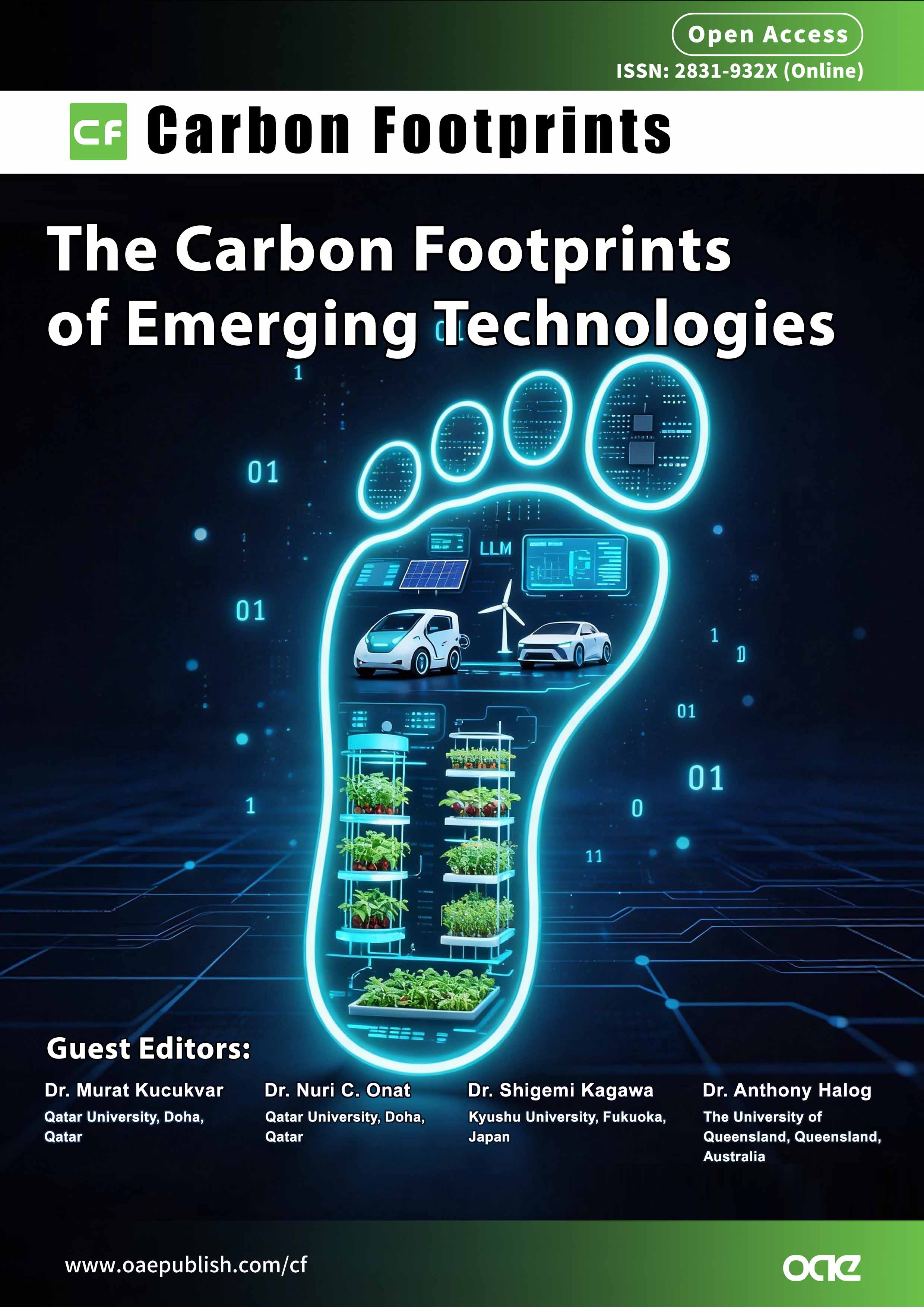
Topic: The Carbon Footprints of Emerging Technologies
Guest Editors
Special Topic Introduction
Emerging technologies are transforming industrial systems, mobility, digital infrastructure, and global supply chains at unprecedented speed. While these innovations offer significant potential to accelerate decarbonization, they also introduce complex and often overlooked life-cycle carbon implications and environmental impacts. As governments and industries invest in efforts toward net-zero pathways, rigorous evaluation of the carbon footprints of next-generation technologies is crucial to ensure that technological progress contributes effectively, equitably, and sustainably to climate change mitigation.
This Special Issue brings together cutting-edge research that rigorously investigates the life-cycle carbon impacts of emerging technologies across various sectors, including energy, mobility, manufacturing, infrastructure, and digital systems. We seek contributions that transcend conventional carbon accounting by integrating advanced analytical perspectives, such as temporal and spatial variability in emissions, rebound effects and behavioral dynamics, critical material and supply chain dependencies, and circular economy principles. By embracing holistic and interdisciplinary approaches, this Special Issue aims to deepen our understanding of the environmental consequences of next-generation technologies and to support the development of climate-aligned, resource-efficient, and socially responsible innovation pathways.
We are particularly interested in interdisciplinary studies that apply or advance analytical methods and tools, including but not limited to:
● Life Cycle Assessment (LCA);
● Life Cycle Sustainability Assessment (LCSA);
● Hybrid Life Cycle Assessment;
● Multi-Regional Input-Output (MRIO) analysis;
● Agent-based and systemdynamics modeling;
● Techno-economic analysis combined with environmental footprintassessment;
● Artificial intelligence (AI)-enabled carbon accounting and digital measurement systems.
Submissions may also address cross-cutting dimensions relevant to the potential topics of interest listed below. We especially encourage studies proposing new methodological models and theories, integrated modeling approaches, and forward-looking industrial strategies that support responsible innovation and climate-aligned technological deployment.
Topics of interest include, but are not limited to, the list below:
- Life-cycle carbon footprints of autonomous and connected vehicle systems, including autonomousvehicle (AV)-enabled energy shifts, data-processing infrastructure, and rebound effects.
- Carbon implications of generative AI and large-scale computing (model training, inference, data centers, energy sources, and semiconductor supply chains).
- LCA-based assessment of the carbon footprints ofclean-energy technologies such as solar photovoltaic (PV) systems, wind power, green hydrogen, battery storage, and alternative low-carbon fuels.
- Carbon impacts of electric mobility ecosystems, including electricvehicle (EV) manufacturing, battery life cycles, charging networks, and grid-integration scenarios.
- Integrated Material Flow Analysis (MFA)–LCA frameworks to quantify material flows, embedded carbon, and end-of-life outcomes for emerging technologies.
- Hybrid LCA and MRIO modeling to evaluate embodied carbon in global supply chains of emerging technologies, particularly those involving critical minerals, rare-earth elements, and cross-border production networks.
- Digitalization and innovationsin carbon accounting, including Internet of Things (IoT)-enabled energy management, smart manufacturing, and AI-assisted carbon measurement and reporting systems.
- Circular-economy strategies for emerging technologies, including designfor reuse, repair, remanufacturing, closed-loop material cycles, and their implications for life-cycle carbon footprints across digital, energy, and mobility systems.
- Carbon footprints of emerging food and agri-tech innovations, including alternative proteins, vertical farming, smart farming systems, and digitally optimized supply chains.
- Scenario modeling, policy evaluation, and techno-economic assessments supporting technology-enabled decarbonization strategies.
- Climate-oriented ethical, social, and governance dimensions of emerging technologies, including issues of carbon equity,risks of burden shifting, environmental justice implications of global supply-chain emissions, responsible and low-carbon AI energy use, and circular, climate-aligned pathways for advanced manufacturing and digital systems.
Keywords
Emerging technologies, Carbon footprint assessment, Life cycle assessment (LCA), circular economy, electric mobility, digitalization and AI-enabled carbon accounting, techno-economic and policy assessment
Submission Deadline
Submission Information
For Author Instructions, please refer to https://www.oaepublish.com/cf/author_instructions
For Online Submission, please login at https://www.oaecenter.com/login?JournalId=cf&IssueId=cf26031710397
Submission Deadline: 30 Sep 2026
Contacts: Leah Zhang, Assistant Editor, [email protected]