



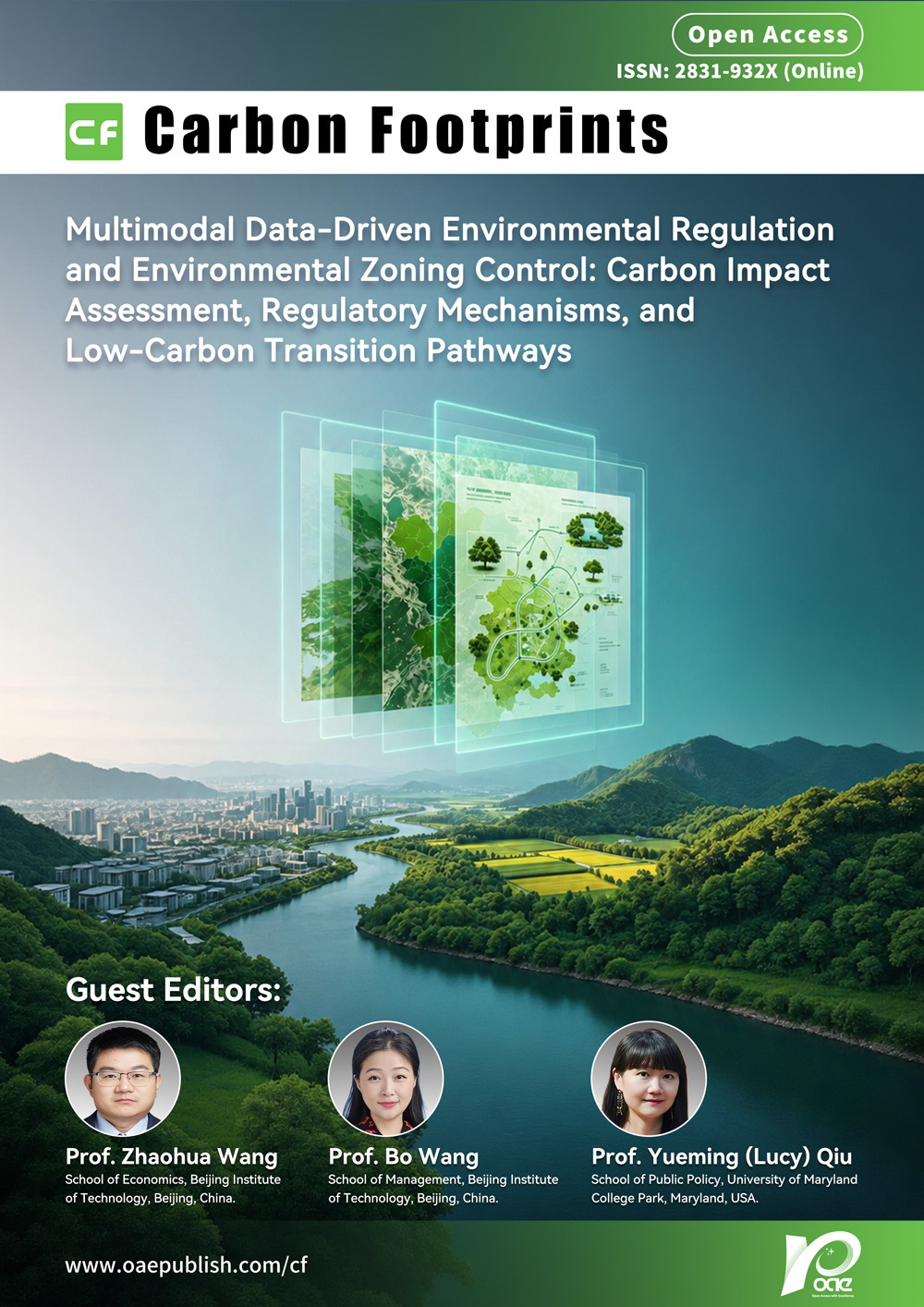
Topic: Multimodal Data-Driven Environmental Regulation and Environmental Zoning Control: Carbon Impact Assessment, Regulatory Mechanisms, and Low-Carbon Transition Pathways
Guest Editors
Special Topic Introduction
The integration of carbon mitigation and pollution control has become a key challenge for environmental governance and sustainable development. As climate objectives are increasingly embedded in regional and national policies, environmental regulation is evolving toward integrated, spatially differentiated, and data-driven zoning control. At the same time, advances in multimodal data—including satellite observations, continuous emission monitoring systems (CEMS), plant-level operational records, policy documents, and geospatial information—are creating new opportunities for more accurate carbon accounting, carbon footprint assessment, emission monitoring, and policy evaluation.
Combined with artificial intelligence, machine learning, spatial analysis, causal inference, and integrated assessment methods, these data support more reliable carbon assessment, regulatory mechanism identification, and evidence-based low-carbon transition planning.
This Special Issue focuses on multimodal data-driven environmental regulation and environmental zoning control, with particular attention to carbon accounting, carbon footprint assessment, carbon impact assessment, regulatory mechanisms, and low-carbon transition pathways. We welcome original research articles, reviews, perspectives, and case studies that advance carbon-oriented environmental regulation, policy evaluation, and sustainable transition through innovative data, analytical methods, and interdisciplinary approaches.
Topics of interest include, but are not limited to:
● Multimodal data integration and spatiotemporal analysis for environmental regulation and environmental zoning control;
● Carbon accounting, carbon footprint assessment, and emission monitoring using satellite observations, continuous emission monitoring systems, and plant-level operational data;
● Carbon impacts and decarbonization effects of environmental regulation and zoning policies;
● Machine learning and artificial intelligence for carbon accounting, environmental monitoring, and policy evaluation;
● Identification of the drivers, transmission mechanisms, and effectiveness of environmental regulation;
● Scenario analysis, integrated assessment, and optimization of regional low-carbon and net-zero transition pathways under uncertainty;
● Environmental justice, regional equity, and distributional effects of environmental regulation and carbon mitigation policies;
● Cross-regional policy coordination and the management of pollution and carbon spillover effects;
● International comparisons of environmental zoning, carbon governance, and low-carbon transition strategies;
● Macro–micro integrated assessment frameworks for evaluating carbon mitigation and environmental policy performance.
This Special Issue aims to advance interdisciplinary research on how multimodal big data and artificial intelligence can support carbon accounting, carbon footprint assessment, precise environmental regulation, and coordinated environmental zoning control. By integrating advanced data analytics, environmental economics, policy evaluation, and carbon science, the Special Issue seeks to improve understanding of carbon impacts, regulatory mechanisms, emission dynamics, and green low-carbon transition pathways, thereby providing scientific evidence for achieving regional carbon neutrality and sustainable development.
Keywords
Multimodal data, carbon accounting, carbon footprint assessment, environmental regulation, environmental zoning control, carbon emission monitoring, carbon impact assessment, artificial intelligence, pollution and carbon mitigation, low-carbon transition; carbon governance, regulatory mechanisms
Submission Deadline
Submission Information
For Author Instructions, please refer to https://www.oaepublish.com/cf/author_instructions
For Online Submission, please login at https://www.oaecenter.com/login?JournalId=cf&IssueId=cf26081110575
Submission Deadline: 31 Dec 2026
Contacts: Leah Zhang, Assistant Editor, [email protected]