



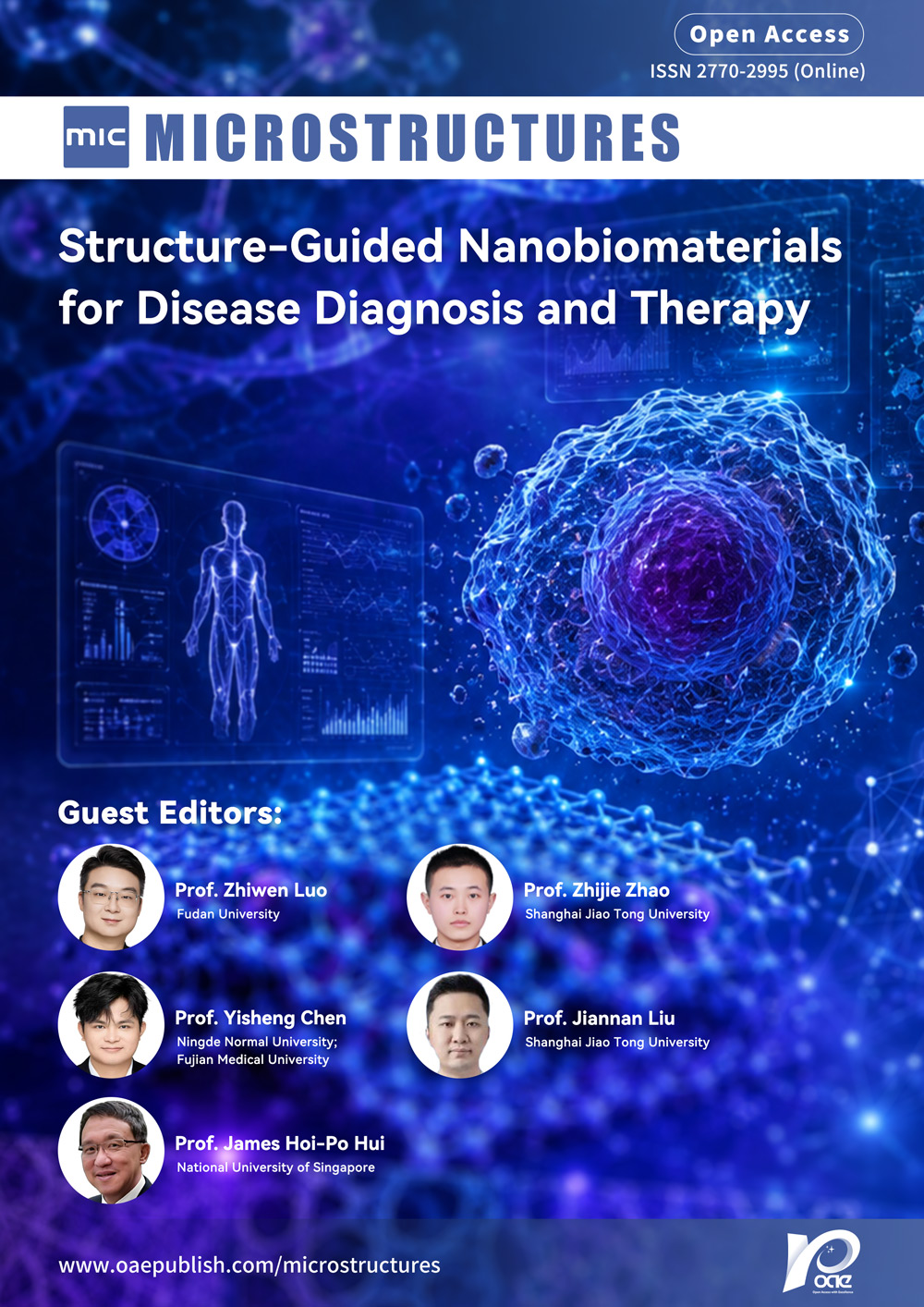
Topic: Structure-Guided Nanobiomaterials for Disease Diagnosis and Therapy
Guest Editors
Special Topic Introduction
Recent advances in nanobiomaterials underscore that clinical performance is governed not only by composition but also profoundly by structural features—including size, morphology, porosity, surface topology, interface organization, and spatiotemporal responsiveness. These structural parameters critically dictate protein corona formation, cellular uptake, immune modulation, tissue penetration, and drug release. However, systematically deciphering the complex relationships between nanomaterial structure and in vivo biological behavior remains a significant challenge.
To overcome this, cutting-edge technologies such as artificial intelligence (AI) and multi-omics (transcriptomics, single-cell and spatial omics, proteomics) are increasingly being utilized to serve and optimize structure design. By providing a systems-level decoding of structure-dependent nano–bio interactions, multi-omics reveals the precise biological consequences of specific material features. Concurrently, AI-driven predictive modeling leverages these complex datasets to accelerate the discovery of novel biomaterials and optimize structure–function relationships. This synergistic approach enables true structure-informed design, linking rational structural engineering with precise biological responses and disease-specific outcomes.
This Special Topic aims to bring together cutting-edge studies that leverage data-driven tools to advance the structural design of nanobiomaterials. We particularly welcome work that intrinsically links material structural features with biological mechanisms and translational outcomes. Of special interest are studies that integrate advanced structural characterization, computational modeling, and omics analysis to establish interpretable relationships among nanomaterial structure, biological response, and disease-specific therapeutic performance. By organically connecting materials science with predictive biology, this Special Topic will provide a timely platform to define next-generation strategies for structure-guided nanobiomaterials in precision medicine.
This Special Topic welcomes submissions covering, but not limited to, the following topics:
● Structure design, fabrication, and characterization of nanobiomaterials for disease diagnosis and therapy;
● Artificial intelligence-assisted structural design and optimization of nanobiomaterials for biomedical applications;
● Multi-omics analysis for decoding structure-dependent nano–bio interactions at the molecular, cellular, and tissue levels;
● Structure-guided biological responses (e.g., protein corona, cellular trafficking, immune modulation, microenvironment regulation) and their precision interventions across specific diseases (e.g., cancer, inflammatory, infectious, cardiovascular, neurological).
Keywords
Nanobiomaterials, structural design, artificial intelligence, multi-omics, nano-bio interactions
Submission Deadline
Submission Information
For Author Instructions, please refer to https://www.oaepublish.com/microstructures/author_instructions
For Online Submission, please login at https://www.oaecenter.com/login?JournalId=microstructures&IssueId=microstructures26062410509
Submission Deadline: 31 Dec 2026
Contacts: Juno, Assistant Editor, [email protected]