




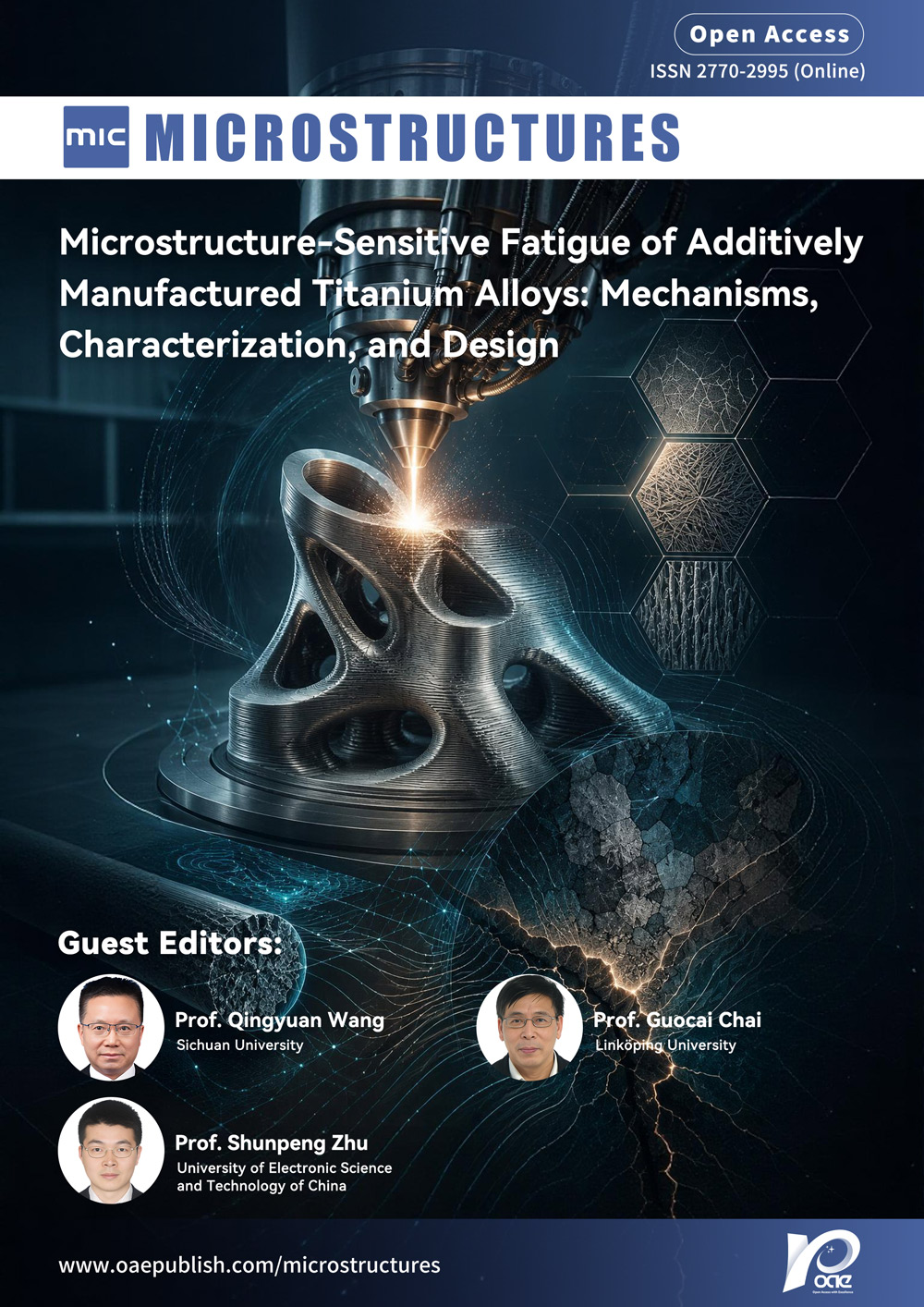
Topic: Microstructure-Sensitive Fatigue of Additively Manufactured Titanium Alloys: Mechanisms, Characterization, and Design
Guest Editors
Special Topic Introduction
Additive manufacturing (AM) offers unprecedented opportunities to fabricate titanium alloy components with complex geometries, lightweight structures, and tailored local properties for aerospace, biomedical, marine, and energy applications. However, fatigue performance remains one of the key barriers to the reliable deployment of AM titanium alloys in safety critical structural components. The layer-by-layer thermal history inherent to AM produces distinctive microstructural features, including prior-β grain morphology, α/β phase distribution, crystallographic texture, residual stresses, interfaces, surface condition, and process-induced defects such as pores and lack-of-fusion flaws. These features strongly influence fatigue crack initiation, short-crack growth, long-crack propagation, and final failure.
Understanding microstructure-sensitive fatigue requires an integrated approach linking AM processing, microstructural evolution, defect population, post-processing treatments, mechanical response, and life prediction. Recent advances in multiscale characterization, in-situ and ex-situ fatigue testing, fracture surface analysis, computational modelling, and data driven methods now provide new opportunities to clarify fatigue mechanisms and design more damage-tolerant AM titanium alloys.
This Special Issue aims to highlight recent progress in understanding, predicting, and improving the fatigue behaviour of additively manufactured titanium alloys through microstructure engineering, defect control, advanced characterization, and modelling-based design. Contributions on other AM metallic systems may also be considered where they provide clear mechanistic insights or comparative understanding relevant to microstructure sensitive fatigue in AM titanium alloys.
Topics of interest include, but are not limited to:
● Microstructure evolution and fatigue behaviour of additively manufactured titanium alloys;
● Processing–microstructure–defect–fatigue property relationships;
● Fatigue crack initiation, short-crack growth, and crack propagation mechanisms;
● Effects of defects, interfaces, phases, crystallographic texture, surface condition, and residual stresses;
● Influence of post-processing, including heat treatment, HIP, surface treatment, and thermomechanical processing;
● Low-cycle, high-cycle, and very-high-cycle fatigue of AM titanium alloys;
● Advanced characterization of fatigue-related microstructures and fracture surfaces;
● Computational modelling and fatigue life prediction;
● Machine learning-enabled microstructure-sensitive fatigue modelling and design;
● Microstructure design and optimization for high-performance AM structural materials.
Keywords
Additive manufacturing, titanium alloys, microstructure-sensitive fatigue, very high cycle fatigue, fatigue crack initiation, fatigue crack propagation, defects, residual stress, texture, phase transformation, post-processing, advanced characterization, fatigue life prediction, computational modelling, machine learning
Submission Deadline
Submission Information
For Author Instructions, please refer to https://www.oaepublish.com/microstructures/author_instructions
For Online Submission, please login at https://www.oaecenter.com/login?JournalId=microstructures&IssueId=microstructures26062510513
Submission Deadline: 31 Dec 2026
Contacts: Juno, Assistant Editor, [email protected]