



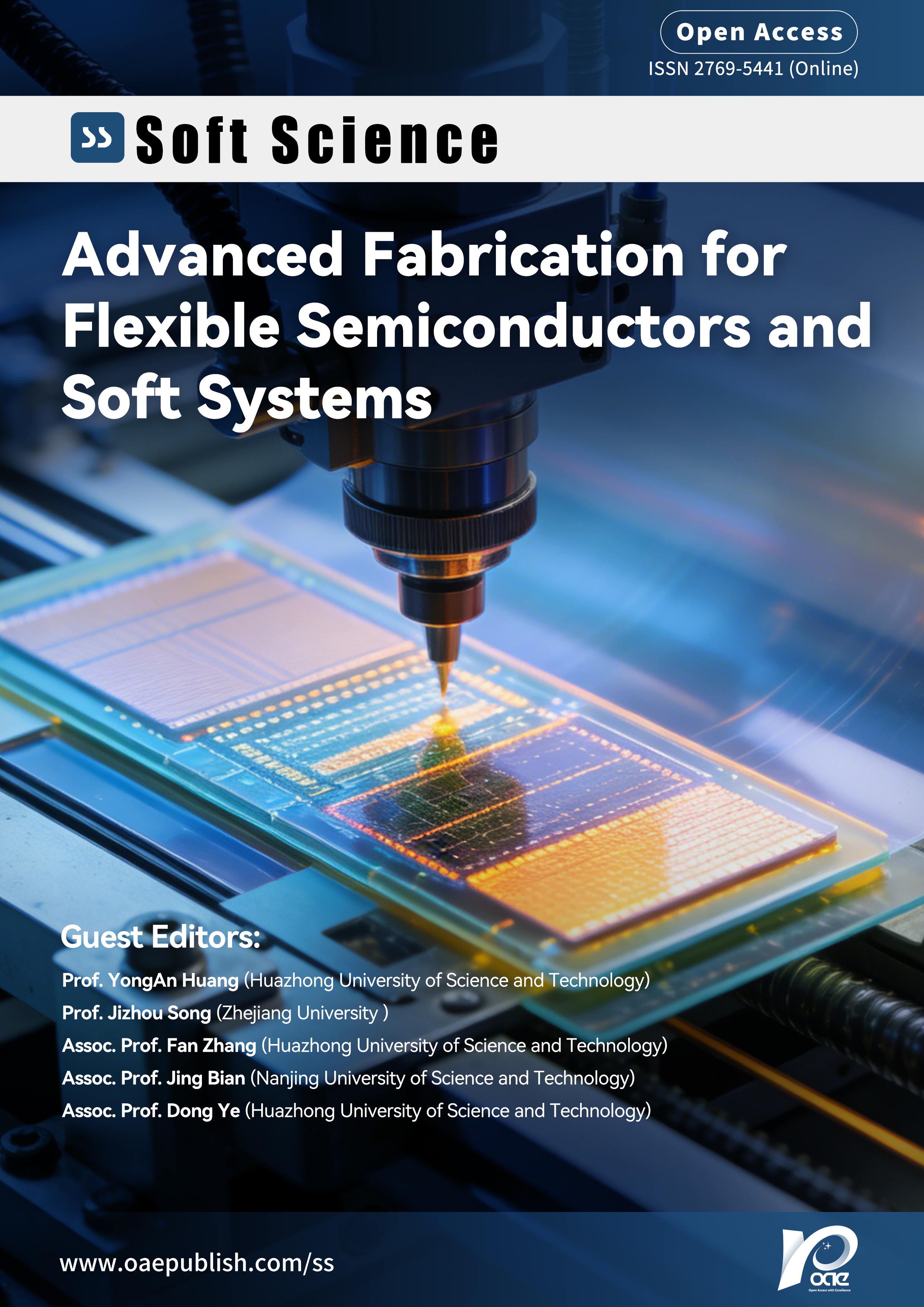
Topic: Advanced Fabrication for Flexible Semiconductors and Soft Systems
Guest Editors
Special Topic Introduction
Advanced fabrication technologies are transforming the development of flexible electronics by enabling lightweight, conformable, and durable devices on non-traditional substrates such as plastics, paper, and textiles. Beyond conventional rigid silicon-based processes, these methodologies incorporate innovative techniques such as solution-based processing (e.g., inkjet, screen, and electrohydrodynamic jet printing), additive manufacturing (e.g., three-dimensional (3D) printing), transfer printing, and laser-based processing. They leverage state-of-the-art materials - including conductive polymers, nanowires, graphene, and other two-dimensional (2D) materials - that can typically be deposited at low temperatures. Notable advancements, such as roll-to-roll (R2R) manufacturing, enable high-throughput, cost-effective production, while hybrid integration strategies combine flexible components with conventional silicon-based electronics. These advanced fabrication techniques are essential for achieving the necessary electrical performance, mechanical resilience, and scalability required for emerging applications, including wearable health monitoring systems, flexible display technologies, epidermal sensors, soft robotics, and Internet of Things (IoT) networks. This Special Issue highlights research exploring the critical interplay between innovative applications and the specialized manufacturing processes that enable them, covering advances in materials, scalable fabrication, and integration challenges.
Topics of interest include, but are not limited to:
● Advanced printing and solution-based fabrication techniques for flexible and stretchable electronics, including inkjet, screen, and electrohydrodynamic jet printing;
● Additive manufacturing and 3Dstructuring for flexible electronics, with emphasis on 3D printing-enabled complex architectures and multifunctional integration;
● Emerging functional materials for flexible electronic fabrication, such as conductive polymers, metal nanowires, graphene, and other 2D;
● Scalable manufacturing strategies, including R2R processing, addressing high-throughput production, process reliability, and cost-effective fabrication;
● Hybrid integration and system-level fabrication of flexible and silicon-based electronics, including transfer printing, heterogeneous integration, and applications in wearable systems, flexible sensors, and IoT platforms.
Keywords
Flexible electronics, flexible device design, manufacturing technologies, manufacturing equipment, innovative applications
Submission Deadline
Submission Information
For Author Instructions, please refer to https://www.oaepublish.com/ss/author_instructions
For Online Submission, please login at https://www.oaecenter.com/login?JournalId=ss&IssueId=ss26032010402
Submission Deadline: 31 Aug 2026
Contacts: Jiaxin Li, In-house Editor, [email protected]