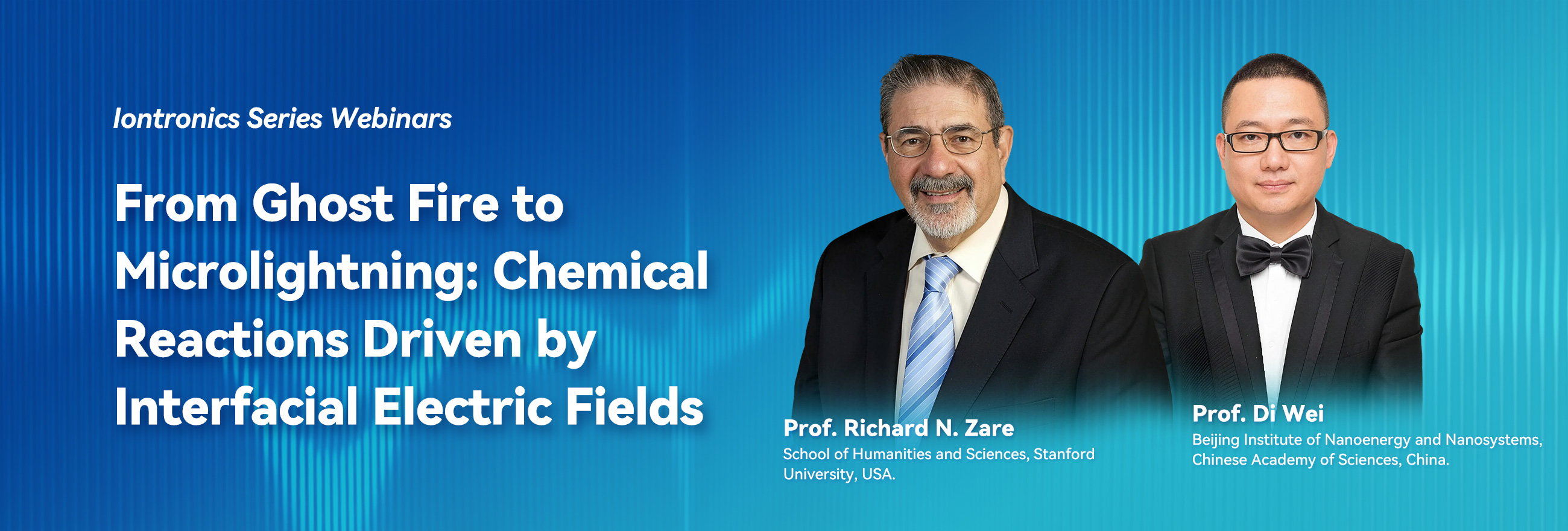
From Ghost Fire to Microlightning: Chemical Reactions Driven by Interfacial Electric Fields
Contents
Chair
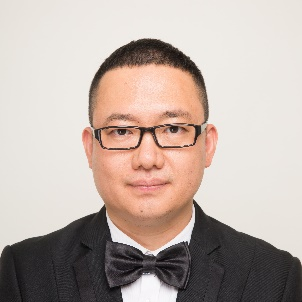
Prof. Di Wei
Beijing Institute of Nanoenergy and Nanosystems, Chinese Academy of Sciences, Beijing, China.
- Principal Investigator and Professor, Beijing Institute of Nanoenergy and Nanosystems, Chinese Academy of Sciences
- Director, Iontronics Laboratory
- Doctoral Supervisor
- Foreign Member, Finnish Academy of Science and Letters
- Foreign Member, Swedish Academy of Engineering Sciences in Finland (LSTV)
- Member, European Academy of Sciences and Arts (MEASA)
- Fellow, European Academy of Sciences (FEurASc)
- Life Fellow, National Academy of Inventors, USA (FNAI)
- Fellow, Royal Society of Chemistry, UK (FRSC)
- Fellow, Institute of Materials, Minerals and Mining, UK (FIMMM)
- Life Senior Member, Wolfson College, University of Cambridge
- Distinguished Expert appointed by the Beijing Municipal Government
- Leading Talent in Science and Technology, Beijing
Biography
Prof. Dr. Di Wei is a Principal Investigator at the Beijing Institute of Nanoenergy and Nanosystems, Chinese Academy of Sciences, and Director of the Iontronics Laboratory. His research seeks to establish iontronics as a new technological paradigm by programming ion–electron interactions for energy conversion, information processing, chemical reactions, sensing, and intelligent systems. His current interests include iontronics, flexible energy systems, advanced functional devices, and nanotechnology-enabled sensing.
Prof. Wei has authored approximately 200 scientific papers, including more than 150 publications as a first or corresponding author, in journals such as Nature Energy, Nature Communications, Science Advances, PNAS, Joule, Matter, Advanced Materials, Angewandte Chemie International Edition, Journal of the American Chemical Society, Energy & Environmental Science, and Chemical Society Reviews. He has also authored or edited 10 books, including six English-language volumes published by Wiley, Springer Nature, and Cambridge University Press.
Prof. Wei holds a portfolio of more than 200 international patent applications, including PCT applications, of which over 120 have been granted. Several of these technologies have been transferred to industrial partners, including Nokia in Finland and Lyten in the United States. He previously led the Flexible Energy Sub-project of the European Union Graphene Flagship and has delivered invited, keynote, and plenary lectures at institutions and conferences worldwide, including Stanford University, the University of Cambridge, EPFL, and the University of Turku.
His research achievements have been recognized by numerous honors, including the First Prize of the Nokia Global Innovation and Excellence Award, the Brian Conway Prize in Physical Electrochemistry from the International Society of Electrochemistry, and the Second Prize of the Beijing Natural Science Award as the principal recipient. He has also been included in Stanford University and Elsevier’s global top 2% scientist rankings for both career-long and single-year scientific impact.
Prof. Dr. Di Wei is a Principal Investigator at the Beijing Institute of Nanoenergy and Nanosystems, Chinese Academy of Sciences, and Director of the Iontronics Laboratory. His research seeks to establish iontronics as a new technological paradigm by programming ion–electron interactions for energy conversion, information processing, chemical reactions, sensing, and intelligent systems. His current interests include iontronics, flexible energy systems, advanced functional devices, and nanotechnology-enabled sensing.
Prof. Wei has authored approximately 200 scientific papers, including more than 150 publications as a first or corresponding author, in journals such as Nature Energy, Nature Communications, Science Advances, PNAS, Joule, Matter, Advanced Materials, Angewandte Chemie International Edition, Journal of the American Chemical Society, Energy & Environmental Science, and Chemical Society Reviews. He has also authored or edited 10 books, including six English-language volumes published by Wiley, Springer Nature, and Cambridge University Press.
Prof. Wei holds a portfolio of more than 200 international patent applications, including PCT applications, of which over 120 have been granted. Several of these technologies have been transferred to industrial partners, including Nokia in Finland and Lyten in the United States. He previously led the Flexible Energy Sub-project of the European Union Graphene Flagship and has delivered invited, keynote, and plenary lectures at institutions and conferences worldwide, including Stanford University, the University of Cambridge, EPFL, and the University of Turku.
His research achievements have been recognized by numerous honors, including the First Prize of the Nokia Global Innovation and Excellence Award, the Brian Conway Prize in Physical Electrochemistry from the International Society of Electrochemistry, and the Second Prize of the Beijing Natural Science Award as the principal recipient. He has also been included in Stanford University and Elsevier’s global top 2% scientist rankings for both career-long and single-year scientific impact.
Speaker
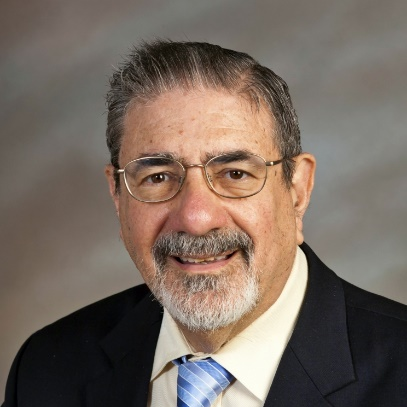
Prof. Richard N. Zare
School of Humanities and Sciences, Stanford University, Stanford, USA.
- Foreign Member, Chinese Academy of Sciences
- Member, U.S. National Academy of Sciences
- Foreign Member, Royal Society (UK)
- Fellow, American Academy of Arts and Sciences
- Wolf Prize in Chemistry
- U.S. National Medal of Science
- ACS Priestley Medal
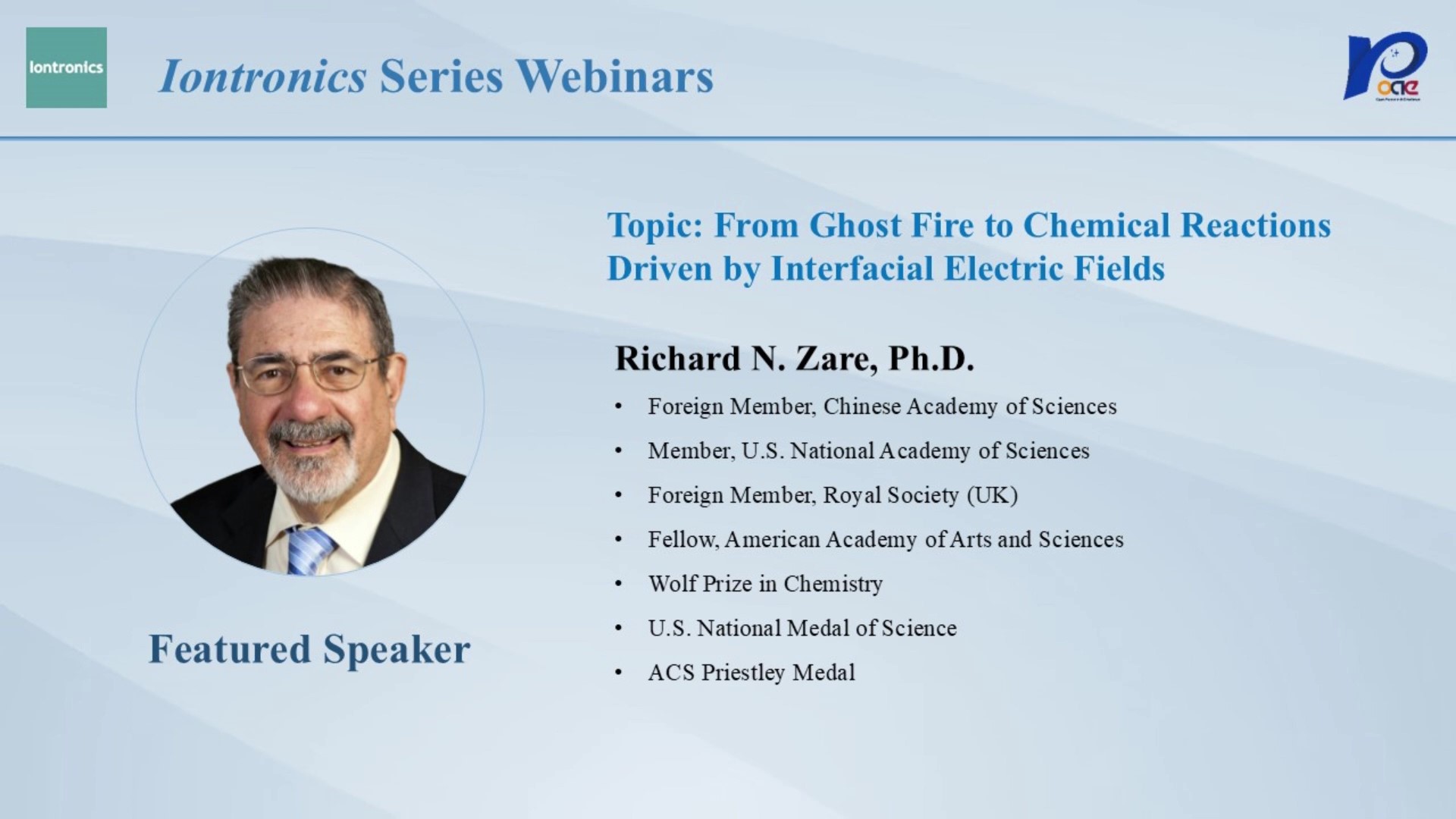
Topic: From Ghost Fire to Chemical Reactions Driven by Interfacial Electric Fields
Richard N. Zare is the Marguerite Blake Wilbur Professor of Natural Science and Professor of Chemistry at Stanford University, with a courtesy appointment in the Department of Physics. He received his B.A. in chemistry and physics from Harvard University in 1961 and his Ph.D. in chemical physics in 1964 under Professor Dudley R. Herschbach. After appointments at the Massachusetts Institute of Technology, the University of Colorado, and Columbia University, he joined Stanford University in 1977 and later served as Chair of its Department of Chemistry.
Professor Zare is internationally recognized as a pioneer in physical chemistry, analytical chemistry, laser spectroscopy, and molecular reaction dynamics. His experimental and theoretical studies have fundamentally advanced the molecular-level understanding of chemical reactions and collision processes. In particular, his development and application of laser-induced fluorescence established an important approach for probing reaction dynamics and quantum-state-resolved molecular behavior. His research has also contributed to capillary electrophoresis, trace-species detection, mass-spectrometric imaging, nanoscale chemical analysis, single-cell measurements, microdroplet chemistry, interfacial reactions, and drug delivery.
Professor Zare has authored or co-authored more than 1,200 publications spanning fundamental molecular science, analytical instrumentation, chemical imaging, biological analysis, and interfacial chemistry. According to his Google Scholar profile, his work has received more than 114,000 citations, with an h-index of 160 as of July 2026, demonstrating its extensive and sustained influence across chemistry and related disciplines.
He was elected to the U.S. National Academy of Sciences in 1976 and is also a member of the American Academy of Arts and Sciences and the American Philosophical Society, as well as a Foreign Member of the Royal Society and the Chinese Academy of Sciences. He has also contributed extensively to science policy, including service as Chair of the U.S. National Science Board.
His major honors include the U.S. National Medal of Science, the Wolf Prize in Chemistry, the Welch Award in Chemistry, the American Chemical Society Priestley Medal, the BBVA Foundation Frontiers of Knowledge Award, the King Faisal International Prize in Science, and the International Science and Technology Cooperation Award of the People’s Republic of China. Professor Zare currently serves as an Honorary Editor-in-Chief of Iontronics. His research on microdroplet chemistry, interfacial processes, molecular analysis, and reaction dynamics closely aligns with the journal’s interdisciplinary focus on ion-mediated phenomena.
Professor Zare is internationally recognized as a pioneer in physical chemistry, analytical chemistry, laser spectroscopy, and molecular reaction dynamics. His experimental and theoretical studies have fundamentally advanced the molecular-level understanding of chemical reactions and collision processes. In particular, his development and application of laser-induced fluorescence established an important approach for probing reaction dynamics and quantum-state-resolved molecular behavior. His research has also contributed to capillary electrophoresis, trace-species detection, mass-spectrometric imaging, nanoscale chemical analysis, single-cell measurements, microdroplet chemistry, interfacial reactions, and drug delivery.
Professor Zare has authored or co-authored more than 1,200 publications spanning fundamental molecular science, analytical instrumentation, chemical imaging, biological analysis, and interfacial chemistry. According to his Google Scholar profile, his work has received more than 114,000 citations, with an h-index of 160 as of July 2026, demonstrating its extensive and sustained influence across chemistry and related disciplines.
He was elected to the U.S. National Academy of Sciences in 1976 and is also a member of the American Academy of Arts and Sciences and the American Philosophical Society, as well as a Foreign Member of the Royal Society and the Chinese Academy of Sciences. He has also contributed extensively to science policy, including service as Chair of the U.S. National Science Board.
His major honors include the U.S. National Medal of Science, the Wolf Prize in Chemistry, the Welch Award in Chemistry, the American Chemical Society Priestley Medal, the BBVA Foundation Frontiers of Knowledge Award, the King Faisal International Prize in Science, and the International Science and Technology Cooperation Award of the People’s Republic of China. Professor Zare currently serves as an Honorary Editor-in-Chief of Iontronics. His research on microdroplet chemistry, interfacial processes, molecular analysis, and reaction dynamics closely aligns with the journal’s interdisciplinary focus on ion-mediated phenomena.
Presentation
NaN

