

Triboelectric Nanogenerators and Iontronics
Contents
Chair

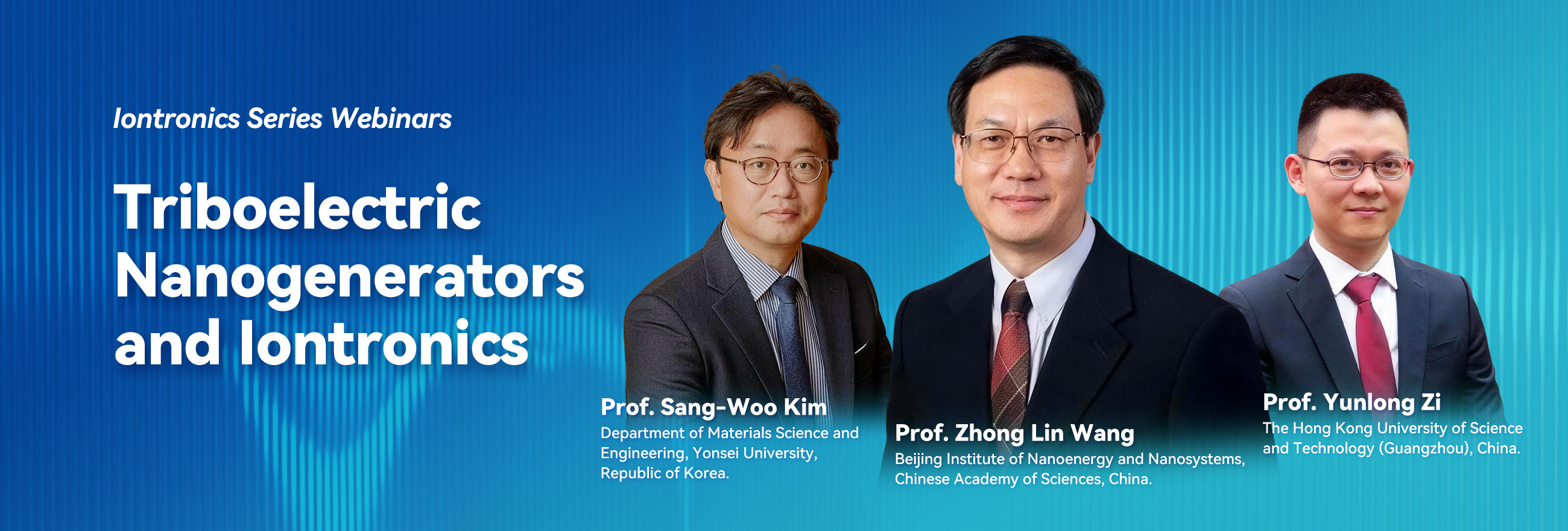
Prof. Zhong Lin Wang
- Director and Chief Scientist, Beijing Institute of Nanoenergy and Nanosystems, Chinese Academy of Sciences
- Foreign Member, Chinese Academy of Sciences
- Fellow, Royal Academy of Engineering, UK
- Fellow, U.S. National Academy of Inventors
- International Fellow, Canadian Academy of Engineering
- Laureate, Global Energy Prize, Eni Award, and Albert Einstein World Award of Science
- Honorary Editor-in-Chief, Iontronics
His research has advanced triboelectric and piezoelectric energy conversion, self-powered sensing, wearable electronics, robotics, the Internet of Things, artificial intelligence, and large-scale blue-energy harvesting. He has also made foundational contributions to the understanding of contact electrification and interfacial charge transfer, providing an important scientific basis for triboelectric nanogenerators and emerging triboelectric iontronics.
According to Scopus, Prof. Wang has authored more than 3,100 indexed documents, receiving over 451,000 citations, with an h-index of 317 as of August 2026.
Speaker(s)

Prof. Sang-Woo Kim
- Professor and YONSEI World-Class Fellow
- Director, Center for Human-Oriented Triboelectric Energy Harvesting
- Fellow, Korean Academy of Science and Technology
- Member, National Academy of Engineering of Korea
- Clarivate Highly Cited Researcher, Cross-Field, 2025
Topic: To be updated
His work has played an important role in extending triboelectric technologies beyond conventional mechanical energy harvesting toward biomedical sensing, implantable electronics, neuromodulation, pathogen control, and emerging therapeutic applications. In particular, his research connects energy conversion with biological interfaces and healthcare technologies, closely aligning with the interdisciplinary scope of this webinar.
Prof. Kim received his PhD in Electronic Science and Engineering from Kyoto University in 2004. Before joining Yonsei University in 2023, he held faculty positions at Sungkyunkwan University and Kumoh National Institute of Technology and worked as a Research Associate at the University of Cambridge.
His official academic profile reports more than 35,000 citations and an h-index of 103.

Prof. Yunlong Zi
- Associate Professor, Thrust of Sustainable Energy and Environment
- Acting Dean, College of Education Sciences
- Fellow, Institute of Physics
- Senior Member, IEEE
- Clarivate Highly Cited Researcher 2025
Topic: Multimodal Tactile Sensing Enabled by Triboelectricity
Abstract: While tactile sensing is fundamental for embodied intelligence to physically interact with and understand the world, its complex and multimodal nature remains significantly underexplored compared with vision, hearing, and other types of sensing. A major challenge lies in the wide range of information involved, including force and pressure, softness, friction, surface roughness, and temperature.
As triboelectrification, or contact electrification, naturally originates from tactile interactions, it may provide a paradigm-shifting strategy for multimodal tactile sensing. Prof. Zi's team has developed a hemispherical bimodal intelligent tactile sensor array based on the triboelectric effect, capable of softness identification, modulus quantification, and material-type recognition.
The team has also employed triboelectrically induced electroluminescence to visualize tactile information with enhanced brightness and a low detection limit. In addition, a self-powered electrotactile textile haptic glove based on the triboelectric-discharge effect has been developed to reproduce high-resolution tactile information.
The presentation will discuss these advances and the multidisciplinary opportunities for developing high-resolution, multimodal tactile sensing and feedback systems toward embodied intelligence.
He received his PhD in Physics from Purdue University in 2014 and his Bachelor of Engineering in Materials Science and Engineering from Tsinghua University in 2009. Before joining HKUST, he served as an Assistant Professor at the Chinese University of Hong Kong from 2017 to 2022 and conducted postdoctoral research at the Georgia Institute of Technology from 2014 to 2017.
His current research focuses on triboelectric energy harvesting, biomimetic tactile sensing, visualized tactile sensing, and self-powered wireless sensing systems. He has published nearly 200 journal articles, receiving more than 20,000 citations with an h-index of 75.
His honors include Clarivate Highly Cited Researcher 2025, the inaugural HKUST(GZ) Lionel M. Ni and Yin Ching Outstanding Teaching Award 2025, inclusion in the Elsevier/Stanford Career-long Scientific Impact List in 2024 and 2025, Fellowship of the Institute of Physics, the NSFC Excellent Young Scientists Fund (Overseas), Guangdong Distinguished Young Scholar, MIT Technology Review Asia-Pacific Innovators Under 35, the Nano Energy Award, and the MRS Postdoctoral Award.
Introduction
Chaired by Prof. Zhong Lin Wang, this international webinar will bring together leading scientists to discuss advances in triboelectric nanogenerators and their emerging convergence with iontronics, from fundamental charge-transfer mechanisms and functional materials to biointegrated devices and embodied intelligence.
Beijing/Hong Kong Time, UTC+8
| Time (Beijing Time, UTC+8) | Chair/Speakers | Topic |
|---|---|---|
| 20:00–20:05 | Prof. Di Wei | Presentation on Iontronics |
| 20:05–20:10 | Prof. Zhong Lin Wang | Welcome Address |
| 20:10–20:40 | Prof. Sang-Woo Kim | To be updated |
| 20:40–21:10 | Prof. Yunlong Zi | Multimodal Tactile Sensing Enabled by Triboelectricity |
| 21:10–21:40 | Distinguished Speaker | To be confirmed |
| 21:40–21:55 | Prof. Zhong Lin Wang | Discussion |
| 21:55–22:00 | Prof. Zhong Lin Wang | Concluding Remarks |
The detailed programme will be updated as additional speakers are confirmed.

