

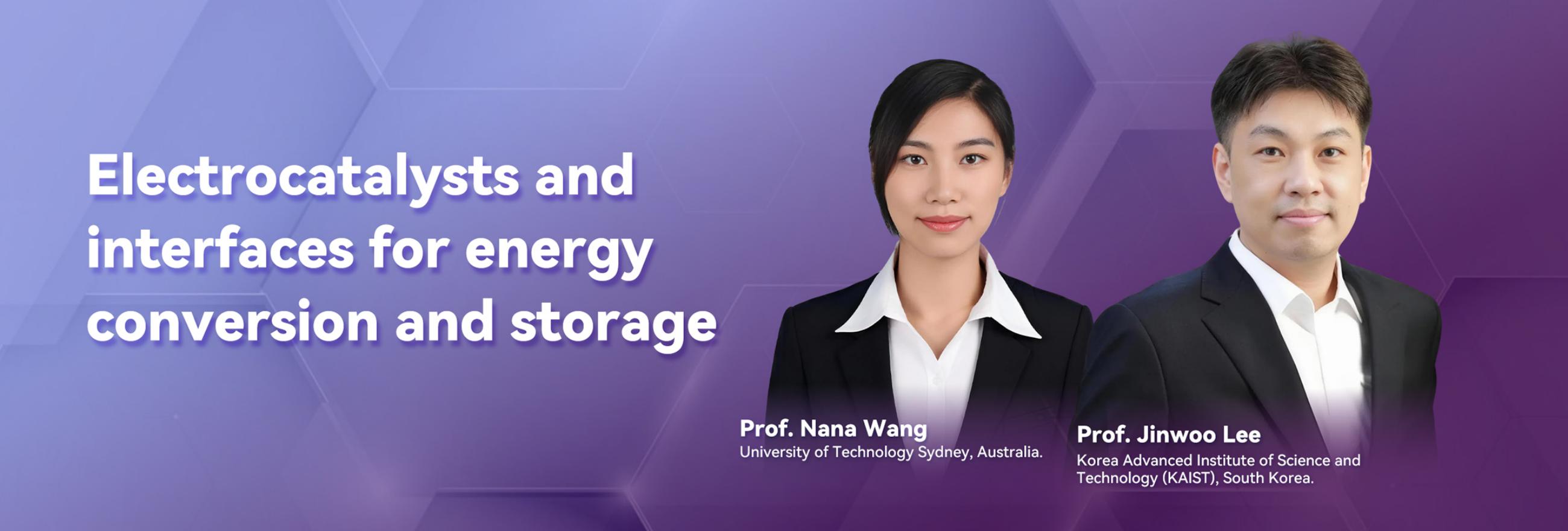
Electrocatalysts and interfaces for energy conversion and storage
Contents
Host

Professor Nana Wang
Speaker

Professor Jinwoo Lee
He started his professional career as an Assistant Professor in Department of Chemical Engineering at POSTECH (2008-2018), and moved to KAIST in 2018 where he was later appointed as the KAIST Chair Professor.
He has published more than 314 papers including Nature Materials, Nature Catalysis, Joule, Nature Comm. Science Advances, JACS, Angew. Chem. Adv. Mater., Energy. Environ. Sci. Total citation number and H-index are >34,000 and 99, respectively. He serves as Editor for Chemical Engineering Journal and Associated Editor for Science Advances (AAAS).
He received the B.S. degree from the School of Chemical and Biological Engineering at Seoul National University, Korea in 1993. He then received the Ph.D. degree from the School of Chemical and Biological Engineering at Seoul National University, Korea in 1998.
Abstract
Single-atom catalysts (SACs) and atomically dispersed catalysts maximize active-site utilization while exhibiting unique catalytic properties. In this presentation, we introduce strategies for engineering atomically dispersed metals and sub-nanometer clusters through dynamic placement and interface design for efficient hydrogen electrocatalysis. Strong metal-support interactions with multifunctional carbide and defect-engineered mesoporous carbon supports provide adjacent *OH binding sites and stabilize active metal species, enhancing reaction kinetics, CO tolerance, and durability. In situ spectroscopy further reveals that sub-nanometer Ru clusters maintain partially oxidized surface states under alkaline HER conditions, promoting favorable interfacial water structures and accelerated hydrogen evolution. Combined with two-dimensional mesoporous architectures that facilitate ion and mass transport, these catalysts achieve industrially relevant current densities and excellent long-term stability in anion exchange membrane water electrolysis. These results highlight atomic-scale interface engineering as a promising strategy for scalable green hydrogen production. Strategies for stabilizing interfaces in next-generation high-capacity lithium-metal and sodium-metal batteries will also be discussed.
Keywords: Electrocatalysts, Anion Exchange Membrane Water Elctrolysis (AEMWE), Interface Engineering, Alkali metal battery.