




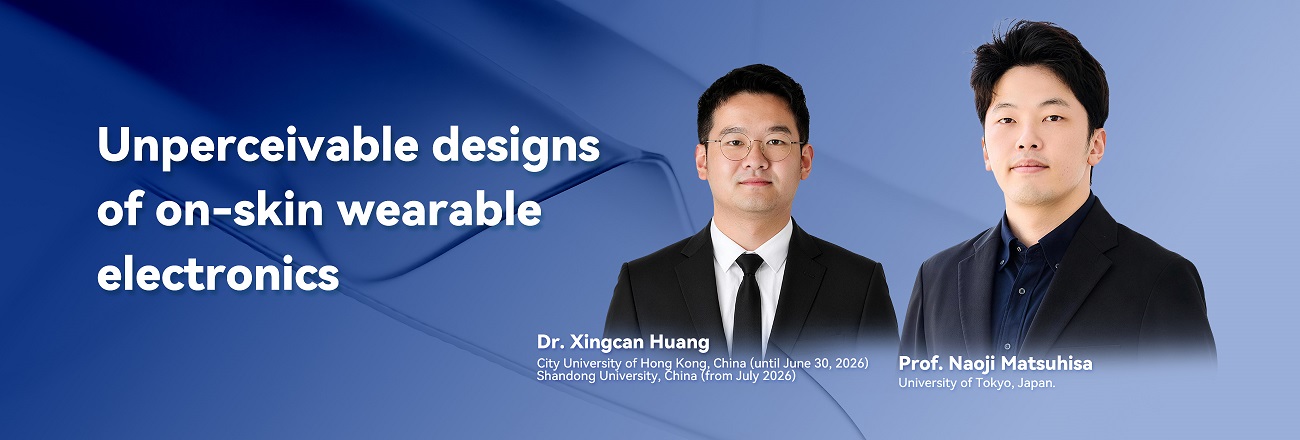
Unperceivable designs of on-skin wearable electronics
Time
1:00 PM (Beijing Time, UTC+8)
2:00 PM (Tokyo Time, UTC+9)
2:00 PM (Tokyo Time, UTC+9)
Join the Webinar

Zoom Meeting ID: 848 6323 3814
Passcode: 336896
Join Zoom Meeting:
https://us06web.zoom.us/j/84863233814?pwd=vLNgM71fols0Ta656GfD4mFxajObzT.1
Share
Contents
Guest

Prof. Naoji Matsuhisa
The University of Tokyo
Naoji Matsuhisa is an Associate Professor at Research Center for Advanced Science and Technology (RCAST) in the University of Tokyo. His research interest is in stretchable electronic materials and devices for the application in next-generation wearable devices, and human-computer interfaces. He received his PhD degree from the University of Tokyo in 2017. Then he worked as a postdoctoral researcher at Nanyang Technological University in Singapore, and Stanford University in the U.S. In 2020, he joined the Department of Electronics and Electrical Engineering at Keio University as an Assistant Professor. In 2022, he became an Associate Professor at Institute of Industrial Science (IIS) in the University of Tokyo. He has published more than 60 peer-reviewed papers (>10,000 citations). He is the recipient of >20 awards including MIT Technology Review Innovators Under 35 in 2022, and Project Management Institute Future 50 in 2023.
Moderator

Dr. Xingcan Huang
City University of Hong Kong (until June 30, 2026)
Shandong University(from July 2026)
Shandong University(from July 2026)
Dr. Xingcan Huang is currently a Postdoctoral Fellow at the Department of Biomedical Engineering, City University of Hong Kong, and a Qilu Young Scholar at Shandong University. He will join the research group of Prof. Hong Liu at the School of Biomedical Engineering, Shandong University, in July 2026 as a Full Research Professor. He received his Ph.D. degree in Biomedical Engineering from City University of Hong Kong in September 2024 under the supervision of Prof. Xinge Yu, and subsequently continued his postdoctoral research at the same institution.
To date, Dr. Huang has published 22 papers as first author or co-first author in leading journals, including Nature Communications, Science Advances, Advanced Materials, and Nano Letters. His collaborative research has also been published in Nature, Nature Materials, and Nature Machine Intelligence. His publications have received more than 4,600 citations according to Google Scholar, with an h-index of 37. In addition, he has been granted or disclosed nine international and domestic invention patents.
To date, Dr. Huang has published 22 papers as first author or co-first author in leading journals, including Nature Communications, Science Advances, Advanced Materials, and Nano Letters. His collaborative research has also been published in Nature, Nature Materials, and Nature Machine Intelligence. His publications have received more than 4,600 citations according to Google Scholar, with an h-index of 37. In addition, he has been granted or disclosed nine international and domestic invention patents.
Abstract
Flexible and stretchable electronics have demonstrated high skin conformability, enabling long-term healthcare monitoring with comfort-of-wear and high signal integrity. However, the device's appearance sometimes psychologically disturbed its use in daily life, especially on the face, which is the source of useful signals, including EEG, EMG, and EOG. In this presentation, we demonstrate fully unperceivable skin electrodes that do not alter the optical or mechanical properties of bare skin. The high optical and mechanical invisibility on the skin was confirmed by a series of physical characterizations and sensory experiments. Furthermore, we verified that the appearance of the electrodes psychologically affects the wearers' emotions and the signals obtained through the devices, which we call appearance artifacts. Still, our unperceivable electrodes didn't leave any appearance artifact. We also constructed a system using unperceivable electrodes and measured EEG, EOG, and EMG signals, whose signal quality was comparable to that of conventional gel electrodes. For your information, we have reviewed the design strategies to harmonize wearable electronics in daily lives [1]. In addition to the unperceivable electrodes, we will also cover recent topics related to soft electronic materials and devices.
References
[1](†Same contribution) Y. Liu†, S. De Mulatier†, N. Matsuhisa*, "Unperceivable Designs of Wearable Electronics", Advanced Materials 37, 2502727 (2025).
References
[1](†Same contribution) Y. Liu†, S. De Mulatier†, N. Matsuhisa*, "Unperceivable Designs of Wearable Electronics", Advanced Materials 37, 2502727 (2025).