

fig2
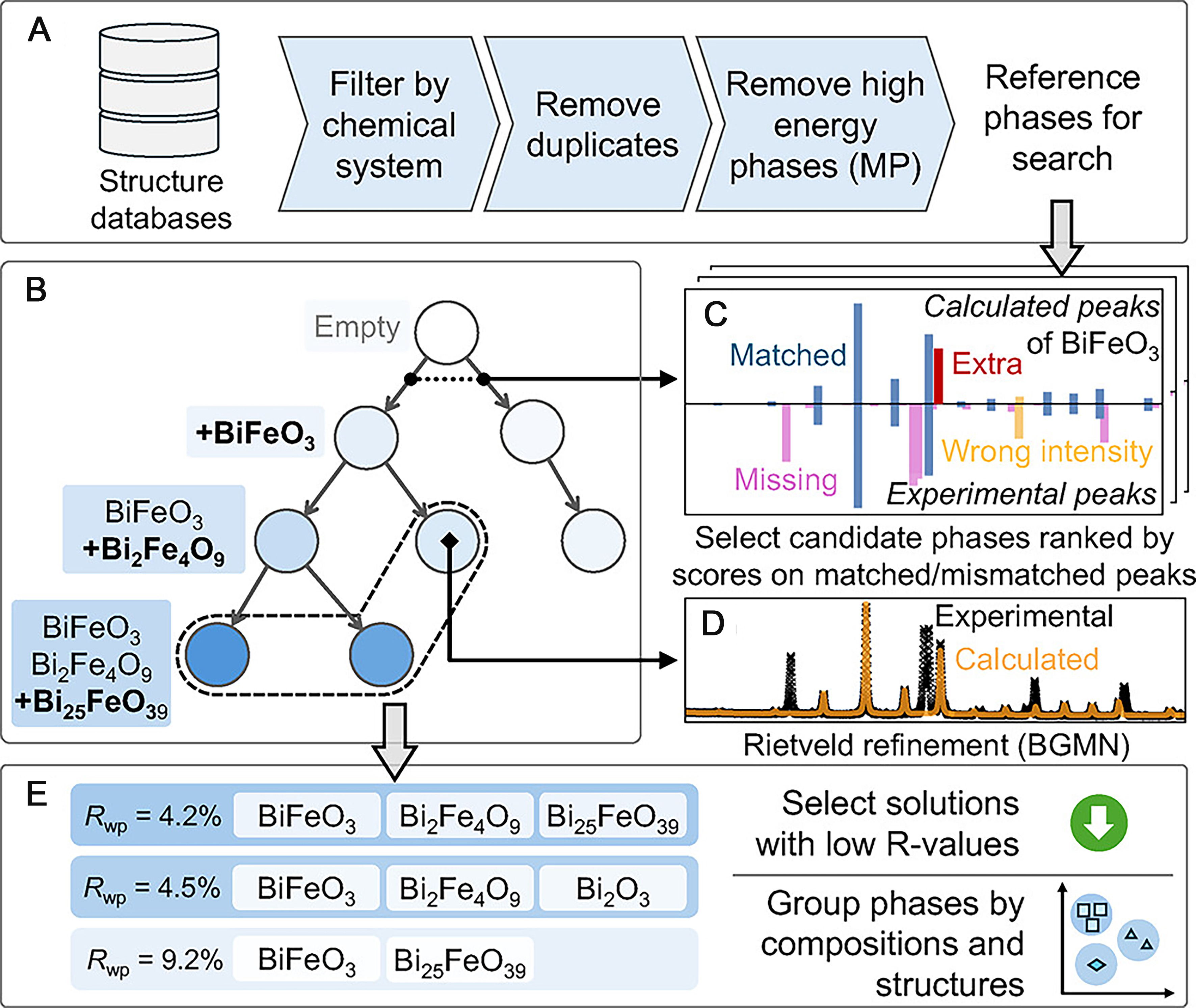
Figure 2. Overview of powder X-ray diffraction phase analysis using Dara. (A) Preprocessing workflow for selecting reference phases from structural databases. Candidate phases within the chemical system of the input diffraction pattern are retained, duplicate structures are removed based on composition and space group, and high-energy phases are excluded using thermodynamic data from the Materials Project; (B) Search tree in which each node represents a phase combination and each directed edge represents the addition of one phase. Node color indicates the weighted-profile residual (Rwp), with darker colors corresponding to lower values and therefore better fits; (C) Peak-matching algorithm used to identify phases that can account for the remaining unmatched peaks, thereby pruning unlikely candidates and reducing computational cost; (D) Rietveld refinement of the selected phases using BGMN. Black crosses represent the experimental diffraction pattern, and the orange line represents the calculated pattern; (E) Candidate solutions extracted from the search tree, ranked by R-values and grouped according to composition and structure; solutions with excessively high R-values are excluded. Reproduced unchanged from reference[4] under the Creative Commons CC BY-NC-ND 4.0 license. Dara: Data-driven automated Rietveld analysis; XRD: X-ray diffraction; PXRD: powder X-ray diffraction; COD: Crystallography Open Database; MP: Materials Project.