
fig6
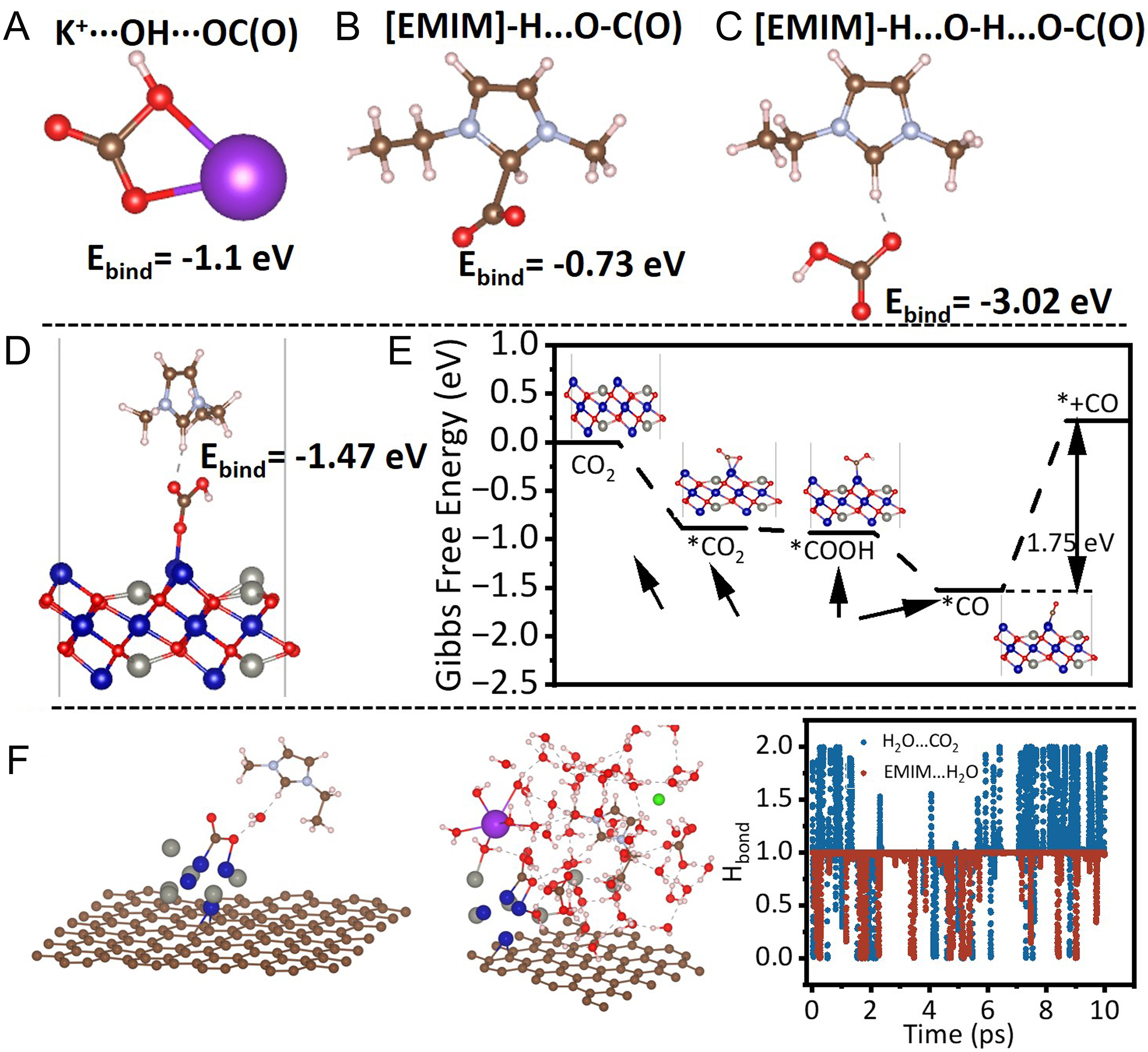
Figure 6. (A) Disordered K+···OH-···OC(O)- in conventional KHCO3: weak interactions, -1.1 eV. (B) Pure [EMIM]Cl: steric hindrance lowers binding to -0.73 eV, hindering direct proton transfer. (C) Linear [EMIM]-H···O-H···O-C(O)- network in [EMIM]Cl/KHCO3 hybrid: binding enhanced to -3.02 eV, highlighting water as proton-bridging mediator. (D) Adsorption of key [EMIM]-H···O-H··· complex on CoZn oxide nanoflower: binding energy -1.47 eV, confirming active species stabilization. (E) Reaction free energy diagram: thermodynamic favorability of CO production pathway validated. (F) AIMD snapshot (10 ps): transient linear H-bonding network between [EMIM]+ and ·CO2- mediated by water, evidencing the synergistic proton tunneling mechanism.