

fig6
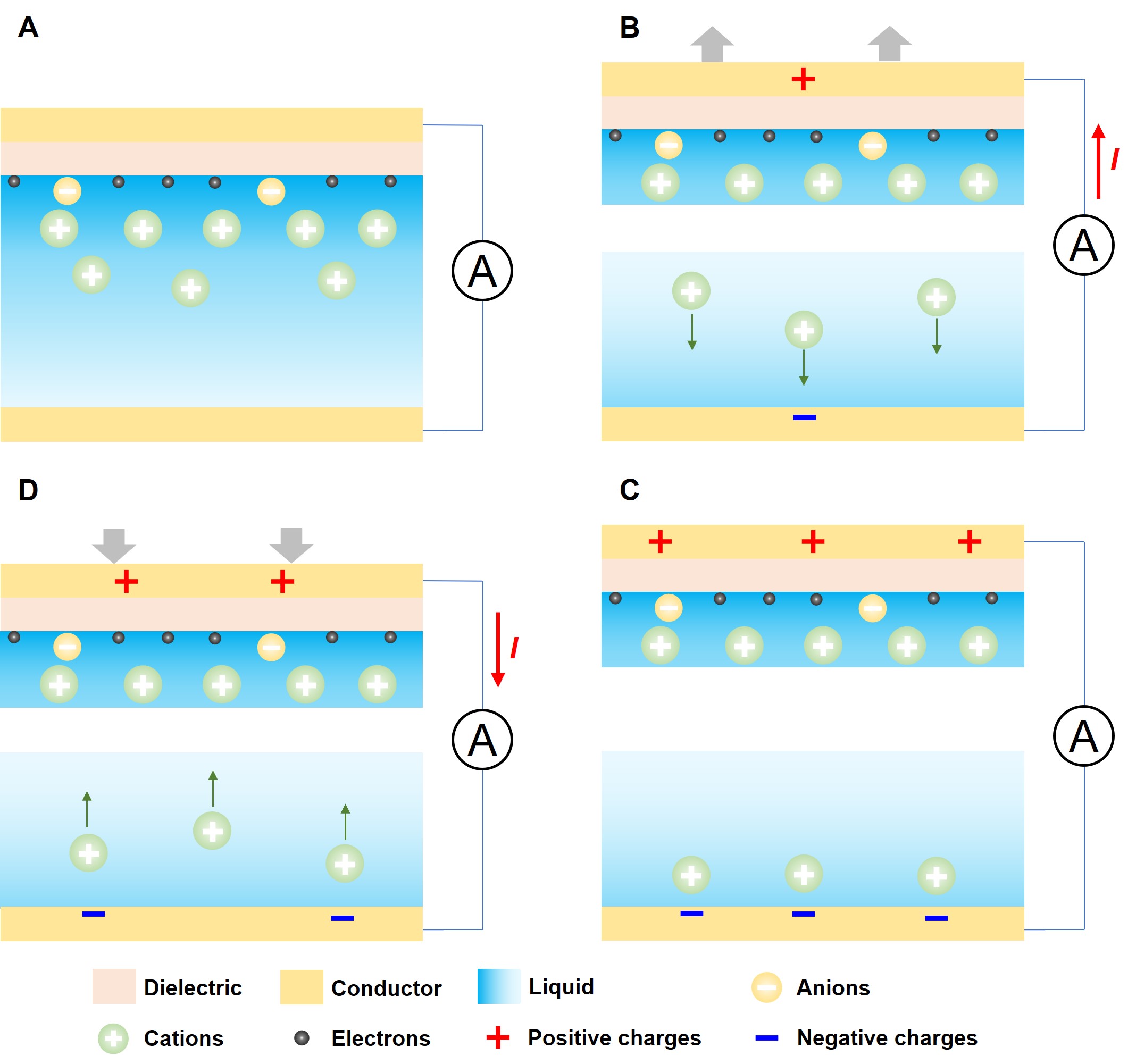
Figure 6. Dynamic EDL-mediated energy-conversion mechanism of S-L TENGs. (A) Contact between a dielectric surface and a liquid induces interfacial charge transfer and ionic redistribution, leading to EDL formation at the interface; (B) Subsequent separation disrupts the EDL, driving ionic migration and generating a transient interfacial electric field that induces electron flow in the external circuit; (C) At complete separation, ionic redistribution approaches a quasi-equilibrium state, corresponding to a maximum charge-separated condition with negligible current output; (D) Re-approach of the dielectric surface reconstructs the EDL, reverses ionic migration, and restores the interfacial electric field, resulting in alternating current output.