

fig3
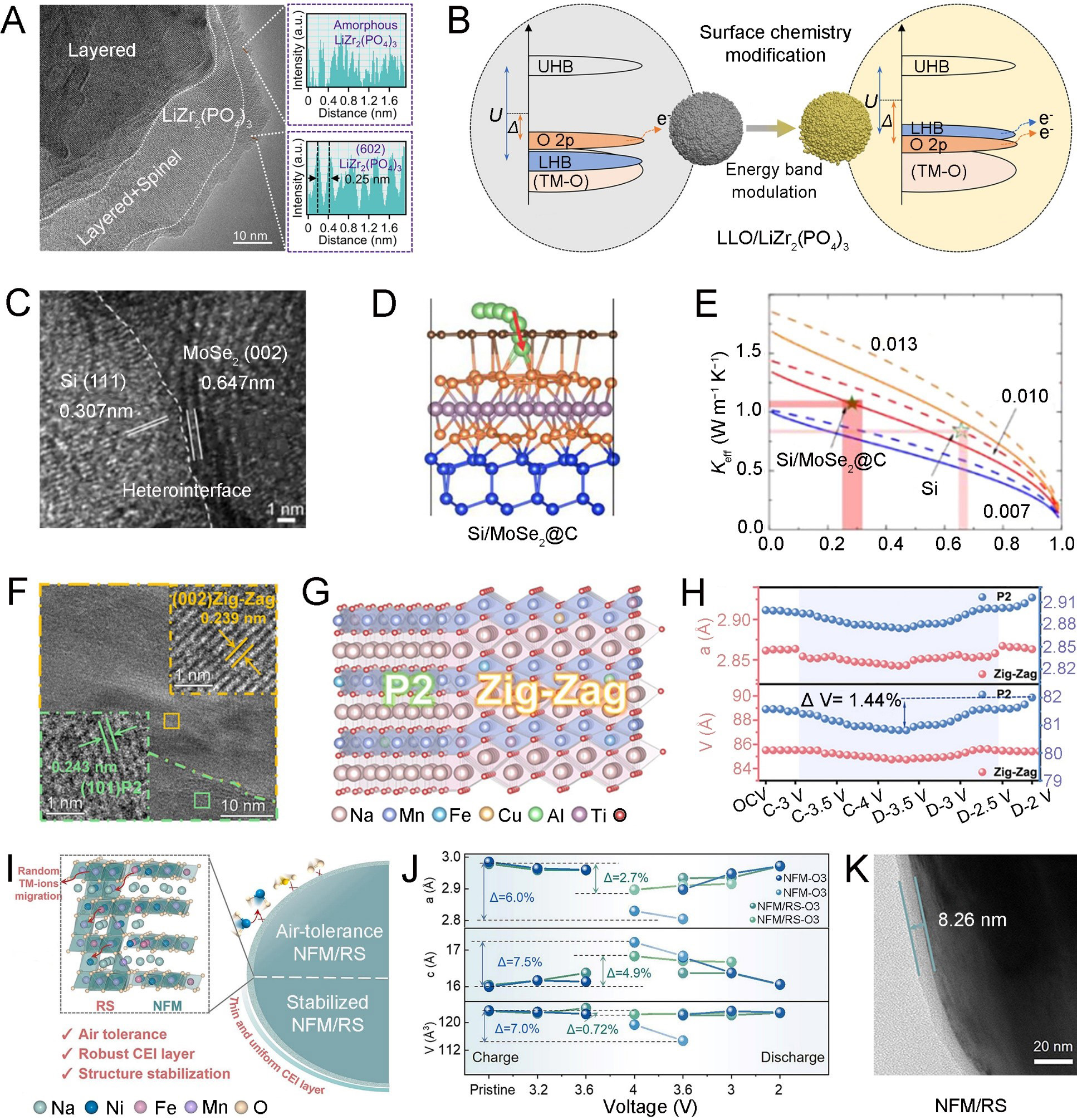
Figure 3. (A) High-resolution transmission electron microscope (HRTEM) image of LLO/LZP with FFT patterns; (B) Schematic illustration of energy band modulation through surface chemistry modification of LLO/LZP. (A and B) are reprinted with permission from Ref.[49], Copyright © 2025 Elsevier; (C) HRTEM image of the Si/MoSe2@C heterostructure; (D) Optimized atomic structure in side view with overlaid Li+ diffusion trajectories; (E) Keff of Si and Si/MoSe2@C-based matrix as a function of porosity (ε). (C-E) are reprinted from Ref.[50], under CC BY 4.0 license; (F) HRTEM image with insets showing magnified views of Zig-Zag and P2; (G) Schematic illustration of the P2/Zig-Zag heterostructure with atomic interlocking; (H) Lattice parameter evolution derived from XRD of the P2/Zig-Zag heterostructure. (F-H) are reprinted with permission from Ref.[25], Copyright © 2025 Wiley; (I) Schematic illustration of the benefits of the layered-to-rocksalt atomic reconfiguration to the NFM/RS; (J) NFM and NFM/RS cathodes changed in lattice parameters a, c and V; (K) The thickness of CEI for NFM/RS after 200 cycles at 1 C. (I-K) are reprinted with permission from Ref.[51], Copyright © 2025 Elsevier. UHB: Upper hubbard band; LHB: lower hubbard band; TM-O: transition metal-oxygen; RS: rocksalt; NFM: NaNi1/3Fe1/3Mn1/3O2; CEI: cathode electrolyte interface; NFM/RS: NaNi1/3Fe1/3Mn1/3O2; LLO: Li-rich layered oxide; LZP: LiZr2(PO4)3; XRD: X-ray diffraction.

