

fig9
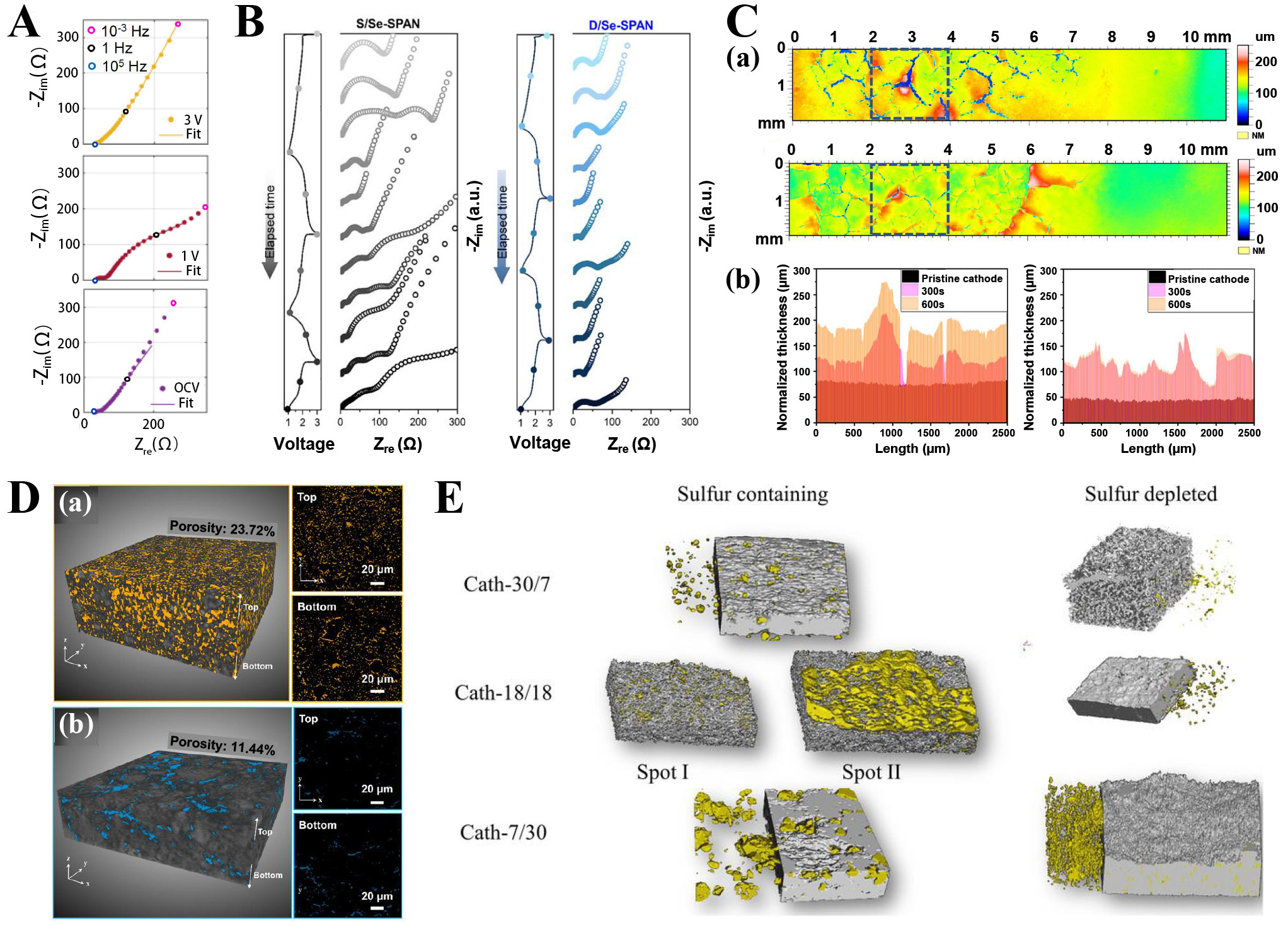
Figure 9. (A) In situ EIS Nyquist plots of ASSLSBs with dry sulfur electrodes measured at different states of charge (OCV, 1 V discharge, and 3 V charge). Reprinted from Ref.[62], under CC BY 4.0 license; (B) Comparison of EIS evolution during initial cycles in SPAN-based lithium-sulfur batteries for wet-processed S/Se-SPAN (left) and dry-processed D/Se-SPAN (right). Reprinted from Ref.[63], under CC BY 4.0 license; (C) Confocal microscopy analysis of surface and thickness changes in dry sulfur cathodes after electrolyte infiltration: (a) extended surface topography maps of uncompressed (top) and compressed (bottom) electrodes, and (b) extracted height profiles after electrolyte infiltration for uncompressed (left) and compressed (right) electrodes. Reprinted from Ref.[107], under CC BY 4.0 license; (D) Internal structures of (a) wet-processed S/Se-SPAN electrodes and (b) dry-processed D/Se-SPAN electrodes, compared using 3D X-ray microscopy-based μCT. The carbon matrix is shown in gray, and sulfur is shown in orange and blue, respectively. Reprinted from Ref.[63], under CC BY 4.0 license; (E) Three-dimensional structure of a dry-processed S/C cathode reconstructed by synchrotron X-ray tomography. The carbon matrix is shown in gray, and sulfur is shown in yellow. Reprinted from Ref.[108], under CC BY 4.0 license. SPAN: Sulfurized polyacrylonitrile; EIS: electrochemical impedance spectroscopy; ASSLSB: all-solid-state lithium-sulfur battery; μCT: micro-computed tomography.

