

Critical advances in charge separation regulation for photocatalytic CO2 reduction
 0
0 Graphical Abstract
Abstract
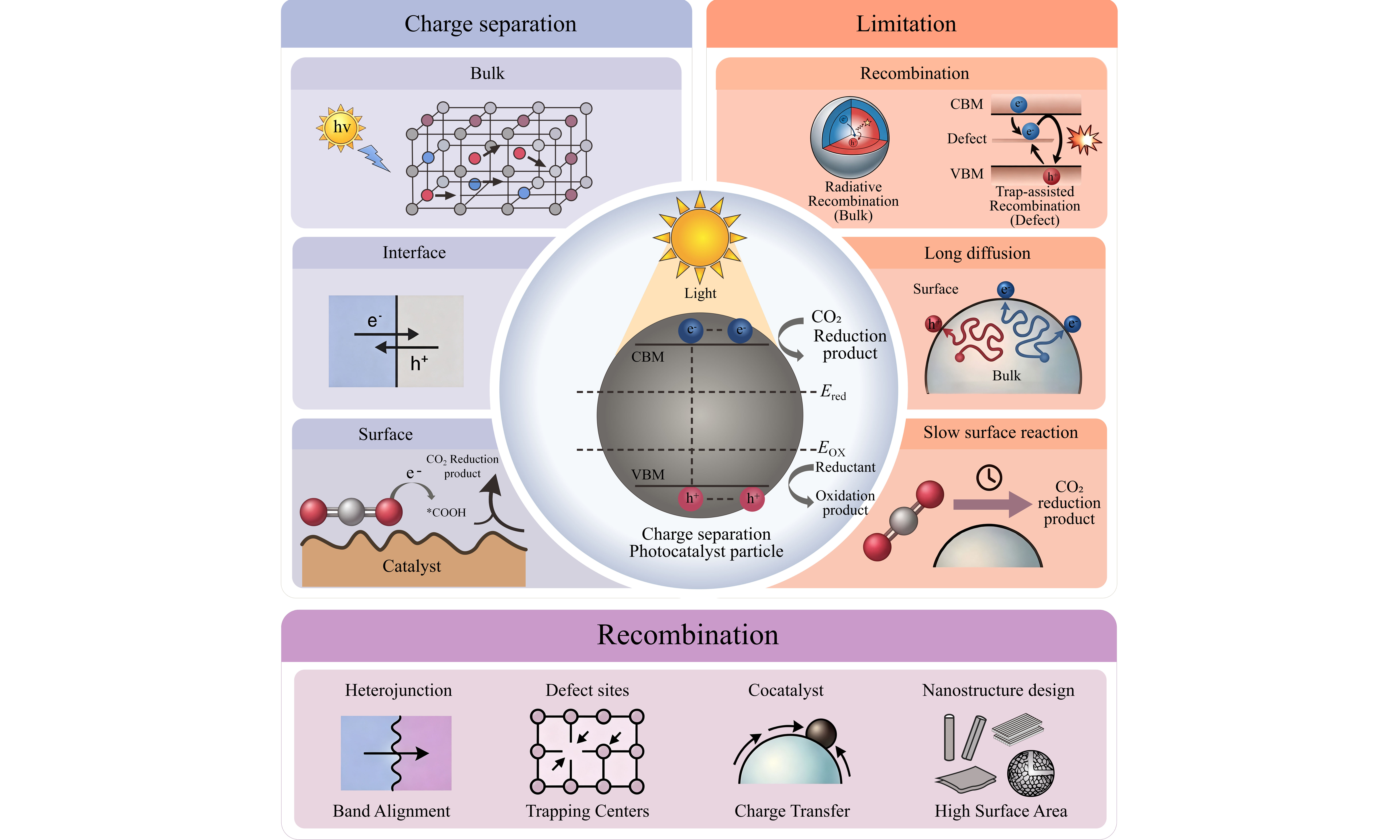
The photocatalytic CO2 reduction (PCR) technology mimics the energy conversion process of natural photosynthesis. PCR is an important strategy to help achieve the future “dual carbon” goals due to its significant advantages of being green, clean, and sustainable. However, the current PCR technology still has a large gap from practical industrial application owing to key problems such as low CO2 conversion efficiency, poor product selectivity, and insufficient photocatalyst stability. The fundamental reason is the low charge separation efficiency, which is also the core bottleneck restricting performance improvement. This review first outlines the basic mechanism of PCR and systematically analyzes the physical essence of charge separation processes at spatial scales. It further sorts out the internal and external factors that limit the charge separation efficiency, as well as the common techniques and evaluation standards for characterizing charge behavior. It also highlights representative progress in boosting charge separation efficiency through such strategies as heterojunction construction, defect engineering, catalyst regulation, and morphology optimization. This review provides references and inspiration for the rational design of high-performance PCR catalysts.
Keywords


 Download PDF
INTRODUCTION
Since the Industrial Revolution, the excessive use of conventional fossil fuels (coal, oil, and natural gas) has resulted in a continuous increase in CO2 concentration, which has become a serious challenge for human society[1,2]. If solar energy can be directly used to convert CO2 into CO, CH4, CH3OH, and even C2+ high-value-added hydrocarbons and oxygen-containing chemicals[3], it will be possible to establish a closed loop of “emission reduction-carbon fixation-fuel/chemical production.” This would partially replace fossil resources and alleviate the pressure of carbon emissions. Currently, there are numerous methods for CO2 reduction, including photocatalysis, electrocatalysis, photoelectrocatalysis, biocatalysis, thermal catalysis, and plasma catalysis[1]. Among these methods, photocatalytic CO2 reduction (PCR) mimics natural photosynthesis by using semiconductor photocatalysts to capture solar energy and drive the direct conversion of CO2 and H2O into hydrocarbons[4]. This process relies solely on solar energy as the input and water and CO2 as feedstocks. Therefore, compared with other CO2 reduction methods, PCR has prominent advantages of being green, clean, and sustainable. In recent years, with the rapid advancement of valuation standardization and mechanism investigation, the PCR research paradigm has gradually shifted from “material screening” to “mechanism-driven directed design”, and has achieved excellent performance.
However, due to some key challenges and drawbacks, PCR technology is currently at the stage of basic research rather than practical application. For instance, under low CO2 concentrations, mass transfer and surface adsorption efficiencies are poor[5]. Furthermore, the inherent chemical inertness of the CO2 molecule imposes high energy barriers for its activation and subsequent multi-step proton-coupled electron transfer processes[5]. Lastly, overall photon utilization and quantum efficiencies remain low[5]. The fundamental cause of these apparent problems is the limited photogenerated charge separation in semiconductor photocatalysts, which remains the core bottleneck in the field of PCR[6]. This is manifested in the following two aspects. Firstly, photogenerated electron-hole pairs undergo rapid recombination. After the semiconductor photocatalyst absorbs photons, electron-hole pairs are generated, but over 90% of them are typically subjected to non-radiative recombination within picoseconds to nanoseconds through bulk or surface defects[7], thus failing to participate in the surface catalytic reaction. This causes a significant loss of photogenerated charges. Secondly, the charge transfer resistance is high. For the separated charges that do migrate to the active sites on the catalyst surface, they often face high interface energy barriers, long transfer paths, and slow coupling rates with reactants or intermediates[8], resulting in sluggish charge utilization kinetics. These bottlenecks not only directly reduce CO2 conversion activity and stability, but also alter the competitive kinetics of the reaction pathways by influencing the formation and accumulation of key intermediates (such as *CO2-, *COOH, *CO, *and CHO). Therefore, insufficient charge separation of photocatalysts is a key factor restricting the activity, selectivity, and stability of PCR. Addressing this challenge, effective charge separation regulation has become a central focus in research on photocatalytic CO2 reduction.
To overcome this issue, researchers have proposed various regulation strategies to enhance charge separation and achieve directional transport. There are three typical examples. (1) At the bulk phase level, the charge transfer path is shortened to inhibit the bulk recombination via band engineering, defect/doping regulation, and morphology structure optimization[9]. (2) At the interface level, spatial charge separation is achieved by constructing various heterojunctions (type-II, Z-scheme, S-scheme, etc.)[2]. (3) At the surface level, the construction of Schottky junctions, loading of cocatalysts, and design of atomic-scale active sites are employed to achieve efficient coupling between electron extraction and reaction sites, thereby accelerating the adsorption and activation of CO2 and lowering the energy barrier of rate-determining reaction steps[10]. Especially in recent years, the heterojunction and multi-interface coupling systems emphasize enhancing charge separation while retaining strong oxidation/reduction capabilities, providing a possibility for CO2 multi-electron deep reduction and C-C coupling.
This review provides a systematic overview of charge separation mechanisms in PCR systems. We first discuss the fundamental principles governing photocatalytic CO2 reduction and charge carrier dynamics, followed by a detailed analysis of intrinsic and extrinsic factors that limit charge separation efficiency. Subsequently, we summarize representative characterization techniques for probing charge behavior across bulk, interface, and surface scales. Finally, we highlight recent advances in charge separation regulation strategies, including heterojunction engineering, defect modulation, cocatalyst optimization, and morphology design, and provide perspectives on future directions for the rational design of high-performance photocatalysts.
FUNDAMENTAL PRINCIPLES OF CHARGE SEPARATION
Principles of photocatalytic CO2 reduction
The photocatalytic CO2 reduction process is governed by three sequential steps: light absorption, charge carrier dynamics, and surface redox reactions, as illustrated in Figure 1. Upon irradiation, the semiconductor photocatalyst absorbs photons with energy equal to or greater than its band gap (hν ≥ Eg). This results in the excitation of electrons from the valence band (VB) to the conduction band (CB), thereby generating electron-hole pairs.
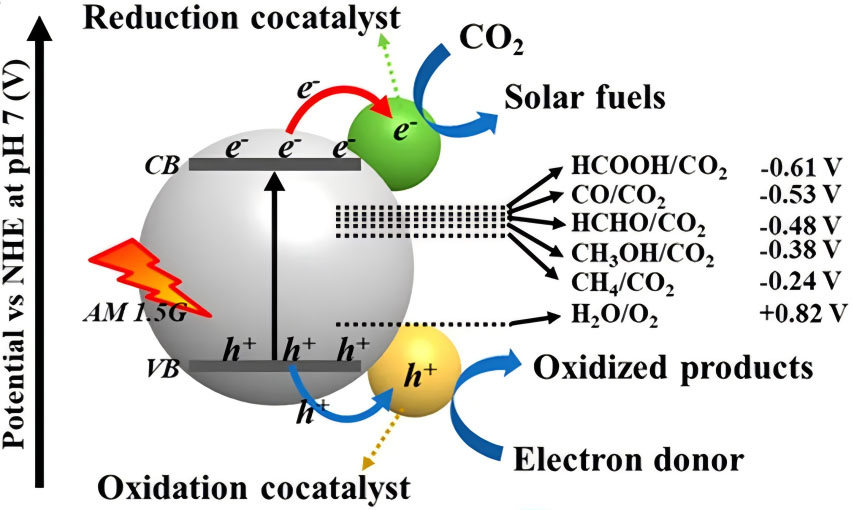
Figure 1. CO2 conversion by semiconductor photocatalyst. Reprinted from Ref.[11] under the CC BY license. NHE: Normal hydrogen electrode.
The photogenerated electrons in the CB migrate to the catalyst surface and can be further transferred to a reduction cocatalyst. Here, they participate in the multi-electron reduction of adsorbed CO2 into solar fuels such as HCOOH, CO, HCHO, CH3OH, and CH4[4]. Thermodynamically, this requires the CB minimum to be more negative than the corresponding CO2 reduction potentials. Meanwhile, the photogenerated holes remaining in the VB migrate to an oxidation cocatalyst to oxidize electron donors (e.g., H2O or sacrificial agents)[6] into oxidized products, provided that the VB potential is more positive than the oxidation potential.
Therefore, the overall efficiency of photocatalytic CO2 reduction is synergistically determined by the light absorption capacity, the separation and migration efficiency of photogenerated charge carriers, and the kinetics of surface redox reactions. In particular, efficient charge separation and transfer are critical, as rapid electron-hole recombination during migration severely limits catalytic performance. Consequently, suppressing charge recombination and promoting directional charge transfer are paramount strategies for enhancing the overall PCR efficiency.
Charge separation process
Bulk charge separation
Spatially, charge separation encompasses bulk diffusion to the semiconductor surface and interfacial transfer between different components in composites[12]. In a pristine photocatalyst, the bulk carrier diffusion length critically dictates the efficiency of charge separation and subsequent participation in CO2 reduction[13]. If the bulk diffusion path is too long, photogenerated electrons will suffer from severe bulk recombination before reaching the active surface sites, rendering even strong light absorption ineffective. Conversely, minimizing the diffusion distance facilitates rapid carrier migration to the active sites. Consequently, engineering low-dimensional nanostructures or hierarchical porous architectures is a highly effective strategy for optimizing bulk charge separation.
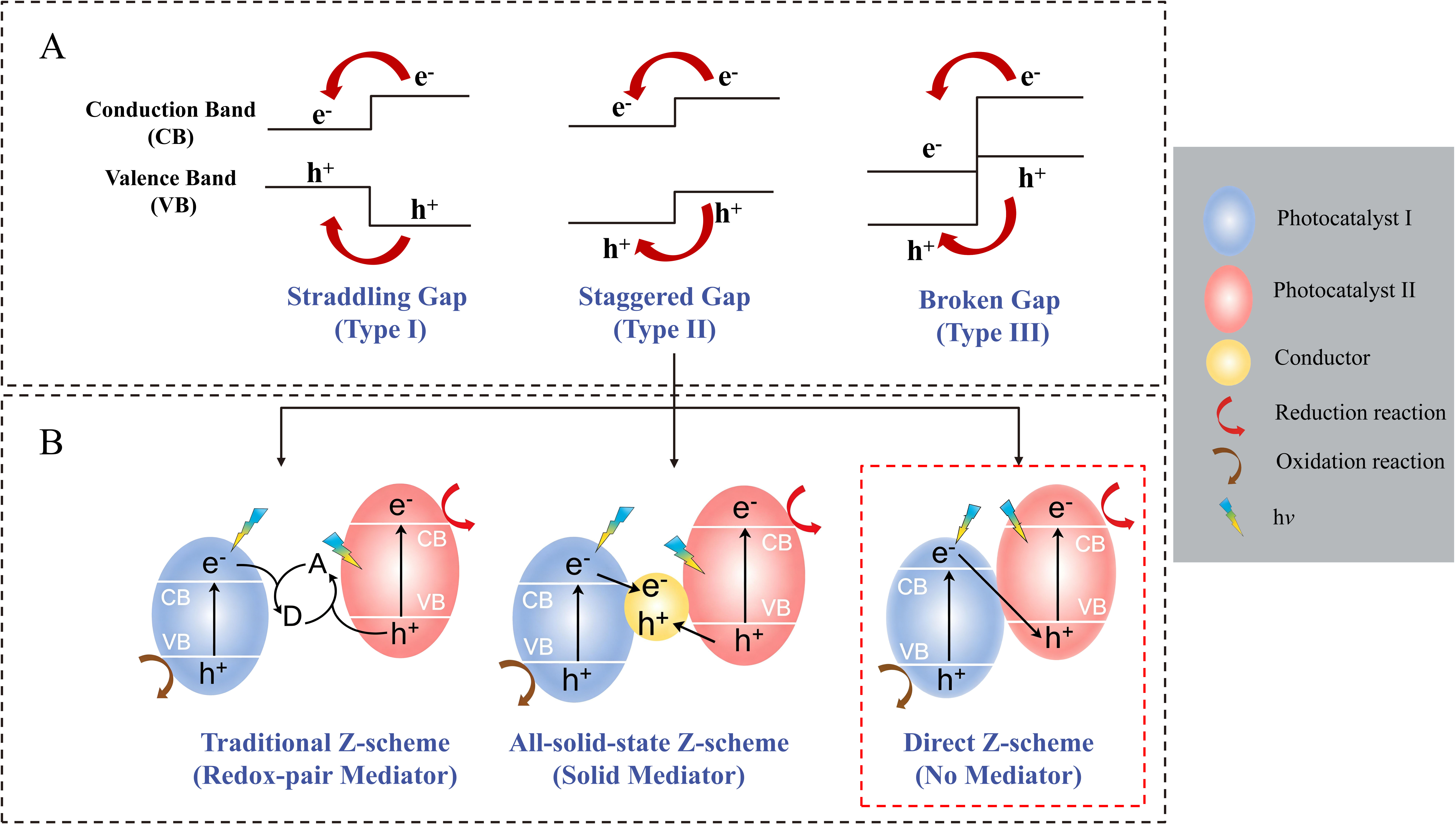
However, the performance of bare photocatalysts remains constrained by rapid bulk charge recombination. To mitigate this, composite photocatalysts are constructed by integrating two semiconductors with appropriately matched energy bands[7]. Based on their relative band alignments, heterojunctions are generally classified into three configurations [Figure 2A]: type-I (straddling gap), type-II (staggered gap), and type-III (broken gap)[14]. In a type-I alignment, both electrons and holes transfer to the narrower-bandgap semiconductor, failing to achieve spatial charge separation. Meanwhile, for a type-III alignment, the extreme band offset renders continuous charge transfer energetically prohibitive. In a type-II heterojunction, electrons migrate to the lower conduction band while holes transfer to the higher valence band. This staggered transfer effectively separates the electron-hole pairs spatially, thereby enhancing photocatalytic performance[2]. However, because electrons accumulate at a less negative conduction band potential, the system’s overall reductive driving force is compromised, which significantly limits multi-electron CO2 reduction kinetics. Alternatively, staggered band structures can facilitate a completely different charge transfer mechanism known as a Z-scheme system, where the charge flow resembles the letter “Z” [Figure 2B]. Depending on the charge-mediating mechanism, Z-scheme systems are classified into traditional (using a redox mediator), all-solid-state (using a solid conductor), and direct Z-scheme (without an intermediate medium) heterojunctions. Compared with traditional Z-scheme and all-solid-state Z-scheme, the direct Z-scheme heterojunction can avoid the selection and shielding effects of electron media and reverse photochemical reactions[14]. In this unique pathway, the photogenerated electrons with weaker reductive capability preferentially recombine with holes possessing weaker oxidative capability. Consequently, the strongly reductive electrons and strongly oxidative holes are preserved in their respective conduction and valence bands. Thus, the direct Z-scheme configuration successfully circumvents the redox potential loss inherent to type-II systems. Therefore, constructing appropriate heterojunctions is a critical strategy for enhancing interfacial and spatial charge separation. XPS is an important means for determining the chemical composition and electronic states of materials[15].
Interface charge separation
Photogenerated charge separation at the interface of composite materials is a critical determinant of both the efficiency and selectivity of CO2 reduction. A prominent example is the charge transfer mechanism in S-scheme heterojunctions, a concept initially introduced by Xu et al. in 2019[15]. An S-scheme system consists of a reducing photocatalyst (RP) and an oxidizing photocatalyst (OP). Upon contact, the difference in their Fermi levels drives spontaneous electron transfer, establishing an internal electric field and inducing corresponding band bending at the interface. Under illumination, this built-in field, synergized with band bending, drives a macroscopic “step-like” interfacial charge transfer pathway [Figure 3A]. This mechanism selectively facilitates the recombination of the less reductive electrons in the OP and the less oxidative holes in the RP. Consequently, the strongly reductive electrons and strongly oxidative holes are preserved in their respective conduction and valence bands. Thus, interfacial charge separation in S-scheme systems is highly directional, achieving efficient carrier separation while maximizing the overall redox potential.
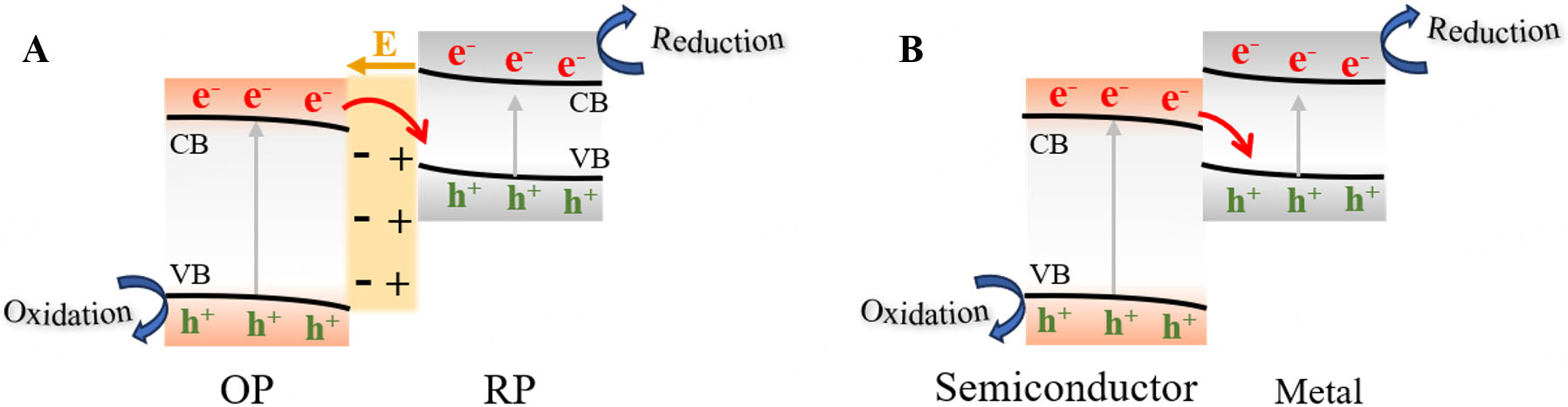
Figure 3. Schematic illustration of typical charge separation paths: (A) S-scheme heterojunction. E is the built-in electric field. (B) Schottky heterojunction. Created with Microsoft PowerPoint. CB: Conduction band; VB: valence band; OP: oxidizing photocatalyst; RP: reducing photocatalyst.
Furthermore, even if photogenerated carriers successfully migrate from the bulk to the semiconductor surface, they remain highly susceptible to rapid recombination if not properly extracted. Therefore, electrons must be further directed across the solid-liquid interface. To achieve this, metallic materials are typically deposited onto the semiconductor surface to form a Schottky junction [Figure 3B][16]. Because the metal generally possesses a larger work function, electrons at the semiconductor surface are preferentially injected into the metal, which acts as an effective electron trap. Ultimately, these electrons are successfully funneled to the solid-liquid interface, where they participate in the CO2 reduction reaction on the catalyst surface. The formation of a Schottky barrier subsequently prevents electron backflow, ensuring the strict directionality of surface charge transfer.
Thermodynamic and kinetic parameters of charge separation
In photocatalytic CO2 reduction, charge separation efficiency is jointly governed by thermodynamic driving forces and kinetic competition[17]. Thermodynamically, this depends on the band alignment between the semiconductor and the CO2 reduction potentials, which must provide sufficient driving force for the redox reactions while minimizing excessive energy loss[1]. The kinetic competition is primarily determined by the relative charge transfer rate (including interfacial charge injection and transport) and the charge recombination rate (non-radiative recombination in the bulk, surface, and interface)[18]. When the charge transfer rate is significantly higher than the recombination rate, the charge separation efficiency is effectively enhanced. The charge separation efficiency can be expressed as[18]:
Key factors limiting charge separation
The efficiency of charge separation in photocatalytic CO2 reduction (PCR) is dictated by a combination of both intrinsic and extrinsic factors, which collectively regulate carrier generation, migration, and utilization across the bulk, interface, and surface of photocatalysts[7]. Distinguishing between these two categories is crucial for understanding their respective roles and interdependent effects[17].
Intrinsic factors are primarily dictated by the physicochemical properties of the photocatalyst. At the bulk level, rapid recombination of photogenerated electron-hole pairs represents the primary source of energy loss. In narrow-bandgap semiconductors, high intrinsic carrier densities can exacerbate Coulombic attraction, leading to severe bulk recombination. In addition, deep-level defects and structural disorder introduce trap states that act as non-radiative recombination centers, accelerating carrier annihilation during migration[16]. At the interface level, intrinsic limitations arise from unfavorable band alignment and lattice mismatch. Improper energy level matching between semiconductors or between semiconductors and cocatalysts impedes the formation of a robust built-in electric field, thereby weakening the driving force for directional charge transfer. Consequently, carriers often recombine at the interface before completing migration[18]. At the surface level, insufficient exposure of active sites or mismatched electronic structures (e.g., inadequate electron affinity) can impede charge utilization. Electrons failing to rapidly inject into adsorbed CO2 molecules remain highly susceptible to recombination. Concurrently, holes that are not efficiently scavenged by oxidation reactions accumulate at surface states, inducing additional recombination losses[18]. Collectively, these intrinsic constraints severely limit the fraction of charge carriers available for catalytic reactions[10].
In contrast, extrinsic factors stem from external operating conditions and the reaction environment. A primary constraint is restricted light-harvesting capability, particularly in wide-bandgap oxide photocatalysts that respond primarily to ultraviolet light[1]. This limited photon absorption not only curtails the initial generation of charge carriers but also creates a spatial mismatch between the regions of carrier generation and reaction sites, increasing the probability of recombination during migration.
Furthermore, sluggish activation and weak adsorption of CO2 molecules significantly impede charge utilization. When CO2 concentration is low or the catalyst-CO2 interaction is weak, sluggish activation and weak adsorption of CO2 molecules significantly impede charge utilization (e.g., *CO2-)[5]. Consequently, accumulated electrons at the interface are more likely to recombine with holes rather than participate in reduction reactions. Because CO2 reduction is a complex multi-electron transfer process, any disruption can ultimately degrade catalytic activity, product selectivity, and apparent quantum efficiency[1].
Ultimately, intrinsic and extrinsic factors do not operate in isolation; rather, they compound one another to dictate the overall charge separation efficiency. Therefore, effective regulation strategies should simultaneously address material design and reaction conditions to minimize recombination losses and maximize carrier utilization[7].
Characterization techniques for charge behavior
To elucidate the intrinsic mechanisms of charge separation in photocatalytic CO2 reduction (PCR) systems, it is essential to transcend isolated descriptors and instead consider charge behavior as a continuous physicochemical process spanning photogeneration, carrier migration[19], interfacial redistribution, and surface reaction coupling, as schematically integrated in Figure 4. In this context, characterization techniques should be interpreted in direct correspondence with these successive stages, rather than as independent analytical tools, so as to establish a mechanistically consistent understanding of charge evolution.
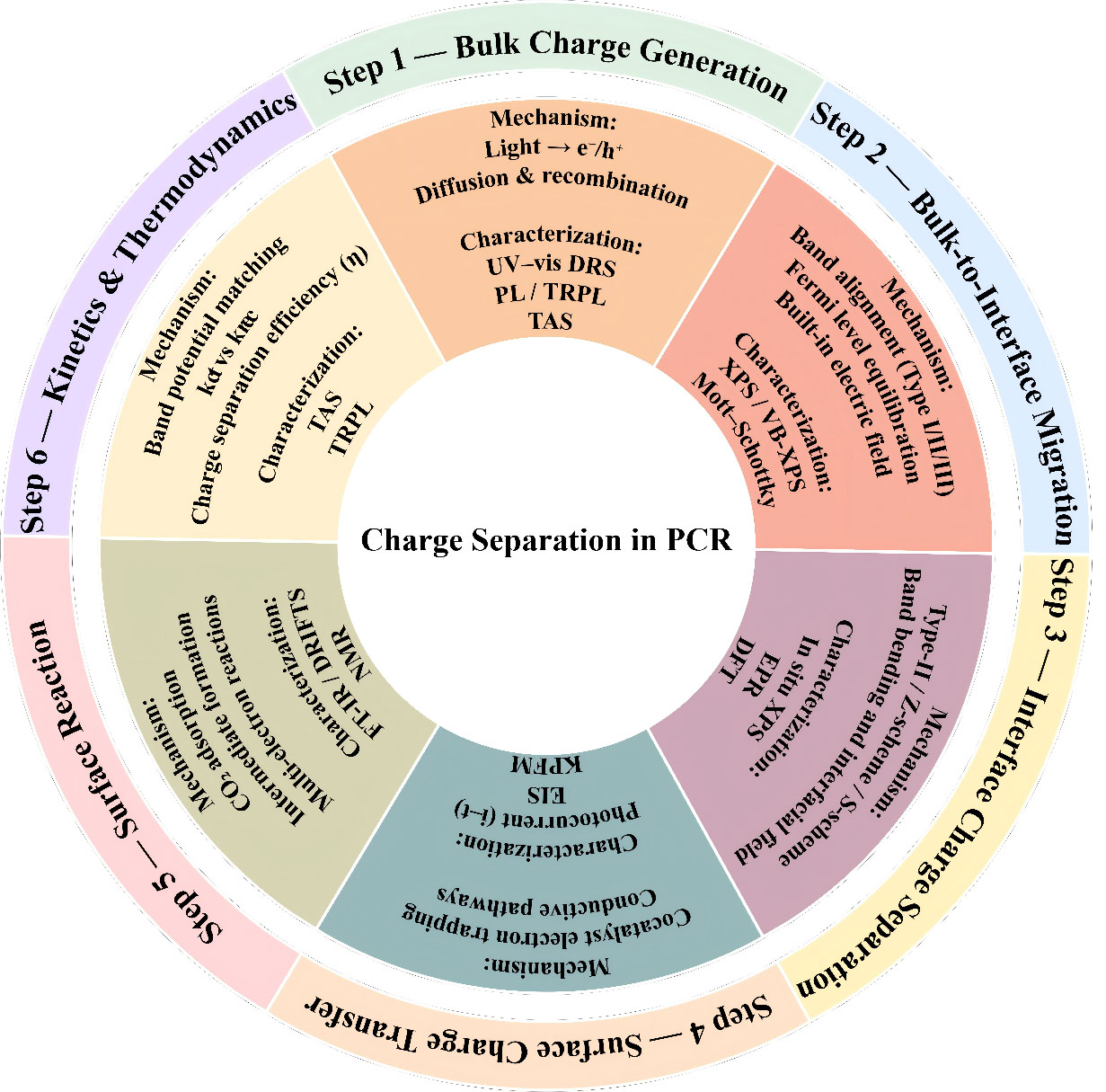
Figure 4. Integrated correlation between charge separation processes and characterization techniques across bulk, interface, and surface levels in PCR systems. Created with Microsoft PowerPoint. PCR: Photocatalytic CO2 reduction; TAS: transient absorption spectroscopy; TRPL: time-resolved photoluminescence; NMR: nuclear magnetic resonance; FT-IR: Fourier transform infrared spectroscopy; EIS: electrochemical impedance spectroscopy; KPFM: Kelvin probe force microscopy; EPR: electron paramagnetic resonance; DFT: density functional theory; XPS: X-ray photoelectron spectroscopy; VB: valence band; UV-vis: ultraviolet–visible; DRS: diffuse reflectance spectroscopy; PL: photoluminescence.
At the initial stage of light absorption and carrier generation (Step 1-2 in Figure 4), the dominant process is the competition between carrier excitation and ultrafast recombination in the bulk phase. The absorption characteristics of light can be analyzed through ultraviolet–visible (UV-vis) diffuse reflectance spectroscopy, and the band gap (Eg) value of the photocatalyst can be estimated using the Tauc plot method[20]. Photoluminescence (PL) and time-resolved photoluminescence (TRPL) are therefore commonly employed to probe recombination dynamics. An attenuated PL intensity or prolonged lifetime is often interpreted as indicative of reduced recombination probability[21]. However, such interpretations are inherently limited because PL-based techniques selectively probe radiative recombination pathways and cannot distinguish whether the attenuation of emission arises from improved spatial charge separation or enhanced non-radiative decay via defect states[22]. In addition, TRPL provides only averaged lifetime information and lacks the spatial resolution required to differentiate recombination occurring in the bulk, at the interface, or on the surface. Consequently, although PL and TRPL are useful for preliminary screening, they cannot independently establish the effectiveness of charge separation along the migration pathway depicted in Figure 4. For instance, in a Co1-C3N4@α-Fe2O3 Z-scheme photocatalyst, TRPL analysis revealed a prolonged exciton lifetime after constructing the heterojunction and introducing single-atomic Co sites, indicating that interfacial charge separation and atomic-site regulation synergistically attenuated carrier recombination[23]. This example demonstrates that PL/TRPL can provide preliminary evidence for recombination inhibition, although such signals should still be correlated with non-radiative pathways and spatial charge migration.
As photogenerated carriers migrate from the bulk toward interfaces (Step 2-3 in Figure 4), the efficiency of charge extraction and transport becomes the critical factor governing subsequent reaction steps. Electrochemical techniques, such as transient photocurrent response and electrochemical impedance spectroscopy (EIS), are frequently used to evaluate this process[24]. Enhanced photocurrent is generally associated with improved carrier mobility and extraction efficiency, while reduced charge-transfer resistance inferred from Nyquist plots is often taken as evidence of facilitated interfacial transport. Nevertheless, these electrochemical responses are intrinsically influenced by extrinsic factors, including electrode configuration, electrolyte diffusion, and interfacial capacitance, which complicates their direct correlation with intrinsic charge-transfer pathways. As a result, EIS cannot unambiguously resolve whether the observed improvement originates from genuine directional charge separation or from changes in macroscopic transport properties, and therefore cannot distinguish between different charge-transfer modes embedded in Figure 4, such as type-II versus S-scheme mechanisms[25]. In a Cu2O@Cu-TCPP heterojunction for CO2 photoreduction, the optimized Cu2O@CP-1 sample exhibited the strongest transient photocurrent response and the smallest EIS semicircle, confirming that the in situ-constructed p-n junction effectively promoted charge separation and interfacial transport. This case illustrates that TPC and EIS are useful macroscopic indicators of carrier extraction efficiency and charge-transfer resistance.
To directly capture the dynamic evolution of carriers along the migration-separation pathway (Step 2-4 in Figure 4), transient absorption spectroscopy (TAS) provides a uniquely powerful approach by resolving carrier kinetics across femtosecond-to-microsecond timescales[21]. By tracking the temporal evolution of excited-state species, TAS enables direct observation of carrier trapping, relaxation, and interfacial transfer processes that are otherwise inaccessible by steady-state techniques. For instance, Wang et al. employed femtosecond transient absorption spectroscopy, in situ irradiated X-ray photoelectron spectroscopy, and electron paramagnetic resonance to investigate a fibrous Ta2O5/Ag2S S-scheme photocatalyst for diluted CO2 photoreduction[21]. The TAS results revealed ultrafast decay components corresponding to the selective recombination of low-energy carriers, while long-lived signals were assigned to high-energy electrons retained for reduction reactions, providing direct kinetic evidence for the selective recombination-retention mechanism characteristic of S-scheme charge transfer[26].
While TAS resolves the temporal dimension of charge evolution, direct identification of charge redistribution at heterointerfaces (Step 3-4 in Figure 4) requires operando-level electronic structure characterization. In this regard, in situ irradiated X-ray photoelectron spectroscopy (ISIXPS) has emerged as one of the most compelling techniques for validating charge-transfer directionality[27]. Under illumination, shifts in core-level binding energies directly reflect electron accumulation or depletion in different components of a heterojunction, thereby providing real-time evidence of charge migration across interfaces[28,29]. A landmark example is the TiO2@ZnIn2S4 photocatalyst reported by Wang et al.[28], in which opposite photoinduced binding-energy shifts were observed for the two semiconductors under irradiation, unambiguously confirming directional electron transfer driven by the built-in electric field. This operando evidence directly maps onto the interfacial charge-separation process depicted in Figure 4 and has become one of the most widely accepted experimental criteria for distinguishing S-scheme mechanisms from conventional type-II charge-transfer models[28].
At the final stage, where separated charges participate in surface reactions (Step 4-6 in Figure 4), the effectiveness of charge separation must ultimately be evaluated in terms of its coupling with CO2 adsorption and activation. Kelvin probe force microscopy (KPFM) provides nanoscale mapping of surface potential and work-function distribution, enabling visualization of spatial charge accumulation at active sites and interfaces under illumination[30]. At the nanoscale, KPFM has been used to directly visualize photo-injected electrons in CdS quantum dot-modified cesium tungstate nanosheets. The light-induced surface-potential variation revealed directional electron injection from the photoexcited CdS quantum dots into the metal oxide nanosheets, thereby mapping spatial charge redistribution at the heterointerface[31]. This example demonstrates that KPFM can correlate local work-function changes with charge accumulation regions, providing spatial evidence complementary to spectroscopic and electrochemical analyses. Meanwhile, in situ spectroscopic techniques such as DRIFTS and electron paramagnetic resonance (EPR) directly track the formation and evolution of reaction intermediates, including *CO2- and *COOH species, thereby linking charge injection to specific elementary reaction steps[32]. These approaches highlight that efficient charge separation, as outlined in Figure 4, only translates into enhanced photocatalytic performance when it is effectively coupled with surface reaction kinetics. At the reaction level, in situ DRIFTS and EPR can further connect separated charges with CO2 activation. In CsBr@CuBr2 and related halogen-defect systems, in situ DRIFTS was used to follow the evolution of CO2-derived intermediates, while EPR-related analysis revealed light-induced defect states that acted as dynamic active sites for CO2 photoreduction[33]. These observations establish a mechanistic link between charge trapping, defect-mediated CO2 activation, and intermediate evolution, thereby providing reaction-level evidence for charge utilization.
Despite the apparent diversity of characterization methods, it is crucial to recognize that each technique probes only a specific segment of the charge evolution pathway illustrated in Figure 4. PL and TRPL primarily reflect recombination behavior in the early stage, electrochemical methods capture macroscopic transport properties during migration, TAS resolves ultrafast carrier kinetics, whereas ISIXPS and KPFM provide direct information on interfacial and spatial charge redistribution. Therefore, reliable identification of charge-transfer mechanisms in PCR systems requires convergent evidence from multiple complementary techniques that collectively reconstruct the full charge separation process from generation to reaction. Recent methodological analyses have further emphasized that operando ISIXPS, ultrafast spectroscopy, and theoretical calculations should be jointly employed to establish a self-consistent charge-transfer framework[27].
Accordingly, the characterization techniques discussed above should not merely be regarded as diagnostic tools but as essential criteria for evaluating the validity of proposed charge-separation models. In the following sections, these methods will be revisited in representative case studies to correlate experimentally validated charge-transfer pathways with photocatalytic performance, thereby establishing a unified framework linking Figure 4 to rational catalyst design.
CHARGE SEPARATION REGULATION STRATEGIES
Heterojunction construction
Heterojunction engineering stands as a paramount strategy for regulating charge separation and directional carrier transport in photocatalytic CO2 reduction systems. From the perspectives of charge-transfer pathways and band alignment, heterojunctions can be generally categorized into conventional type-II, advanced systems (Z-scheme and S-scheme), and Schottky junctions[34].
Historically, the type-II heterojunction has served as the classical model for achieving spatial separation of photogenerated electrons and holes through staggered band alignment. While this configuration effectively suppresses carrier recombination, it inevitably drives electrons and holes toward lower-energy band edges, precipitating a substantial loss of reduction and oxidation potentials[35]. This inherent trade-off fundamentally limits its applicability in photocatalytic CO2 reduction, where multi-electron transfer reactions demand robust thermodynamic driving forces.
Consequently, recent studies have progressively shifted from conventional type-II systems toward advanced heterojunction configurations that can simultaneously promote charge separation while preserving high-energy carriers. In this context, Z-scheme and S-scheme heterojunctions achieve the selective recombination of low-energy carriers and the retention of strong redox potentials through distinct interfacial charge-transfer pathways. This represents a paradigm evolution from “separation-dominated” to “energy-preserved” charge regulation. In parallel, Schottky heterojunctions, formed at semiconductor-metal interfaces, provide an alternative route by enabling efficient electron extraction and directional transfer via built-in Schottky barriers. This curtails surface recombination without relying on inter-semiconductor band alignment.
Guided by these considerations, the following sections will focus on Z-scheme, S-scheme, and Schottky heterojunctions as representative advanced models for efficient charge separation and utilization. Meanwhile, the conventional type-II mechanism will serve primarily as a foundational reference framework for understanding the evolution of heterojunction design.
Z-scheme heterojunction
The Z-scheme heterojunction is derived from the “Z-scheme” electron transfer mechanism of natural photosynthesis[36]. Its core advantage lies in achieving efficient separation of photogenerated electrons and holes while retaining high-energy electrons with strong reducing ability and high-energy holes with strong oxidizing ability to the greatest extent[37]. This not only provides sufficient high-energy electron donors for the CO2 photoreduction reaction but also lays a thermodynamic foundation for multi-step proton-coupled electron transfer (PCET) processes, making it an important design direction for catalytic systems to enhance the performance of CO2 photoreduction.
Fundamentally, the direct Z-scheme heterojunction is an effective charge-transfer regulation strategy[38], and its fundamental charge transfer mechanism is illustrated in Figure 5A. A typical Z-scheme system couples a semiconductor possessing strong oxidation capabilities (analogous to Photosystem II) with another possessing strong reduction capabilities (analogous to Photosystem I). After the two come into contact, the low-energy electrons in the conduction band of PS I and the low-energy holes in the valence band of PS II will preferentially recombine and be consumed at the interface; ultimately the high-energy electrons with strong reduction ability on the conduction band of PS II (directly used for the activation and reduction of CO2), and the high-energy holes with strong oxidation ability on the valence band of PS I (used to oxidize sacrificial agents) are retained. This characteristic recombination-retention pathway enables both efficient charge separation and strong redox capability. As shown in Figure 5A, the photogenerated electrons in semiconductor B are excited to its conduction band, while holes remain in the valence band. Meanwhile, semiconductor A undergoes a similar excitation process. The key feature is that the electrons in the conduction band of semiconductor A recombine with the holes in the valence band of semiconductor B at the interface (indicated by the downward arrow in Figure 5A), forming a typical “recombination-retention” pathway. Consequently, the electrons with strong reduction ability are preserved in the conduction band of semiconductor B, while the holes with strong oxidation ability remain in the valence band of semiconductor A. Compared to conventional type-II heterojunctions, this architecture offers two distinct advantages. First, it enhances directional charge transfer, wherein built-in electric fields, Fermi level equilibration, and interfacial barrier effects synergistically suppress bulk carrier recombination. Second, it preserves thermodynamic driving forces by circumventing the transfer of carriers to weakly redox-active band edges. The retained high-energy electrons have a sufficiently negative chemical potential, which can efficiently overcome the highest energy barrier of the first electron injection step in the CO2 reduction reaction, and at the same time provide sufficient energy support for subsequent multi-electron coupling processes, ensuring the continuous progress of the reduction reaction. For further reduction of CO2, especially the further hydrogenation of *CO intermediates or C-C coupling and other complex steps, the value of the Z-scheme heterojunction is not limited to the basic charge separation, but is reflected in three key dimensions: Firstly, the precise retention of high-energy active electrons can provide the power for the further reduction steps with high energy barriers; Secondly, promoting the rapid cross-interface charge transfer can reduce energy loss during the migration process; Thirdly, maintaining the high availability of electrons at the interface ensures that there is always an adequate electron supply at the reduction sites.
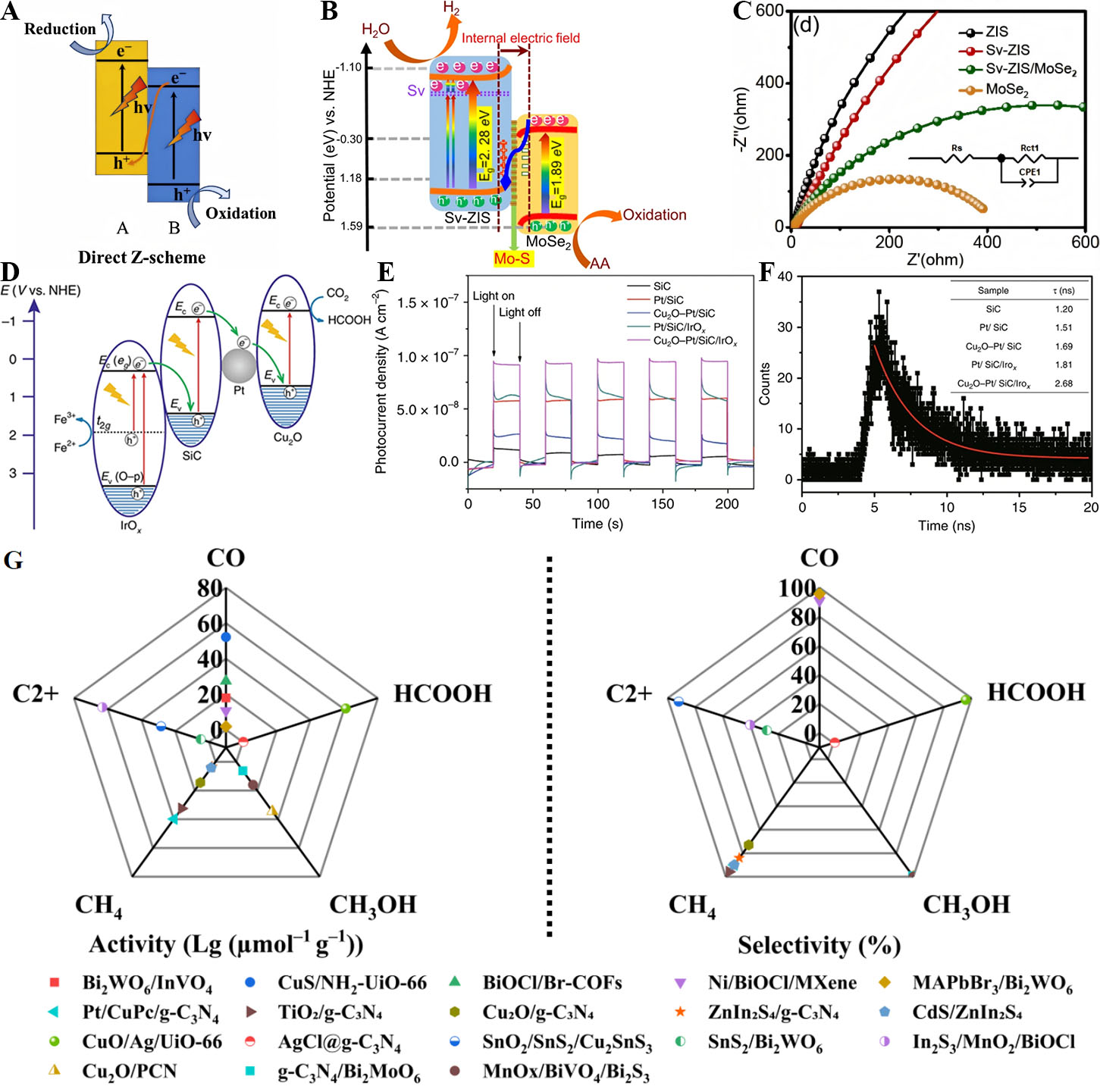
Figure 5. (A) Schematic illustration of charge carrier separation and transfer in a direct Z-scheme heterojunction. Reprinted from Ref.[39] under the CC BY 4.0 license; (B) Schematic illustration of the Z-scheme charge transfer mechanism mediated by interfacial Mo-S chemical bonds; (C) Charge density difference demonstrating electron redistribution at the interface, indicating the role of Mo-S bonds as fast charge transfer channels. Figure 5B and C is reprinted from Ref.[40] under the CC BY 4.0 license; (D-F) Charge transfer pathways and corresponding photocatalytic performance in representative Z-scheme heterojunction systems. Figure 5D-F is reprinted from Ref.[41] under the CC BY 4.0 license; (G) Radar plot comparing catalytic activity (expressed as the logarithm of production rate per mass of catalyst) and selectivity among carbon-containing products. NHE: Normal hydrogen electrode; ZIS: ZnIn2S4; AA: ascorbic acid.
In 2020, Wang et al.[41] reported that the Cu2O-Pt/SiC/IrOx composite system achieved the coupled photocatalytic reduction of CO2 to formic acid (HCOOH) and oxidation of water to oxygen (O2) through the direct and indirect Z-scheme connection of the reduction and oxidation half-reactions. As illustrated in Figure 5D, the Cu2O-Pt/SiC/IrOx system integrates spatially separated reduction and oxidation units, in which Cu2O-Pt mainly serves as the CO2 reduction side, while SiC/IrOx functions as the water oxidation side. The Z-scheme charge-transfer pathway enables the recombination of low-energy carriers while retaining electrons with strong reduction ability for CO2-to-HCOOH conversion and holes with strong oxidation ability for water oxidation. The enhanced charge separation and utilization efficiency are further supported by Figure 5E and F. The higher HCOOH and O2 evolution rates indicate that the photogenerated electrons and holes are effectively consumed in the reduction and oxidation half-reactions, respectively. This balanced production behavior suggests that the Z-scheme configuration promotes efficient charge separation and suppresses the reverse reaction, thereby improving the overall photocatalytic CO2 reduction performance.
Beyond basic composite designs, the integration of multi-component architectures and interface engineering has further amplified Z-scheme performance. In the ternary ZnFe2O4/ZnO/CdS system, the Z-scheme charge transport path was constructed by controlling the interface structure to achieve efficient carrier separation[42]. The yield of CO2 to CH4 was significantly higher than that of single or simple composite systems. The Z-scheme heterojunction constructed through synergy of interface and defect engineering also exhibits remarkable advantages. In the ZnO/ZnAl2O4 composite, the introduction of oxygen vacancies and interface defects not only improves the interface charge transfer impedance but also promotes the formation of key intermediates (such as *COOH, *HCO3-), making the conversion performance of CO2 to CO approximately three times that of pure ZnAl2O4[43]. At the same time, both the quantum efficiency and the interface charge separation efficiency have been enhanced. This indicates that the Z-scheme interface has a significant effect in enhancing charge directional migration and reaction kinetics. Recently, some novel Z-scheme heterojunctions have been reported. For instance, in Z-scheme CuS/PCN-222 heterojunction, an intimate contact and efficient electron-hole separation were achieved at the interface between CuS and PCN-222, thereby further enhancing the CO2 reduction activity and carrier utilization rate. This demonstrated the development potential of Z-scheme MOF/sulfide heterojunctions in PCR[44]. Such studies generally indicate that the charge dynamics in Z-scheme heterojunctions can be significantly optimized by regulating the charge separation pathways through interface structure design (such as interface chemical coupling, defect introduction, and multiphase energy level platforms). Beyond constructing intimate interfacial contact, the introduction of interfacial chemical bonding has emerged as a more effective strategy for regulating charge transfer. The formation of covalent or strongly coupled chemical bonds at heterojunction interfaces can not only significantly reduce interfacial charge transfer resistance, but also provide stable and continuous electron transport pathways, thereby enabling more efficient charge separation and directional migration. Recent studies further reveal that interfacial chemical bonding plays a crucial role in charge transfer regulation. As illustrated in Figure 5B and C, the introduction of interfacial bonds (e.g., Mo-S bonds) can establish strong electronic coupling, optimize band alignment, and facilitate directional charge migration. For instance, in a Bi19S27Br3/g-C3N4 direct Z-scheme system, the construction of interfacial C-S bonds establishes strong electronic coupling between the two components[45]. This not only accelerates the transfer of photogenerated electrons from g-C3N4 to Bi19S27Br3, but also increases interfacial electron density and enhances CO2 adsorption capability. Although the CO2 adsorption energy of the Bi19S27Br3/g-C3N4 composite is slightly lower than that of pure Bi19S27Br3, this limitation is effectively compensated by the significantly improved charge separation efficiency arising from the Z-scheme heterojunction and interfacial C-S bonds, ultimately leading to markedly enhanced photocatalytic CO2 reduction performance[45]. Charge density difference analysis further confirms that such interfacial bonds act as efficient charge transfer channels [Figure 5F]. Compared to traditional type-II heterojunctions in which electrons/holes separately migrate to lower energy levels and lose their reduction/oxidation capabilities, the Z-scheme heterojunction effectively retains high-energy carriers and reduces bulk-phase recombination through interface advantages[38], thereby achieving high charge separation efficiency in CO2 photoreduction reactions and maintaining strong redox driving forces, which is conducive to the complex multi-electron CO2 reduction (such as the formation of CH4, C2+ products)[39].
In addition, Figure 5G summarizes the photocatalytic CO2 reduction performance of representative Z-scheme heterojunctions by correlating activity and product selectivity for the same material systems. The performance parameters were collected from representative studies reported in Refs.[46-62] and further reorganized and visualized by the authors to enable a comparative analysis across different Z-scheme heterojunction systems. The left panel compares the production rates of different reduction products, including CO, CH4, CH3OH, and HCOOH, while the right panel presents the corresponding selectivity toward carbon-containing products for each catalyst. This paired comparison shows that Z-scheme heterojunctions not only enhance the overall CO2 conversion activity but also regulate the product distribution. This unequivocally demonstrates that efficient interfacial charge separation, coupled with the thermodynamic retention of high-energy electrons is the critical determinant in steering the complex reaction pathways of multi-electron CO2 reduction.
S-scheme heterojunction
In recent years, step-scheme (S-scheme) heterojunctions have rapidly emerged as a focal point in photocatalysis, driven by their unique capacity to regulate interfacial charge transport through a characteristic S-shaped pathway[15]. Typically composed of two semiconductors with distinct work functions[54], the S-scheme architecture leverages this work function differential to drive the formation of an intrinsic electric field. As illustrated in Figure 6A, this internal field, coupled with interfacial band bending and electrostatic potential differences, synergistically establishes the foundation for directional charge migration. Mechanistically, an S-scheme system couples an OP with a RP. Upon illumination, the synergistic driving forces compel photogenerated carriers to follow an S-shaped transport route, where low-energy electrons in the conduction band of the OP preferentially recombine with low-energy holes in the valence band of the RP. Consequently, high-energy electrons with robust reducing capabilities (in the RP) and high-energy holes with potent oxidizing capabilities (in the OP) are selectively preserved and directed to their respective active sites. This selective retention mechanism inherently achieves both spatial charge separation and directional charge transfer. Building upon this concept, dual S-scheme heterojunctions, as illustrated in Figure 6B, further introduce multi-interface coupling to construct cascade built-in electric fields, enabling stepwise directional charge transfer across different interfaces. In such systems, the photogenerated carriers undergo hierarchical recombination of low-energy electrons and holes at multiple junctions, while high-energy electrons and holes are progressively separated and enriched at spatially distinct active sites. This multi-level charge regulation not only enhances charge separation efficiency but also maximizes the preservation of strong redox potentials, thereby offering superior performance in driving multi-electron CO2 reduction reactions. Ultimately, the defining thermodynamic advantage of the S-scheme heterojunction is its ability to fully preserve the original, highly active band edge positions of the constituent semiconductors. This circumvents the energy level compromises typical of conventional heterojunctions, ensuring that the composite maintains sufficient thermodynamic potential to simultaneously drive both CO2 reduction and complementary oxidation half-reactions.
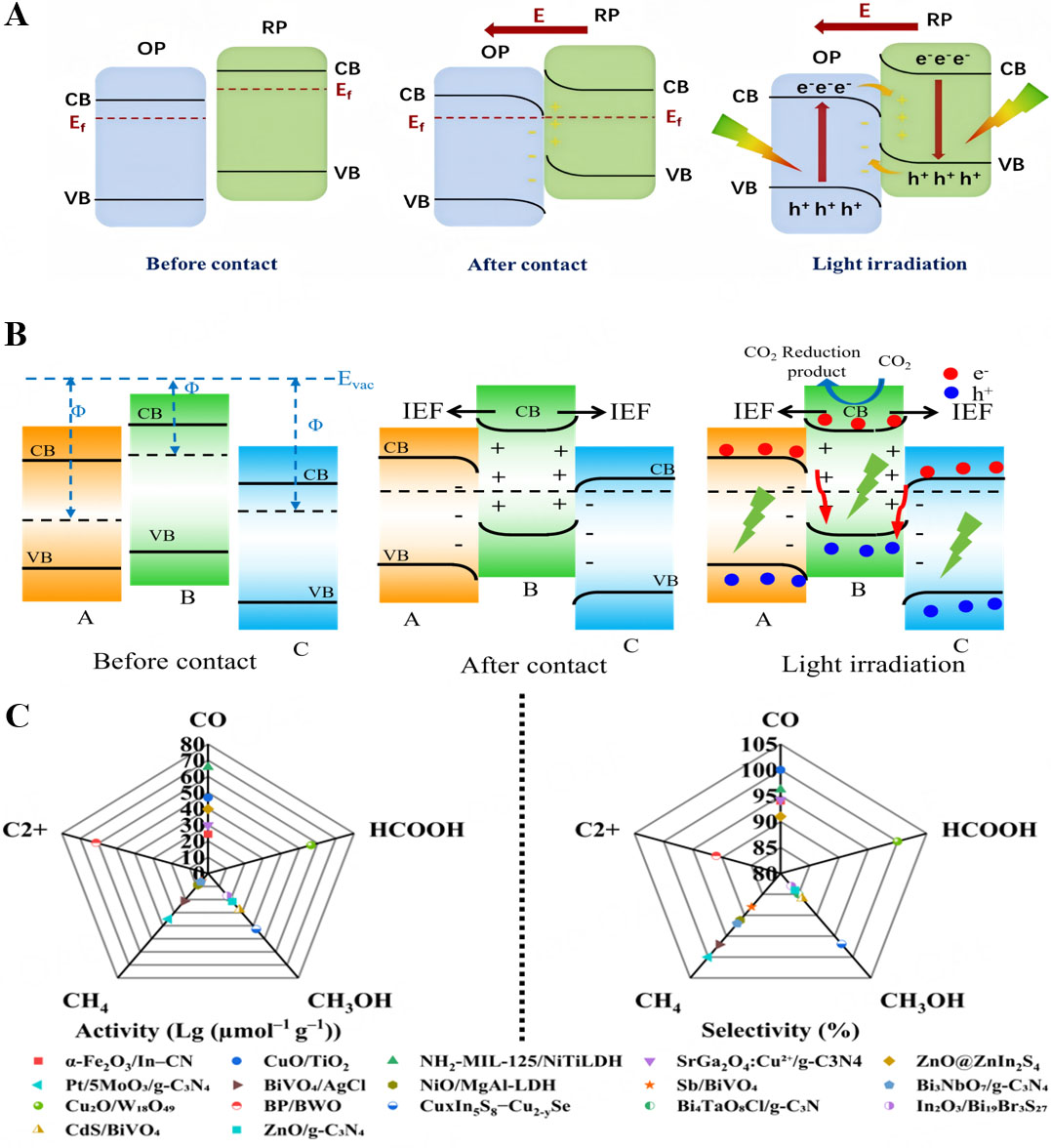
Figure 6. Schematic illustration of the S-scheme heterojunction mechanism: (A) Schematic illustration of the formation mechanism of an S-scheme heterojunction. Reprinted from Ref.[54] under the CC BY 4.0 license; (B) Schematic illustration of dual S-scheme charge carrier transfer process; (C) Radar plot comparing catalytic activity (expressed as the logarithm of production rate per mass of catalyst) and selectivity among carbon-containing products. CB: Conduction band; VB: valence band; IEF: internal electric field.
Recently, Xu et al.[63] reported S-scheme CeO2/Bi2S3 photocatalysis with palladium-catalyzed carbonylation. The CeO2/Bi2S3 system demonstrated a good yield of CO2 into CO and a high selectivity of approximately 98%, which highlights the comprehensive advantages of the S-scheme structure in enhancing charge separation and product utilization value. Similarly, Zhang et al.[64] engineered an interfacial S-scheme heterojunction by anchoring ultrasmall copper phosphosulfide onto 2D g-C3N4. Fourier transform infrared (FT-IR) spectroscopy confirmed the formation of interfacial P-N chemical bonds, which act as highly efficient charge transport channels. This synergistic coupling of chemical bonding and S-scheme transport elevated the CO generation rate to eight times that of pristine g-C3N4.
Beyond enhancing overall activity, S-scheme heterojunctions demonstrate a remarkable capability to regulate product selectivity in photocatalytic CO2 reduction. As summarized in Figure 6C, unlike conventional systems where product distribution is primarily dictated by intrinsic material properties, S-scheme architectures fundamentally reshape the reaction kinetics of competing reduction routes.
Because the mechanism selectively preserves high-energy electrons with highly negative potentials, it provides the robust thermodynamic driving force required for complex, multi-electron transfer processes. This ensures a continuous supply of active electrons to drive the formation of deeply reduced species, such as CH4, CH3OH, and C2+ hydrocarbons, rather than being limited to two-electron products. Consequently, by finely tuning the band alignment, interfacial electric fields, and catalytic active sites, researchers can effectively modulate the competitive pathways of CO2 reduction.
The product distributions highlighted in Figure 6C provide a comparative overview of the photocatalytic CO2 reduction performance of representative S-scheme heterojunctions. The catalytic activity and product selectivity parameters were collected from representative studies reported in Refs.[65-81] and further extracted, reorganized, and visualized by the authors to facilitate cross-comparison among different material systems. The comparison indicates that S-scheme heterojunctions exhibit diverse hydrocarbon production capabilities, which are closely associated with the synergistic regulation of charge separation, redox potential retention, and surface reaction kinetics. By promoting the accumulation of high-energy electrons and stabilizing key intermediates (e.g., *CO and *CHO), S-scheme heterojunctions can facilitate subsequent hydrogenation and C-C coupling processes. These characteristics highlight the potential of S-scheme architectures as versatile platforms for the selective synthesis of value-added solar fuels.
Schottky heterojunction
Schottky heterojunctions are highly effective in enhancing charge separation for photocatalytic CO2 reduction (PCR). For instance, when a metal contacts an n-type semiconductor [Figure 7A and B][82], the metal’s typically higher work function drives spontaneous electron transfer across the interface. To satisfy thermodynamic stability, electrons flow from the semiconductor to the metal until their Fermi levels equilibrate. This interfacial equilibration induces local band bending and establishes a built-in electric field, simultaneously forming a depletion layer within the semiconductor. Consequently, a Schottky barrier emerges at the interface, defined by ΦB = ΦM - XSM, where ΦM represents the work function of the metal and XSM is the electron affinity of the semiconductor. This barrier fundamentally rectifies charge transport by inhibiting the reverse flow of electrons from the metal back to the semiconductor. As a result, the metal acts as a robust “electron sink”, facilitating targeted electron accumulation on its surface and effectively suppressing deleterious charge recombination.
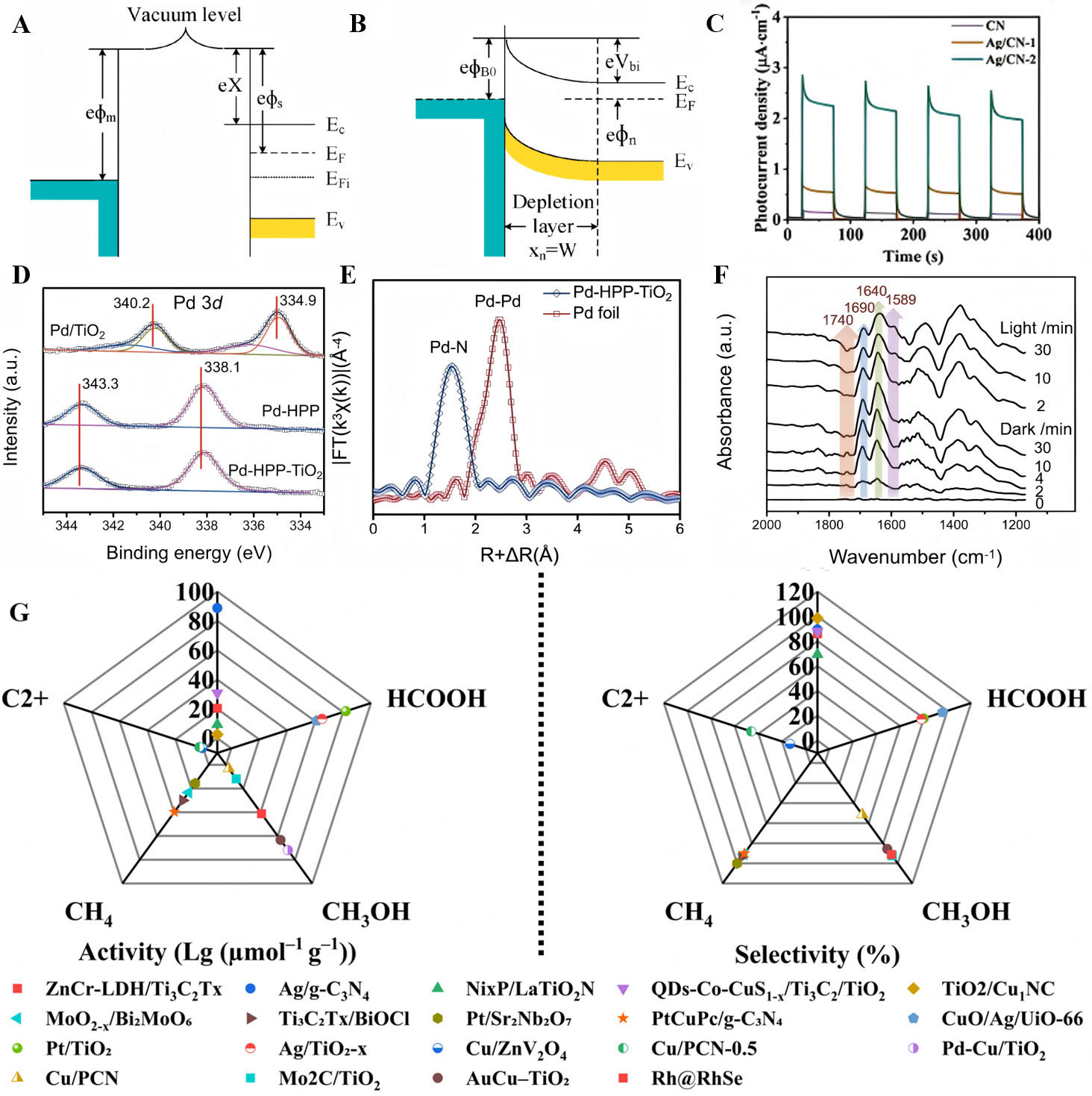
Figure 7. An ideal band diagram of the metal-N semiconductor (A) before contact and (B) after contact. Figure 7A and B is reprinted from Ref.[82] under the CC BY 4.0 license; (C) Transient photocurrent spectra (TPC). Reprinted from Ref.[83] under the CC BY 4.0 license; (D) Comparison of Pd 3d XPS spectra for three photocatalysts; (E) Fourier transformed EXAFS spectra of Pd-HPP-TiO2 and references; (F) In situ DRIFTS test of gas adsorption on Pd-HPP-TiO2 in the dark and during the photocatalytic CO2 reduction under UV-visible light irradiation. Figure 7D-F is reprinted from Ref.[84] under the CC BY 4.0 license; (G) Radar plot comparing catalytic activity (expressed as the logarithm of production rate per mass of catalyst) and selectivity among carbon-containing products. XPS: X-ray photoelectron spectroscopy; EXAFS: extended X-ray absorption fine structure; DRIFTS: diffuse reflectance infrared Fourier transform spectroscopy; Pd-HPP-TiO2: Palladium(II)-coordinated hyper-crosslinked porphyrin-based polymer coated hollow titanium dioxide; UV: ultraviolet.
These enhanced photocatalytic performances can be attributed to the favorable interfacial electronic interactions in Schottky structures, which facilitate electron transfer and promote surface reaction processes during CO2 reduction. Crucially, the functional utility of Schottky junctions extends beyond mere charge separation. In PCR systems, the metal component frequently serves as the primary catalytic active site and CO2 adsorption-activation center, dynamically regulating the adsorption configuration and electronic structure of key intermediates. Furthermore, when plasmonic metals (e.g., Au, Ag) are employed, localized surface plasmon resonance (LSPR) dramatically amplifies optical absorption. This synergistic coupling of hot-electron injection and the Schottky barrier effect fundamentally fortifies interfacial charge separation and modulates product selectivity. These kinetic advantages are thoroughly corroborated by electrochemical characterizations. As illustrated in Figure 7C, the enhanced transient photocurrent response and diminished electrochemical impedance radius collectively signify improved charge separation efficiency and accelerated interfacial transfer dynamics, ultimately elevating overall PCR performance.
Beyond charge transfer kinetics, nuanced interfacial electronic structures and corresponding reaction mechanisms can be elucidated via advanced in situ spectroscopy [Figure 7D-F]. X-ray photoelectron spectroscopy (XPS) and extended X-ray absorption fine structure (EXAFS) mapping provide deep insights into the electronic interactions and coordination environments of the metal sites. Complementarily, in situ diffuse reflectance infrared Fourier transform spectroscopy (DRIFTS) visualizes the dynamic adsorption and photo-activation of CO2 molecules[84]. Together, these results substantiate that Schottky metal sites operate dually as efficient electron sinks and active centers for intermediate stabilization.
To further validate the general advantages of Schottky architectures beyond individual case studies, a comprehensive literature comparison was performed [Figure 7G]. The integrated radar plot summarizes the reported photocatalytic CO2 reduction performance of representative Schottky systems. The integrated radar plot in Figure 7G provides a comparative overview of the reported photocatalytic CO2 reduction performance of representative Schottky architectures. The catalytic activity and product selectivity parameters were collected from representative studies reported in Refs.[51,83-100] and subsequently extracted, reorganized, and visualized by the authors to enable comparison among different Schottky-type systems and their corresponding single-component counterparts. The comparison indicates that Schottky architectures frequently exhibit enhanced reported catalytic performance, particularly in terms of carbon-containing product formation and selectivity toward specific reduction products, including CO, CH4, CH3OH, and HCOOH. These trends can be attributed to the favorable interfacial electronic interactions in Schottky structures, which facilitate electron transfer and may promote surface reaction processes during CO2 reduction.
Guided by these mechanistic insights, coupling single atoms or highly dispersed nanometals with semiconductors has emerged as a premier strategy for optimizing charge dynamics. For example, in an Ag single-atom anchored TiO2 system[101], macroscopic electron trapping-induced coloration is harnessed to bolster electron storage and migration. The isolated Ag atoms act as dominant active sites to stabilize C1 intermediates, while adjacent Ti sites facilitate H2O activation for proton supply, culminating in highly selective CH4 generation[101]. Molecular and polymeric photocatalytic platforms analogously benefit from Schottky junction integration to direct charge flow and maximize surface utilization. In benchmark Ag/g-C3N4 systems[102], loading high-work-function metals onto the polymer surface constructs stable Schottky interfaces. This architecture prompts the preferential injection and surface accumulation of photogenerated electrons at the metal sites, severely curtailing bulk-phase recombination and prolonging carrier lifetimes, thereby enhancing the CO production rate significantly beyond that of pristine g-C3N4. Moreover, integrating 2D conductive phases, such as MXenes, introduces rapid electron transport channels that augment the interfacial electric field while minimizing contact resistance. For instance, the ZnCr-LDH/Ti3C2Tx Schottky system[85], exhibits exceptional CO yield and selectivity under simulated sunlight, validating the dual role of 2D conductive phases in improving electron extraction and reinforcing the Schottky barrier. Additionally, coupling Schottky junctions with defect engineering further amplifies these kinetic efficiencies. In ultrathin SnS2 layers enriched with sulfur vacancies, the defect sites dramatically expedite proton and electron supply for the complementary water oxidation half-reaction[103]. By synergizing the electron utilization efficiency of the Schottky junction with the enhanced oxidation kinetics of the defect sites, this dual-modulation approach bypasses the kinetic bottlenecks associated with half-reaction mismatches, amplifying the CO generation rate to nearly eight times that of the pristine material. Consequently, contemporary research on Schottky heterojunctions for PCR prioritizes three main trajectories: (i) transitioning from metal nanoparticles to single-atom or atomic-level dispersions to achieve highly efficient electron extraction and precisely defined active sites; (ii) integrating 2D conductive phases as electron transport layers to construct stronger built-in electric fields and minimize interfacial resistance; and (iii) synergizing Schottky architectures with defect engineering to mutually optimize barrier heights, charge separation, and half-reaction kinetic matching. Collectively, these advancements establish Schottky heterojunctions as highly tunable interfacial modules for dictating charge and reaction pathways.
To consolidate this mechanistic landscape, the fundamental characteristics of various heterojunction architectures are summarized in Table 1. The core divergence among these designs lies in their driving forces for charge transfer and the consequent impact on redox potential preservation. Conventional type-II heterojunctions rely on standard band alignment, which ensures spatial separation but inevitably sacrifices critical redox energy. In contrast, both Z-scheme and S-scheme systems employ selective recombination mechanisms that preserve high-energy charge carriers necessary for multi-electron CO2 reduction. Conversely, Schottky heterojunctions are uniquely driven by work function differentials, establishing robust interfacial barriers that enforce directional electron extraction and maximize charge utilization efficiency.
Comparison of heterojunction architectures for charge separation in photocatalytic CO2 reduction
| Type | Charge separation mechanism | Carrier transfer pathway | Redox capability | Key advantage | Limitation |
| Z-scheme | Selective recombination of low-energy carriers | High-energy electrons and holes retained in respective bands | Strong | Maintains strong redox ability and improves charge utilization | Requires precise interface design |
| S-scheme | Built-in electric field-driven selective recombination | Directional recombination via band bending and Fermi level equilibration | Strong | Combines efficient separation with high redox potential | Mechanism identification can be complex |
| Schottky | Electron extraction via metal-semiconductor interface | Electrons transferred to metal and trapped by Schottky barrier | Strong | Promotes directional electron transfer and suppresses surface recombination | Limited hole utilization and depends on metal properties |
This progressive evolution from simple band-aligned separation toward advanced, thermodynamics-preserving charge regulation highlights the critical necessity of coupling efficient carrier separation with robust redox potential preservation, aligning perfectly with the overarching charge evolution framework conceptualized in Figure 4.
Defect engineering
Defect engineering focuses on deliberately introducing appropriate lattice defects to precisely regulate the local electronic structure and charge-transfer pathways of semiconductors, thereby achieving highly efficient control over charge capture, storage, and reuse[104]. These defects can induce localized charge density redistribution, modulate band bending, tune built-in electric fields, and dictate the binding affinity and selectivity for surface-adsorbed species. For example, electron-rich defects can enhance molecular adsorption and activate chemical bond bending, thus promoting the formation of critical intermediates (e.g., *CO2- and *COOH). Concurrently, hole-trapping centers can suppress non-radiative recombination, ensuring a higher fraction of photogenerated carriers participate in surface catalytic reactions[105]. Furthermore, the localized polarization and electron-rich microenvironments induced by these defects significantly facilitate direct electron transfer to CO2 molecules. This establishes a highly favorable thermodynamic landscape for subsequent reduction steps, including C-O bond cleavage and C-H bond formation[106]. By systematically regulating defect concentration, type, trap depth, and spatial distribution, researchers can precisely optimize charge capture efficiency, migration pathways, and interfacial reaction kinetics-all without perturbing the intrinsic band edges of the host photocatalyst[107]. Notably, when defect engineering is synergized with complementary strategies, such as interfacial electric field modulation or heterojunction construction, a powerful dual-mechanism emerges: defects serve as localized hubs for electron capture and redistribution, while the enhanced built-in electric field drives rapid, directional charge transfer. Together, these synergistic effects fundamentally elevate overall charge separation and utilization efficiencies in photocatalytic systems.
Vacancy defects
Vacancy defects are one of the most common intrinsic defects in crystalline materials. They refer to the defect formed when lattice nodes lack atoms[108]. Among them, oxygen vacancies (VO), sulfur vacancies (VS), and metal vacancies (VM) are the most representative. In metal oxides (e.g., TiO2, CeO2, In2O3, ZnO), VO are typically generated via the detachment of lattice oxygen atoms, leaving behind undercoordinated metal centers and localized electron-rich microenvironments[109, 110]. These localized states serve a dual function: they act as electron-trapping centers that prolong carrier lifetimes by suppressing non-radiative recombination, while simultaneously serving as prime active sites for the adsorption and activation of CO2 and critical intermediates (e.g., *CO2-, *COOH)[111]. Advancing beyond empirical observations, recent in situ and theoretical studies provide a deeper mechanistic understanding. For example, VO in CeO2 induce the formation of active Ce3+ species, which lower the energy barrier for the initial single-electron injection into CO2 via localized charge redistribution[112]. Rather than acting merely as static binding sites, these vacancies function as dynamic electron reservoirs that dictate the spatiotemporal distribution of interfacial electrons. However, excessive vacancy concentrations can introduce deep trap states that inadvertently accelerate charge recombination. Consequently, contemporary research has pivoted from indiscriminately maximizing vacancy density toward the precise tuning of vacancy type, trap depth, and spatial distribution to achieve an optimal synergy between charge dynamics and catalytic activity.
Similarly, sulfur vacancies (VS) are predominantly engineered in 2D transition metal dichalcogenides and sulfides (e.g., MoS2, WS2, and SnS2). The introduction of VS breaks local crystalline symmetry, exposing previously inert metal centers and substantially amplifying surface reactivity without perturbing the macroscopic band structure[113]. Recent studies reveal a dual regulatory role for VS[114]: they introduce shallow defect states that facilitate electron trapping to extend carrier lifetimes, and they trigger an electronic reconstruction of adjacent metal atoms, which strengthens CO2 binding affinity and expedites electron injection. Density of states (DOS) analyses provide direct evidence for this VS-mediated electronic reconstruction. As depicted in Figure 8A-C, the introduction of VS generates distinct mid-gap localized states (denoted as State 1 and State 2) originating from the rehybridization of metal d and chalcogen p orbitals. These electron-rich mid-gap states effectively accumulate photogenerated electrons, mitigating rapid recombination and providing an energetically favorable pathway for charge transfer to adsorbed CO2[113]. Catalytically, these electron-enriched VS sites promote the back-donation of electrons into the antibonding orbitals of CO2, accelerating the formation of key intermediates such as *CO2- and *COOH. This underscores that sulfur vacancies actively orchestrate interfacial charge transfer and molecular activation rather than functioning as passive electron traps. Consequently, VS engineering is now a cornerstone design strategy for sulfide-based photocatalytic systems.
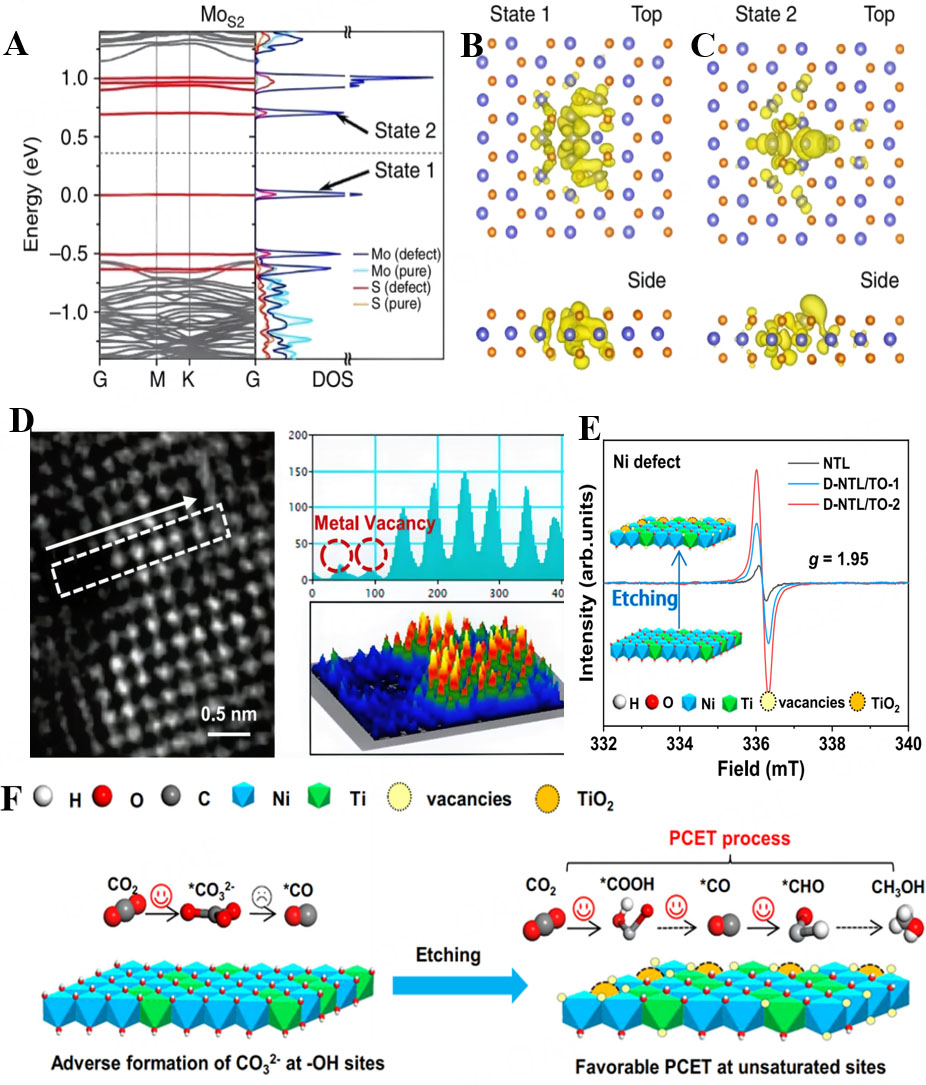
Figure 8. Evidence for vacancy defects in modulating electronic structure and CO2 reduction pathways: (A) Band structure and corresponding density of states (DOS) of antisite defect MoS2. The grey bands are from normal lattice sites, similar to conduction band and valence band of perfect monolayer, while the discrete red bands show the localized defects states. The DOS is projected onto the atoms around the defect (defect) and those in the middle plane of two adjacent defects (pure), respectively. The grey dashed line indicates the position of the Fermi Level. (B, C) Real-space distribution of the wave functions of the two defect states below and above the Fermi energy. Figure 8A-C is reprinted from Ref.[113] under the CC BY 4.0 license; (D)AC-TEM image with corresponding 3D surface plot and atomic profile of white-dotted area, and m EDS-STEM element mapping of D-NTL/TO-2. (E)EPR spectra of bulk NTL and acid-etched derivatives. (F) Schematic illustration of the CO2 activation mechanism on NTL and D-NTL/TO. Figure 8D-F is reprinted from Ref.[115] under the CC BY-NC-ND license. D-NTL/TO: Defective NiTi-layered double hydroxide/titanium dioxide; PCET: proton-coupled electron transfer; AC-TEM: Aberration-corrected transmission electron microscopy; EDS-STEM: energy-dispersive X-ray spectroscopy–scanning transmission electron microscopy; EPR: electron paramagnetic resonance.
In contrast to anion vacancies, metal vacancies (VM) generally demand higher formation energies, typically requiring harsh annealing or reducing atmospheres, but exert a far more profound impact on the electronic structure and catalytic behavior of the host material[104]. VM disrupt the local coordination environment, inducing substantial charge redistribution and lattice polarization that enhance both carrier transport and interfacial kinetics. As illustrated in Figure 8D, high-resolution intensity mapping reveals that structurally unsaturated VM sites trigger pronounced local lattice distortions. These coordination-unsaturated centers induce spatially confined electronic perturbations, fostering charge localization under reaction conditions. This electronic modulation is further corroborated by electron paramagnetic resonance (EPR) spectroscopy [Figure 8E], where a distinct signal at g = 1.95 directly evidences the formation of paramagnetic defect centers associated with Ni vacancies. The intensity evolution of this signal across different treatment conditions highlights that VM concentration and electronic activity can be dynamically manipulated via post-etching strategies. Catalytically, these VM-rich domains critically govern adsorption energetics and intermediate evolution. As summarized in Figure 8F, a defective NiTi-TiO2 system effectively suppresses the formation of thermodynamically stable yet catalytically inert carbonate species, selectively stabilizing the *COOH intermediate, a widely recognized rate-determining precursor for CO2-to-methanol conversion[115]. This pathway reconfiguration stems from the synergy between VM-induced electronic state redistribution (enhancing electron availability) and localized geometric distortions (optimizing proton accessibility). Crucially, this modulation transcends static adsorption to actively accelerate PCET kinetics. By shortening the effective distance between charge carriers and intermediates, these unsaturated sites lower the activation barriers for sequential hydrogenation steps (*CO2 → *COOH → *CO → *CHO). Furthermore, from a carrier dynamics perspective, VM in metal oxides (e.g., WO3, TiO2, Bi2O3) decrease the effective mass of holes, thereby boosting their mobility and expediting bulk-to-surface carrier migration[116]. In transition metal oxides like Co3O4, VM promote the formation of high-valence metal species, further driving oxidation kinetics[117]. Thus, metal vacancies operate as multifunctional catalytic motifs that concurrently optimize charge separation, intermediate stabilization, and reaction pathway selectivity.
Ultimately, the formation and behavior of these vacancy defects are intimately governed by the interplay of material composition, crystal structure, and synthetic conditions (e.g., temperature and atmospheric composition). Thermodynamically, vacancy generation must overcome binding-energy-dependent barriers; kinetically, it is dictated by atomic diffusion during thermal or reductive treatments. Table 2 comprehensively summarizes recent advances in vacancy-engineered photocatalysts for PCR. These benchmarks collectively illustrate that whether leveraging VO in metal oxides, VS in sulfides, or more complex VM and dual-defect architectures (VM + VS), vacancy engineering remains a paramount strategy. It not only suppresses deleterious charge recombination but also fundamentally dictates the surface reaction pathways and product selectivity in photocatalytic CO2 reduction.
Summary of vacancy-defect-engineered photocatalysts for CO2 reduction
| Material | Vacancy type | Main product | Light sources | Sacrificial agents | AQE (%) | Rate µmol·g-1·h-1 | Ref. |
| TiO2-x | VO | CH4 | 300 W Xe lamp | H2O | 0.12 (365 nm) | 41.8 | [118] |
| Pd/CeO2 | VO | CO | 300 W Xe lamp | H2O | - | 210.9 | [119] |
| Bi12O17Cl2 | VO | CO | 300 W Xe lamp | H2O | - | 64.3 | [120] |
| BiOCl | VO | CO | 300 W Xe lamp | H2O | - | 14.51 | [121] |
| BiOBr | VO | CO | 300 W Xe lamp λ ≥ 420 nm | H2O | - | 122.38 | [122] |
| BWO | VO | CO | 300 W Xe lamp | H2O | 0.00394 (500 nm) | 18.73 | [123] |
| MoO2-x | VO | CO | 250 W high-pressure mercury lamp | H2O | - | 62.75 | [124] |
| Bi/BiOBr | VO | CO | 200 mW/cm2 Xe lamp | H2O | - | 251.2 | [125] |
| Bi2MoO6@In2S3 | VO | CO | 300 W Xe lamp λ ≥ 420 nm | H2O | 2.11 (420 nm) | 28.54 | [126] |
| ReS2/CdS | VS | CO | 300 W Xe lamp λ ≥ 420 nm | H2O | - | 7.1 | [127] |
| ZIS | VS | CO | 300 W Xe lamp λ ≥ 420 nm | TEOA | - | 61.94 | [128] |
| ZnS/OMNC | VS | CO | 300 W Xe lamp λ ≥ 420 nm | H2O | - | 712.1 | [129] |
| SnS2 | VS | CO | 300 W Xe lamp | H2O | - | 25.71 | [103] |
| Au/CdS-SV | VS | CO | 300 W Xe lamp λ ≥ 400 nm | TEOA | - | 12.48 | [130] |
| ZnIn2S4 | VM | CO | 300 W Xe lamp λ ≥ 420 nm | H2O | 2.29 (420nm) | 5630 | [131] |
| BiOBr-1 | VM | CO | 300 W Xe lamp | H2O | - | 71.23 | [132] |
| VBi-BiOBr | VM | CO | 300 W Xe lamp | H2O | - | 20.1 | [133] |
| Cu1.95S1-x | VM+VS | CH4 | 300 W Xe lamp | H2O | - | 12.42 | [134] |
Doping defects
Doping defects, introduced via the interstitial or substitutional incorporation of metallic or non-metallic heteroatoms, profoundly reconfigure the electronic band structure, local coordination environments, and charge dynamics of host lattices[109]. Unlike intrinsic vacancies, doping provides a highly tunable platform to actively dictate the spatiotemporal behavior of photogenerated carriers and optimize interfacial catalytic performance.
Non-metal dopants (e.g., N, C, S, P, B) primarily modulate the valence band architecture, inducing electronic state reconstruction and generating localized impurity states[106]. Beyond merely broadening the optical absorption spectrum, non-metal doping fundamentally governs interfacial charge transfer. For example, synergistic P-S co-doping transforms polymeric g-C3N4 into a narrow-bandgap “black” carbon nitride. This architectural modification not only extends light harvesting into the near-infrared regime but also instigates a redistribution of electron density and local structural polarization, dramatically accelerating CO2-to-CO conversion by mitigating electron-hole recombination[135].
Conversely, metal ion doping predominantly engineers shallow energy levels near the conduction band and modulates the Fermi level, steering the directional migration of photogenerated carriers. A quintessential example of metal-doping synergy is the Bi-incorporated In2O3-x(OH)y system. Here, the strategic construction of surface frustrated Lewis pairs (FLPs, cooperatively regulated by hydroxyl groups and oxygen vacancies) is further optimized by Bi3+ substitution at In3+ sites. This targeted metal incorporation finely tunes the surface active motifs, dictating both the thermodynamic activation of CO2 and the ultimate product selectivity[136,137].
Extending these principles, dual-doping strategies (e.g., metal/non-metal combinations or dopant-vacancy couplings) elicit robust synergistic effects. For instance, P-K co-doping in g-C3N4 amplifies charge separation while driving the multielectron reduction of CO2 toward CH4[138], whereas N-metal co-doping in TiO2 concurrently broadens spectral responsiveness and enhances product selectivity[139]. Table 3 systematically catalogs recent benchmarks in doping-engineered photocatalysts, highlighting the macroscopic performance gains achieved through these elemental substitutions.
Summary of doped photocatalysts for CO2 reduction
| Material | Vacancy type | Main product | Light sources | Sacrificial agents | AQE (%) | Rate µmol·g-1·h-1 | Ref. |
| TiO2 | N | CO | 300 W Xe lamp | H2O | - | 41.1 | [140] |
| TiO2 | N+Eu | CH4 | 300 W Xe lamp λ ≥ 400 nm | H2O | 9.1 (350 nm) | 13.48 | [141] |
| BiOBr | P | CO | 300 W Xe lamp | H2O | - | 9.13 | [142] |
| BiOBr | N | CO | 300 W Xe lamp | H2O | - | 18.28 | [143] |
| BiOBr | B | CO | 300 W Xe lamp | H2O | - | 21.72 | [144] |
| BiOBr | Co | CO | 300 W Xe lamp λ ≥ 420 nm | H2O | - | 11.71 | [145] |
| BiOBr | Eu | CO | 300 W Xe lamp | H2O | - | 22.3 | [146] |
| BiOBr-2 | Br | CO | 300 W Xe lamp | H2O | - | 95.6 | [147] |
| ZnIn2S4 | O | CO | 300 W Xe lamp λ ≥ 420 nm | TEOA | - | 1680 | [148] |
| ZnIn2S4 | Er | CH4 | 300 W Xe lamp λ ≥ 420 nm | TEOA | - | 6.68 | [149] |
| ZnIn2S4 | Y | CO | 300 W Xe lamp λ ≥ 420 nm | TEOA | 0.97 (350 nm) | 297.46 | [150] |
| ZnIn2S4 | Yb | CO | 300 W Xe lamp λ ≥ 420 nm | TEOA | - | 4.59 | [151] |
| CN | P+F | CO | 300 W Xe lamp 350 nm ≤ λ ≤ 780 nm | H2O | - | 39.9 | [152] |
| CN | P | CO | 300 W Xe lamp | H2O | - | 31.22 | [153] |
| Au/CN | B+K | CO | 300 W UV lamp λ = 400 nm | H2O | - | 11.56 | [154] |
| g-C3N4 | Eu | CH4 | 300 W Xe lamp | H2O | 1.6 (420 nm) | 22.8 | [155] |
| CN | Cu+P | CO | 300 W Xe lamp | H2O | 0.005 (375 nm) | 6.01 | [156] |
| Bi3O4Br | Co | CO | 300 W Xe lamp | H2O | - | 107.1 | [157] |
To bridge these macroscopic catalytic enhancements with atomic-scale charge dynamics, interstitial carbon-doped SnS2 (SnS2-C) serves as an elegant mechanistic model [Figure 9A-C]. Interstitial carbon incorporation disrupts local structural symmetry, inducing pronounced lattice microstrain and charge polarization. High-resolution XPS [Figure 9A and B] unveils a distinct positive shift in the binding energies of both Sn 3d and S 2p core levels. This phenomenon signifies partial electron depletion from the host lattice, indicating that interstitial carbon acts as a potent electron-withdrawing locus. Such localized electron redistribution generates a robust built-in electric field that drives the spatial separation of bulk electron-hole pairs, funneling them directionally toward the catalytic interface. Furthermore, as depicted in Figure 9C, the synergy between carbon-induced lattice strain and electronic modulation broadens visible-light harvesting while establishing energetically favorable pathways for charge injection into adsorbed CO2. Ultimately, this paradigm underscores that doping defect engineering transcends simple bandgap narrowing; it acts as a comprehensive tool to construct internal electric fields, optimize charge routing, and fundamentally dictate the fate of photogenerated carriers at the atomic level.
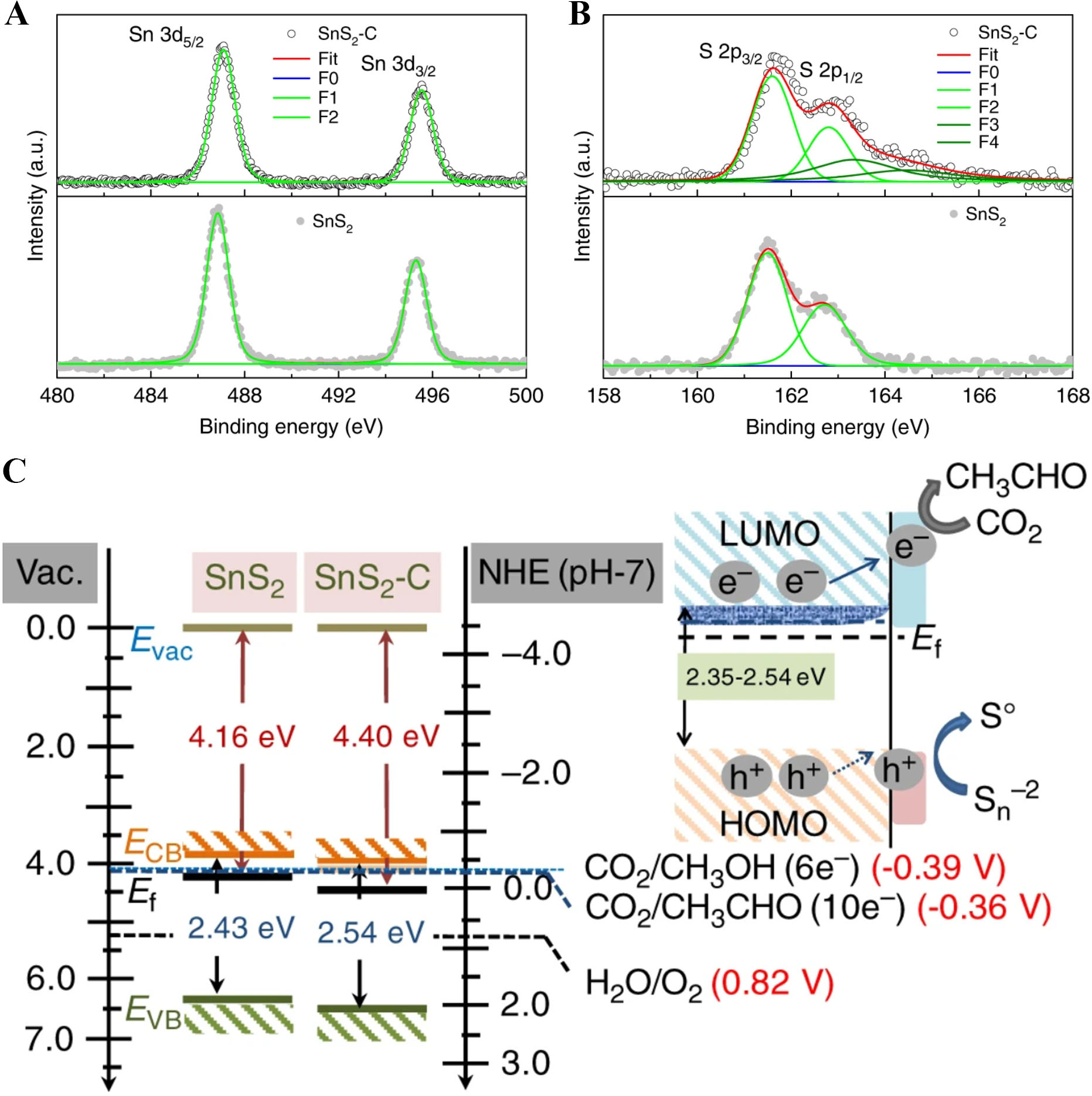
Figure 9. (A) High-resolution XPS Sn 3d spectra of SnS2-C and SnS2; (B) High-resolution XPS S 2p spectra of SnS2-C and SnS2; (C) Band edge positions and photocatalytic reaction mechanism: Comparative band diagram of SnS2-C and SnS2, together with a proposed electron-hole separation of photo-excited electron-hole pairs in SnS2-C. Figure 9A-C is reprinted from Ref.[158] under the CC BY 4.0 license. SnS2-C: Carbon-doped SnS2; CB: conduction band; VB: valence band; NHE: normal hydrogen electrode; LUMO: lowest unoccupied molecular orbital; HOMO: highest occupied molecular orbital; XPS: X-ray photoelectron spectroscopy.
Cocatalyst modification
Loading cocatalysts on the photocatalyst surface can enhance charge separation, improve charge transfer, or adjust the reaction pathway, thereby improving the overall PCR performance. Generally, cocatalysts are classified into metal cocatalysts and non-metal cocatalysts[109].
Cocatalysts serve as indispensable structural motifs in photocatalytic systems, bridging the spatial gap between bulk charge separation and interfacial catalytic turnover. Among these, metal nanostructures remain a cornerstone, functioning as potent electron sinks. High-work-function noble metals (e.g., Pt, Au, Pd) equilibrate with the Fermi level of n-type semiconductors upon contact[159], inducing spontaneous band bending and the formation of a robust Schottky junction [Figure 10A]. This built-in potential barrier actively circumvents electron backflow, funneling photogenerated electrons directionally toward the metallic surface where CO2 reduction transpires. Furthermore, plasmonic cocatalysts (e.g., Ag, Au) harness localized surface plasmon resonance (LSPR) to inject hot electrons directly into the semiconductor conduction band, synergistically amplifying the overall quantum efficiency alongside Schottky-directed charge extraction[102,159].
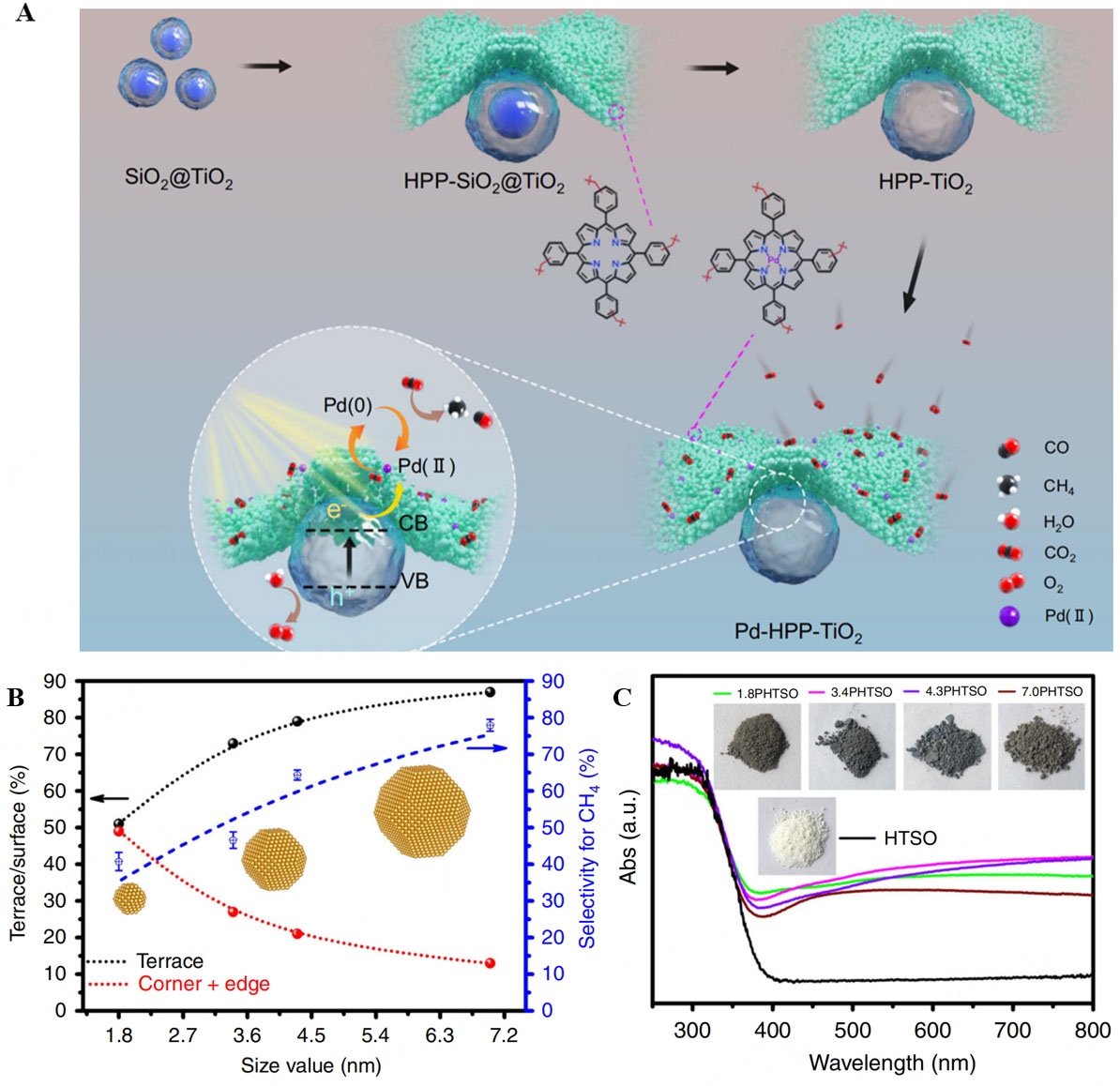
Figure 10. (A) Synthesis of porous Pd-HPP-TiO2 and the possible mechanism of photocatalytic CO2 reduction. Reprinted from Ref.[84] under the CC BY 4.0 license. (B) Correlations between the selectivity for CH4 and surface site proportion as functions of the size of Pt NPs in xPHTSO (x = 1.8, 3.4, 4.3, and 7.0). (C) UV-Vis DRS spectra and the corresponding samples’ photos (inset). Figure 10B and C is reprinted from Ref.[160] under the CC BY 4.0 license. HPP: Hyper-crosslinked porphyrin-based polymer; CB: conduction band; VB: valence band; PHTSO: Pt-loaded hollow TiO2 with a silica overlayer; NP: nanoparticle; UV-Vis: ultraviolet-visible; DRS: diffuse reflectance spectroscopy.
Crucially, the catalytic efficacy of these metallic sinks is exquisitely sensitive to their geometric dimensions [Figure 10B and C]. Downsizing nanoparticles maximizes the population of low-coordinated surface atoms (corner and edge sites), augmenting electron trapping efficiency[160]. However, this miniaturization simultaneously alters the binding energetics of crucial intermediates, occasionally compromising target product selectivity. Conversely, larger nanoparticles predominantly expose terrace sites that thermodynamically favor specific multistep pathways, such as deep reduction to CH4. This intricate trade-off dictates that metal cocatalyst design must transcend mere work-function matching, necessitating precise geometric tailoring to harmonize charge extraction kinetics with surface reaction specificity.
Pushing this geometric limit to the atomic scale, single-atom catalysts (SACs), such as Cu, Ni, and Co, have emerged as a transformative frontier. Unlike their nanoparticulate counterparts, SACs offer maximum atom utilization, well-defined coordination environments, and the ability to modulate local electronic structures without fundamentally perturbing the host semiconductor's band architecture[161]. In model systems like Ag-anchored TiO2, isolated Ag atoms operate as exclusive electron-trapping loci, substantially extending carrier lifetimes while stabilizing critical C1 intermediates. The adjacent Ti sites synergistically facilitate water oxidation and proton supply, dictating a highly selective CO2-to-CH4 conversion pathway[101]. Similarly, anchoring isolated Cu species on polymeric carbon nitride (Cu-PCN) directly mediates electron transfer to adsorbed CO2. Theoretical and in situ spectroscopic investigations corroborate that these atomic Cu sites significantly lower the activation barrier for *COOH formation, the rate-determining step, thereby steering the reaction with near-unity selectivity toward CO[151-153].
Complementing metallic systems, non-metallic and quasi-metallic cocatalysts leverage extended π-conjugated networks and high carrier mobilities to orchestrate directional charge routing. Carbon quantum dots (CQDs), acting as dynamic “electron reservoirs”, provide rapid, delocalized electron transport channels that decisively mitigate bulk recombination when integrated into heterostructures (e.g., TiO2/SrTiO3 or Z-scheme Bi12O17Cl2/NiAl-LDH)[162,163]. Furthermore, covalent organic frameworks (COFs) and conjugated polymers offer unprecedented molecular-level tunability. By constructing continuous interfacial π-electron channels, these materials expedite carrier migration while circumventing the strong, often irreversible metal-intermediate bonds characteristic of inorganic systems[164]. Consequently, non-metal cocatalysts typically govern intermediate stabilization via soft non-covalent interactions (e.g., π-π or electrostatic forces). By fine-tuning the adsorption energetics of species like *CO, these networks strategically suppress over-hydrogenation pathways, favoring highly selective CO evolution[165].
Table 4 systematically compiles recent benchmarks in cocatalyst-engineered photocatalysts, detailing the interplay between cocatalyst identity, half-reaction dynamics, and product distribution. Collectively, these studies underscore that rational cocatalyst integration is not merely a strategy to accelerate redox kinetics, but a fundamental prerequisite for bridging spatial charge extraction with precisely tailored interfacial reaction pathways in advanced CO2 reduction systems.
Summary of cocatalyst-modified photocatalysts for CO2 reduction
| Material | Vacancy type | Main product | Light sources | Sacrificial agents | AQE (%) | Rate µmol·g-1·h-1 | Ref. |
| Co-Bi3O4Br | single-atom Co | CO | 300 W Xe lamp | H2O | - | 107.1 | [157] |
| Co-TCPP/Bi3O4Br | molecular Co | CO | 300 W Xe lamp | H2O | 0.53 (380 nm) | 71.3 | [166] |
| CO2N/BiOBr | non-noble nitride | CO | 300 W Xe lamp | H2O | - | 67.8 | [167] |
| Ni SAs-Bi3O4Br | single-atom Ni | HCOOH | 300 W Xe lamp | H2O | - | 3632.6 | [168] |
| Cs3Bi2Br9/Co-NG | Co single-atom modified graphene | CO | 300 W Xe lamp | H2O | - | 123.16 | [169] |
| LaNi-Phen/COF-5 | La-Ni bimetallic | CO | 500 W Xe lamp | H2O | - | 605.8 | [170] |
| Cu-HCOF | atomically dispersed Cu | CO | 400-W high-pressure Hg lamp | TEOA | - | 960 | [171] |
| AgCo/Al-SrTiO3 | dual Ag/Co | CO | 400-W high-pressure Hg lamp | H2O | 0.03 (365 nm) | 105.4 | [172] |
| Ag@Cr/Ga2O3 | Ag-Cr core-shell | CO | 300 W Xe lamp | H2O | - | 999.2 | [173] |
| Cu/TiO2 | Cu | CH4 | 300 W Xe lamp | H2O | - | 12.52 | [174] |
| PtCuCN | Pt-loaded CuPc/g-C3N4 | CH4 | LED light source (365 ± 10 nm) | TEOA | - | 39.8 | [51] |
| Pt-Au/R-TNTs | Pt-Au | CH4 | UV light irradiation (300 nm < λ < 400 nm) | H2O | 17.9 (365 nm) | 360 | [175] |
| Pt/TiO2 | Pt | CH4 | 300 W Xe lamp λ ≥ 400 nm | H2O | - | 4.6 | [176] |
| Pd TP/Pd SA-CN | Pd single atoms + twinned Pd nanoparticles | CO | 600 mW/cm2 | H2O | - | 46.5 | [177] |
| Pd NPs/TiO2 | Pd | CH4 | 350 W Xe lamp | H2O | - | 28.5 | [178] |
| g-C3N4/MoS2/Cu | Cu | CO | 300 W Xe lamp | H2O | 3.2 (420 nm) | 146.7 | [179] |
| Co1In1/CN | Co-In dual single-atom | CH4 | UV light | H2O | - | 18.8 | [180] |
| Pt@CeO2/3D CN | Pt | CO | 300 W Xe lamp | TEOA | - | 4.69 | [181] |
| Cu0.7Au0.3/TiO2 | Cu-Au bimetal | CO | 300 W Xe lamp | H2O | - | 6.08 | [182] |
| Ag-Cu/TiO2 | Ag-Cu dual | CO | 300 W Xe lamp | H2O | - | 286.7 | [183] |
| Au6Ag4/TiO2 | Au-Ag alloy | CO | 300 W Xe lamp 320 nm < λ < 780 nm | H2O | 0.91 (450 nm) | 99.54 | [184] |
| Cu2O@Cu-MOF/TiO2 | Cu2O/Cu-MOF core-shell | CH4 | 300 W Xe lamp | H2O | - | 366 | [185] |
Microstructure design
Microstructure engineering represents a quintessential strategy in photocatalytic CO2 reduction (PCR) systems to fundamentally optimize mass diffusion and truncate charge transfer pathways. Dimensionality reduction to the 2D ultrathin limit effectively circumvents bulk recombination by ensuring that structural thicknesses are comparable to, or smaller than, the carrier diffusion length. For instance, atomic-scale Bi4O5Br2 nanosheets exhibit drastically enhanced CO2-to-CO activity compared to their bulk counterparts, as photogenerated electron-hole pairs are inherently forced to migrate toward surface active sites[186].
Furthermore, assembling 2D/2D heterojunctions (e.g., LDHs/MoS2 or MXene/g-C3N4) maximizes interfacial contact area while minimizing transport resistance. In such architectures, highly conductive substrates such as MXenes function as robust “electron highways” expediting the directional funneling of photogenerated electrons to surface catalytic loci and markedly suppressing recombination[187,188].
Transitioning to 3D hierarchical designs, core-shell architectures introduce radial charge partitioning and coaxial transport cascades. By spatially decoupling oxidation and reduction half-reactions across a distinct geometric boundary, these structures foster robust built-in electric fields that orchestrate directional charge flow. Complex configurations, such as TiO2@NiAl-LDH, Cu2O@Cu-MOF, and ternary Cu2O@NiAl-LDH/CQDs systems, vividly demonstrate how rational shell selection concentrates CO2 molecules at the outermost reactive sites while spatially isolating them from internal charge generation centers, thereby firmly averting reverse charge recombination and enhancing multi-electron C2 product selectivity[185,189-191].
Porous and hollow microstructures culminate this spatial optimization by synchronously addressing the “light-harvesting, mass-transfer, and charge-separation” trifecta. As systematically elucidated in Figure 11, the advantages of these geometries are multidimensional. Internally, multi-shelled or hollow cavities induce severe light scattering and multireflection [Figure 11A], drastically amplifying the photon absorption path length. Electronically, the attenuated physical distance from the bulk to the solid-gas interface expedites charge extraction, a phenomenon universally corroborated by quenched steady-state photoluminescence (PL) [Figure 11B] and prolonged carrier lifetimes in time-resolved PL (TRPL) spectra [Figure 11C]. Concurrently, the interconnected porous networks massively expand surface accessibility, translating to superior CO2 adsorption capacities [Figure 11D][194].
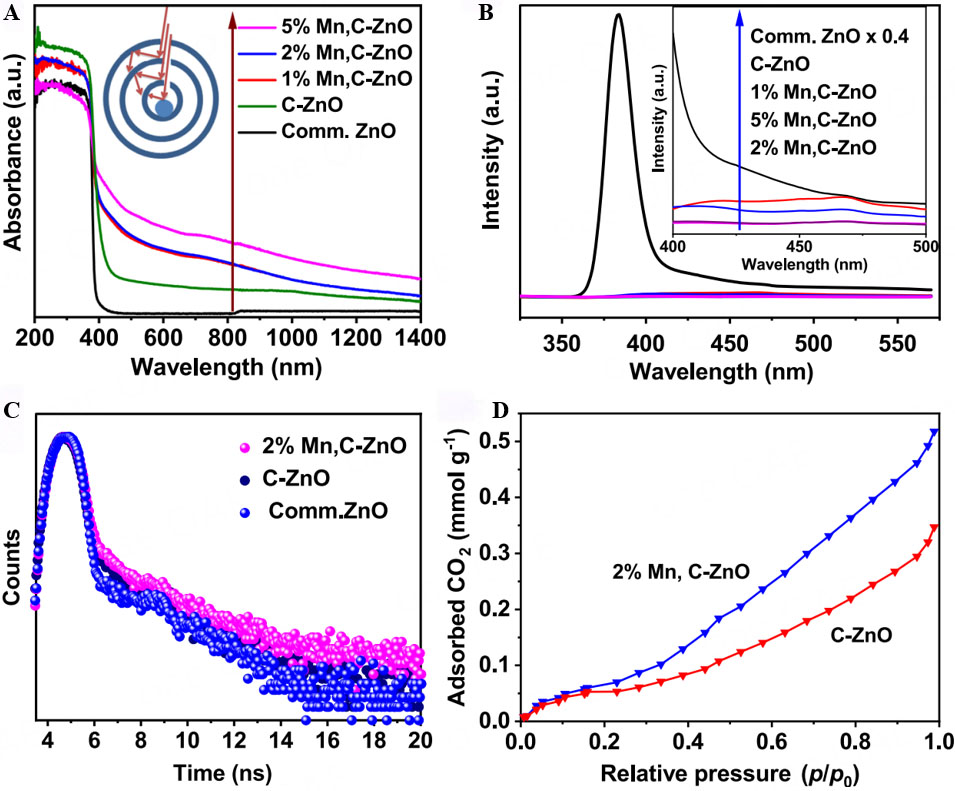
Figure 11. (A) UV-vis light absorption of the prepared photocatalysts and the inset represents the multiple reflection effect of the incident light inside the hollow cavities. (B) PL spectra of photocatalysts at excitation wavelength of 380 nm. (C) TRPL spectra of the samples. (D) CO2 adsorption isotherm of C-ZnO CTSHSs and 2% Mn, C-ZnO-CTSHS samples. Figure 11 A-D is reprinted from Ref.[192] under the CC BY 4.0 license. UV-vis: Ultraviolet–visible; PL: photoluminescence; TRPL: time-resolved photoluminescence; CTSHS: core-triple shell hollow sphere.
These synergistic mechanisms dictate the exceptional performance of practical systems, such as hierarchical porous ZnIn2S4 nested heterojunctions, hollow g-C3N4@TiO2 microspheres, and hollow CeO2 structures[193-196]. In these configurations, the structural voids not only host enriched active sites but fundamentally accelerate interfacial reaction kinetics under visible-light irradiation.
Table 5 summarizes state-of-the-art microstructure-engineered photocatalysts. Collectively, these geometric modulations, ranging from atomic 2D exfoliation to hierarchical 3D hollowing, demonstrate that macroscopic catalytic enhancements are inextricably linked to the precise nanoscale management of photon flux, reactant diffusion, and carrier transport vectors.
Summary of microstructure-engineered photocatalysts for CO2 reduction
| Material | Vacancy type | Main product | Light sources | Sacrificial agents | AQE (%) | Rate µmol·g-1·h-1 | Ref. |
| Bi4O5Br2-UN | 2D nanosheets | CO | 300 W Xe lamp | H2O | - | 31.57 | [186] |
| TC/g-C3N4 | 2D/2D heterojunction | CO | 300 W Xe lamp λ ≥ 420 nm | H2O | - | 5.19 | [188] |
| TiO2@CN | core-shell Z-scheme | CO | 300 W Xe lamp 320 nm < λ < 780 nm | H2O | 1.829 (400 nm) | 26.89 | [191] |
| Cu2O@NA-LDH/CQDs | ternary core-shell | C2H6 | 300 W Xe lamp λ ≥ 420 nm | TEOA | - | 8.18 | [190] |
| NiAl-LDH@TiO2/Ti3C2 | hierarchical core-shell | CO | 300 W Xe lamp | H2O | 0.81 (365 nm) | 86.52 | [197] |
| CNGA/CdS | ultrathin porous nanosheets | CO | 300 W Xe lamp λ ≥ 420 nm | H2O | 0.65 (500 nm) | 32.75 | [198] |
| CDs-1/CdS | hierarchical hollow microspheres | CO | 300 W Xe lamp | TEOA | - | 16.09 | [199] |
| H-Cs3Sb2Br9 | hollow nanospheres | CO | 300 W Xe lamp λ ≥ 400 nm | CH3OH | 2.65 (400 nm) | 1876.3 | [200] |
| Bi4O5Br2 | hollow core-shell | CO | 300 W Xe lamp | H2O | - | 3.61 | [201] |
| NiCO2V2O8 | hollow nanospheres | CO | 300 W Xe lamp λ ≥ 420 nm | TEOA | 5.76 (380 nm) | 198.65 | [202] |
| g-C3N4/rGO/NiAl-LDHs | layered hierarchical heterojunction | CH4 | 300 W Xe lamp | TEOA | 1.36 (380 nm) | 20 | [203] |
| BWO | ultrathin nanosheets | CO | 300 W Xe lamp | H2O | 0.35 (350 nm) | 19.45 | [204] |
| F-2D BMO | 2D nanosheets | CO | 300 W Xe lamp | H2O | 1.5 (420 nm) | 5.6 | [205] |
| CdS/TiO2 | hollow microspheres | CH4 | 350 W Xe lamp | H2O | - | 27.85 | [206] |
| Cu-HCOF | hollow COF structure | CO | 500 W Xe lamp | TEOA | - | 960 | [171] |
| Bi-CuO | core-shell | CO | 300 W Xe lamp | H2O | - | 106.07 | [207] |
| Ag/hollow-TiO2 | hollow spheres | CH4 | 300 W Xe lamp | H2O | - | 6.72 | [208] |
| Pt/β-SiC HS | open-mouthed hollow spheres | CH4 | 300 W Xe lamp | H2O | - | 16.8 | [209] |
| Co9S8@ZnIn2S4/CdS | hollow core-shell nanoreactor | CO | 300 W Xe lamp | H2O | - | 82.1 | [210] |
| SnS2/CeO2 | 2D/0D heterojunction | CO | 300 W Xe lamp | TEOA | - | 16.27 | [211] |
| SiW11Cu@TiO2 | heterointerface core-shell-like composite | CO | 300 W Xe lamp | TEOA | - | 84.12 | [212] |
| Au/CdS HMCHPs | hierarchical multi-cavity hollow particles | CO | 300 W Xe lamp λ ≥ 400 nm | TEOA | 0.61 (420 nm) | 3,758 | [213] |
| Ni/Bi-30 | porous ultrathin nanosheets | CO | 460 nm LED | TEOA | - | 10.2 | [214] |
| NFMS | 2D/2D heterojunction | CO | 300 W Xe lamp | H2O | - | 2.68 | [187] |
While the aforementioned strategies ranging from band engineering to microstructural design have individually propelled photocatalytic CO2 reduction (PCR) forward, a critical appraisal reveals a persistent “single-strategy bottleneck”. For instance, Z- and S-scheme heterojunctions elegantly preserve high-energy charge carriers, yet their efficacy is strictly tethered to interfacial electronic coupling; poorly matched work functions or structural deviations inevitably spawn parasitic recombination pathways. Similarly, while metallic sinks and Schottky junctions expedite charge extraction, their optimization is plagued by a delicate balancing act, as excessive loading invariably triggers light-shielding effects or active-site occlusion. Furthermore, morphological tuning and defect engineering (e.g., oxygen vacancies) effectively shorten diffusion lengths and enhance reactant adsorption, respectively, but they often lack the intrinsic thermodynamic driving force required to independently orchestrate long-distance, directional charge separation.
Consequently, tackling the PCR bottleneck demands a paradigm shift from isolated component optimization to the synergistic integration of multi-dimensional strategies. This synergy transcends a mere mathematical superposition of effects; rather, it orchestrates a holistic reconstruction of charge-transfer networks across diverse spatiotemporal scales. For example, coupling defect engineering with built-in electric fields, as demonstrated in oxygen-vacancy-rich Ni2P2O7/g-C3N4 heterojunctions[215] or ferroelectric Bi3TiNbO9 nanosheets[216], establishes a powerful dual-regulation mechanism. In these systems, vacancies serve as localized reactant-trapping and activation loci, while the overarching internal polarization fields forcefully dictate directional carrier migration, synchronously suppressing bulk recombination and accelerating surface reaction kinetics.
Furthermore, integrating Schottky junctions with plasmonic architectures introduces distinct energetic advantages. In plasmonic Ag/TiO2 systems, the localized surface plasmon resonance (LSPR) effect harvests lower-energy photons to inject hot electrons, while the proximal Schottky barrier immediately rectifies their flow, preventing back-transfer. Time-resolved spectroscopy confirms that this precise energetic and spatial synchronization profoundly amplifies overall multi-electron transfer efficiency[217].
Ultimately, the zenith of photocatalytic CO2 reduction will not be reached through isolated structural tweaks, but through the mastery of multi-level coupled mechanisms. By hierarchically integrating interfacial electric fields, precise defect distributions, and optimally configured active sites, researchers can construct continuous, energetically cascaded electron “highways” from bulk generation centers directly to adsorbed CO2 molecules. This synergy-driven design paradigm stands as the definitive roadmap for circumventing intrinsic thermodynamic limitations and steering PCR technology toward viable practical applications.
CONCLUSIONS AND OUTLOOK
This review systematically discusses the charge separation process in photocatalytic CO2 reduction (PCR) systems from a multi-scale perspective, integrating bulk generation, interfacial migration, and surface reaction coupling within a unified framework. As emphasized throughout the manuscript, charge separation efficiency is the core bottleneck governing PCR performance, as it directly determines the effective utilization of photogenerated carriers in multi-electron CO2 conversion processes.
By correlating thermodynamic driving forces with kinetic competition, we clarify that charge separation is not an isolated step but a dynamic process governed by the interplay between carrier generation, migration, and recombination across different spatial scales. Intrinsic limitations such as bulk recombination, interfacial energy mismatch, and surface charge consumption inefficiency, together with non-intrinsic factors including light harvesting and CO2 activation barriers, collectively define the upper limit of photocatalytic efficiency.
From a materials design perspective, we further summarize that charge separation regulation must rely on synergistic strategies rather than single-factor optimization. In particular, heterojunction engineering, including type-II, Z-scheme, S-scheme, and Schottky junctions, provides effective pathways for directional charge transfer and redox potential preservation. Among these, Z-scheme and S-scheme systems are especially effective in balancing charge separation with strong redox capability, while Schottky junctions offer an additional route for surface electron extraction and reaction-site coupling.
In addition, as highlighted in the characterization section, reliable evaluation of charge separation requires a multi-technique and multi-timescale approach. No single method can fully describe the complete carrier evolution process; instead, only the convergence of spectroscopic, electrochemical, ultrafast kinetic, and operando techniques can reconstruct the full pathway from photogeneration to catalytic consumption. Overall, this work establishes a unified picture linking charge generation, separation, transport, and utilization in PCR systems, providing mechanistic guidance for the rational design of high-efficiency photocatalysts.
Despite the remarkable progress in regulating charge separation for photocatalytic CO2 reduction (PCR), several critical challenges remain before translating these advances into practical applications. Future research should move beyond isolated optimization strategies toward data-driven, mechanism-oriented, and application-relevant catalyst design frameworks, with particular emphasis on charge behavior under realistic reaction environments.
First, AI-assisted catalyst design is expected to play a transformative role in accelerating the discovery of high-performance PCR systems. Machine learning has been widely recognized as an effective tool for accelerating molecular and materials discovery, and its application in electrocatalyst and photocatalyst design has provided new opportunities for identifying structure-property-activity relationships[218,219]. By integrating machine learning with density functional theory calculations and high-throughput experimentation, it becomes possible to establish quantitative correlations between electronic structure descriptors, such as band alignment, charge density distribution, carrier lifetime, and catalytic performance. In particular, AI models can be trained to predict charge separation efficiency, interfacial charge-transfer kinetics, and optimal heterojunction configurations, thereby guiding the rational design of multi-component catalysts beyond empirical trial-and-error approaches.
Second, the development of advanced operando characterization techniques is essential to directly probe charge behavior under working conditions. Although PL, TRPL, EIS, and TAS provide valuable information on carrier recombination and transport, they often cannot fully capture real-time charge redistribution during CO2 adsorption, activation, and conversion. Emerging in situ/operando spectroscopies, including operando XPS, XAS, FT-IR/DRIFTS, Raman, and EPR, can provide more direct evidence for photoinduced charge migration, interfacial band bending, active-site evolution, and reaction intermediate formation under illumination[220]. Therefore, future studies should combine ultrafast spectroscopy, operando electronic-structure characterization, and theoretical calculations to reconstruct the full charge evolution pathway from photogeneration to surface reaction.
Third, the rational design of multi-strategy synergistic catalysts should be significantly strengthened. Instead of relying on a single modulation strategy, future PCR catalysts should integrate heterojunction engineering, defect regulation, cocatalyst loading, morphology optimization, and internal electric-field construction into unified architectures. In such systems, charge separation is not governed by one isolated interface but by multi-level coupling across the bulk, interface, and surface. For example, ferroelectric polarization coupled with oxygen vacancies can simultaneously promote bulk charge separation and surface CO2 activation[220], while plasmonic metal/semiconductor interfaces can couple Schottky-barrier-driven charge extraction with hot-electron injection and enhanced light absorption. These examples indicate that synergistic catalyst design should aim to regulate the entire charge-transfer network, including carrier generation, directional migration, interfacial accumulation, and final utilization at CO2 reduction sites.
Fourth, a deeper understanding of charge separation mechanisms under conditions closer to practical application is urgently needed. Most current PCR studies are still performed under idealized conditions, such as high-purity CO2, sacrificial agents, static batch reactors, and simplified gas-solid or liquid-solid interfaces. However, under realistic conditions, including low-concentration CO2, fluctuating light intensity, water vapor, gas-liquid-solid interfaces, and continuous-flow operation, charge behavior may be strongly affected by mass transfer, competitive adsorption, surface reconstruction, and local reaction microenvironments[221,222]. Therefore, future research should investigate charge transport, recombination, and interfacial electron utilization in diluted CO2 systems and continuous-flow photoreactors. Such studies will be essential for bridging the gap between laboratory-scale photocatalytic activity and scalable CO2 conversion systems.
Finally, from a fundamental perspective, future research should aim to establish a unified theoretical framework for charge behavior that integrates thermodynamics, kinetics, and interfacial physics. This framework should quantify the competition between charge transfer and recombination across multiple spatial and temporal scales and identify key descriptors governing charge separation efficiency. In summary, advancing photocatalytic CO2 reduction toward practical implementation requires a paradigm shift from material-centered optimization to charge-behavior-centered design, supported by AI-driven catalyst discovery, operando characterization, multi-strategy synergistic engineering, and realistic-condition mechanism studies. These directions will provide new opportunities for developing highly efficient, selective, stable, and scalable photocatalytic CO2 reduction systems.
DECLARATIONS
Authors’ contributions
Writing - review & editing: Wang, J.; Wang, C.
Review: Fan, C.; Liu, H.
Funding acquisition: Wang, J.
Supervision: Wang, J.; Cheng, J.; Yang, H. Y.
Availability of data and materials
Not applicable.
AI and AI-assisted tools statement
During the preparation of this manuscript, the AI tool ChatGPT (version 5.5, released 2026-04-24) was used solely for language editing. The tool did not influence the study design, data collection, analysis, interpretation, or the scientific content of the work. All authors take full responsibility for the accuracy, integrity, and final content of the manuscript.
Financial support and sponsorship
This work was supported by the National Natural Science Foundation of China (No. 52372151).
Conflicts of interest
Hui Ying Yang is an Associate Editor of the journal Energy Z; however, she had no involvement in the editorial handling of this manuscript, including the selection of reviewers, manuscript processing, or decision-making. The other authors declare that they have no conflicts of interest.
Ethical approval and consent to participate
Not applicable.
Consent for publication
Not applicable.
Copyright
© The Author(s) 2026.
REFERENCES
1. Akbar, H.; Javed, M. S.; Iqbal, S. T.; et al. A review of photocatalytic CO2 reduction: exploring sustainable carbon emission mitigation from thermodynamics to kinetics and strategies for enhanced efficiency. J. Korean. Ceram. Soc. 2024, 61, 367-90.
2. Wang, L.; Zhu, B.; Zhang, J.; Ghasemi, J. B.; Mousavi, M.; Yu, J. S-scheme heterojunction photocatalysts for CO2 reduction. Matter 2022, 5, 4187-211.
3. Fang, S.; Rahaman, M.; Bharti, J.; et al. Photocatalytic CO2 reduction. Nat. Rev. Methods. Primers. 2023, 3, 243.
4. Fu, C.; Wan, Z.; Yang, X.; Zhang, J.; Zhang, Z. Artificial CO2 photoreduction: a review of photocatalyst design and product selectivity regulation. J. Mater. Chem. A. 2024, 12, 28618-57.
5. Long, D.; Li, J.; Qian, G.; et al. Photocatalytic reduction of low-concentration CO2: progress and challenges. Coord. Chem. Rev. 2026, 549, 217246.
6. Choi, S. H.; Song, I.; Dong, W. J. Recent progress of photothermal catalysts for carbon dioxide conversion. Energy. Mater. 2025, 5, 500062.
7. Zhang, J.; Jiang, J.; Lei, Y.; et al. Photocatalytic CO2 reduction reaction: Influencing factors, reaction pathways and dominant catalysts. Sep. Purif. Technol. 2024, 328, 125056.
8. Wang, Z.; Xiang, F.; Chen, C.; Wang, Y.; Zhao, X.; Fan, W. Boosting photocatalytic reduction of low-concentration CO2 to CO via hydrophilic/CO2-philic interface microenvironment engineering in Ag/TiO2-x Schottky junctions. Appl. Catal. B:. Environ. Energy. 2026, 381, 125906.
9. Sun, B.; Mo, J.; Wang, Q.; et al. Outstanding specific yield strength of a refractory high-entropy composite at an ultrahigh temperature of 2273 K. J. Mater. Sci. Technol. 2023, 166, 145-54.
10. Li, X.; Yu, J.; Jaroniec, M.; Chen, X. Cocatalysts for selective photoreduction of CO2 into solar fuels. Chem. Rev. 2019, 119, 3962-4179.
11. Park, Y. H.; Murali, G.; Modigunta, J. K. R.; In, I.; In, S. I. Recent advances in quantum dots for photocatalytic CO2 reduction: a mini-review. Front. Chem. 2021, 9, 734108.
12. Jiang, C.; Moniz, S. J. A.; Wang, A.; Zhang, T.; Tang, J. Photoelectrochemical devices for solar water splitting - materials and challenges. Chem. Soc. Rev. 2017, 46, 4645-60.
13. Li, Y.; Bian, Y.; Qin, H.; Zhang, Y.; Bian, Z. Photocatalytic reduction behavior of hexavalent chromium on hydroxyl modified titanium dioxide. Appl. Catal. B. Environ. 2017, 206, 293-9.
14. Wang, J.; Sun, Y.; Lai, J.; et al. Two-dimensional graphitic carbon nitride/N-doped carbon with a direct Z-scheme heterojunction for photocatalytic generation of hydrogen. Nanoscale. Adv. 2021, 3, 6580-6.
15. Xu, Q.; Zhang, L.; Cheng, B.; Fan, J.; Yu, J. S-scheme heterojunction photocatalyst. Chem 2020, 6, 1543-59.
16. Eshete, M.; Li, X.; Yang, L.; et al. Charge steering in heterojunction photocatalysis: general principles, design, construction, and challenges. Small. Sci. 2023, 3, 2200041.
17. Kovačič, Ž.; Likozar, B.; Huš, M. Photocatalytic CO2 reduction: a review of ab initio mechanism, kinetics, and multiscale modeling simulations. ACS. Catal. 2020, 10, 14984-5007.
18. Thompson, W. A.; Sanchez, Fernandez. E.; Maroto-Valer, M. M. Review and analysis of CO2 photoreduction kinetics. ACS. Sustainable. Chem. Eng. 2020, 8, 4677-92.
19. Ma, J.; Miao, T. J.; Tang, J. Charge carrier dynamics and reaction intermediates in heterogeneous photocatalysis by time-resolved spectroscopies. Chem. Soc. Rev. 2022, 51, 5777-94.
20. Makuła, P.; Pacia, M.; Macyk, W. How to correctly determine the band gap energy of modified semiconductor photocatalysts based on UV-vis spectra. J. Phys. Chem. Lett. 2018, 9, 6814-7.
21. Miao, T. J.; Tang, J. Characterization of charge carrier behavior in photocatalysis using transient absorption spectroscopy. J. Chem. Phys. 2020, 152, 194201.
22. Kirchartz, T.; Márquez, J. A.; Stolterfoht, M.; Unold, T. Photoluminescence-based characterization of halide perovskites for photovoltaics. Adv. Energy. Mater. 2020, 10, 1904134.
23. He, B.; Zhang, C.; Luo, P.; Li, Y.; Lu, T. Integrating Z-scheme heterojunction of Co1-C3N4@α-Fe2O3 for efficient visible-light-driven photocatalytic CO2 reduction. Green. Chem. 2020, 22, 7552-9.
24. De, Pasquale. L.; Tavella, F.; Longo, V.; et al. The role of substrate surface geometry in the photo-electrochemical behaviour of supported TiO2 nanotube arrays: a study using electrochemical impedance spectroscopy (EIS). Molecules 2023, 28, 3378.
25. Kumar, S.; Ojha, K.; Ganguli, A. K. Interfacial charge transfer in photoelectrochemical processes. Adv. Materials. Inter. 2017, 4, 1600981.
26. Wang, K.; Cheng, Q.; Hou, W.; et al. Unlocking the charge-migration mechanism in S-scheme junction for photoreduction of diluted CO2 with high selectivity. Adv. Funct. Materials. 2024, 34, 2309603.
27. Zhang, J.; Zhang, L.; Wang, W.; Yu, J. In situ irradiated X-ray photoelectron spectroscopy investigation on electron transfer mechanism in s-scheme photocatalyst. J. Phys. Chem. Lett. 2022, 13, 8462-9.
28. Wang, L.; Cheng, B.; Zhang, L.; Yu, J. In situ irradiated XPS investigation on S-scheme TiO2@ZnIn2S4 photocatalyst for efficient photocatalytic CO2 reduction. Small 2021, 17, e2103447.
29. Yang, J.; Wang, J.; Wang, G.; Wang, K.; Li, J.; Zhao, L. In situ irradiated XPS investigation on S-scheme TiO2/Bi2S3 photocatalyst with high interfacial charge separation for highly efficient photothermal catalytic CO2 reduction. J. Mater. Sci. Technol. 2024, 189, 86-95.
30. Chen, R.; Zhu, J.; An, H.; Fan, F.; Li, C. Unravelling charge separation via surface built-in electric fields within single particulate photocatalysts. Faraday. Discuss. 2017, 198, 473-9.
31. Kondo, A.; Yin, G.; Srinivasan, N.; Atarashi, D.; Sakai, E.; Miyauchi, M. Kelvin probe imaging of photo-injected electrons in metal oxide nanosheets from metal sulfide quantum dots under remote photochromic coloration. Nanoscale 2015, 7, 12510-5.
32. Kasimayan, U.; Nadarajan, A.; Singaravelu, C. M.; et al. In-situ DRIFT investigation of photocatalytic reduction and oxidation properties of SiO2@α-Fe2O3 core-shell decorated RGO nanocomposite. Sci. Rep. 2020, 10, 2128.
33. Cui, J.; Shen, Z.; Cao, G.; Zhao, X.; Li, W. Highly efficient and 100 % selectivity of CO generation via CO2 photoreduction over a novel CsBr@CuBr2 heterojunction. Heliyon 2024, 10, e33653.
34. Que, M.; Cai, W.; Chen, J.; Zhu, L.; Yang, Y. Recent advances in g-C3N4 composites within four types of heterojunctions for photocatalytic CO2 reduction. Nanoscale 2021, 13, 6692-712.
35. Zhang, G.; Wang, Z.; Wu, J. Construction of a Z-scheme heterojunction for high-efficiency visible-light-driven photocatalytic CO2 reduction. Nanoscale 2021, 13, 4359-89.
36. Ng, B. J.; Putri, L. K.; Kong, X. Y.; Teh, Y. W.; Pasbakhsh, P.; Chai, S. P. Z-scheme photocatalytic systems for solar water splitting. Adv. Sci. (Weinh). 2020, 7, 1903171.
37. Xu, Q.; Zhang, L.; Yu, J.; Wageh, S.; Al-Ghamdi, A. A.; Jaroniec, M. Direct Z-scheme photocatalysts: principles, synthesis, and applications. Mater. Today. 2018, 21, 1042-63.
38. Liao, G.; Li, C.; Liu, S.; Fang, B.; Yang, H. Z-scheme systems: from fundamental principles to characterization, synthesis, and photocatalytic fuel-conversion applications. Phys. Rep. 2022, 983, 1-41.
39. Chen, X.; Zhao, C.; Wu, H.; Shi, Y.; Chen, C.; Zhou, X. Two-dimensional ZnS/SnS2 heterojunction as a direct Z-scheme photocatalyst for overall water splitting: a DFT study. Materials. (Basel). 2022, 15, 3786.
40. Wang, X.; Wang, X.; Huang, J.; Li, S.; Meng, A.; Li, Z. Interfacial chemical bond and internal electric field modulated Z-scheme Sv-ZnIn2S4/MoSe2 photocatalyst for efficient hydrogen evolution. Nat. Commun. 2021, 12, 4112.
41. Wang, Y.; Shang, X.; Shen, J.; et al. Direct and indirect Z-scheme heterostructure-coupled photosystem enabling cooperation of CO2 reduction and H2O oxidation. Nat. Commun. 2020, 11, 3043.
42. Feng, B.; Wang, Q.; Liu, P.; et al. Z-scheme heterojunction enhanced photocatalytic performance for CO2 reduction to CH4. Nanoscale 2024;16:17616-23.[DOI:10.1039/d4nr02897j] Caution!.
43. Pan, M.; Zheng, L.; Cai, C.; Wang, W. Z-Scheme ZnO/ZnAl2O4 heterojunction with synergistic effects for enhanced photocatalytic CO2 reduction. Molecules 2025, 30, 2626.
44. Xue, Y.; Wei, K.; Yang, J.; et al. Z-scheme heterojunction between CuS and PCN-222 for efficient photothermal catalytic CO2 reduction. Mol. Catal. 2025, 587, 115511.
45. Zhao, J.; Ji, M.; Chen, H.; et al. Interfacial chemical bond modulated Bi19S27Br3/g-C3N4 Z-scheme heterojunction for enhanced photocatalytic CO2 conversion. Appl. Catal. B:. Environ. Energy. 2022, 307, 121162.
46. Li, J.; Wei, F.; Xiu, Z.; Han, X. Direct Z-scheme charge transfer of Bi2WO6/InVO4 interface for efficient photocatalytic CO2 reduction. Chem. Eng. J. 2022, 446, 137129.
47. Zhang, Y.; Jiang, X.; Jiang, M.; Dong, W.; Zhao, J.; Li, D. Enhancing CO2 photoreduction efficiency via direct Z-scheme CuS/NH2-UiO-66 heterojunction with high selectivity of CO2 to CO. J. Solid. State. Chem. 2025, 348, 125398.
48. Wang, Y.; Cao, Y.; Wei, S.; et al. N-Bi covalently connected Z-scheme heterojunction by in situ anchoring BiOCl on triazine-based bromine-substituted covalent organic frameworks for the enhanced photocatalytic reduction of CO2 and Cr (VI). Chem. Eng. J. 2025, 505, 159349.
49. Zeng, X.; Zhu, J.; Xia, W.; et al. Ni-doped flower-like BiOCl/MXene composite catalysts for enhanced CO2 reduction performance. Ionics 2025, 31, 11991-2003.
50. Zhang, Y.; Nwaji, N.; Wu, L.; et al. MAPbBr3/Bi2WO6 Z-scheme-heterojunction photocatalysts for photocatalytic CO2 reduction. J. Mater. Sci. 2024, 59, 1498-512.
51. Chen, J.; Lu, J.; Lang, R.; et al. Enhanced and selective photocatalytic reduction of CO2 to CH4 using a Pt-loaded CuPc/g-C3N4 Z-scheme heterojunction catalyst. Green. Energy. Environ. 2025, 10, 1348-58.
52. Mehregan, S.; Hayati, F.; Mehregan, M.; et al. Exploring the visible light-assisted conversion of CO2 into methane and methanol, using direct Z-scheme TiO2@g-C3N4 nanosheets: synthesis and photocatalytic performance. Environ. Sci. Pollut. Res. Int. 2022, 29, 74951-66.
53. Wang, T.; He, X.; Li, Y.; Li, J. Novel poly(piperazine-amide) (PA) nanofiltration membrane based poly(m-phenylene isophthalamide) (PMIA) hollow fiber substrate for treatment of dye solutions. Chem. Eng. J. 2018, 351, 1013-26.
54. Li, M.; Cui, H.; Zhao, Y.; et al. S-scheme heterojunction photocatalysts for CO2 reduction. Catalysts 2024, 14, 374.
55. Zou, J.; Li, L.; Tan, N.; Zhang, K.; Wang, L.; Chen, Z. Construction of S-scheme heterojunction with interfacial chemical bonds for enhanced photocatalytic CO2 reduction. Appl. Surf. Sci. 2026, 719, 165001.
56. Wang, P.; Ba, X.; Zhang, X.; et al. Direct Z-scheme heterojunction of PCN-222/CsPbBr3 for boosting photocatalytic CO2 reduction to HCOOH. Chem. Eng. J. 2023, 457, 141248.
57. Wang, F.; Zhang, S.; Jing, W.; Qiu, H.; Liu, Y.; Guo, L. Double Z-scheme in SnO2/SnS2/Cu2SnS3 heterojunction for photocatalytic reduction of CO2 to ethanol. J. Mater. Sci. Technol. 2024, 189, 146-54.
58. Xu, Y.; Yu, J.; Long, J.; Tu, L.; Dai, W.; Yang, L. Z-scheme heterojunction of SnS2/Bi2WO6 for photoreduction of CO2 to 100% alcohol products by promoting the separation of photogenerated charges. Nanomaterials. (Basel). 2022, 12, 2030.
59. Chen, Q.; Wang, S.; Miao, B.; Chen, Q. Dual p-n Z-scheme heterostructure boosted superior photoreduction CO2 to CO, CH4 and C2H4 in In2S3/MnO2/BiOCl photocatalyst. J. Colloid. Interface. Sci. 2024, 663, 1005-18.
60. Tian, Z. Y.; Kong, L. H.; Wang, Y.; et al. Construction of low-cost Z-scheme heterostructure Cu2O/PCN for highly selective CO2 photoreduction to methanol with water oxidation. Small 2021, 17, e2103558.
61. Jiao, Q.; Gao, B.; Zhang, L.; et al. Rational design of a Z-scheme 2D/2D S-doped g-C3N4/Bi2MoO6 heterostructure for enhanced photocatalytic CO2 reduction to CH3OH. Colloids. Surf. A. Physicochem. Eng. Asp. 2025, 726, 137798.
62. Wang, M.; Zeng, S.; Woldu, A. R.; Hu, L. BiVO4/Bi2S3 Z-scheme heterojunction with MnOx as a cocatalyst for efficient photocatalytic CO2 conversion to methanol by pure water. Nano. Energy. 2022, 104, 107925.
63. Xu, F.; Zhao, F.; Deng, X.; et al. Integrating S-scheme photocatalysis with tandem carbonylation: a green and scalable strategy for CO2 valorization. Nat. Commun. 2025, 16, 6882.
64. Zhang, X.; Kim, D.; Yan, J.; Lee, L. Y. S. Photocatalytic CO2 reduction enabled by interfacial S-scheme heterojunction between ultrasmall copper phosphosulfide and g-C3N4. ACS. Appl. Mater. Interfaces. 2021, 13, 9762-70.
65. Wu, J.; Li, K.; Li, J.; et al. An S-scheme heterojunction constructed from α-Fe2O3 and In-doped carbon nitride for high-efficiency CO2 photoreduction. Catal. Sci. Technol. 2022, 12, 1520-9.
66. Jing, Y. N.; Yin XL. CuO/TiO2 S-scheme heterostructure for efficient photocatalytic CO2 reduction with nearly 100 % CO selectivity. Ceram. Int. 2025, 51, 8260-8.
67. Wang, R.; Wang, Z.; Shang, X.; Yang, Y.; Ding, J.; Zhong, Q. A novel S-scheme heterojunction constructed by Ti-based hydrotalcite decorating MOFs for boosting CO2-to-CO photoreduction and mechanism insights. J. Mater. Chem. A. 2023, 11, 630-41.
68. Pei, L.; Luo, Z.; Zhong, J.; et al. Carbon dioxide photoreduction using a photocatalyst with prolonged charge-separated states and excess electron reservoirs. Cell. Rep. Phys. Sci. 2024, 5, 102194.
69. Zhang, Y.; Xu, M.; Zhou, W.; et al. Fabricated ZnO@ZnIn2S4 S-scheme heterojunction photocatalyst for enhanced electron-transfer and CO2 reduction. J. Colloid. Interface. Sci. 2023, 650, 1762-72.
70. Wang, T.; Lu, J.; Chen, J.; Wang, C.; Li, K.; Mei, Y. Achieving high CH4 selectivity in CO2 photoreduction via S-type MoO3/g-C3N4 heterojunction with Pt co-catalyst. Catal. Sci. Technol. 2025, 15, 2938-49.
71. Ma, Q.; Ren, J.; Sun, X.; et al. Enhanced CO2 photoreduction over S-scheme Sdoped-BiVO4/AgCl heterostructures and interface interaction mediated selective generation of CH4. Chem. Eng. J. 2025, 509, 161444.
72. Yang, H.; Hou, H.; Yang, M.; et al. Engineering the S-scheme heterojunction between NiO microrods and MgAl-LDH nanoplates for efficient and selective photoreduction of CO2 to CH4. Chem. Eng. J. 2023, 474, 145813.
73. Zhang, Z.; Liu, X.; Yuanling, L.; Yu, H.; Li, W.; Yu, H. Unveiling the role of Ag-Sb bimetallic S-scheme heterojunction for vis-NIR-light driven selective photoreduction CO2 to CH4. Appl. Catal. B. Environ. 2022, 319, 121960.
74. Wang, K.; Feng, X.; Shangguan, Y.; Wu, X.; Chen, H. Selective CO2 photoreduction to CH4 mediated by dimension-matched 2D/2D Bi3NbO7/g-C3N4 S-scheme heterojunction. Chin. J. Catal. 2022, 43, 246-54.
75. Liu, X.; Gao, A.; Dong, T.; Li, J.; Liu, J.; Jia, C. Regulation of charge carrier migration in Cu2O/W18O49 S-scheme heterostructure for highly selective photocatalytic reduction of CO2 to HCOOH in water. Sep. Purif. Technol. 2025, 362, 131791.
76. Zhang, M.; Mao, Y.; Bao, X.; et al. Coupling benzylamine oxidation with CO2 photoconversion to ethanol over a black phosphorus and bismuth tungstate S-scheme heterojunction. Angew. Chem. Int. Ed. Engl. 2023, 62, e202302919.
77. Zhao, H.; Duan, J.; Zhang, Z.; Wang, W. S-scheme heterojunction and defect site engineering on CuxIn5S-Cu2-ySe for highly efficient photoreduction of CO2 to methanol. ChemCatChem 2022, 14, e202101733.
78. Zhang, Y.; Dai, L.; Wang, X.; et al. S-scheme Bi4TaO8Cl/g-C3N4 heterostructure accelerates photocatalytic CO2 reduction to CH3OH. Colloids. Surf. A. Physicochem. Eng. Asp. 2026, 735, 139451.
79. Bian, Y.; He, H.; Dawson, G.; Zhang, J.; Dai, K. In2O3/Bi19Br3S27 S-scheme heterojunction with enhanced photocatalytic CO2 reduction. Sci. China. Mater. 2024, 67, 514-23.
80. Mao, Q.; Jiao, S.; Ren, K.; et al. Transition metal and phosphorus co-doping induced lattice strain in mesoporous Rh-based nanospheres for pH-universal hydrogen evolution electrocatalysis. Chem. Eng. J. 2021, 426, 131227.
81. Singh, P. Synthesis of novel benzocoronene tetracarboxdiimides for fluorescent imaging of latent fingerprints. J. Photoch. Photobio. A. 2020, 403, 112824.
82. Guo, Q.; Lu, F.; Tan, Q.; Zhou, T.; Xiong, J.; Zhang, W. Al2O3-based a-IGZO Schottky diodes for temperature sensing. Sensors. (Basel). 2019, 19, 224.
83. Jiang, P.; Wang, K.; Liu, W.; et al. Hot electrons induced by localized surface plasmon resonance in Ag/g-C3N4 Schottky junction for photothermal catalytic CO2 reduction. Polymers. (Basel). 2024, 16, 2317.
84. Ma, Y.; Yi, X.; Wang, S.; et al. Selective photocatalytic CO2 reduction in aerobic environment by microporous Pd-porphyrin-based polymers coated hollow TiO2. Nat. Commun. 2022, 13, 1400.
85. Zhou, B.; Yang, Y.; Liu, Z.; et al. Boosting photocatalytic CO2 reduction via Schottky junction with ZnCr layered double hydroxide nanoflakes aggregated on 2D Ti3C2Tx cocatalyst. Nanoscale 2022, 14, 7538-46.
86. Xu, G.; Chen, Y.; Lin, P.; Zhang, Z.; Ji, T.; Su, W. Construction of a 0D/2D Ni x P/LaTiO2 N Schottky junction photocatalyst for efficient visible-light-driven photocatalytic CO2 reduction. Catal. Sci. Technol. 2025, 15, 2027-33.
87. Ma, S.; Yang, P.; Sun, H.; et al. Enhanced CO2 photoreduction by constructing BiOCl/NiS Schottky heterojunction with a giant internal electric field. Sep. Purif. Technol. 2025, 354, 128976.
88. Zhou, G.; Zhang, L.; Xia, Y.; et al. Highly selective photocatalytic CO2 reduction by metal-N4 dynamically generated from atomically dispersed copper. Chem. Eng. J. 2023, 477, 147040.
89. Meng, M.; Wu, X.; Chai, Q.; et al. Enhanced interface coupling accelerates charge transfer of a MoO2-x/Bi2MoO6 Schottky junction for CO2 photoreduction to CH4. Rare. Metals. 2025, 44, 10271-81.
90. Zhu, Y.; Lin, L.; Zhou, M.; et al. Regulating the oxygen vacancies on the Ti3C2Tx/BiOCl Schottky heterojunction for highly efficient photoreduction of CO2 to CH4. Sep. Purif. Technol. 2025, 379, 134865.
91. Pan, L.; Qi, J.; Mei, H.; et al. Nearly 100% selectivity of photothermal CO2 reduction into CH4 achieved by Pt/Sr2Nb2O7 heterojunction. Mater. Today. Nano. 2023, 22, 100327.
92. Zhang, M.; Wang, X.; Qi, X.; et al. Effect of Ag cocatalyst on highly selective photocatalytic CO2 reduction to HCOOH over CuO/Ag/UiO-66 Z-scheme heterojunction. J. Catal. 2022, 413, 31-47.
93. Guan, Q.; Chen, J.; Chen, D.; et al. A new sight on the catalytic oxidation kinetic behaviors of bamboo cellulose fibers under TEMPO-oxidized system: the fate of carboxyl groups in treated pulps. J. Catal. 2019, 370, 304-9.
94. Yi, J.; Li, H.; Gong, Y.; et al. Phase and interlayer effect of transition metal dichalcogenide cocatalyst toward photocatalytic hydrogen evolution: The case of MoSe2. Appl. Catal. B. Environ. 2019, 243, 330-6.
95. Rhimi, B.; Zhou, M.; Yan, Z.; Cai, X.; Jiang, Z. Cu-based materials for enhanced C2+ product selectivity in photo-/electro-catalytic CO2 reduction: challenges and prospects. Nanomicro. Lett. 2024, 16, 64.
96. Shang, X.; Li, G.; Wang, R.; Xie, T.; Ding, J.; Zhong, Q. Precision loading of Pd on Cu species for highly selective CO2 photoreduction to methanol. Chem. Eng. J. 2023, 456, 140805.
97. Du, H.; Gao, X.; Ma, Q.; Yang, X.; Zhao, T. S. Cu/PCN Metal-semiconductor heterojunction by thermal reduction for photoreaction of CO2-Aerated H2O to CH3OH and C2H5OH. ACS. Omega. 2022, 7, 16817-26.
98. Albo, J.; García, G. Enhanced visible-light photoreduction of CO2 to methanol over Mo2C/TiO2 surfaces in an optofluidic microreactor. React. Chem. Eng. 2021, 6, 304-12.
99. Cen, G.; Chu, W.; Lu, J.; Ding, J.; Hu, Y.; Wang, W. Boosting photocatalytic CO2 reduction to CH3OH on TiO2 via AuCu alloy synergistic catalysis without sacrificial agent. J. Environ. Chem. Eng. 2026, 14, 121314.
100. Chen, W.; Wu, S.; Xie, L.; et al. Surface selenation engineering on metal cocatalysts for highly efficient photoreduction of carbon dioxide to methanol. Chem. Eng. J. 2023, 464, 142612.
101. Ban, C.; Wang, Y.; Feng, Y.; et al. Photochromic single atom Ag/TiO2 catalysts for selective CO2 reduction to CH4. Energy. Environ. Sci. 2024, 17, 518-30.
102. Chen, L.; Li, H.; Li, H.; et al. Accelerating photogenerated charge kinetics via the g-C3N4 Schottky junction for enhanced visible-light-driven CO2 reduction. Appl. Catal. B. Environ. 2022, 318, 121863.
103. Yin, S.; Zhao, X.; Jiang, E.; Yan, Y.; Zhou, P.; Huo, P. Boosting water decomposition by sulfur vacancies for efficient CO2 photoreduction. Energy. Environ. Sci. 2022, 15, 1556-62.
104. Bai, S.; Zhang, N.; Gao, C.; Xiong, Y. Defect engineering in photocatalytic materials. Nano. Energy. 2018, 53, 296-336.
105. Maarisetty, D.; Baral, S. S. Defect engineering in photocatalysis: formation, chemistry, optoelectronics, and interface studies. J. Mater. Chem. A. 2020, 8, 18560-604.
106. Zuo, C.; Tang, X.; Wang, H.; Su, Q. A Review of the effect of defect modulation on the photocatalytic reduction performance of carbon dioxide. Molecules 2024, 29, 2308.
107. Pastor, E.; Sachs, M.; Selim, S.; Durrant, J. R.; Bakulin, A. A.; Walsh, A. Electronic defects in metal oxide photocatalysts. Nat. Rev. Mater. 2022, 7, 503-21.
108. Xiong, F.; Tan, S.; Yao, X.; An, Q.; Mai, L. Crystal defect modulation in cathode materials for non-lithium ion batteries: progress and challenges. Mater. Today. 2021, 45, 169-90.
109. Li, R.; Li, T.; Zhou, Q. Impact of titanium dioxide TiO2 modification on its application to pollution treatment - a review. Catalysts 2020, 10, 804.
110. Zhan, F.; Wen, G.; Li, R.; et al. A comprehensive review of oxygen vacancy modified photocatalysts: synthesis, characterization, and applications. Phys. Chem. Chem. Phys. 2024, 26, 11182-207.
111. Adormaa, B. B.; Darkwah, W. K.; Ao, Y. Oxygen vacancies of the TiO2 nano-based composite photocatalysts in visible light responsive photocatalysis. RSC. Adv. 2018, 8, 33551-63.
112. Lee, G. R.; Song, K.; Hong, D.; et al. Unraveling oxygen vacancy-driven catalytic selectivity and hot electron generation on heterointerfaces using nanostructured platform. Nat. Commun. 2025, 16, 2909.
113. Hong, J.; Hu, Z.; Probert, M.; et al. Exploring atomic defects in molybdenum disulphide monolayers. Nat. Commun. 2015, 6, 6293.
114. Garcia-Esparza, A. T.; Park, S.; Abroshan, H.; et al. Local structure of sulfur vacancies on the basal plane of monolayer MoS2. ACS. Nano. 2022, 16, 6725-33.
115. Wang, R.; Zhang, M.; Liu, J.; et al. Defect-phase engineered NiTi-TiO2 enabling near-unity selective photocatalytic CO2-to-methanol conversion. Nat. Commun. 2025, 16, 7844.
116. Wang, J.; Liu, K.; Liao, W.; et al. Metal vacancies in semiconductor oxides enhance hole mobility for efficient photoelectrochemical water splitting. Nat. Catal. 2025, 8, 229-38.
117. Liu, Z.; Wang, G.; Guo, J.; Wang, Y. Accurate construction of cobalt vacancies in Co3O4 to promote oxyhydroxide formation for water oxidation. Sci. China. Mater. 2024, 67, 780-7.
118. Deng, H.; Zhu, X.; Chen, Z.; Zhao, K.; Cheng, G. Oxygen vacancy engineering of TiO2-x nanostructures for photocatalytic CO2 reduction. Carbon. Lett. 2022, 32, 1671-80.
119. Kong, F.; Lu, X.; Xie, J.; Lu, Z.; Hu, J.; Cao, Y. Enhanced photocatalytic CO2 reduction by controlled oxygen vacancy generation and co-constructed heterojunction strategy for Pd/CeO2. Inorg. Chem. Front. 2024, 11, 2932-44.
120. Guan, M.; Lu, N.; Zhang, X.; et al. Engineering of oxygen vacancy and bismuth cluster assisted ultrathin Bi12O17Cl2 nanosheets with efficient and selective photoreduction of CO2 to CO. Carbon. Energy. 2024, 6, e420.
121. Cheng, S.; Sun, Z.; Lim, K. H.; et al. BiOCl nanoflowers with high levels of oxygen vacancy for photocatalytic CO2 reduction. ACS. Appl. Nano. Mater. 2023, 6, 3608-17.
122. Yang, Q.; Wang, Y.; Tian, Q.; et al. Enhancement effect of oxygen vacancy on photocatalytic CO2 reduction. J. Mater. Chem. A. 2024, 12, 7207-14.
123. Liu, H.; Chen, Y.; Wang, W.; et al. In situ solvothermal reduction engineering enables delicate control over surface-rich oxygen vacancies on Bi2WO6 for highly efficient photocatalytic CO2 reduction. EES. Catal. 2023, 1, 495-503.
124. Liu, X.; Yang, L.; Huang, M.; et al. Oxygen vacancy-regulated metallic semiconductor MoO2 nanobelt photoelectron and hot electron self-coupling for photocatalytic CO2 reduction in pure water. Appl. Catal. B. Environ. 2022, 319, 121887.
125. Qian, Z.; Zhang, L.; Zhang, Y.; Cui, H. Synergistically boosting of CO2 photoreduction over Bi/BiOBr nanostructure via in-situ formation of oxygen vacancy and metallic Bi. Sep. Purif. Technol. 2023, 324, 124581.
126. Yu, B.; Wu, Y.; Meng, F.; et al. Formation of hierarchical Bi2MoO6/ln2S3 S-scheme heterojunction with rich oxygen vacancies for boosting photocatalytic CO2 reduction. Chem. Eng. J. 2022, 429, 132456.
127. Zhang, Y.; Yao, D.; Xia, B.; et al. ReS2 Nanosheets with in situ formed sulfur vacancies for efficient and highly selective photocatalytic CO2 Reduction. Small. Sci. 2021, 1, 2000052.
128. Wang, F.; Jiang, R.; Sun, H.; Yao, S.; Wang, H.; Liu, L. Enhanced photocatalytic CO2 reduction to CO performance by regulable surface active sulfur vacancies. Sust. Chem. Energy. Mater. 2025, 2, 100023.
129. Gao, X.; Li, L.; Zhao, Z.; et al. Sulfur vacancy-rich ZnS on ordered microporous carbon frameworks for efficient photocatalytic CO2 reduction. Appl. Catal. B. Environ. Energy. 2025, 364, 124835.
130. Sun, T.; Zhao, P.; Zhou, Q.; Zhang, Y.; Li, Q.; Chen, C. γ-radiation induced deposition of au nanoparticles on defect-rich CdS for enhanced CO2 photoreduction under visible light. Water. Air. Soil. Pollut. 2024, 235, 6975.
131. Nie, Y.; Bo, T.; Zhou, W.; et al. Understanding the role of Zn vacancy induced by sulfhydryl coordination for photocatalytic CO2 reduction on ZnIn2S4. J. Mater. Chem. A. 2023, 11, 1793-800.
132. Xie, J.; Lu, Z.; Feng, Y.; et al. A small organic molecule strategy for remedying oxygen vacancies by bismuth defects in BiOBr nanosheet with excellent photocatalytic CO2 reduction. Nano. Res. 2024, 17, 297-306.
133. Di, J.; Chen, C.; Zhu, C.; et al. Bismuth vacancy-tuned bismuth oxybromide ultrathin nanosheets toward photocatalytic CO2 reduction. ACS. Appl. Mater. Interfaces. 2019, 11, 30786-92.
134. Shi, X.; Dai, W.; Dong, X.; Ren, Q.; Sheng, J.; Dong, F. Dual Cu and S vacancies boost CO2 photomethanation on Cu1.95S1-x: vacancy-regulated selective photocatalysis. Appl. Catal. B. Environ. 2023, 339, 123147.
135. Guo, Z.; Shen, B.; Jiang, Z.; Wu, N.; You, Y. Effective near-infrared light-driven photocatalytic reduction of CO2 by dual-site doped carbon nitrides. Ind. Eng. Chem. Res. 2024, 63, 18931-9.
136. Ghuman, K. K.; Wood, T. E.; Hoch, L. B.; Mims, C. A.; Ozin, G. A.; Singh, C. V. Illuminating CO2 reduction on frustrated Lewis pair surfaces: investigating the role of surface hydroxides and oxygen vacancies on nanocrystalline In2O3-x(OH)y. Phys. Chem. Chem. Phys. 2015, 17, 14623-35.
137. Yan, T.; Li, N.; Wang, L.; et al. Bismuth atom tailoring of indium oxide surface frustrated Lewis pairs boosts heterogeneous CO2 photocatalytic hydrogenation. Nat. Commun. 2020, 11, 6095.
138. Ismail, A.; Zahid, M.; Ahmad, B.; et al. Tailoring g-C3N4 properties through P and K co-doping: advancing photocatalytic CO2 reduction to CH4. Chem. Eng. J. 2025, 513, 163023.
139. Thambiliyagodage, C.; Usgodaarachchi, L. Photocatalytic activity of N, Fe and Cu co-doped TiO2 nanoparticles under sunlight. Curr. Res. Green. Sustain. Chem. 2021, 4, 100186.
140. Zhang, J.; Wang, W.; Yang, Y.; Yan, Y.; Yan, Y.; Zhu, Z. N-doping of TiO2 for enhanced CO2 photocatalytic reduction and research on reaction mechanisms. Carbon. Lett. 2025, 35, 2215-26.
141. Zhang, W.; Zhou, Q.; Li, N.; Li, M. Enhanced photocatalytic reduction of CO2 into CH4 over N, Eu co-doped TiO2: Insight into the synergistic effect of N and Eu. Appl. Catal. A-Gen. 2023, 650, 118977.
142. Peng, H.; Zhang, Q.; Fan, Z.; et al. A P-doped BiOBr nanosheet for enhanced photocatalytic CO2 reduction efficiency. J. Mol. Struct. 2024, 1307, 138041.
143. Song, X.; Liu, X.; Ren, Z.; et al. Insights into the greatly improved catalytic performance of N-doped BiOBr for CO2 photoreduction. Acta. Physico-Chimica. Sinica. 2025, 41, 100055.
144. Shen, M.; Cai, X.; Cao, B.; Cao, J.; Xu, Y. Boron-doped ultrathin BiOBr nanosheet promotion for photocatalytic reduction of CO2 into CO. J. Alloy. Compd. 2024, 981, 173727.
145. Xie, Y.; Wang, Y.; Zhou, Y.; et al. Cation exchange strategy to construct Co-doped BiOBr nanosheets for high-efficient photocatalytic CO2 to CO. Appl. Catal. A-Gen. 2024, 669, 119504.
146. Xiong, Y.; Luo, Y.; Qin, W.; et al. Europium doping into BiOBr to promote photogenerated electron-hole separation and enhance photocatalytic reduction of CO2 to CO. J. Rare. Earths. 2026, 44, 2368-75.
147. Fang, M.; Li, N.; Han, Y.; et al. Br self-doping enhances the piezo-photocatalysis of BiOBr for efficient CO2 reduction and antibiotic degradation. Chem. Eng. J. 2025, 524, 169525.
148. Pan, B.; Wu, Y.; Rhimi, B.; et al. Oxygen-doping of ZnIn2S4 nanosheets towards boosted photocatalytic CO2 reduction. J. Energy. Chem. 2021, 57, 1-9.
149. Zhou, F.; Zhang, Y.; Wu, J.; et al. Utilizing Er-doped ZnIn2S4 for efficient photocatalytic CO2 conversion. Appl. Catal. B. Environ. 2024, 341, 123347.
150. Wang, W.; Gu, S.; Guan, Y.; et al. Y-doped improved ZnIn2S4 promotes photocatalytic reduction of CO2 reaction. Mater. Today. Commun. 2025, 46, 112624.
151. Jiang, H.; Zhang, Y.; Zhou, F.; et al. Yb-doped ZnIn2S4 with S vacancies for photocatalytic reduction of CO2 to CO. J. Environ. Chem. Eng. 2025, 13, 118709.
152. Gao, X.; Zhao, J.; Song, H.; et al. Ionic liquid-assisted synthesis of P- and F-co-doped porous CN for boosting CO2 photoreduction. New. J. Chem. 2025, 49, 18830-9.
153. Huang, X.; Gu, W.; Hu, S.; et al. Phosphorus-doped inverse opal g-C3N4 for efficient and selective CO generation from photocatalytic reduction of CO2. Catal. Sci. Technol. 2020, 10, 3694-700.
154. Shi, X.; Zhang, Q.; Zhou, Y.; et al. Boosting charge transfer in Au-decorated B/K co-doped CN nanosheets towards enhanced photocatalytic CO2 reduction. Mater. Chem. Front. 2023, 7, 2049-58.
155. Tang, J.; Guo, R.; Pan, W.; Zhou, W.; Huang, C. Visible light activated photocatalytic behaviour of Eu (III) modified g-C3N4 for CO2 reduction and H2 evolution. Appl. Surf. Sci. 2019, 467-468, 206-12.
156. Liang, J.; Tian, F.; Li, Y.; Wang, Y.; Yan, X.; Zhang, H. Single-atom Cu anchored phosphorus-doped graphitic carbon nitride for selective photocatalytic CO2 reduction. Environ. Res. 2025, 285, 122324.
157. Di, J.; Chen, C.; Yang, S. Z.; et al. Isolated single atom cobalt in Bi3O4Br atomic layers to trigger efficient CO2 photoreduction. Nat. Commun. 2019, 10, 2840.
158. Shown, I.; Samireddi, S.; Chang, Y. C.; et al. Carbon-doped SnS2 nanostructure as a high-efficiency solar fuel catalyst under visible light. Nat. Commun. 2018, 9, 169.
159. Zaera, F. Role of Metal Cocatalysts in the photocatalytic production of hydrogen from water revisited. Energy. Fuels. 2025, 39, 2422-34.
160. Dong, C.; Lian, C.; Hu, S.; et al. Size-dependent activity and selectivity of carbon dioxide photocatalytic reduction over platinum nanoparticles. Nat. Commun. 2018, 9, 1252.
161. Lee, S.; Lee, D. H.; Hong, Y. H. Heterogenized homogeneous catalysts for photoelectrochemical carbon dioxide reduction: a path toward ideal hybrid systems. Energy. Mater. 2026, 6, 600017.
162. Wang, Q.; Yuan, Y.; Li, C.; et al. Carbon quantum dot-modified TiO2/SrTiO3 heterojunction for boosting photocatalytic CO2 reduction. Renewable. Energy. 2024, 231, 120997.
163. Guo, R. T.; Bi, Z. X.; Lin, Z. D.; et al. Carbon quantum dots-modified Z-scheme Bi12O17Cl2/NiAl-LDH for significantly boosting photocatalytic CO2 reduction. J. Colloid. Interface. Sci. 2022, 627, 343-54.
164. Deore, P. S.; Gray, M. D.; Chung, A. J.; Manderville, R. A. Ligand-induced G-quadruplex Polymorphism: a DNA nanodevice for label-free Aptasensor platforms. J. Am. Chem. Soc. 2019, 141, 14288-97.
165. Li, X.; Duan, M.; Deng, Z.; et al. Catalytic enantioselective synthesis of chiral tetraarylmethanes. Nat. Catal. 2020, 3, 1010-9.
166. Zhang, Y.; Guo, F.; Wang, K.; et al. Precisely modulate interfacial Bi-O bridge bond in Co-TCPP/Bi3O4Br to trigger long-lasting charge separation for boosting CO2 photoreduction. Chem. Eng. J. 2023, 465, 142663.
167. Di, J.; Chen, C.; Zhu, C.; et al. Cobalt nitride as a novel cocatalyst to boost photocatalytic CO2 reduction. Nano. Energy. 2021, 79, 105429.
168. Meng, W.; Sui, X.; Liu, Y.; et al. Collaborative influence of Ni single atoms and oxygen defects on Bi3O4Br for boosting light-driven CO2 hydrogenation to CH4. Appl. Catal. B. Environ. Energy. 2025, 366, 125033.
169. Fu, H.; Tian, J.; Zhang, Q.; et al. Single-atom modified graphene cocatalyst for enhanced photocatalytic CO2 reduction on halide perovskite. Chin. J. Catal. 2024, 64, 143-51.
170. Zhou, M.; Wang, Z.; Mei, A.; et al. Photocatalytic CO2 reduction using La-Ni bimetallic sites within a covalent organic framework. Nat. Commun. 2023, 14, 2473.
171. Roudsari, B. D.; Hasannia, S.; Kazemeini, M. Selective photocatalytic reduction of CO2 to CO mediated by atomically dispersed Cu-anchored upon hollow covalent organic frameworks. , 102, 103282.
172. Wang, S.; Teramura, K.; Hisatomi, T.; et al. Dual Ag/Co cocatalyst synergism for the highly effective photocatalytic conversion of CO2 by H2O over Al-SrTiO3. Chem. Sci. 2021, 12, 4940-8.
173. Pang, R.; Teramura, K.; Morishita, M.; Asakura, H.; Hosokawa, S.; Tanaka, T. Enhanced CO evolution for photocatalytic conversion of CO2 by H2O over Ca modified Ga2O3. Commun. Chem. 2020, 3, 137.
174. Hu, S.; Deng, Z.; Xing, M.; Wu, S.; Zhang, J. Construction of Cu cocatalyst on TiO2 for regulating the selectivity of photocatalytic CO2 reduction. Res. Chem. Intermed. 2022, 48, 3275-87.
175. Pan, H.; Wang, X.; Xiong, Z.; Sun, M.; Murugananthan, M.; Zhang, Y. Enhanced photocatalytic CO2 reduction with defective TiO2 nanotubes modified by single-atom binary metal components. Environ. Res. 2021, 198, 111176.
176. Xiong, Z.; Lei, Z.; Chen, X.; et al. CO2 photocatalytic reduction over Pt deposited TiO2 nanocrystals with coexposed {101} and {001} facets: effect of deposition method and Pt precursors. Catal. Commun. 2017, 96, 1-5.
177. Li, L.; Dai, X.; Lu, M.; et al. Electron-enriched single-Pd-sites on g-C3N4 nanosheets achieved by in-situ anchoring twinned Pd nanoparticles for efficient CO2 photoreduction. Advanced. Powder. Materials. 2024, 3, 100170.
178. Huang, Z.; Sun, S.; Ma, M.; et al. Facile synthesis of TiO2 supported Pd nanoparticles for efficient photocatalytic CO2 reduction to CH4 with H2O. Sustainable. Mater. Technol. 2025, 43, e01247.
179. Bashal, A. H.; Alkanad, K.; Al-ghorbani, M.; Ben, Aoun. S.; Bajiri, M. A. Synergistic effect of cocatalyst and S-scheme heterojunction over 2D/2D g-C3N4/MoS2 heterostructure coupled Cu nanoparticles for selective photocatalytic CO2 reduction to CO under visible light irradiation. J. Environ. Chem. Eng. 2023, 11, 109545.
180. Hu, B.; Li, Z.; Wang, B.; et al. Construction of Co-In dual single-atom catalysts for photocatalytic CO2 reduction into CH4. Appl. Catal. B. Environ. Energy. 2025, 371, 125196.
181. Zhao, X.; Guan, J.; Li, J.; et al. CeO2/3D g-C3N4 heterojunction deposited with Pt cocatalyst for enhanced photocatalytic CO2 reduction. Appl. Surf. Sci. 2021, 537, 147891.
182. Mu, X.; Xu, Q.; Xie, Y.; et al. Hollow cubic TiO2 loaded with copper and gold nanoparticles for photocatalytic CO2 reduction. J. Alloy. Compd. 2024, 980, 173589.
183. Li, N.; Geng, D.; Zhou, J. Ag and Cu nanoparticles synergistically enhance photocatalytic CO2 reduction activity of B phase TiO2. Catal. Lett. 2022, 152, 124-38.
184. Wang, L.; Xiong, J.; Yu, X.; et al. Synergistic integration of Au-Ag alloy nanoparticles with TiO2 for efficient photocatalytic CO2 reduction. J. Environ. Chem. Eng. 2025, 13, 119971.
185. Dai, F.; Zhang, M.; Han, J.; et al. Bifunctional core-shell co-catalyst for boosting photocatalytic CO2 reduction to CH4. Nano. Res. 2024, 17, 1259-66.
186. Bai, Y.; Yang, P.; Wang, L.; et al. Ultrathin Bi4O5Br2 nanosheets for selective photocatalytic CO2 conversion into CO. Chem. Eng. J. 2019, 360, 473-82.
187. Zhou, L.; Xu, J.; Wei, S.; Liu, L.; Zhou, Z.; Liu, X. Fabrication of NiFe-LDH/MoS2 2D/2D material to construct direct Z-scheme heterojunction for enhanced C2O photocatalytic reduction under visible light irradiation. Carbon. Capture. Sci. Technol. 2024, 12, 100223.
188. Yang, C.; Tan, Q.; Li, Q.; et al. 2D/2D Ti3C2 MXene/g-C3N4 nanosheets heterojunction for high efficient CO2 reduction photocatalyst: dual effects of urea. Appl. Catal. B. Environ. Energy. 2020, 268, 118738.
189. Jo, W.; Moru, S.; Tonda, S. A green approach to the fabrication of a TiO2/NiAl-LDH core-shell hybrid photocatalyst for efficient and selective solar-powered reduction of CO2 into value-added fuels. J. Mater. Chem. A. 2020, 8, 8020-32.
190. Guo, S.; Guo, R.; Zhang, Z.; et al. Core-shell structured Cu2O@NiAl-LDH/CQDs photocatalysts for efficient photocatalytic reduction of CO2 to C2 products. Sep. Purif. Technol. 2025, 354, 129449.
191. Li, Z.; Xiong, J.; Huang, Y.; et al. Synergy mechanism of confined effect and Z-scheme electron transfer in core-shell structure photocatalyst for boosting photoreduction CO2 activity. Chem. Eng. J. 2024, 486, 150304.
192. Sayed, M.; Xu, F.; Kuang, P.; et al. Sustained CO2-photoreduction activity and high selectivity over Mn, C-codoped ZnO core-triple shell hollow spheres. Nat. Commun. 2021, 12, 4936.
193. Wang, M.; Chen, D.; Lu, J. Recent advances in the construction of structurally diverse catalysts for enhanced photocatalytic CO2 reduction. Sep. Purif. Technol. 2024, 343, 126917.
194. Zheng, Z.; Du, T.; Chen, P.; et al. 2D/1D nested hollow porous ZnIn2S4/g-C3N4 heterojunction based on morphology modulation for photocatalytic CO2 reduction. J. Environ. Chem. Eng. 2024, 12, 112971.
195. Dehkordi A, Ziarati A, Ghasemi JB, Badiei A. Preparation of hierarchical g-C3N4@TiO2 hollow spheres for enhanced visible-light induced catalytic CO2 reduction. Solar. Energy. 2020, 205, 465-73.
196. Guan, Z.; Chen, Y.; Ding, Y.; et al. Efficient charge transfer and CO2 photoreduction of hierarchical CeO2@SnS2 heterostructured hollow spheres with spatially separated active sites. Appl. Surf. Sci. 2022, 592, 153192.
197. Lee, D.; Devthade, V.; Abraham, B. M.; Jo, W.; Tonda, S. An S-scheme heterointerface-engineered high-performance ternary NiAl-LDH@TiO2/Ti3C2 MXene photocatalytic system for solar-powered CO2 reduction to produce energy-rich fuels. Chem. Eng. J. 2024, 480, 148227.
198. Li, Q.; He, L.; Zeng, Y.; Zhao, Y.; Ding, M. CdS-assisted ultrathin porous nitrogen-vacancy carbon nitride nanosheets for visible-light photocatalytic CO2 reduction. Carbon 2023, 214, 118384.
199. Liu, C.; Zhang, Y.; Shi, T.; Liang, Q.; Chen, Z. Hierarchical hollow-microsphere cadmium sulfide-carbon dots composites with enhancing charge transfer efficiency for photocatalytic CO2 reduction. J. Alloy. Compd. 2023, 936, 168286.
200. Mu, Y.; Zhao, J.; Wu, L.; et al. Lead-free halide perovskite hollow nanospheres to boost photocatalytic activity for CO2 reduction. Appl. Catal. B. Environ. 2023, 338, 123024.
201. Meng, J.; Jin, X.; Zhao, M.; et al. Construction of core-shell Bi4O5Br2 structure for efficient photocatalytic CO2 reduction. Vacuum 2025, 233, 114022.
202. Gong, S.; Niu, Y.; Liu, X.; et al. Fabrication of hetero-metal oxide NiCo2V2O8 hollow nanospheres for efficient visible light-driven CO2 photoreduction. Appl. Catal. B. Environ. 2022, 316, 121663.
203. Zhou, D.; Zhang, J.; Jin, Z.; Di, T.; Wang, T. Reduced graphene oxide assisted g-C3N4/rGO/NiAl-LDHs type II heterostructure with high performance photocatalytic CO2 reduction. Chem. Eng. J. 2022, 450, 138108.
204. Zhao, L.; Hou, H.; Wang, L.; et al. Atomic-level surface modification of ultrathin Bi2WO6 nanosheets for boosting photocatalytic CO2 reduction. Chem. Eng. J. 2024, 480, 148033.
205. Zhang, Y.; Liu, S.; Guo, X.; Mikulčić, H.; Xiao, R.; Wang, X. F-doped Bi2MoO6 nanosheets for photoreduction of CO2 with H2O. J. Photoch. Photobio. A. 2024, 447, 115278.
206. Wang, Z.; Chen, Y.; Zhang, L.; Cheng, B.; Yu, J.; Fan, J. Step-scheme CdS/TiO2 nanocomposite hollow microsphere with enhanced photocatalytic CO2 reduction activity. J. Mater. Sci. Technol. 2020, 56, 143-50.
207. Ma, D.; Bao, R.; Wang, J.; et al. Hyperdispersed and highly stable Bi single atom doped core-shell CuO for efficient photocatalytic CO2 reduction via modulation of electronic structure. Mater. Today. Energy. 2025, 53, 102004.
208. Zhao, T.; Cheng, G.; Zhang, W.; Xiong, J. Cocatalysts engineering promotes photocatalytic CO2 reduction of hollow TiO2 nanospheres: From Cu nanoparticles to CuAg species. J. Alloy. Compd. 2025, 1010, 177677.
209. Wang, Y.; Zhang, L.; Zhang, X.; et al. Openmouthed β-SiC hollow-sphere with highly photocatalytic activity for reduction of CO2 with H2O. Appl. Catal. B. Environ. 2017, 206, 158-67.
210. Zhang, Y.; Wu, Y.; Wan, L.; et al. Hollow core-shell Co9S8@ZnIn2S4/CdS nanoreactor for efficient photothermal effect and CO2 photoreduction. Appl. Catal. B. Environ. 2022, 311, 121255.
211. Zhou, H.; Wang, Y.; Wu, J.; et al. Enhanced photocatalytic reduction of CO2 using a novel 2D/0D SnS2/CeO2 binary photocatalyst with Z-scheme heterojunction and oxygen vacancy. , 76, 102591.
212. Wu, P.; Wang, Q.; Xue, Q.; Xie, X.; Xia, L.; Wang, T. Enhancing photocatalytic CO2 reduction via S-scheme heterojunctions with tuned band structure and enhanced built-in electric field. J. Environ. Chem. Eng. 2025, 13, 119778.
213. Zhang, P.; Wang, S.; Guan, B. Y.; Lou, X. W. Fabrication of CdS hierarchical multi-cavity hollow particles for efficient visible light CO2 reduction. Energy. Environ. Sci. 2019, 12, 164-8.
214. Li, R.; Feng, P.; Li, B.; et al. Photocatalytic reduction of CO2 over porous ultrathin NiO nanosheets with oxygen vacancies. Chin. J. Catal. 2025, 73, 242-51.
215. Li, X.; Sun, B.; Fan, H.; et al. Oxygen vacancy-rich Ni2P2O7 modified g-C3N4 heterojunction for highly-efficient CO2 photoreduction. Chem. Eng. J. 2024, 500, 157174.
216. Yu, H.; Chen, F.; Li, X.; et al. Synergy of ferroelectric polarization and oxygen vacancy to promote CO2 photoreduction. Nat. Commun. 2021, 12, 4594.
217. Collado, L.; Reynal, A.; Fresno, F.; et al. Unravelling the effect of charge dynamics at the plasmonic metal/semiconductor interface for CO2 photoreduction. Nat. Commun. 2018, 9, 4986.
218. Butler, K. T.; Davies, D. W.; Cartwright, H.; Isayev, O.; Walsh, A. Machine learning for molecular and materials science. Nature 2018, 559, 547-55.
219. Mai, H.; Le, T. C.; Chen, D.; Winkler, D. A.; Caruso, R. A. Machine learning for electrocatalyst and photocatalyst design and discovery. Chem. Rev. 2022, 122, 13478-515.
221. Behroozi, A. H.; Xu, R. Photocatalytic CO2 reduction: photocatalysts, membrane reactors, and hybrid processes. Chem. Catalysis. 2023, 3, 100550.
Cite This Article
 Open Access
How to Cite
Download Citation
If you have the appropriate software installed, you can download article citation data to the citation manager of your choice. Simply select your manager software from the list below and click on download.
Export Citation File
Type of Import
Tips on Downloading Citation
Citation Manager File Format
Type of Import
Direct Import: When the Direct Import option is selected (the default state), a dialogue box will give you the option to Save or Open the downloaded citation data. Choosing Open will either launch your citation manager or give you a choice of applications with which to use the metadata. The Save option saves the file locally for later use.
Indirect Import: When the Indirect Import option is selected, the metadata is displayed and may be copied and pasted as needed.
About This Article
Copyright

Data & Comments
Data
0








Comments
Comments must be written in English. Spam, offensive content, impersonation, and private information will not be permitted. If any comment is reported and identified as inappropriate content by OAE staff, the comment will be removed without notice. If you have any queries or need any help, please contact us at [email protected].