
fig1
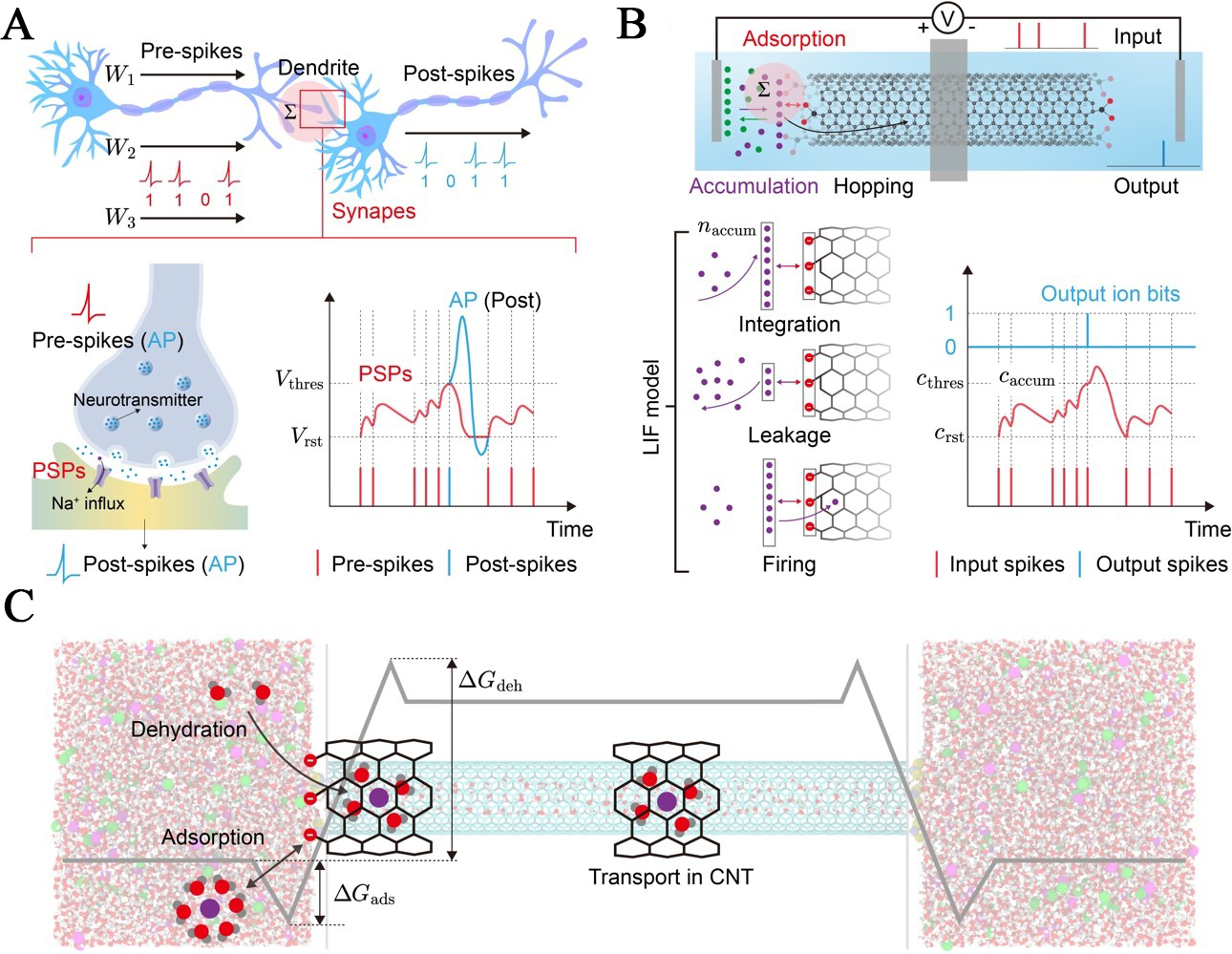
Figure 1. Biomimetic iontronic architecture and ion transport mechanisms. (A) Schematic of a biological synapse and the signaling process. Pre-synaptic spikes are modulated by synaptic weights (W1, W2, W3) and integrated at the soma. The arrival of an AP triggers neurotransmitter release and subsequent Na+ influx, generating PSPs. When the PSPs rise from the resting potential (Vrst) and exceed a threshold (Vthres), the neuron fires a post-spike, transmitting information to downstream dendrites; (B) The CNT-based iontronic neurons and their operation based on the LIF model. Input spikes drive the accumulation of ions, increasing the local concentration (caccum) at the entrance. Without input, ions thermally dissipate, causing the concentration to decay toward the resting state (crst). When caccum exceeds the critical threshold (cthres), the system triggers a stochastic ion transport event, producing a discrete output ionbit; (C) The multi-stage physical process of ion transport. Hydrated ions are trapped by the functionalized entrance, corresponding to the energy well ΔGads. Then ions strip part of their hydration shell to overcome the primary energy barrier at the entrance (ΔGF = ΔGads + ΔGdeh). LIF: Leaky integrate-and-fire; AP: action potential; CNT: carbon nanotube; PSP: postsynaptic potential; ΔGF: the entrance energy barrier; ΔGads: the desorption energy barrier; ΔGdeh: the dehydration energy barrier.

