




fig5
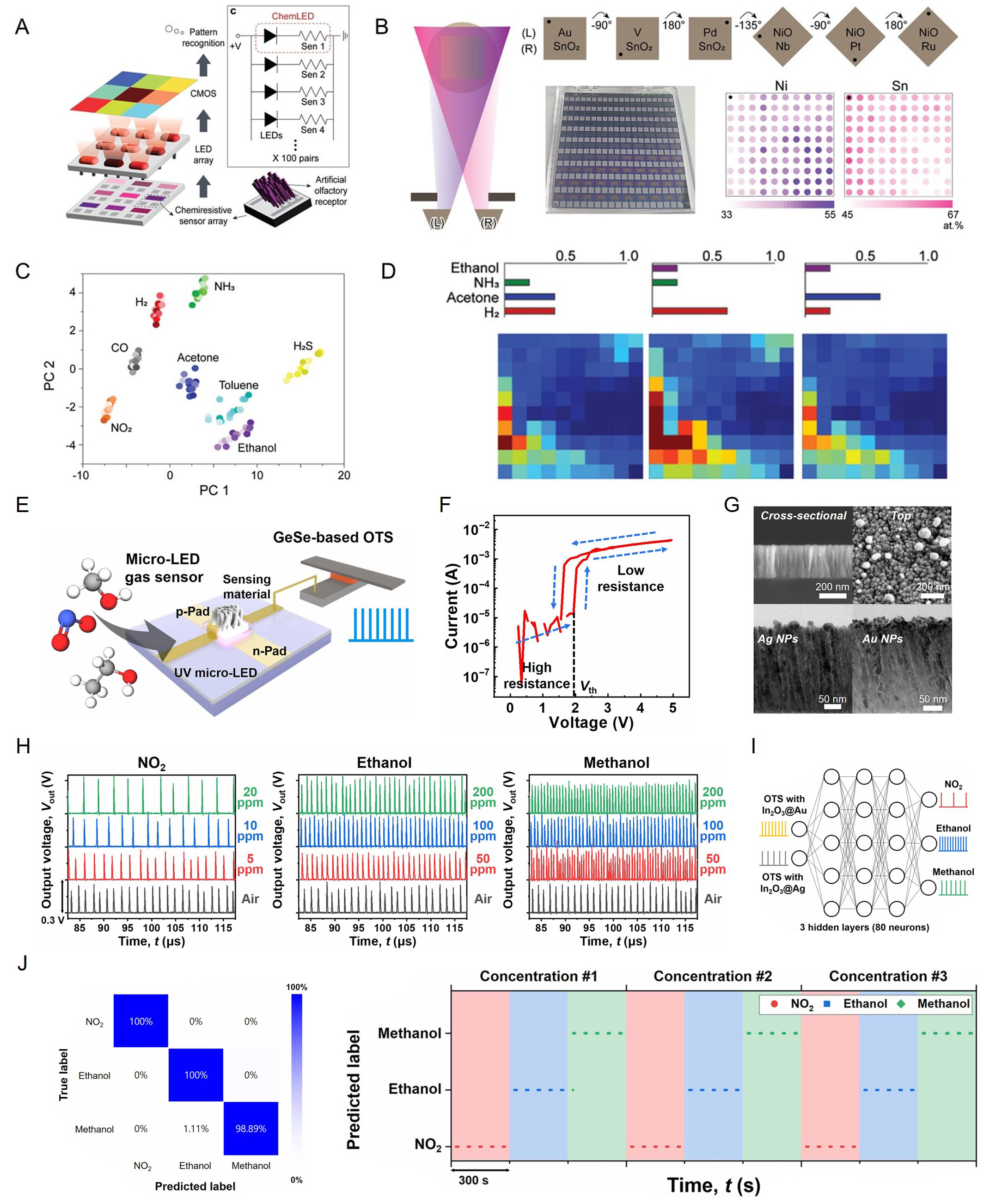
Figure 5. (A) Optical nose system: a chemoresistive nanostructure sensor array drives an LED array (ChemLED units) to generate optical patterns captured by CMOS for odor recognition; (B) Combinatorial fabrication of gradient sensing arrays using tilted deposition and shadow masks; energy dispersive X-ray spectroscopy (EDX) confirms spatial elemental gradients; (C) Principal component analysis (PCA) plot showing distinct clustering for eight gases across concentrations; (D) Response maps of representative gas mixtures derived from ChemLED optical intensities. Reprinted with permission. Copyright 2024 (A-D)[157], Wiley; (E) Schematic of the artificial olfactory neuron module integrating a micro-LED gas sensor and GeSe-based OTS neuron; (F) Current-voltage characteristics of the GeSe-based OTS neuron; (G) SEM and TEM images of porous In2O3 nanostructures decorated with Ag and Au nanoparticles; (H) Spiking behavior of the In2O3@Au-based neuron module under exposure to NO2, ethanol, and methanol; (I) SNN architecture for real-time gas classification with three hidden layers; (J) Confusion matrix and real-time gas classification results showing 99.6% accuracy. Reprinted with permission. Copyright 2025 (E-J)[28], American Association for the Advancement of Science (AAAS). ChemLED: Chemical light-emitting diode; OTS: ovonic threshold switch; CMOS: complementary metal-oxide-semiconductor; TEM: transmission electron microscopy; SNN: spiking neural network.