



fig4
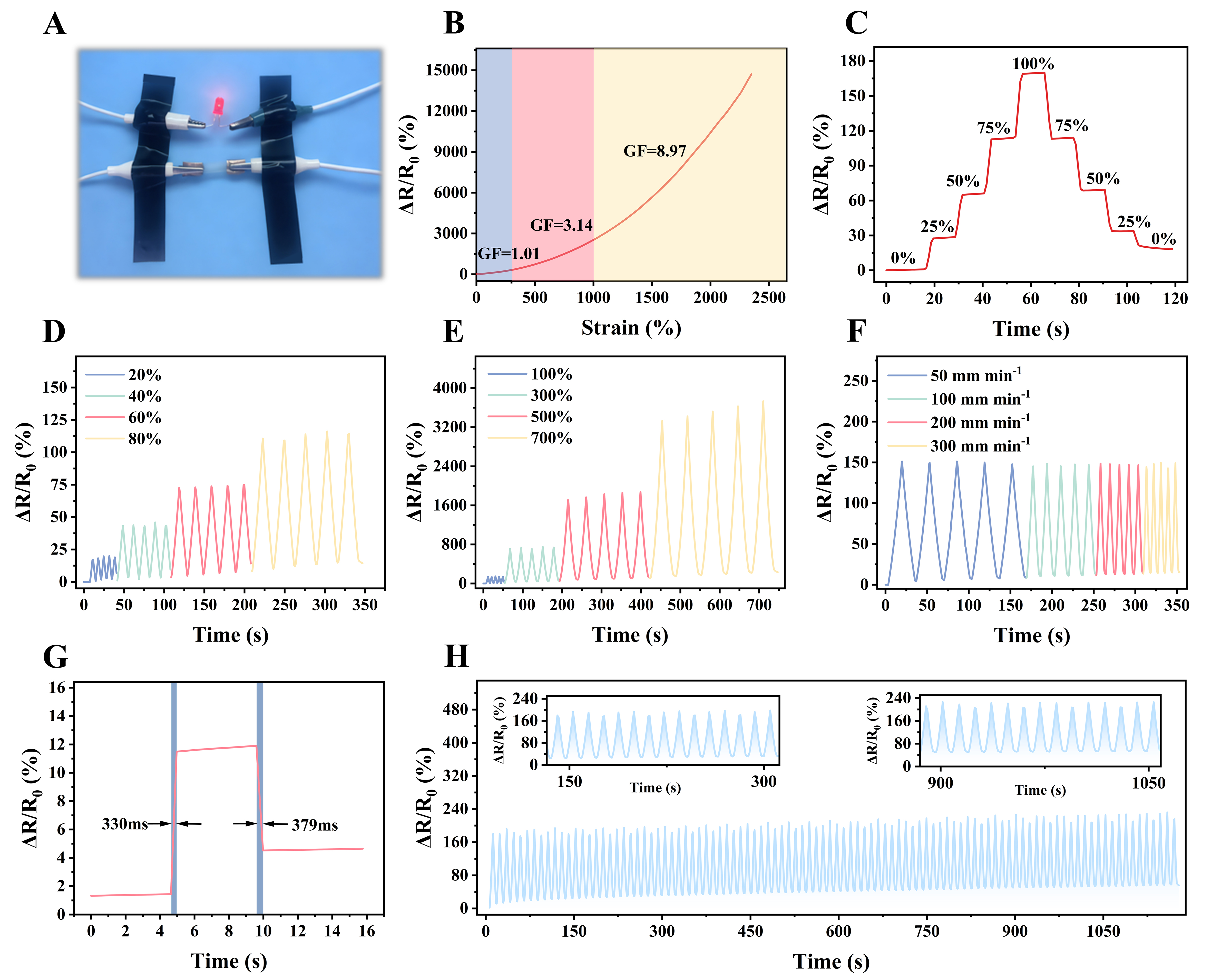
Figure 4. (A) Images showing the luminance of LEDs when the PAM/COS@SIW hydrogel was used as a conductor in series circuits. All optical photographs were taken by the authors using personal mobile devices; (B) Relative resistance variation (ΔR/R0) of a PAM/COS@SIW hydrogel as a function of tensile strain and the corresponding GF; (C) Stepwise relative resistance response of the PAM/COS@SIW hydrogel during incremental strain loading (0%-100%) and subsequent unloading to 0%, with each strain maintained for 10 s; ΔR/R0 of the PAM/COS@SIW hydrogel under five repeated stretching - releasing cycles under (D) small strain levels (20%, 40%, 60%, and 80%) and (E) large strain levels (100%, 300%, 500%, and 700%); (F) ΔR/R0 of the PAM/COS@SIW hydrogel under five repeated stretching - releasing cycles at different stretching rates (50, 100, 200, and 300 mm·min-1) at 100% strain; (G) Response and recovery times of the PAM/COS@SIW hydrogel; (H) ΔR/R0 of the PAM/COS@SIW hydrogel under 100% strain for 100 consecutive cycles. LEDs: Light-emitting diodes; PAM: polyacrylamide; COS: chitosan oligosaccharide; SIW: silicotungstic acid; GF: gauge factor.