



fig5
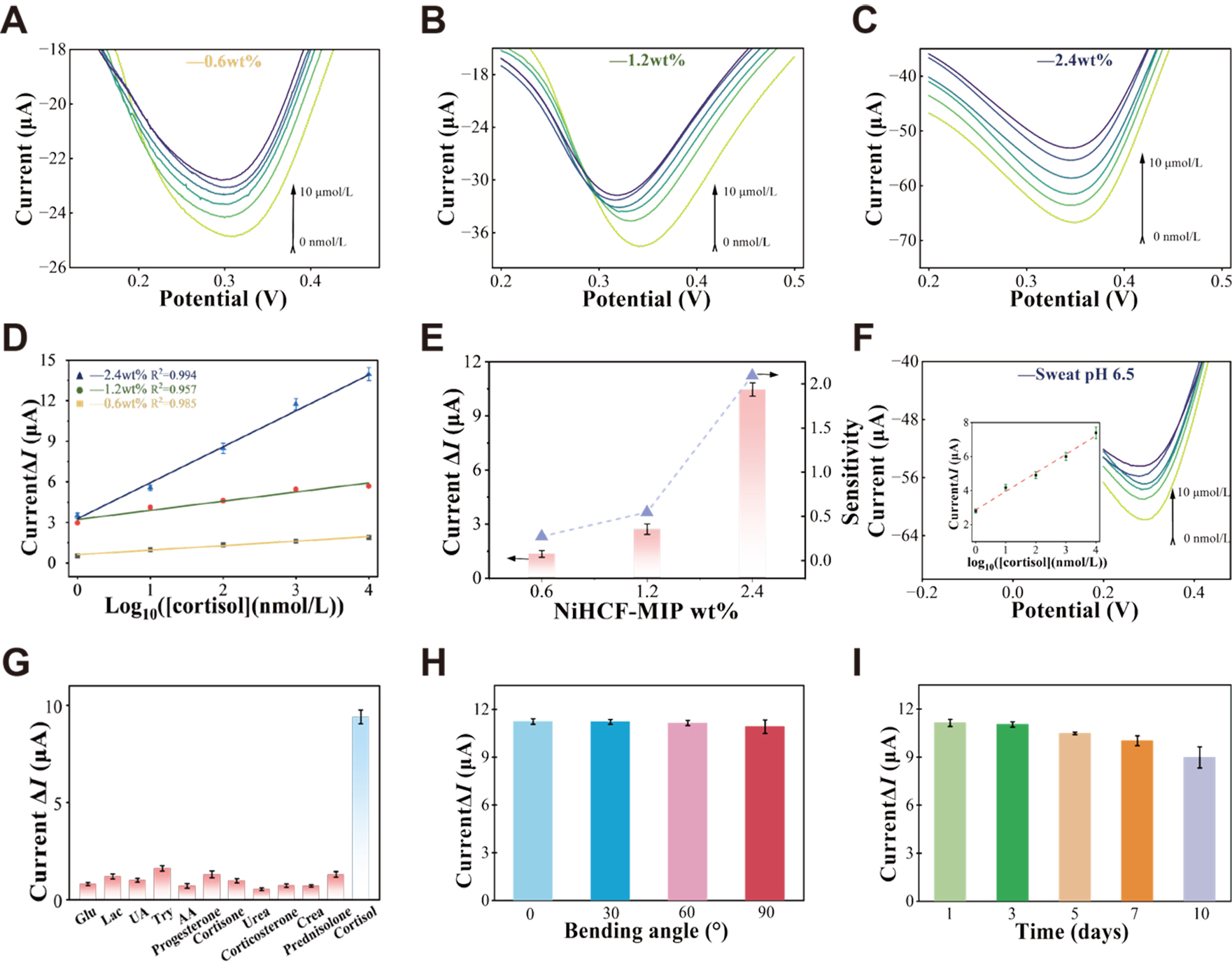
Figure 5. (A-C) LSV curves of the yarns prepared with different NiHCF-MIP amounts (0.6, 1.2, and 2.4 wt%) tested in blank and 1 nmol/L~10 μmol/L cortisol. Ag/AgCl as the reference electrode and Pt as the counter electrode; (D) Linear fitting plots (n = 3, signifying 3 independent sensors); (E) Summary and comparison of current difference (∆I) and sensitivity (n = 3, signifying 3 independent sensors); (F) Calibration curve of the amperometric response versus cortisol concentration in artificial sweat, ranging from 1 nmol/L to 10 μmol/L. Inset: calibration plot with a linear fit (n = 3, signifying 3 independent sensors); (G) Selectivity of the yarns towards cortisol and other sweat secretions (n = 3, signifying 3 independent sensors); (H) LSV current response of the sensing fiber to a fixed cortisol concentration (1 μmol/L) under various mechanical deformations (e.g., bending at 0°, 30°, 60°, and 90°) (n = 3, signifying 3 independent sensors); (I) Long-term stability assessment of the fiber sensor for detecting a fixed cortisol concentration (1 μmol/L) (n = 3, signifying 3 independent sensors). Error bars represent the SD of the mean from three sensors in (D-I). LSV: Linear sweep voltammetry; NiHCF: nickel hexacyanoferrate; MIP: molecularly imprinted polymer; SD: standard deviation.