

fig6

Electrochemical biosensing across microsampled blood and interstitial fluid for metabolic, hormonal, and therapeutic monitoring

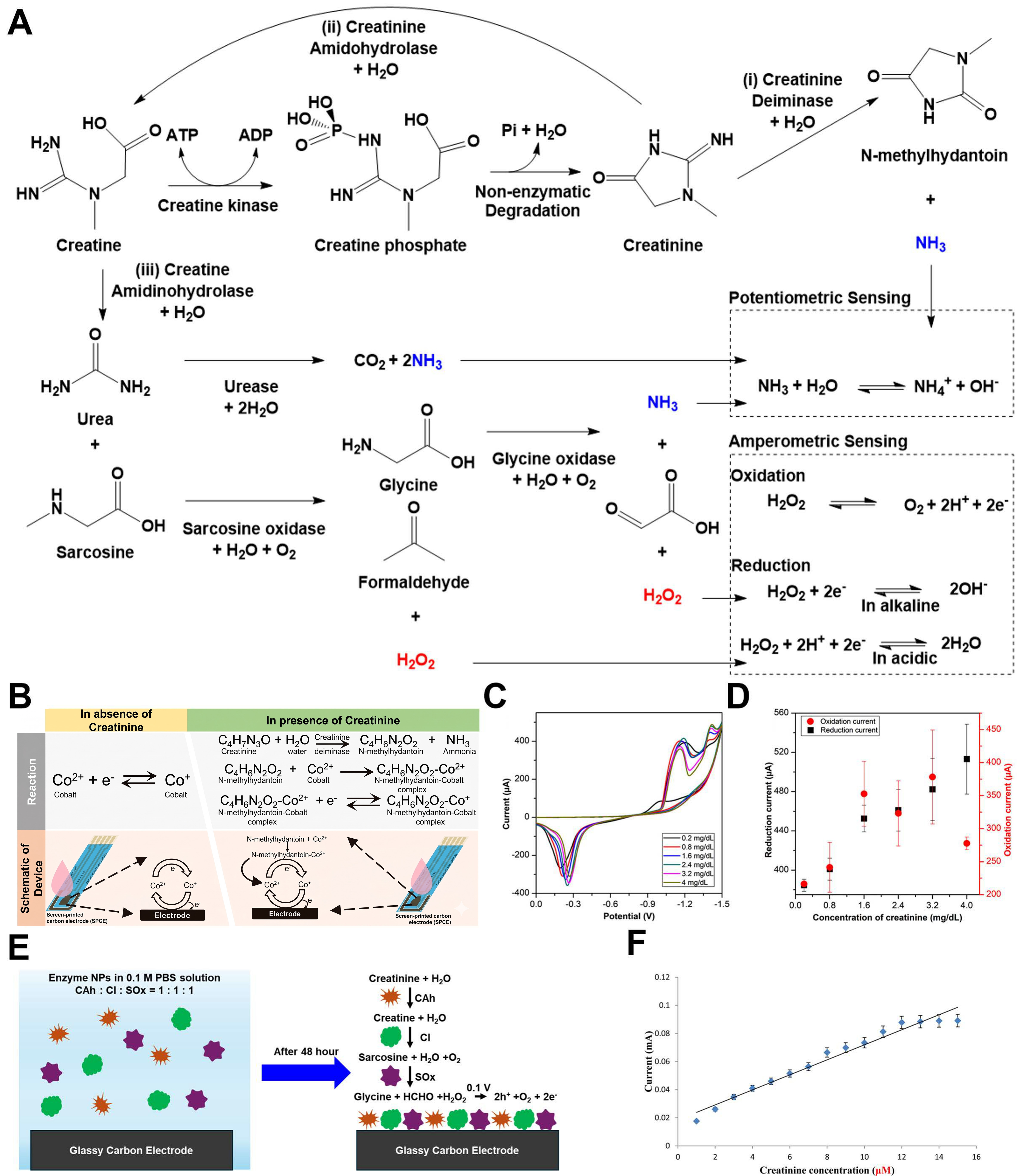
Figure 6. Creatine metabolic pathway and creatinine sensing mechanisms. (A) Creatine undergoes non-enzymatic degradation to spontaneously form creatinine, which is subsequently decomposed through enzymatic reactions to yield electroactive species. The generated H2O2 can undergo either oxidation or reduction; (B) Mechanism of a second-generation enzyme-based creatinine sensor. H2O2 produced from the enzymatic cascade modulates the oxidation state of Co; (C) CV obtained at varying creatinine concentrations; (D) Calibration plots of current versus concentration extracted at -1.4 V (reduction) and +1.4 V (oxidation); (E) Fabrication scheme and enzymatic reaction pathway of the CAhNP/CINPs/SOxNPs/GCE sensor; (F) Current-concentration plots obtained from CV (-0.3 to +1.0 V in pH 7.0 PBS) for creatinine sensing. The error bars in (D) and (F) represent the standard deviation. (B-D) Reproduced with permission Copyright 2020, ACS Omega[191]. (F) Reproduced with permission Copyright 2017, Analytical Biochemistry[125]. CV: Cyclic voltammetry; CAhNP: creatinine amidohydrolase nanoparticle; CINPs: creatine amidinohydrolase nanoparticles; SOxNPs: sarcosine oxidase nanoparticles; GCE: glassy carbon electrode; NPs: nanoparticles; PBS: phosphate buffered saline.

Soft Science
ISSN 2769-5441 (Online)

Portico

All published articles are preserved here permanently:

https://www.portico.org/publishers/oae/

Portico

All published articles are preserved here permanently:

https://www.portico.org/publishers/oae/