



fig1
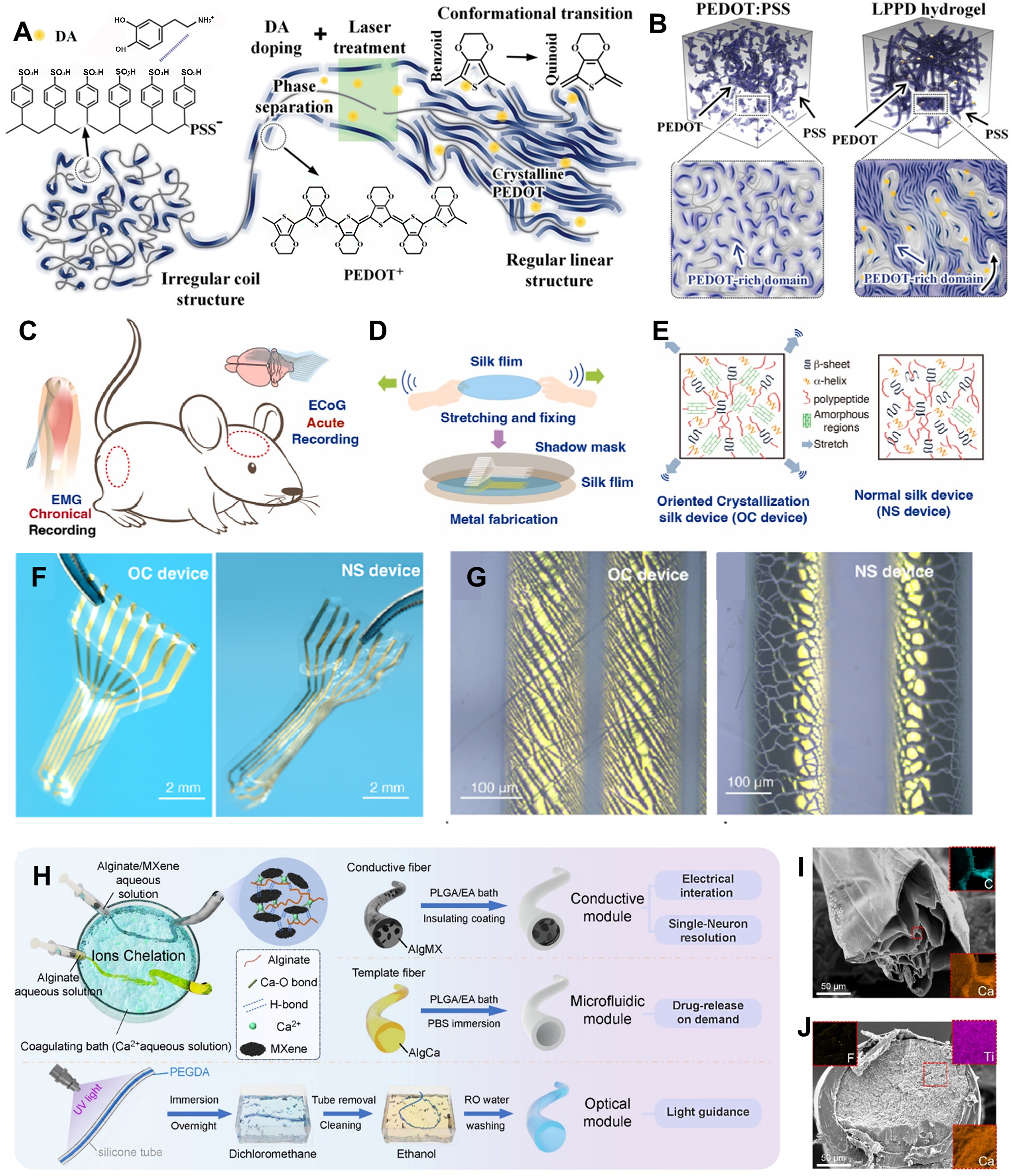
Figure 1. Fabrication and characterization of functional fiber materials. (A) Structural transition from PEDOT:PSS to laser/DA-treated LPPD; (B) Conformational change of PEDOT and increased domain richness. (A and B) are reproduced from Reference[28]. Copyright 2024, Wiley-VCH; (C) Concept of an OC device for neural signal monitoring; (D) Fabrication step of the OC device involving film fixation and metal patterning; (E) Microstructural differences between OC and NS devices; (F) Optical images of OC and NS devices after water immersion; (G) Metal area structure of both devices after water soaking. (C-G) are reproduced from Reference[33]. Copyright 2024, Elsevier; (H) Preparation routes for functionalized fibers via wet spinning; (I) Cross-sectional SEM and elemental mapping of an AlgCa fiber; (J) Cross-sectional SEM and elemental mapping of an AlgMX fiber. (H-J) are reproduced from Reference[35]. Copyright 2025, American Chemical Society. PEDOT:PSS: Poly(3,4-ethylenedioxythiophene):poly(styrenesulfonate); DA: dopamine; LPPD: laser/DA-treated PEDOT:PSS-derived fiber; OC: oriented crystallization; NS: normal silk; SEM: scanning electron microscopy; AlgCa: calcium alginate fiber; AlgMX: MXene-alginate fiber.