



fig14
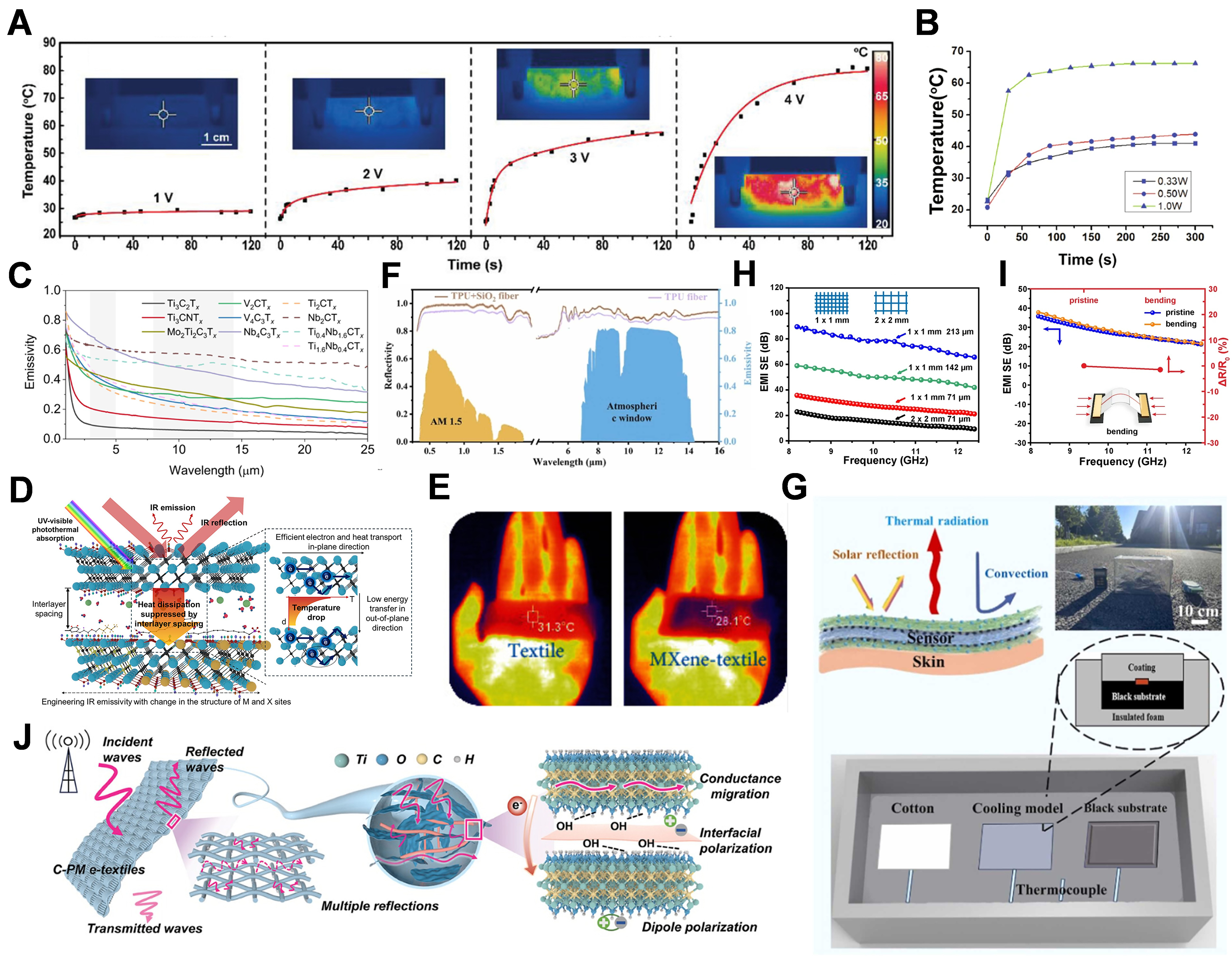
Figure 14. (A) Joule heating performances of silicone-coated M-textile. Reproduced with permission[166], Copyright © 2018 John Wiley and Sons; (B) Temperature increase profiles of the RMFs under 0.33, 0.50, and 1.0 W of NIR light. Reproduced with permission[167], Copyright © 2021 Springer Nature; (C) The room-temperature IR emissivity spectra of MXene coatings at a range of 1-25 μm. Dash lines show the comparison of solid solution MXenes. The shadows show the two atmospheric windows. Reproduced with permission[168], Copyright © 2023 Elsevier; (D) Schematic illustrating the interaction of IR light with MXenes, and heat transfer mechanisms coupled to structure parameters in MXenes. Reproduced with permission[169], Copyright © 2025 American Chemical Society; (E) IR images of skin covered by commercial textile and MXene-functionalized textile. Reproduced with permission[170], Copyright © 2022 The American Association for the Advancement of Science; (F) Thermal emissivity and sunlight reflectivity of the pristine TPU and TPU/SiO2 nanofiber mat. The yellow area denotes the spectra of solar irradiance and the blue area denotes the atmospheric window; (G) Schematic diagram illustrating the passive cooling effect and photograph showing the testing setup. (F and G) are reprinted with permission from Ref.[171], Copyright © 2023 Elsevier; (H) Plots of EMI SE vs. different mesh grids and thicknesses of the 17-1.1-50 M textile; (I) Changes in resistance and EMI shielding performance after 5,000 cycles of bending; (J) Schematic for EMI shielding mechanism of C-PM e-textiles. (H-J) are reprinted with permission from Ref.[114], Copyright © 2022 Springer Nature. RMFs: MXene nanobelt fibers; NIR: near-infrared; IR: infrared; TPU: thermoplastic polyurethane; EMI: electromagnetic interference; SE: shielding effectiveness; C-PM: crosslinked PVA/MXene; UV: ultraviolet; AM: air mass.