




fig7
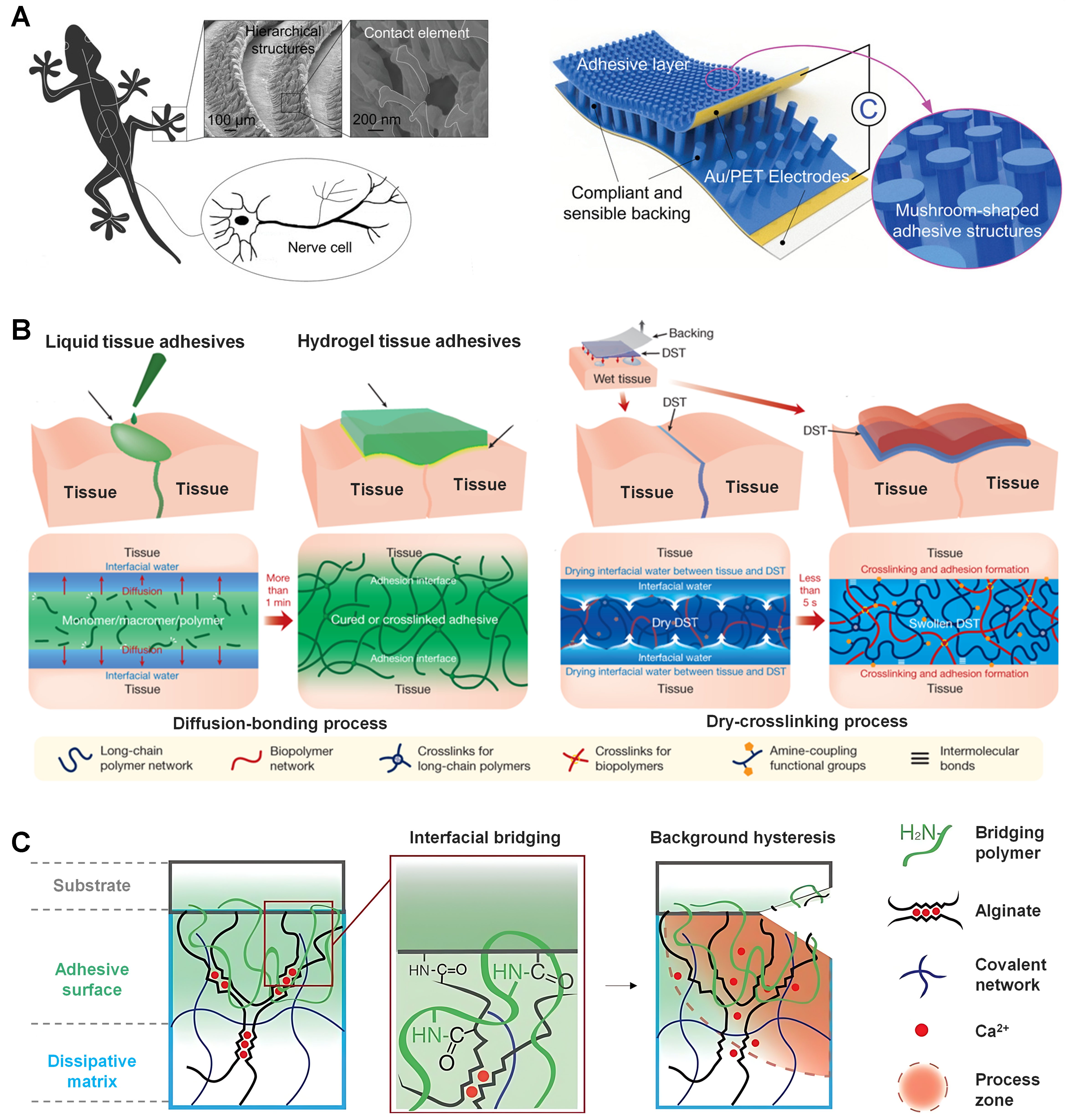
Figure 7. Bioinspired strategies and interfacial mechanisms for hydrogel-based tissue adhesion. (A) Bioinspiration from natural adhesive systems, where hierarchical surface structures such as gecko-inspired architectures provide design principles for contact-mediated adhesion across multiple length scales[183]. Copyright 2022, Wiley-VCH; (B) Bioinspired adhesive microstructures integrated into engineered devices, where mushroom-shaped microstructures combined with compliant substrates and conductive electrodes enable conformal contact and enhanced interfacial adhesion[186]. Copyright 2019, Springer Nature; (C) Mechanisms of hydrogel-based tissue adhesion, including polymer network formation, interfacial bridging, and molecular interactions such as covalent bonding, ionic coordination, and polymer entanglement that contribute to strong adhesion and energy dissipation at the tissue–material interface[187]. Copyright 2017, The American Association for the Advancement of Science. PET: Polyethylene terephthalate; DST: double-sided tape.