




fig3
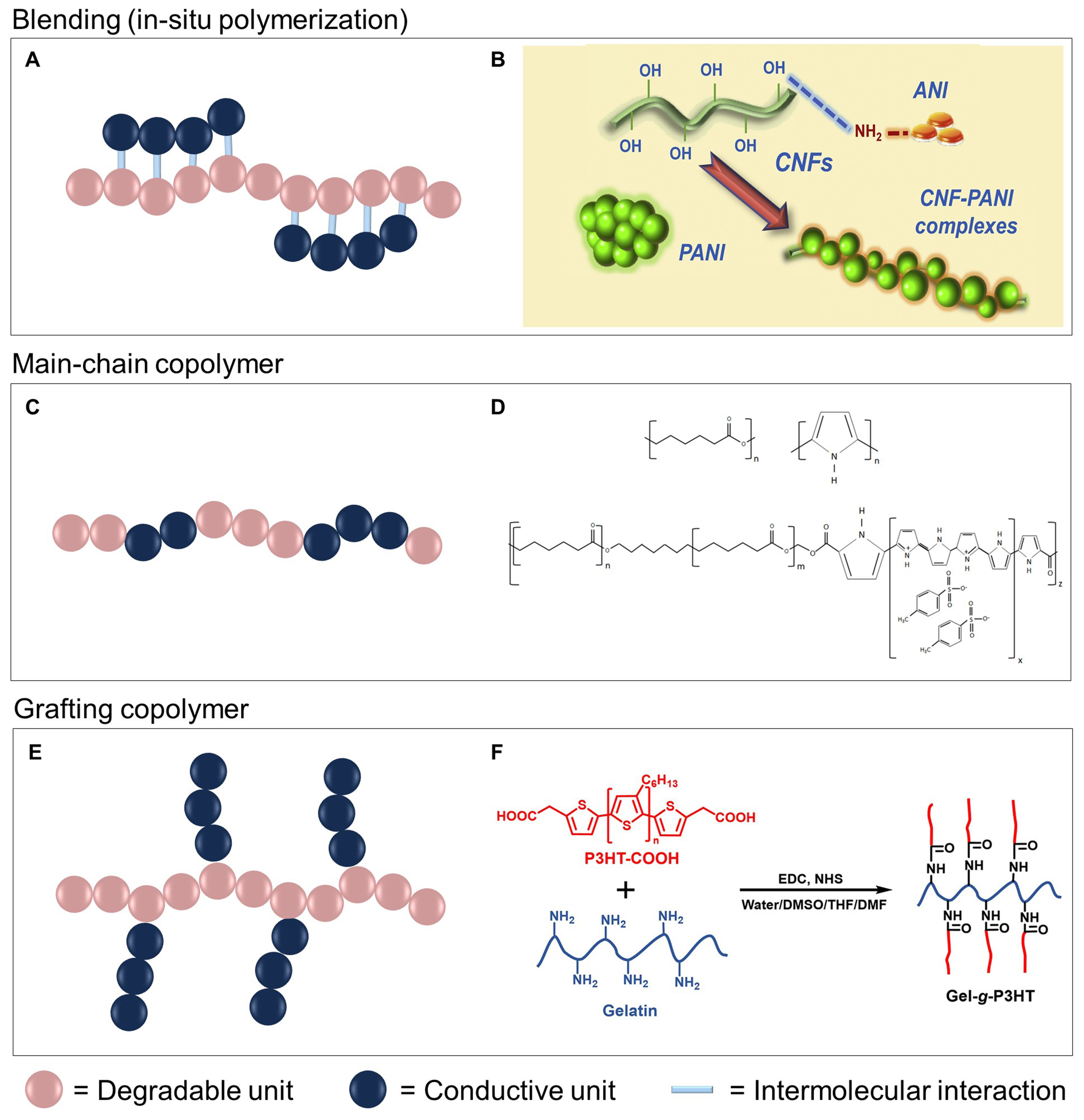
Figure 3. Various synthesis strategies for tailoring the properties of partially biodegradable conductive polymers. (A) Blending strategy involving the in situ polymerization of conductive polymers within biodegradable polymer matrices, featuring biodegradable backbones and in situ–formed conductive segments through intermolecular interactions; (B) Schematic illustration of the formation of CNF-PANI polymer blends via in situ polymerization. Reprinted with permission from Ref.[71]. Copyright 2019, Elsevier; (C) Main-chain copolymer strategy, in which degradable and conductive segments are incorporated into a single backbone in a repeating manner; (D) Chemical structures of the biodegradable PCL segment, the conductive PPy polymer, and the resulting conductive PPy-b-PCL block copolymer. Reproduced with permission from Ref.[72] under the CC BY license; (E) Grafting copolymer strategy for attaching conductive segments to a biodegradable backbone; (F) Schematic illustration of the synthesis of Gel-g-P3HT and grafting of P3HT-COOH onto gelatin via an EDC/NHS coupling reaction. Reprinted with permission from Ref.[73]. Copyright 2024, American Chemical Society. CNF: Cellulose nanofiber; PANI: polyaniline; PCL: polycaprolactone; PPy: polypyrrole; Gel-g-P3HT: gelatin-grafted poly(3-hexylthiophene-2,5-diyl); EDC: N-(3 -dimethylaminopropyl)-N′-ethylcarbodiimide; NHS: N-hydroxysuccinimide; ANI: aniline.